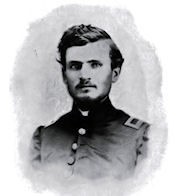
14th. Wednesday. Left Carthage at 8. Most of the boys footed it. My horse was well enough but I thought I would fare as the rest did. Stopped to graze our horses at ten miles. I was very tired. Got my haversack and gave my horse into Tom’s care. I went to a little bush and ate a lunch in sight of my horse. Soon fell asleep and when I awoke, could not find my horse. Baggage wagons were going on. One of the boys said he saw the horse go ahead. Hurried on to see. Tom rode all about the field and prairie vainly. I got a horse and another man and went back and searched thoroughly and vainly. Reached Lamar in the evening.
May 2012
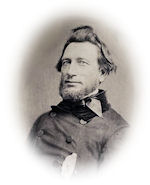
14th.—At White House. Marched here to-day. It is known as the “Custis Estate,” and is now owned by the rebel General Lee, nephew of the wife of General Washton, and has on it a large family of negroes, about 300. ‘Twas here that General Washington overstaid his leave, the only time during his eventful life that he was known to be guilty of a breach of military discipline. Here he courted and married his wife. It is a most beautiful place on the banks of the Pamunkey river. It consists of about 5,000 acres and we now pasture our horses in a field of 1,000 acres of the prettiest wheat I ever saw. ‘Tis waist high, thick on the ground, just heading out, and stretches away down the river as far as the sight can reach. By the side of it is an immense plain of rich and luxuriant clover, on which is encamped our army of about 80,000, with all the concomitants of horses, mules, ambulances, transportation wagons, &c.
Close by our encampment runs the Pamunkey River, up and down which a crowd of transports, gun boats, steamers, schooners, and all manner of water craft, are constantly passing. And here again we get another view of the blasting influence of the institution of Slavery—the most beautiful country on earth, with a fine navigable stream opening to it the markets of the world, and yet in its whole course of 100 miles, it has not, in two hundred and fifty years, built up a town of one thousand inhabitants.
We found and captured on this farm five thousand bushels of corn and seven thousand bushels of wheat. On this place, too, crosses the railroad from Richmond to West Point, making it a strong strategic point.
One circumstance occurred on our arrival here this morning, showing the distance between officers and men, and so characteristic is it of the man, that I cannot refrain from recording it in my journal, as “food for thoughts” hereafter. We found some negroes drawing a seine in the river here. Some soldiers made a bargain to make a draw for them, fixing price and paying for it. The men had been on short rations of hard bread and salt meat for several days. Being compelled to carry their provisions in their haversacks, they can carry nothing but this simple food, whilst the officers, having transportation at command, take with them all the comforts of the country. Well, the net was cast, and whilst the drawing was going on, General H______ rode down to the beach and watched the operation with much apparent interest. The draught was nearly at shore; the hungry mouths, and watching eyes of the soldiers were being gratified by the anticipations of a joyous feast, for it was now beyond doubt that the net was cast at a propitious moment, and was coming in loaded with herring, shad and eels. But what right had common soldiers to indulgences like these? The General’s mouth watered too. The instant the draught was brought to land, the bayonets of the General’s guard bristled all around, and the General’s capacious bags received every fish. Off they were carried for himself and friends, without even a nod in acknowledgement. How ungrateful common soldiers must be not to love their commanders! How abject common soldiers are when compelled to submit to indignities like this, and dare not murmur! Now there was scarcely a soldier on that beach who would not have deemed it a pleasure to relinquish his right to what he so much coveted, at the request of his General, but to be driven from his rights by the bayonets of his legitimate protector!
Rains hard this P. M.
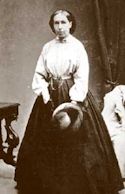
“Wilson Small,” May 14.
Dear Friend, — Last evening we parted from all our poor fellows, except Captain Curtis, the extensive hero, who is said to-day to have a chance for life. Our men were put on board the “Elm City,” which has been detailed to the Commission. She filled up this morning with four hundred and forty patients, and sailed for Washington. Mrs. George Strong takes charge of the women’s department, and Miss Whetten goes with her. I was sent on board this morning to assist them, and remained there till the boat sailed. The “Elm City” is a large river-steamboat, with wide spaces on all her decks, where badly wounded men can be laid in rows on cots and mattresses, — they could not be put in bunks or berths. She cannot make a sea-passage, and is therefore sent up the Potomac to Washington.
It is an immense piece of work to get the patients (many of them very low, or in great agony) on board and into their .beds, and stimulated and fed and made comfortable. So much is needed, — quick eyes and ears, and, above all, some one to keep severe order in the pantry, or rather the kitchen for the sick-food. Mrs. Griffin is magnificent at that. I never saw her hurried or worried for a moment; consequently she saves time and temper, and does the very best that can be done. She spent this morning on the “Elm City” watching over three men until they died, receiving their last wishes, which she is now writing to their wives.
You will get little public information from me. I am told we went some way up the Pamunky River yesterday. Mr. Olmsted landed, and went over the Williamsburg battle-field with incredible difficulty and jolting. It is two and a half miles long, with the fences all broken down. The enemy are expected to make a desperate stand at Bottom Bridge — wherever that may be. The army is now making its way along the banks of the Pamunky; great regret is felt that General McDowell was not allowed to co-operate at Gloucester. The spirit of our men, their confidence in their leaders, their pride in belonging to McClellan and the Army of the Potomac, is splendid, so far as I see it; and everybody says the same. Many fine traits of character come out,—such as their self-forgetfulness and tenderness in caring for sick comrades, their endurance of suffering, and even contempt for it. A poor little boy of seventeen, shot through the lungs, was so unwilling to speak of himself, never murmuring, but roused into excitement on the arrival of the New York papers with accounts of the battles. I began to read to him about the battle of Williamsburg, where he was wounded; but he gurgled out: “Not that! I know all about that. What did our boys do next?”
The fire we saw on our way across the Chesapeake was the burning of the Navy-yard at Norfolk, and the dull explosion which we heard was the blowing up of the “Merrimac.”
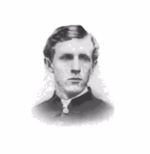
Fort Barnard, Va., May 14, 1862.
Dear Mother:
We have had great news for the week past, but are a little anxious about Halleck; afraid he will be whipped and that will be a stunner. Norfolk has been taken. You will have heard of it before this reaches you; however, it is good news. I can scarcely hear myself think, the drums are beating so like the old Harry.
Roll-call. Bed-time.
Tuesday morning, 6 a.m.
Just answered to the roll-call and now can write a line. We had mortar firing the other day. The shell can be seen in the air; it goes to an immense height and then comes down on the object smash. The shell weighs 91 lbs. It would be a good thing if a fellow had got to die, to have it drive him in; but he would want it taken off afterwards, because it would make a fellow’s head ache.
Yours,
L. Bradley, Jr.
Picket Duty.
May 14. I was out in the woods yesterday and last night on picket duty, and picket duty is simply lying around in the brush watching the approach of outside parties. Parties approaching in the night time and failing to promptly respond to the hail of the picket are given an instantaneous passport to a land that is fairer than this. A picket is composed of three or more men stationed at convenient distances from each other along the roads, horse paths and anywhere an enemy might be supposed to come. One keeps watch while the others sleep, but with the hooting of the owls, sand-fleas, woodticks, lizards and mosquitoes, their repose is a good deal disturbed.
A Scouting Party.
Yesterday Col. Upton with a strong scouting party went out to Tuscarora, a little hamlet about five miles distant, where is the enemy’s outpost and where is kept a party of observation. On the approach of the colonel and his party they left, but before doing so set fire to a new steam saw and grain mill which was destroyed. Mr. Bogey was a good deal vexed at the destruction of this mill. He said it was built only two years ago at a cost of $5000 and was a great accommodation to the people here abouts, and he, with other farmers, put in their money to help build it. These people have a great notion of burning their property on our approach. I really cannot understand it. They ought to know that it is of no use to us, and in the end will be a sore loss to them.
 Abby Howland Woolsey to Georgy and Eliza.
May 14.
My dear Girls: Since Mother wrote you yesterday the Daniel Webster has come in again. Fred Rankin called last night with a message from Mrs. Trotter, whom he met in the street on the way from the steamer to take the cars for home. He told us that Charley had stayed down at Yorktown. It may have been necessary for him to do so, in the service, or at the request of the Sanitary Commission, but we feel disappointed that he did not finish up the round trip and return in the steamer. . . .
“Capture of Richmond” has been cried every day for a week by the “Express; 4th Edition” boys!
Mrs. Trotter sent word that she had a very pleasant and satisfactory trip and should sail again on Friday; that most of the men improved on the voyage. They were all to be landed at 194 Broadway, F. Rankin thought. Among them, in the newspaper list, we see Capt. Parker, Co. D, 16th New York. Carry has just started down town, and a boy with her, carrying a quantity of flannel shirts for convalescents and some cotton ones for the City Hospital. She will stop at all the depots, the Hospital, Park Barracks and 194, and at the two latter will enquire for Captain Parker. She has stuck some handkerchiefs and cologne in her pocket, and I think delights at the prospect of sallying forth unwatched to “find some wounded soldiers.” . . . Last night Mother made a white flannel shirt, which has gone down to be put in use at once. She sighs for the quiet of Washington and the companionship of G. and E., whom she admires, and who, she is afraid, are making themselves sick. . . .
Do take care of yourselves and let us know what we can do. I am having long, white, flannel hospital shirts made, and have bought and sent off all I could find at the employment societies of cotton night-gowns and red volunteer shirts.
 May 14th. Weather magnificent. Providence, this time, is surely on our side, and why we do not take advantage of the splendid roads and close quickly on the rebel army, I cannot understand, nor do I find any one who can; the enemy could not have a more accommodating foe than we, since we give them all the time they want for preparation, and advertise everything we do. The great campaigns of history were not conducted on this plan, and one cannot help thinking our general a little slow; luckily, the rebs are about as slow, or something very disagreeable might happen. This part of the country is better cultivated, and more interesting than any we have seen before; there are more large houses, and the soil seems better, but nowhere yet have I seen a grass field. Most of the houses are occupied by women, and in such cases they are quite safe, but where they are abandoned, the soldier makes himself free with whatever suits his fancy. The colonel inspected the regiment during the morning, and in his opinion, it never looked so well before. It turned out just six hundred muskets, every man fully equipped, well armed, and clothed; the men’s boots and brasses shone like burnished steel, and every one felt and looked his very best. General French was enthusiastic in his praise, and said no regiment of the old army ever made a better appearance. We ought to be as good as any, of course, having worked, and drilled, and studied, every day for almost a year, and have with us more than a hundred men, who served many years in the old army before enlisting in the Fifty-seventh; moreover, the colonel is a thorough soldier, maintaining the strictest discipline, and is absolutely perfect in drill and tactics.
 Eliza’s journal.
May 14.
I can’t keep the record of events day by day, but last Friday we came down again from West Point to Yorktown, and G. and I went to Fortress Monroe on two hospital ships, G. on the Knickerbocker with the sick of Franklin’s Division, and Miss Whetten and I on the Daniel Webster No. 2, with two hundred of the Williamsburg wounded. Since the day of the battle they had lain in the wet woods with undressed wounds. Some one had huddled them on to a boat without beds or subsistence, and then notified the Sanitary Commission to take care of them; and we were detailed to attend to them on the way to Fortress Monroe, with basins, soap, towels, bandages, etc. We washed and fed them all, Moritz going round with buckets of tea and bread. The poor fellows were very grateful, but we had a terribly hard experience. One man had lost both legs and had one arm useless, but was as cheerful and contented as possible. Colonel Small, of the 26th Pennsylvania, was wounded and lying in the dining room. Just before midnight I went in to see Colonel Fiske, sick with typhoid fever, lying on the bare slats of a berth with only his blanket under him and a knapsack for a pillow. We made him tolerably comfortable and left him much happier than we found him.
Sunday morning the sick were all carefully removed by Dr. Cuyler to the shore hospital at Fortress Monroe, and we ran back to Yorktown, where we found Charley, just arrived on the Daniel Webster from New York, transferred to the Small.

Title: A group of “contrabands”
Summary: Stereograph showing a group of slaves including men, women and children gathered outside a building at the Foller Plantation in Cumberland Landing, Pamunkey Run, Virginia.
Photographed by James F. Gibson.
Part of Civil War glass negative collection. Library of Congress Prints and Photographs Division Washington, D.C. 20540 USA
Record pages
- for this image: http://www.loc.gov/pictures/item/cwp2003000055/PP/
- for another version with more detailed information: http://www.loc.gov/pictures/item/2011660086/
May 14.—President Lincoln, accompanied by Secretary Stanton, and Captain Dahlgren, visited Fredericksburgh, Va., to-day. The Martha Washington conveyed the party to Acquia Creek, from whence they were taken by railroad to Gen. McDowell’s headquarters, opposite Fredericksburgh. The occasion was made a gala-day. Flags were displayed from the steamboats and shipping at Acquia Creek. Several regiments were reviewed by the President. In the afternoon Mr. Lincoln, accompanied by General McDowell, Gen. Patrick, and a body-guard, visited and rode through the streets of Fredericksburgh. The President was greeted by the troops and many of the citizens with the utmost enthusiasm. A National salute was fired by one of the batteries in Falmouth. The Presidential party returned late in the evening to Washington.
—A skirmish took place about five miles from Trenton Bridge, N. C, between a detachment of Union troops under command of Colonel Amory, consisting of twelve companies of cavalry, the Seventeenth and Twenty-fifth Massachusetts infantry, and a section of the Third New-York artillery, and a body of rebels secreted in the woods along the roadside. After a fierce contest, which lasted only about ten minutes, the rebels were routed, leaving nine of their number dead on the field, among whom was Lieutenant Rogers, a favorite officer among them.—N. Y. Tribune.
—A soldier, belonging to Col. Catherwood’s regiment, Sixth Missouri State Militia, named Donegan, was inhumanly murdered by “bushwhackers,” within gun-shot hearing of his father’s house, from which he was returning unarmed to his regiment. Several outrages of this kind having occurred about this time in the neighborhood of Cameron, Missouri, Col. Catherwood detailed a scouting party of sixty men, under the command of Capt Bassett, to ferret out the perpetrators. After four days’ ceaseless riding, they succeeded in capturing eighteen prisoners, twenty-nine Mississippi rifles, and three kegs of powder.—Missouri Democrat.
—The Charleston Mercury of this day publishes the following circular, which, it says, is “the deliberate expression of probably the largest, wealthiest and most influential class of the citizens of New-Orleans,” and says, also, that “for reasons that will be manifest to all,” no signatures are attached to it:
“To Cotton Planters. — New-Orleans has fallen, not degraded or enslaved, but yielding to armed ships with guns levelled at the homes of our defenceless wives and children. The escutcheon of Louisiana is unstained, and her flag has been desecrated but by her enemies. None could be found among us so vile, low or degraded as to lower her national insignia. We have yielded to brute force but for the moment.
“It becomes now the duty of all planters to display more than ever their patriotism and devotion to their country. They have sealed that devotion upon the battle-field. Now let us fight our enemies, as well by burning and destroying every bale of cotton upon the river or rivers liable to capture, as well as refusing ever to ship or sell a bale of cotton until peace is declared and our nationality is fixed. Let their conquest be a barren one.
“The merchant fleets of Europe and of Yankeedom will soon be bringing their riches among us to trade with us, expecting an exchange of cotton. If commerce is once revived we are enslaved for ever. Let Europe howl at the waste the barbarity of the North will have brought upon the country. The United States Government has promised renewed trade to the world so soon as our ports are opened. If we are true to ourselves, there will be no trade, and the countless millions of foreign products will be without purchasers. How long will they remain idle spectators of such a scene? The Powers of Europe will see that there is no sentiment of regard for the old flag—that we despise the race; and when we withhold or destroy our property, they will find that Unionism is dead for ever.”
The United States steamers Ceres and Lockwood pursued the rebel steamer Alice up Roanoke River, and captured her about two miles below Williamston. She had on board bacon for the rebel army, and the church-bells of Plymouth, which were to be cast into field-pieces. At Plymouth, the Commodore Perry found the lantern from the light-boat at the mouth of Roanoke River, concealed in the Custom-House.— Official Report.
—In the United States Senate Mr. Wright, of Indiana, presented a petition from citizens of that State, asking Congress to stop the agitation of the negro question and attend to the business of putting down the rebellion.


