Following the American Civil War Sesquicentennial with day by day writings of the time, currently 1863.

May 2012

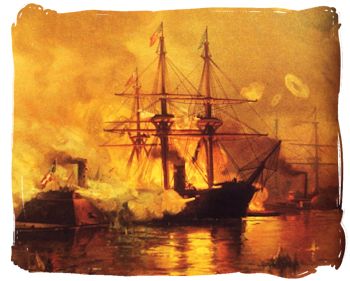
MAY 15TH.—The enemy’s gun-boats, Monitor, Galena, etc. are at Drewry’s Bluff, eight miles below the city, shelling our batteries, and our batteries are bravely shelling them. The President rode down to the vicinity this morning, and observed the firing.


The guns are heard distinctly in the city, and yet there is no consternation manifested by the people. If the enemy pass the obstructions, the city will be, it is true, very much at their mercy. They may shell us out of it, and this may occur any hour. South of the city the enemy have no forces, and we can find refuge there. I suppose the government would go to Lynchburg. I shall remain with the army, and see that the tobacco be burnt, at all hazards, according to law. I have seen some of our generals, and am convinced that the Baltimore rabble, and those that direct them, will be suppressed, or exterminated, if they attempt to throw impediments in the way of our soldiers in the work of destroying the tobacco, as enjoined by Congress.

Our marksmen will keep up an incessant fire into the port-holes of the gun-boats; and if it be at all practicable, we will board them. So hope is by no means extinct. But it is apprehended, if the enemy get within shelling distance of the city, there will be an attack along our lines by McClellan. We must beat him there, as we could never save our guns, stores, etc. retreating across the river. And we will beat him, for we have 80,000 men, and more are coming.

Joyful tidings! the gun-boats have been repulsed! A heavy shot from one of our batteries ranged through the Galena from stem to stern, making frightful slaughter, and disabling the ship; and the whole fleet turned about and steamed down the river! We have not lost a dozen men. We breathe freely; and the government will lose no time in completing the obstructions and strengthening the batteries.

Charley’s hurried letters from Headquarters of the Sanitary Commission no doubt gave the account of his arrival and his work as purser on the Daniel Webster, and as clerk in the Quartermaster’s Department later. We have nothing left but an occasional mention of letters as received. Aunt E. among others says, “ Charley’s long, interesting letter reached us to-day,” and in a letter of F. L. Olmsted’s to the Rev. Dr. Bellows his name occurs in this paragraph:—

Off Yorktown, May 15

. . . It is now midnight. Knapp and two supply boats started five hours ago for the sick at Bigelow’s Landing. Two of the ladies are with him; the rest are giving beef tea and brandy and water to the sick on the Knickerbocker, who have been put into clean beds. Drs. Ware and Swan are in attendance, aided most efficiently by Wheelock and Haight. Mr. Collins is executive officer on the boat, and Mr. Woolsey, clerk, taking charge of the effects of the soldiers.”

And later from Miss Wormeley:

“We all take the greatest interest in Charley’s letter. He writes well, just what he sees and thinks about and throws genuine light on other accounts.”

May 15.—Heavy firing was heard today, and I felt certain that a battle had commenced. I was in the kitchen when I first heard it, and was compelled to stop what I was doing, as the sound makes me unfit for any thing.

May 15.—A company of infantry of General Geary’s command was ordered to Linden, Va., to remain stationed there. A detachment of seventeen men, guard to the company wagon, reached there a short time before the main body of the company, which was on a train. They were attacked by a body of cavalry, variously estimated at from three to six hundred, coming upon them from four different directions. The Nationals resisted them, keeping up a sharp fire under shelter of the depot, which was riddled with bullets. Gen. Geary’s men were overpowered; one was killed and fourteen were taken prisoners, three of whom were wounded, when the enemy hastily retired under fire.— General Geary’s Despatch.

—The United States gunboats Galena, Monitor, Aroostook, Naugatuck, and Port Royal were repulsed from Fort Darling, on the James River. The one hundred pound gun on the Naugatuck exploded at the first fire.—(Doc.37.)

— Great excitement existed in Richmond, Va., on the approach of Gen. McClellan’s army and the gunboats. A joint Committee were appointed by the Legislature of Virginia to communicate with Jeff Davis in relation to the defence of the city. The General Assembly resolved that the capital of the State should be defended to the last extremity. Governor Letcher issued a proclamation calling all the officers out of service, and others who were willing to unite in defending the capital, to meet at the City Hall that evening. The meeting was held amid great excitement and enthusiasm. The action of the Governor was warmly commended.—(Doc. 109.)

—In the Senate of Virginia Mr. Collier submitted a joint resolution declaring that slavery is the fundamental doctrine of Southern civilization.— (See Supplement.)

—A skirmish took place, nine miles east of Batesville, Arkansas, between a party of the Fifth Illinois cavalry, under Lieut Smith, and a small force of the enemy. The rebels were repulsed, leaving in the hands of the Unionists, a major, a captain, and one private. The Union party lost none.—Missouri Democrat.

—Alexander H. Brown, Assistant Provost Marshal at Charleston, S. C, issued the following regulations in reference to travelling in that department:

“With the view of preventing any unauthorized person of color, bond or free, from leaving the city, the following regulations have been adopted by this department:

“1. Railroads and other means of transportation are forbid conveying, without a passport, any free person of color or slave from the limits wherein martial law prevails.

“2. Applications for passports for free persons of color must be made by their guardians or other responsible white person.

“3. Applications for passports for slaves must be made either by their owners or responsible representatives or agents.

“4. Travelling with a white person will not dispense with these regulations.”

Camp near Mouth East River, Giles County, May 14, 1862. Wednesday. — Rained violently last night; not a bad morning, however. Rumors of defeat of General Milroy up northeast by Stonewall Jackson. Don’t believe it. If true, it is not very important, if the taking of Norfolk holds out. We ought to catch the whole Rebel army near Richmond. With gunboats at West Point up York River, up James River, and so on, we must have that whole region soon. We now have a base of operations close up to the enemy’s right. — Rain in violent storms during the day two or three times.

No bread; men want crackers. Transportation insufficient. But for the large quantities of bacon we get in this neighborhood, we should suffer. General Cox with Second Brigade is at Napoleon French’s, six or seven miles from here. Will be here tomorrow. General McClellan within twenty miles of Richmond! The crisis is now at hand. If no serious disaster occurs in the next ten days, the Rebel cobhouse tumbles speedily and forever!

May 14.—The anxiety of all classes for the safety of Richmond is now intense, though a strong faith in the goodness of God and the valour of our troops keeps us calm and hopeful. A gentleman, high in position, panic-struck, was heard to exclaim, yesterday: “Norfolk has fallen, Richmond will fall, Virginia is to be given up, and to-morrow I shall leave this city, an exile and a beggar.” Others are equally despondent, and, as is too frequently the case in times of trouble, attribute all our disasters to the incompetency and faithlessness of those entrusted with the administration of public affairs. Even General Lee does not escape animadversion, and the President is the subject of the most bitter maledictions. I have been shocked to hear that a counter-revolution, if not openly advocated, has been distinctly foreshadowed, as the only remedy for our ills. The public authorities of Richmond, greatly moved by the defenceless condition of the city, appointed a committee, and appropriated funds to aid in completing the obstructions at Drury’s Bluff. The Legislature also appointed a committee to wait upon the President and ascertain the progress of the work. A member of this committee, a near connection of mine, has given me an account of their interview with Mr. Davis. He received them, as is his invariable custom, with marked cordiality and respect. The subject was opened by the chairman of the Senate Committee, who stated the object of the mission, and made appropriate inquiries for information. The President proceeded to give a distinct narrative of the progress of the work, expressed his great desire for its early completion, and regretted, that the natural difficulties arising from frequent freshets in the river, which the efforts of man could not overcome, had rendered the progress of the work slow. He said he had just returned from a visit to the Bluff, accompanied by General Lee; and having heard complaints against the man in charge of the work, he had discharged him, and had appointed another, strongly recommended for efficiency. That the flood was now subsiding, and he thought he could assure the committee that the obstruction of the river would be complete in twenty-four hours. At this point the door-bell rang, and General Lee was announced. “Ask General Lee in,” said the President. The servant returned, saying that the General wished to see the President for a few moments in the ante-room. The President retired, met General Lee and the Secretary of the Navy, and soon returned to the committee. The conversation being renewed, some further inquiry was made with regard to Drury’s Bluff. The President replied: “I should have given you a very different answer to your question a few moments ago from that which I shall be compelled to give you now. Those traitors at Norfolk, I fear, have defeated our plans.” “What traitors ?” asked nearly every member of the committee at the same moment. He then proceeded to give a detail of the desertion of the captain and crew of a steamer engaged in transporting guns from Norfolk to Drury’s Bluff, who had gone over to the enemy with vessel and cargo, and full information as to the unfinished condition of the works. A member of the committee asked: “Can nothing be done to counteract these traitors?” The President replied: “Every thing will be done, I assure you, which can be done.” The member continued: “But, Mr. President, what will be done?” The President politely declined to answer the question, saying there were some things that it was not proper to communicate. The member again pressed for the information, saying: “This is a confidential meeting, and, of course, nothing transpiring here will reach the public.” The President, with a smile on his countenance, said: “Mr. _____, I think there was much wisdom in the remark of old John Brown at Harper’s Ferry: ‘A man who is not capable of keeping his own secrets is not fit to be trusted with the business of other people.'” There was no unpleasant feeling manifested in the committee, and the parting was kind and cordial on both sides; yet, next morning, it was rumoured on the streets that the President had been rude to the committee, and that the meeting had been extremely unpleasant. On the night of this meeting the river was obstructed by the sinking of the steamer Patrick Henry, and other vessels, in the channel. This, it is supposed, was the plan agreed upon by Mr. Davis and General Lee in their short interview. Several days have passed since this interview, and I trust that all is now safe. How thankful I am that I knew nothing of this until the danger was passed! The Legislature is in almost constant session during these dark days. It contains many gentlemen of great intelligence and of ardent zeal in the public cause. The whole body is as true as steel, and its constant effort is to uphold the hands of the President, to fire the popular heart, and to bring out all the resources of Virginia in defence of the liberty and independence of the South. I am told that day after day, and night after night, “thoughts that breathe and words that burn” are uttered in that hall, which, in other days, has often rung with the eloquence of the noblest statesmen, patriots, and orators of the land. These proceedings are all in secret session, and, for prudential reasons, are withheld from the public; but are they never to see the light? Is no one taking note of them? I trust so, indeed, that the civil history of Virginia, during this great struggle, may not be lost to posterity.

MAY 14TH.—Our army has fallen back to within four miles of Richmond. Much anxiety is felt for the fate of the city. Is there no turning point in this long lane of downward progress? Truly it may be said, our affairs at this moment are in a critical condition. I trust in God, and the chivalry and patriotism of the South in the field.

The enemy’s fleet of gun-boats are ascending James River, and the obstructions are not completed. We have but one or two casemated guns in battery, but we have brave men there.

Wednesday, 14th—We cleaned up our camp today and had company drill twice. There was some heavy musketry firing on the front lines, and the artillery was in action on both sides, but not much damage was done.

May 14th. We weighed anchor early for Vicksburg; at noon we came upon an island which divided the river into two channels. We took the right and pushed along within three rods of the trees, and could hear the birds singing in them. Nothing of note occurred until two o’clock P. M., when in making a short turn we ran aground, but by properly disposing of the crew we were soon afloat and passing along as gaily as ever; we ran on till eight P. M., when in trying to lay the ship to out of the current she was run high aground; the night was occupied in trying to get her afloat, but without success.

May 14th.

I am beginning to believe that we are even of more importance in Baton Rouge than we thought we were. It is laughable to hear the things a certain set of people, who know they can’t visit us, say about the whole family. . . . When father was alive, they dared not talk about us aloud, beyond calling us the “Proud Morgans” and the “Aristocracy of Baton Rouge” . . . But now father is gone, the people imagine we are public property, to be criticized, vilified, and abused to their hearts’ content. . . .

And now, because they find absurdities don’t succeed, they try improbabilities. So yesterday the town was in a ferment because it was reported the Federal officers had called on the Miss Morgans, and all the gentlemen were anxious to hear how they had been received. One had the grace to say, “If they did, they received the best lesson there that they could get in town; those young ladies would meet them with the true Southern spirit.” The rest did not know; they would like to find out.

I suppose the story originated from the fact that we were unwilling to blackguard — yes, that is the word — the Federal officers here, and would not agree with many of our friends in saying they were liars, thieves, murderers, scoundrels, the scum of the earth, etc. Such epithets are unworthy of ladies, I say, and do harm, rather than advance our cause. Let them be what they will, it shall not make me less the lady; I say it is unworthy of anything except low newspaper war, such abuse, and I will not join in.

I have a brother-in-law in the Federal army whom I love and respect as much as any one in the world, and shall not readily agree that his being a Northerner would give him an irresistible desire to pick my pockets, and take from him all power of telling the truth. No! There are few men I admire more than Major Drum, and I honor him for his independence in doing what he believes right. Let us have liberty of speech and action in our land, I say, but not gross abuse and calumny. Shall I acknowledge that the people we so recently called our brothers are unworthy of consideration, and are liars, cowards, dogs? Not I! If they conquer us, I acknowledge them as a superior race; I will not say that we were conquered by cowards, for where would that place us? It will take a brave people to gain us, and that the Northerners undoubtedly are. I would scorn to have an inferior foe; I fight only my equals. These women may acknowledge that cowards have won battles in which their brothers were engaged, but I, I will ever say mine fought against brave men, and won the day. Which is most honorable?

I was never a Secessionist, for I quietly adopted father’s views on political subjects without meddling with them. But even father went over with his State, and when so many outrages were committed by the fanatical leaders of the North, though he regretted the Union, said, “Fight to the death for our liberty.” I say so, too. I want to fight until we win the cause so many have died for. I don’t believe in Secession, but I do in Liberty. I want the South to conquer, dictate its own terms, and go back to the Union, for I believe that, apart, inevitable ruin awaits both. It is a rope of sand, this Confederacy, founded on the doctrine of Secession, and will not last many years — not five. The North Cannot subdue us. We are too determined to be free. They have no right to confiscate our property to pay debts they themselves have incurred. Death as a nation, rather than Union on such terms. We will have our rights secured on so firm a basis that it can never be shaken. If by power of overwhelming numbers they conquer us, it will be a barren victory over a desolate land. We, the natives of this loved soil, will be beggars in a foreign land; we will not submit to despotism under the garb of Liberty. The North will find herself burdened with an unparalleled debt, with nothing to show for it except deserted towns, burning homes, a standing army which will govern with no small caprice, and an impoverished land.

If that be treason, make the best of it!