Following the American Civil War Sesquicentennial with day by day writings of the time, currently 1863.

May 2012

Tuesday, May 13th.—Moved back this morning about one mile, and cleaned off new camps. Orderly Harmon came round and said he wanted two good-looking men—men that the ladies loved to walk with—and detailed Brother Tom and myself, and then sent us out to dig sinks. Such is life—in camps. Dress parade this eve; notified that this place shall be known as Camp Kirby Smith.


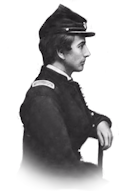
(Note: picture is of an unidentified Confederate soldier.)

From Mother.

8 Brevoort Place, May 13th.

My Dear Girls: I have just come up to my own room from breakfast, and from the reading of your most welcome and satisfactory letter, my dear Eliza, written off West Point; and now before anything calls off my attention, or any visitors arrive to “sit the morning,” I have seated myself to thank you both, Georgy for her’s of the 8th, received on Saturday, and yours E., this morning. It is very thoughtful and kind in you to write at all, and I wonder how you can do it in the midst of such scenes! and yet how miserable it would be for us if we did not hear directly from your own pens of your welfare. I am as much and more at a loss than yourself where to begin to tell you all I want to say. .. . Miss H. and a lady friend were ushered in upon me this morning, the latter wishing to know all the particulars about the position of lady nurses down at Yorktown, and what was particularly required of them, as she had started from home with a “strong impulse” to offer her services. All I could tell her was that “a desire to be useful, plain common sense, energetic action, fortitude, and a working apron, were some of the absolute essentials!—not to be a looker-on, but a doer—to take hold with a good will and a kind heart. She left with a feeling that perhaps she could be quite as useful without going down to Yorktown! I have no doubt she can. . . . Charley must have seen you before this. He will tell you all about his getting off and our being on board with him. He took a quantity of things for himself and you girls, which I hope you may find useful. I told him to help himself from the long basket, and use anything he wanted for himself or others on the voyage. The fruit, I was afraid, might not keep. The fresh eggs were from Fishkill, especially for you, E. I long to hear from Charley all about his trip, and I wonder much whether he will come back in the boat or stay behind. I think it will be better, perhaps, for him to make the trip back here, and then return to stay with you. But this you will, of course, arrange among you. . . . So you have both seen Fortress Monroe, and landed, in spite of Stanton and his strict rules! I am glad of it. You are certainly highly favored girls, and I must give way to a little motherly feeling and say you deserve it all. You cannot imagine what our anxieties have been since the commencement of McClellan’s move to push the enemy to the wall. The evacuation of Yorktown took us by surprise, and somehow or other we do not seem to get up the proper degree of enthusiasm about it. The subsequent doings, with the destruction of the much dreaded Merrimac, have not called forth the jubilant demonstrations throughout the cornmunity here that I supposed such news would produce. They seem to be waiting for the occupation of Richmond to burst out with a joyous and prolonged expression of their feelings. Think of our troops being so near the desired “on to Richmond!” We can scarcely realize all that has happened since our parting that Sunday morning. Oh! how lonely and sad I felt when I turned away from the window to the empty room, and the deserted little beds in the corners at the Ebbitt House. But Hatty and I made the most of each other. I did not leave her that day. . . . A young gentleman sent in his card last evening,—Julian T. Davies—and followed in. He came to see Mrs. Howland, as her name and Miss Woolsey’s were mentioned as having arrived here in the Ocean Queen. Mr. Hone had called for the same reason, and Mrs. Russell, I believe. Young D. said the report that Colonel Howland was wounded went up one aisle of the church in Fishkill, and immediately after, the contradiction went up the other, but he called to know what we had heard from you. You cannot tell what a relief and comfort your letter this morning gives us. I drove out on Saturday to Astoria with your Uncle E. Took an early dinner there, and then went up to Mary’s and sat with her till six o’clock. Found her perfectly well, and the children lovely. . . . Abby mails you the daily papers constantly; they must be taken by other eager hands. Do let us know if any men from the 16th are brought here. We would like to find them out. Jane is untiring in her visits and attentions at the Hospitals—Abby at her shirt-making and cutting out for others to make, and doing all sorts of good things in the intervals, and doing all the running for the family generally. We cannot prevail on her to take time or money to buy herself a spring bonnet or dress. My love to Charley. I do not write him, as he may be on his way back. Hatty is still in Philadelphia. I am so glad you have Lenox Hodge at hand. It is a real comfort to think of it—tell him so, with my love. Give a great deal of love to our own Joe from us all. We shall be so anxious now to hear all the time. We grasp at every paper. . . . Farewell, dear girls, with a kiss to each, and to Charley two, if with you. We look anxiously for the Daniel Webster. Dr. Buck came and told us all about you—exalted praises!

May 13th. By seven o’clock yesterday morning, the regiment was on board the steamer Louisa, and heading up the York river. The colonel had no orders, excepting those to go on board, and only found out his destination from the captain of the boat, who said he was to go to West Point. We were the last regiment to leave, and are glad to get away. Arriving at West Point towards evening, we steamed about four miles up the Pamunkey, a very narrow but deep stream, when the boat stopped and anchored about dark; in the morning the colonel sent me ashore to find out where we were expected to land. Broom volunteered to go along, and so together getting into a boat, we were rowed ashore, and soon ascertained that our division was in camp about two miles further up the river, so we returned to the ship. The captain weighed anchor and steamed slowly ahead, until opposite a wharf, where we disembarked, and marched to the ground reserved for us. The whole division lay here encamped in an enormous corn field, surrounded on three sides by dense pine woods; a delightful situation, but without water, in consequence of which the men had to dig holes and collect the surface water, which was very warm and poor. In the evening held a reception at our headquarters, and had a jolly time, congratulating each other on being within so short a distance of the rebel capital, and once more united; the flowing bowl passed merrily, every one in the best of spirits.

May 13.—Our troops have gone out this morning to endeavor to tempt the enemy to fight, but they will not leave their intrenchments. It is reported that they have been heavily reinforced, but, with all that, I have no doubt that if they would only fight our men would whip them.

We have a member of the Twenty-first Alabama Regiment from Mobile, who was badly wounded at the battle of Shiloh.

There is no hope of his recovery. Every thing has been done for him that it is possible to do. He is a sad spectacle; he is so worn and wasted. He is a German, and can not understand any thing said to him by us. He has no relatives in this country.

Conversing with one of the patients, a very intelligent gentleman, I asked him what he thought of President Davis. He thought that he was a good man, but not the one for the place. I did not ask him his reason for this opinion. He is the first man that I have heard say this, and I hope that he is mistaken, as at this time the country needs a great man at its head.

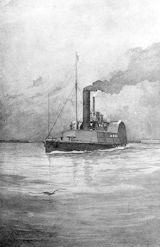
On May 13, 1862, Robert Smalls, the pilot of the side-wheel steamer, Planter, led his crew and relatives to freedom in an act that would be soon acclaimed across the Union.  Smalls later became the first black captain of a United States ship on the USS Planter, now an Army transport vessel. 

May 18, 1862, The New York Herald

HILTON HEAD, S. C., May 14, 1862.

One of the most daring and heroic adventures since the war commenced was undertaken and successfully accomplished by a party of negroes in Charleston on Monday night last. Nine colored men, comprising the pilot, engineers and crew of the rebel gunboat Planter, took the vessel under their exclusive control, passed the batteries and forts in Charleston harbor, hoisted a white flag, ran out to the blockading squadron, and thence to Port Royal, via St. Helena Sound and Broad river, reaching the flagship Wabash shortly after ten o’clock last evening.

The following are the names of the black men who performed this gallant and perilous service: —

Robert Smalls, pilot; John Smalls and Alfred Gradine, engineers; Abraham Jackson, Gabriel Turno, William Morrison, Samuel Chisholm, Abraham Allston and David Jones. They brought with them the wife and three children of the pilot, and the wife, child and sister of the first engineer, John Smalls. The balance of the party were without families.

The Planter is a high-pressure, side-wheel steamer, one hundred and forty feet in length, and about fifty feet beam, and draws about five feet of water. She was built in Charleston, was formerly used as a cotton boat, and is capable of carrying about 1,400 bales. On the organization of the Confederate navy she was transformed into a gunboat, and was the most valuable war vessel the Confederates had a Charleston. Her armament consisted of one thirty-two pound rifle gun forward and a twenty-four pound howitzer aft. Besides, she had on board when she came into the harbor one seven-inch rifled gun, one eight-inch columbiad, one eight-inch howitzer, one long thirty-two pounder, and about two hundred rounds of ammunition, which had been consigned to Fort Ripley, and which would have been delivered at that fortification on Tuesday had not the designs of the rebel authorities been frustrated. She was commanded by Captain Relay, of the Confederate navy — all the other employes of the vessel, excepting the first and second mates, being persons of color.

Robert Smalls, with whom I had a brief interview at General Bonham’s headquarters this morning, is an intelligent negro, born in Charleston, and employed for many years as a pilot in and about that harbor. He entered upon his duties on board the Planter some six weeks since, and, as he told me, adopted the idea of running the vessel to sea from a joke which one of his companions perpetrated. He immediately cautioned the crew against alluding to the matter in any way on board the boat, but asked them, if they wanted to talk it up in sober earnestness, to meet at this house, where they would devise and determine upon a plan to place themselves under the protection of the Stars and Stripes instead of the stars and bars. Various plans were proposed; but finally the whole arrangement of the escape was left to the discretion and sagacity of Robert, his companions promising to obey him and be ready at a moment’s notice to accompany him. For three days he kept the provisions of the party secreted in the hold, awaiting an opportunity to slip away. At length on Monday evening, the white officers of the vessel went on shore to spend the night, intending to start on the following morning for Fort Ripley and to be absent from the city for some days. The families of the contrabands were notified and came stealthily on board. At about three o’clock the fires were lit under the boilers, and the vessel steamed quietly away down the harbor. The tide was against her, and Fort Sumter was not reached till broad daylight. However, the boat passed directly under its walls, giving the usual signal — two long pulls and a jerk at the whistle cord — as she passed the sentinel.

Once out of range of the rebel guns the white flag was raised, and the Planter steamed directly for the blockading steamer Augusta. Captain Parrott, of the latter vessel, as you may imagine, received them cordially heard their report, placed Acting Master Watson of his ship, in charge of the Planter and sent the confederate gunboat and crew forward to Commodore Dupont. The families of the crew have been sent to Beaufort, where General Stevens will make suitable provision for them. The crew will be taken care of by Commodore Dupont.

The Planter is just such a vessel as is needed to navigate the shallow waters between Hilton Head and the adjacent islands, and will prove almost invaluable to the government. It is proposed, I hear, by the Commodore to recommend an appropriation of $20,000 as a reward to the plucky Africans who have distinguished themselves by this gallant service — $5,000 to be given to the pilot and the remainder to be divided among his companions.

The contrabands who came by the Planter represent that the feeling in Charleston approaches nearer to a panic than at any time since the rebellion was inaugurated. The women and children have been ordered out of the place, and have taken whatever of value they could carry with them. The troops are in constant expectation of an attack, and the remaining citizens are nightly holding meetings to devise further means of defence. The steamers in the harbor are seven in number; but only one of them — the Marion — is armed, and she is not capable of doing any damage or offering any resistance to an attacking force. Provisions are terribly scarce and dear.

May 13.—Martial law went into force in Charleston, S. C, this day. Squads of the Provost-Marshal’s guard were to be seen here and there in the more public portions of the city, and many a luckless wight, in military or semi-military costume, who had no furlough or leave of absence to show, was trotted off to the guard-house, where he either did have, or at some future time will have, an opportunity of giving an account of himself. In more than one instance eminently peaceful individuals, affecting the jaunty and warlike “Beauregard cap,” were hauled up with that true military sternness which is deaf alike to entreaties and remonstances. The quiet precincts of the City Hall were suddenly converted into a veritable camp, to the manifest delight of the urchins who thronged the railings of the enclosure, gazing admiringly upon the taut canvas walls.

There was a great rush at the passport office. Owing to the very limited time allotted for the preparation of passports, only a small portion of those desiring to leave the city were accommodated with the indispensable documents. Some arrangement should immediately be made to remedy this great inconvenience to the public. If the passport system is to be carried out, it is absolutely necessary that the passport office should be open to applicants at all hours —or nearly so. Otherwise, persons passing through the city upon legitimate business will be subject to unreasonable and altogether needless delay.— Charleston Mercury, May 14.

—Gen. Fremont with his command reached Franklin, Western Virginia. He went thither by forced marches, as it was apprehended that an attack would be made on Generals Schenck and Milroy, already in that neighborhood. — The Army of the Potomac made an average advance of twelve miles to-day.—Major-General Halleck at Monterey, Tenn., issued an order expelling newspaper correspondents from his lines.

—General Butler at New-Orleans, issued the following order:—”It appearing that The New Orleans Crescent, a newspaper published in this city, is owned and edited by J. O. Nixon, a rebel, now in arms against the Government of the United States, the Commanding General of this Department orders that the publication of that newspaper be suppressed; and that no publication, by pamphlet, handbill, or otherwise, in any form whatever, shall be made from said office after the promulgation of this order.”

—Brigadier-Gen. Kelly was, with a force of National troops, attacked this afternoon in a pass at Reedy Creek, Va., by guerrillas firing from the mountain-top, but no one was killed or wounded. His men made a gallant charge up the mountain, and returned the guerrillas’ fire with so much spirit, that they fled and made their escape.— Gen. Kelly’s Despatch.

—The rebel armed steamer Planter was run out of the harbor of Charleston, S. C, by a crew of negroes, and surrendered to Commander Parrott, of the United States steamer Augusta. At four o’clock in the morning, Robert Small, pilot of the Planter, got up steam, cast off his moorings, took on board, besides his regular crew, five women and three children, hoisted the rebel and Palmetto flags, steamed down the bay, saluted the forts as he passed them, pulled down the flags when he got past the last fort, hoisted instead a white flag, and steamed boldly out to the blockading vessel.—(Doc. 36.)

—Suffolk, in Virginia, was occupied by Major Dodge with a portion of General Wool’s command.—General Wool’s Despatch.

—Eight hundred and eighty-five prisoners, released from Richmond on parole, left Old Point. Ninety rebel prisoners, who were to be returned to Richmond, positively refused to go, and took the oath of allegiance.—N. Y. Tribune, May 14.

—A Reconnoitring party, under Brigadier General Smith, had a skirmish with the rebel pickets, near Monterey, Tenn., which resulted in killing two, wounding three, and capturing five rebels. The National loss was two.

—At New-Orleans, La., General Butler issued the following order:

It having come to the knowledge of the Commanding General that Friday next is proposed to be observed as a day of fasting and prayer, in obedience to some supposed proclamation of one Jefferson Davis, in the several churches of this city, it is ordered that no such observance be had.

Churches and religious houses are to be kept open, as in times of profound peace, but no religious exercises are to be had upon the supposed authority above mentioned.

—Last evening the rebels commenced shelling Fort Wright, on the Mississippi River, from behind Craighead Point, which, until yesterday, was occupied by the National mortar-boats. They kept up a fire during the night, the shells exploding wide of the mark. They are provided with mortars equal in weight of metal to those used by the Federal fleet.—Chicago Tribune, May 15.

—Dr. Nathan S. Jarvis, surgeon of the regular army, died at Baltimore, Md., this morning.

—Natchez, Miss., surrendered to the Union fleet, under the command of Flag-Officer Farragut—(Doc. 108.)

—The Mobile Evening Telegraph, of this date, contains the following: As is customary, a handcar is sent from Pass Manchac down to Kenner, to ascertain if the road is clear; if so, a signal is given to the conductor of the regular train. In this instance, on Friday evening, the first handcar went down and was questioned by the Federal pickets and allowed to pass. The second car attempted to run past and was fired upon, killing two men and wounding two others. One of the men killed is said to be Mr. Crickard, Assistant Quartermaster at Camp Moore. The third handcar that went down they seized, and took the other two and the hands on board prisoners. Then about twenty-five Federal soldiers came up on the hand-cars and fired on our soldiers stationed to guard the bridge. The Federals set fire to the bridge, and our forces fired two shots at the enemy, when they retreated toward New Orleans. Our forces then went to work and extinguished the fire.

—Genekal Negley, of the army of the Southwest, occupied the town of Rogersville, in Northern Alabama, and drove the rebels across the Tennessee River.—(Doc. 35.)
Headquarters 23D Regt. O. V. I., Camp At Mouth

Of East River, Giles County, Virginia,

May 12, 1862.

Sir : — Enclosed I send you the proceedings of the company commanders of the Twenty-third Regiment O. V. I. nominating Rev. Russell G. French, a clergyman of the Methodist Episcopal Church, to the office of chaplain of the regiment. I have to request that Mr. French may be immediately commissioned — his commission to bear date May 1, 1862.

Rev. Amos Wilson was the former chaplain. He resigned on the 30th of April. His resignation was accepted and I directed his name to be stricken from the roll of officers of the Twenty-third Regiment.

Mr. French is a loyal citizen of Mercer County, of unblemished character, and with a fair reputation as a Christian and clergyman. He was driven from his home because he was a Union man; joined my command at Raleigh to act as guide and scout. We found him a most valuable man. He served without compensation. When serving with Company C in the late fight at Camp Creek he had his right thigh shattered to pieces by a Rebel ball. He is probably mortally wounded; in any event, he is crippled for life. Lieutenant Bottsford, who commanded Company C, says he behaved with great gallantry. He has a large family and small means. Officers and men all desire his appointment as herein requested.

Respectfully,

R. B. Hayes,
Lieutenant-colonel 23D Regiment O. V. I.,

Commanding.

Brigadier-general C. P. Buckingham,
Adjutant-general.

Copy [of] letter to Governor Tod asking a commission for Russell G. French, our wounded scout, etc., etc., as chaplain Twenty-third Regiment O. V. I.

Monday, May 12. Camp at north of East River near line between Giles and Mercer Counties, eleven miles from Giles Courthouse. — We moved here to a strong position. The whole brigade as now organized is with us. This is the First Brigade of the Army of the District of Kanawha — General Cox. It consists of [the] Twelfth, Twenty-third, and Thirtieth Ohio Regiments, McMullen’s Battery (two brass six-pounders and four howitzers), and four companies [of] Paxton’s or Bowles’ Second Virginia Cavalry; with Captain Gilmore’s Cavalry for the present. Brigade commanded by Colonel Scammon.

Colonel White of [the] Twelfth a clever gentleman. Lieutenant-Colonel Hines, ditto, but a great talker and a great memory for persons and places.

Fine weather since Sunday the 4th. Out of grub, out of mess furniture. Rumors of the defeat of Milroy and of overwhelming forces threatening us. Great news by telegraph: The capture of Norfolk, blowing up the Merrimac, and the like! Corinth being abandoned. York peninsula falling into McClellan’s hands. If all that this indicates comes to pass, the Rebellion is, indeed, on its last legs.

Written from the Sea islands of South Carolina.
Monday, May 12, 1862.

The black day.

[Diary]

Yesterday afternoon, Captain Hazard Stevens and orderly came here with an order from General Hunter, commanding Mr. Pierce to send every able-bodied negro down to Hilton Head to-day. Mr. Pierce was alarmed and indignant and instantly went to Beaufort to see General Stevens, who told him that he knew nothing of this but the order, and that he considered it very ill-advised. Mr. Pierce went to Hilton Head to-day and saw General Hunter. Meanwhile, last evening we were anxious and depressed at tea-time and talked in a low tone about this extraordinary proceeding. It had been agreed with Mr. Forbes that we should go to Hilton Head in his yacht to-day and we spoke of not going. When Miss Walker came in we told her all about it, still in a low tone. She was astonished at first and then said, “Sister French’s time is come.” “What time?” “She said she wanted to weep and pray with the people, and the time has come to do it.” Miss Walker left the table crying herself. Rina and Lucy were in the room, of course. After tea Rina came to my room and stood hanging coaxingly about. “What are you going to do, missus,to-morrow? ” she asked. “Spend it in the cotton-house,” I said. “You not going to Hilton Head?” “No, I guess not.” One question followed another, and I saw she was uneasy, but did not know exactly what for. By the moonlight soon after when I looked out of the window, I saw a company of soldiers marching up to the house. They stood for some time about the yard and then marched off to go to the different plantations in squads. Before they arrived, we all three, Miss W., Miss Nellie, and I, had had a quiet time in the Praise House. Miss W. came to me and said she wanted to go to-night, and so I went, too, and heard good old Marcus exhort, Dagus pray, Miss Nelly read, and then all sing. Marcus said he had often told the negroes “dat dey must be jus’ like de birds when a gunner was about, expectin’ a crack ebery minute;” that they never knew what would befall them, and poor black folks could only wait and have faith; they could n’t do anything for themselves. But though his massa had laughed and asked him once whether he thought Christ was going to take d—d black niggers into heaven, he felt sure of one thing, that they would be where Christ was, and even if that was in hell, it would be a heaven, for it did not matter what place they were in if they were only with Christ.

They thanked us for going to pray with them, so feelingly; and I shook hands nearly all round when I came away, all showing gentle gratitude to us. I could not help crying when Marcus was speaking to think how soon the darkness was to close around them. It was after this that the soldiers marched silently up and then away. The whole matter was unexplained to the negroes, as by command we were not to speak of it to-night, lest the negroes should take to the woods. Robert, however, asked Nelly why we were going to Hilton Head, and other questions. Mr. Hooper and Mr. Pierce both having gone away, I determined to go and tell Rina that their masters were not coming back, for this I saw was their fear. So I went out to the yard and along to Rina’s house. I knocked, but she did not answer, and then I went to Susannah’s. There was no answer there either and so I came home. But the poor people, though all looked quiet in the little street, were really watching and trembling. They set a guard or watch all along the Bay here, and poor old Phyllis told me she shook all night with fear. I suppose there was little sleep. Old Bess, when I went to dress her leg, said, “Oh, I had such a night, so ‘fraid. Dey all run and I not a foot to stan’ on. Dey must leave me. Oh, missus, do cure my leg. What shall poor Bess do when dey all take to de woods, and I can’t go — must stay here to be killed. Dey kill me sure.” I told her they would not kill the women, but she was sure they would shoot them or “lick” them to death. We were astir early and up very late, for after twelve o’clock we heard a horse gallop up and a man’s step on the porch. I got out of the window and peeped over. It was Stevens’ orderly with his horse. I went down, let him have Mr. Hooper’s bed on the parlor floor, and tie his horse in the yard. After breakfast I went but to the cotton house and was getting old Phyllis some clothes, when Nelly sent for me. When I got in I saw two or three of the men standing on the porch talking together and Captain S. saying it was dirty work and that he would resign his commission before he would do it again. It appears that he had been up all night riding over the island, and the poor soldiers had to march all that time through the deep sand, those who had the farthest to go, and they were ill-supplied with food. When the men came in from the stables and field, Captain S. told them to stand below the steps while he spoke to them. So they gathered around, distrust or dismay or else quiet watching on their faces. “General Hunter has sent for you to go to Hilton Head and you must go.” Here the two soldiers who came with him began loading their guns noisily. Captain S. went on to say that General H. did not mean to make soldiers of them against their will, that they should return if they wished to; but that they had better go quietly. Miss W. then asked leave to speak, told them we knew nothing of this, but that we knew General H. to be a friend to the black men, and they must trust, as we did, that all was right and go willingly. “Oh, yes, missus,” they all said, and some looked willing; others less so, but they all seemed to submit passively and patiently if not trustfully. I said, “I hope you will all be back again in a few days with your free papers, but if you are needed, I hope you will stay and help to keep off the rebels.” Some mentioned their wives, and begged in a low tone that Miss W. would care for them; two set out to bid good-bye and a soldier followed them. Others sent for their caps and shoes, and without a farewell to their wives were marched unprepared from the field to their uncertain fate. It made my blood boil to see such arbitrary proceedings, and I ached to think of the wives, who began to collect in the little street, and stood looking towards their husbands and sons going away so suddenly and without a word or look to them. I gave each negro man a half-dollar and Miss W. each a piece of tobacco, and then they marched off. Sometime after I saw the women still standing, and I went, on the excuse of dressing Bess’s leg, down to them. Some were crying bitterly, some looked angry and revengeful, but there was more grief than anything else. I reassured them a little, I think, and told them we would not leave them in danger and fly without letting them know. How they could see their able-bodied men carried away so by force when they were all last night in the terror of their masters’ return, I do not see, for they must see that with these men gone, they are like lambs left without dogs when there are wolves about. How rash of General Hunter to risk the danger of resistance on their part, and how entirely unprotected he leaves us! Besides, he takes the laborers from the field and leaves the growing crop to waste, for the women alone cannot manage all these cotton and corn fields now that the foreman and ploughman have gone. This Mr. Pierce stated forcibly to General Hunter, and he admitted he had not thought of that. At least he might have thought of the limits of his authority, for such forced levies are surely not at the discretion of any general. It was so headlong! At Nelly’s school the children saw the soldiers coming with their fathers and brothers. They began to cry and sob, and could not be comforted, for Nelly could say nothing but that she knew no more than they did what it all meant. But she soon dismissed school and came home to this sad house. We have been indignant and very sad, but I have had too much to do to feel deeply or think at all. I have had everybody at the plantation up to the cotton-room and have given each some garments. This, with selling, took my entire day.

It is heart-rending to hear of the scenes to-day — of how in some places the women and children clung and cried — in others, how the men took to the woods and were hunted out by the soldiers — of how patiently they submitted, or trusted in others. Just at dusk a great number with a guard were marched to this place. Mr. Pierce would not let them stay. He made a little speech to the negroes. Told them General Hunter said they should not be made soldiers against their will, and that he hoped they would get their free papers by going. Told them to be cheerful, though it was not pleasant being marched away from home and wives. They said, “Yes, sah,” generally with cheerfulness. We then said good-bye to them; Miss W. and I having gone to them and Said a few words of encouragement. The soldiers were grumbling at the work, and at having had to march day and night on four biscuit — dinnerless and supperless, and through sand, on a repulsive duty; it is pretty hard. They were the Seventy-ninth New York (Highlanders), Company D.

About four hundred men, or perhaps not so many, were taken to Beaufort to-night and are to go to Hilton Head to-morrow. The population is here about 3000 to St. Helena’s, and 1500 to Ladies’ Island. It is too late to retrace this step, but the injustice need be carried no further. Mr. P. wants to write full accounts to the War Department, but I will not do as he wishes — give my observation of to-day’s scenes, till I know that General H. is not trying for freedom.

12th.—Just returned from a visit to S. H. The family full of patriotism and very bright. While there, dear W’s horse and servant came home. His family bore it well, considering imprisonment the least casualty that could have befallen him. If Richmond is invested, that beautiful country will be in the hands of the enemy; the families (except the gentlemen) will remain at home to protect the property as best they may. They are now sending com, bacon, etc., into Richmond for safety. None but the croakers believe for an instant that it will fall.

Two hours ago we heard of the destruction of the “Virginia” by our own people. It is a dreadful shock to the community. We can only hope that it was wisely done. Poor Norfolk must be given up. I can write no more to-day.