Following the American Civil War Sesquicentennial with day by day writings of the time, currently 1863.

May 2012

MAY 12TH.—I suggested to the Provost Marshal several days ago that there was an act of Congress requiring the destruction of tobacco, whenever it might be in danger of falling into the hands of the enemy. He ran to Gen. Winder, and he to some one else, and then a hundred or more negroes, and as many wagons, were “pressed” by the detectives. They are now gathering the weed from all quarters, and piling it in “pressed” ware-houses, mixed with “combustibles,” ready for the conflagration.

And now the consuls from the different nations are claiming that all bought on foreign account ought to be spared the torch. Mr. Myers, the little old lawyer, has been employed to aid them. He told me to-day that none ought to be burnt, that the Yankees having already the tobacco of Missouri, Kentucky, and Maryland, if we burn ours it will redound to their benefit, as it will enhance the price of that in their hands. That is a Benjamite argument. He hastened away to see the Secretary of State, and returned, saying, in high glee (supposing I concurred with him, of course), Mr. B. agreed with him. I told him, very gravely, that it mattered not who agreed with him; so soon as the enemy came to Richmond all the tobacco would be burned, as the retiring army would attend to it; several high officers were so resolved. He looked astounded, and departed.

Monday, 12th[1]—Batallion drill today. Sixteen of the boys of our regiment failed to appear for the drill and later they were put into a squad by themselves under an officer and put through the drill until dark—that was their punishment for disobeying orders.


[1] On this day George T. Willcott of Company E died of fever in Scott County, Iowa, and George W. Simmons died of his wounds at Tipton, Iowa. This makes Company E’s loss in the battle of Shiloh, nine—six killed and three dying of their wounds.—A. G. D.

Georgeanna to Mother.

Steamer Knickerbocker.

If my letter smells of “Yellow B.” sugar, it has a right to, as my paper is the cover of the sugar-box. Since I last wrote I have been jumping round from boat to boat, and Saturday came on board the Knickerbocker at Mr. Olmsted’s request, with Mrs. Strong and some others, to put things in order, and, privately, to be on hand to “hold” the boat, which had been made over to the Commission, over the heads of the New Jersey delegation. Dr. Asch was on board, and we had the New Jersey dinner table abolished and 56 Sanitary Commission beds made on the dining-room floor that night. The 200 wounded and sick brought down to Fortress Monroe under our care were transferred to the shore hospital, where we stole some roses for our patients on the Small. Saw regiments embarking for Norfolk, which surrendered the next day. Saw Mr. Lincoln driving past to take possession of Norfolk; and by Tuesday had the boat all in order again, with the single exception of a special-diet cooking-stove. So we went ashore at Gloster Point and ransacked all the abandoned rebel huts to find one, coming down finally upon the sutler of the “Enfants Perdus,” who was cooking something nice for the officers’ mess over a stove with four places for pots. This was too much to stand; so under a written authority given to “Dr. Olmsted” by the quartermaster of this department, we proceeded to rake out the sutler’s fire and lift off his pots, and he offered us his cart and mule to drag the stove to the boat and would take no pay! So through the wretched town filled with the debris of huts and camp furniture, old blankets, dirty cast-off clothing, smashed gun-carriages, exploded guns, vermin and filth everywhere, and along the sandy shore covered with cannon-balls, we followed the mule,—a triumphant procession, waving our broken bits of stovepipe and iron pot-covers. I left a polite message for the Colonel “Perdu,” which had to stand him in place of his lost dinner. I shall never understand what was the matter with that sutler, whose self-sacrifice was to secure some three hundred men their meals promptly.

We set up our stove in the Knickerbocker, unpacked tins and clothing, filled a linen-closet in each ward, made up beds for three hundred, set the kitchen in order, and arranged a black hole with a lock to it, where oranges, brandy and wine are stored box upon box; and got back to Yorktown to find everybody at work fitting up the “Spaulding.” I have a daily struggle with the darkeys in the kitchen, who protest against everything. About twenty men are fed from one pail of soup, and five from a loaf of bread, unless they are almost well, and then no amount of food is enough.

One gets toughened on one’s fourth hospital ship and now I could stop at nothing; but it is amusing to see the different ways taken to discover the same thing. Dr. McC.: “Well-my-dear-fellow-is-anything-the-matter-with-your-bowels-do-your-ears-ring-what-’s-your-name?” Dr. A.: “Turn over my friend, have you got the diaree?” Dr. A. was in a state of indignation with Miss Dix in the shore hospital at Yorktown. She has peculiar views on diet, not approving of meat, and treating all to arrowroot and farina, and by no means allowing crackers with gruel. “Them does not go with this,” as Dr. A. gracefully puts the words into Miss Dix’s mouth.

May 12th. Monday. Major Miner arrived at three A. M. Major Purington left early to report under arrest at Fort Scott. Miner commenced a rigid discipline and introduced a new system. Quite an alarm from shooting at an ox. Companies turned out.

12th.—No move to-day. Still encamped near West Point. Selected out our men disabled by sickness, and sent them off to general hospital. This is usually the precurser of active work. The crisis approaches. Let it come.

Headquarters U. S. Sanitary Commission,
Steamer “Wilson Small,”

Off Yorktown, May 12.

Dear A., —Transferred to this boat. Mr. Olmsted came on board at twelve o’clock last night and ordered Mrs. Griffin and me off the “Daniel Webster.” We had just received, stowed, and fed two hundred and forty-five men, most of them very ill with typhoid fever. The ship sailed at eight o’clock this morning, and will be in New York to-morrow night. Mrs. Trotter went back in charge of our department, and Mrs. Bellows (wife of the president of the Sanitary Commission) accompanied her.

The “Webster” could not get up to the wharf, so the sick men were brought off to us in tug-boats. As each man came on board (raised from one vessel and lowered to the second deck of ours in cradles), he was registered and “bunked.” In my ward, as each man was laid in his berth, I gave him brandy and water, and after all were placed, tea and bread and butter, if they could take it, or more brandy or beef-tea if they were sinking. Of course it was painful; but there was so much to be done, and done quietly and quickly, that there was no time to be conscious of pain. But fever patients are very dreadful, and their moans distressing. The men were all patient and grateful. Some said, “You don’t know what it is to me to see you.” “This is heaven, after what I’ve suffered.” “To think of a woman being here to help me!” One little drummer-boy thought he was going to die instantly. I said: “Pooh! you’ll walk off the ship at New York. Take your tea.” He was quite hurt that I could ask it; but presently I found he had demolished a huge slice of bread and butter, and was demanding more. Then the doctors made their rounds; and after that, such, as were in a condition to be handled were put into clean hospital clothing. Some, however, were allowed to rest until morning.

We did not get them all settled and the watches set till 1 A. M.; after which Mrs. Griffin and I packed up, to leave the ship at daybreak. Oh! if I had it to do over again, I’d have an organized carpet-bag, with compartments for everything. As it was, all was poked in and stamped upon.

This is a little boat, headquarters of the Sanitary Commission, Mr. Olmsted, the General Secretary, in charge of the whole transport service, and Mr. Knapp, his second in command, living on board. At present she is filled in every available corner by severely wounded men brought from the battle-field of Williamsburg, —wounded chiefly in the legs and thighs. Today Mrs. Griffin and I are supernumeraries, the ladies on board being sufficient for all purposes. They are, so far as I have yet ascertained, Mrs. George Strong, wife of the Treasurer of the Sanitary Commission, Miss Mary Gardiner, of New York, Mrs. Howland., whose husband is the colonel of a regiment in the advance, a tall, symmetrical Miss Whetten,[1] and a pretty little creature, half nun, half soubrette, whose name I don’t know. They all seem easy and at home in their work, as if they had been at it all their lives. I use my eyes and learn, and have taken a hand here and there as occasion offered. Terrible things happened yesterday. Many of the wounded of the Williamsburg battle were found lying in the woods with their wounds not dressed, and they starving. Mrs. Strong saw them, and says it was like going over a battle-field.

There is a general cry throughout the female department for “Georgy.” “Where is Georgy?” “Oh, if Georgy were here!” “Georgy” is on board a hospital boat called the “Knickerbocker,” which appears to be missing. As I have nothing to do, I speculate a good deal as to who and what “Georgy” may be.

Yesterday we went all over Yorktown. I sent a few relics to Ralph by the “Daniel Webster,” one of them much envied, — an iron pulley from the celebrated gun which McClellan telegraphed had been “impertinent this morning,” and which afterwards burst, to the great relief of our men. It is amazing that Yorktown was so soon evacuated. Its strength seems very great, not only from its defences, but from the lay of the land, — range after range of hill and ravine, every hill commanding the plain over which our army had to creep up, and which was also covered by the water-batteries at Gloucester, until the gunboats silenced them. We went round the fortifications and saw everything,— the siege-guns, eighty of them; the fine log-houses of the men; the ten thousand abandoned tents, many of which were still standing. Guards were placed about the magazines; and at various points, in the paths or by the wayside, we came upon placards marked “Dangerous,” as a warning of torpedoes. I saw the fragments of a flour-barrel in which one was buried, killing the man who dipped into it; also a walnut-tree under which the earth was torn up, and where six men were yesterday blown to fragments by somebody stepping on the fuse of one. We saw what was once Lafayette’s headquarters, — now supposed to be a prison, where the prisoners seemed to be very little guarded or regarded; then we paid a visit to General Van Alen, commanding the post, and called upon Miss Dix at the Hospital, — Lord Cornwallis’s headquarters; the best house in the place, with a wide-panelled hall and staircase. The rooms above were crowded with wounded men, all looking clean and comfortable. It is wonderful how in the midst of our own excitements these historical places impressed us, and it was hard enough to believe that the confusion, destruction, and filth about us were making a new history.

We did all this in three hours before the sick men could be brought off to the “Webster.” We shuffle about without hoops; Mrs. Griffin says it is de rigueur that they shall not be worn in hospital service. I like it very well on board ship: it is becoming to Miss Whetten, who is symmetry itself; but it must be owned that some of us look rather mediæval. I have no idea what we are to do, and I ask no questions. Mr. Olmsted is the law-giver; he knows the fact of my existence, and will use me when he wants me. It is very cold, and the air has the texture of your worst Boston weather, — steel-filings and all.


[1] Now Mrs. Gamble, of Intervale, N. H.

May 12th.—Started for Clinton about 8 A. M.; went on train to Copper Hill. Had to leave our mess box; think we will get it again in few days. Marched and found regiment camped on bank of Clinch River, about sundown.


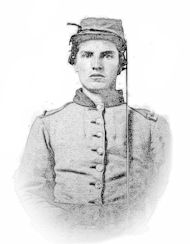
(Note: picture is of an unidentified Confederate soldier.)

May 12.—Two men died this morning, Mr. Adams and Mr. Brennan, from Coffee County, Alabama. Mr. B. was wounded. As a friend, Mr. A. came to nurse him. Both were taken sick this morning, and died after a few hours’ illness.

We have the same sad scenes to witness as ever—sick and wounded men lying on the platform at the depot, night and day, and we are not allowed to take them any thing to eat. Dr. Smith is obliged to prohibit it, as it is contrary to orders, and he has not the food to spare for them.

A terrible circumstance happened a few nights since. Our druggist, Dr. Sizemore, went out about 9 o’clock to see some one. When within a short distance from the hospital he heard groans; went to the place from which they proceeded, and found a box-car, that had been switched off the track, filled with wounded men, some dead and others dying, and not a soul with them to do any thing for them. The conductor was censured, but I think whoever sent the men off are in fault for not sending proper persons to take care of them. If this kind of treatment of our brave men continues much longer, I fear that we will have none to fight for us, for such a total disregard of human life must have a demoralizing effect. If we had many more such kind-hearted officers as Dr. Smith, our men would suffer little through neglect. None leave this hospital without he is certain they can go comfortably, and have plenty of nourishment to last them on their journey. I have seen him, many a time, go to the cars himself, to see that they were properly put in. I am informed that he spends every cent of his pay for their comfort . He will reap his reward.

May 12th.—Mr. Chesnut says he is very glad he went to town. Everything in Charleston is so much more satisfactory than it is reported. Troops are in good spirits. It will take a lot of iron-clads to take that city.
Isaac Hayne said at dinner yesterday that both Beauregard and the President had a great opinion of Mr. Chesnut’s natural ability for strategy and military evolution. Hon. Mr. Barnwell concurred; that is, Mr. Barnwell had been told so by the President. “Then why did not the President offer me something better than an aideship?” “I heard he offered to make you a general last year, and you said you could not go over other men’s shoulders until you had earned promotion. You are too hard to please.” “No, not exactly that, I was only offered a colonelcy, and Mr. Barnwell persuaded me to stick to the Senate; then he wanted my place, and between the two stools I fell to the ground.”

My Molly will forget Lige and her babies, too. I asked her who sent me that beautiful bouquet I found on my center-table. “I give it to you. ‘Twas give to me.” And Molly was all wriggle, giggle, blush.

May 12.—General McClellan, in camp at Roper’s Church, Virginia, sent the following despatch to the War Department:

“Commander Rodgers writes me to-day that he went with the gunboats yesterday past Little Brandon. Every thing quiet and no signs of troops crossing the river. He found two batteries, of ten or twelve guns each, on the south side of James River; one opposite the mouth of the Warwick, the other about south-west from Mulberry Point.

“The upper battery, on Hardin’s, or Mother Pine’s Bluff, has heavy rifled pieces. Between the batteries lay the Jamestown and Yorktown. Commander Rodgers offered battle, but the gunboats moved off. He silenced one battery and ran past the other.”

—Harvey Brown was confirmed as Brevet Brigadier-General in the United States army.

— President Lincoln issued a proclamation declaring that the blockade of the ports of Beaufort, Port Royal, and New-Orleans shall so far cease and determine, from and after the first of June next, that commercial intercourse with these ports, except as to persons and things and information contraband of war, may from that time be carried on, subject to the laws of the United States and to the limitations and in pursuance of the regulations which are prescribed by the Secretary of the Treasury.— (Doc. 14.)

—Commander Palmer, of the United States steamer Iroquois, demanded the surrender of the city of Natchez, Mississippi, to the naval forces of the United States.

—Two regiments from Kentucky and Tennessee attempted to desert from the rebel army, near Corinth, but were forcibly detained.—The rebel steamer Gov. Morton was captured.

—The United States Senate passed Mr. DooIittle’s bill providing for the collection of taxes in the insurrectionary districts.—During a debate on the motion fixing a time of adjournment, Mr. Wilson called Mr. Davis, of Kentucky, to order for uttering treasonable sentiments. After some explanation the point of order was withdrawn, and the motion laid on the table.

—A Convention of Unionists was held at Nashville, Tennessee, this day. Patriotic resolutions were adopted without dissent, and eloquent addresses were made by Governor Andrew Johnson, William H. Polk, General Campbell, Wm. B. Stokes, W. H. Wisner, Edmund Cooper, and others. A committee was appointed to prepare an address to the people of the State; and the policy of Governor Johnson was “cordially approved.”— (Doc. 97.)

—The Charleston (S. C.) Courier of this date congratulates the citizens of Charleston upon their being four times stronger than New-Orleans. Large consignments of stones from Columbia and the interior, and iron chains and other materials will soon be on their way to aid in constructing a stone wall to block out the invaders from approaching within shelling distance of the city. The Southern papers condemn General Butler’s order No. 28, as “cowardly and infamous,” but do not publish it

—This night a party under Lieut. Flusser of the Commodore Perry went on shore six miles above Elizabeth City, N. C, and three miles into the country, and recovered the White Point Light-House apparatus. To prevent information of the movement being conveyed to some rebel cavalry in the neighborhood, all the men found on the route were retained until every thing had been conveyed to one of the boats, which was done by some rebel teams pressed into the service.— Official Report.