Following the American Civil War Sesquicentennial with day by day writings of the time, currently 1863.

May 2012

Off Yorktown, May 11.

Up at five o’clock to give the last finishing touches to the wards. At seven called to breakfast, and found Mr. Olmsted and Mr. Knapp on board; McClellan nine miles beyond West Point. We are to get sick men on board this afternoon, and sail to-morrow, — unless Mr. Olmsted wants us to go elsewhere; Mrs. Griffin and I have volunteered to do so.

Last evening, as we entered the Chesapeake, we saw the crimson glow of a great fire in the direction of Fortress Monroe or Norfolk; and this morning early we heard the dull, heavy sound of an explosion or brief cannonading in the same direction. We are now going ashore to look at Yorktown, for the wards are all in perfect order, and the men can’t be shipped till evening. The press of work here is overwhelming, they say. I am writing with everybody about me. Surgeons are coming off to us in tugs and row-boats, clamorous for brandy, beef-stock, lemons, and all stimulating and supporting things.

Good-bye! This is life. It is by mere luck that I am here, for Mrs. Griffin never received my letter, and only heard by chance that I had written it.

May 11th.—Slept on floor; thought it a pretty hard bed, but guess we will have to get used to such. Took train at 2 A. M.; arrived at Knoxville, A. M. Went out to where some sick are staying in camp; drew guns, knapsacks, etc. Well, here comes trouble! Don’t think this concern will hold all my clothes, but howsomever, I will do the best I can. Reckon I will have to leave my box. Good-bye, boquets, etc. Guess I can’t carry you round on my back. What would they think if they knew I had thrown these away? but, dear me, and them, too, I can’t carry everything. Packed up at last; contents of my knapsack considerable, if not more; holds more than I thought.


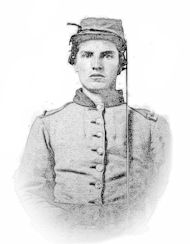
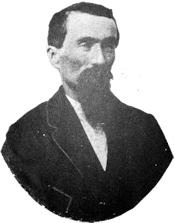
(Note: picture is of an unidentified Confederate soldier.)

Mr. Bogey.

May 11. This place is what is called a turpentine plantation, where they get the pitch from which turpentine is distilled. The owner, Mr. Bogey, a harmless, inoffensive old gentleman, claims to be a Union man, and I reckon he is, because he does not run away or seem to be afraid of us. He tells me he owns 2000 acres of land, nearly all turpentine forest, and has 10,000 trees running pitch. He said the war had ruined him and thinks it has the whole south. He said the rebels had taken all but one of his horses and about everything else he had that they wanted. His niggers had all left him and gone down town. He expected that when we came, but cared very little about it, as he had only a few and they were about as much trouble and expense to him as they were worth. He said he was getting old, his business was all broke up and by the time the war was over and things settled he would be too old for anything. I asked him if all those pigs running about in the woods were his. He reckoned they were. I inquired if he knew how many he had. He couldn’t tell exactly, but reckoned there was right smart. The thought occurred to me that if that was as near as he could tell, if a few of them were gobbled they would never be missed, provided the squeal could be shut off quick enough. I learn that Gen. Burnside has given Mr. Bogey a protection, whatever that is. That perhaps may do well enough for him, but I should not want to warrant it a sure thing for all these pigs and sheep running about here.

Camp Bullock.

Our camp is named Camp Bullock, in honor of Alex. H. Bullock of Worcester, Mass. Today the boys are busy writing letters home, and it troubles them to tell where to date their letters from. They invent all sorts of names; some of them with a romantic turn of mind, date from Camp Rural, Woodlawn, Forestdale, Riverdale, etc., but Mason, with a more practical turn of mind, dates his from Hell Centre. The boys who were out in the woods last night say it is great fun, although they were not disturbed; there is just enough excitement and mosquitoes to keep them from getting drowsy.

May 11th. High wind all day long, driving clouds of sand before it, making it impossible to move outside with comfort. It being Sunday morning, we held the usual inspection, notwithstanding the bad weather. While the inspection was going on we received orders to prepare three days’ cooked rations, and be ready to embark early in the morning; the remainder of the day was occupied in preparing the rations and packing up.

Sunday, May 11.—A very hot, sultry day. I am very tired, as I have all to attend, the other ladies being sick; many of the nurses are sick also. It is more unhealthy now than ever, and unless some change takes place I fear that we will all die.

As there is much noise and confusion constantly here, it is almost impossible to collect one’s thoughts. I miss the calm of the holy Sabbath more than any thing. I have read and talked to the men, and it astonishes me to see how few are members of the Church. They all seem to think and know that it is their duty to belong to it, but still they remain out of it. How much more will they have to answer for than those who have never known God, and have not enjoyed the privileges of the gospel. “He that confesseth me before men, him will I confess before my Father which is in heaven.”

May 11.—The jayhawker Cleveland, whose band of robbers had infested Northern Kansas for some months past, was arrested at Ossawatomie by Lieut Walker and ten men of the Kansas Sixth. Cleveland broke away from the guard, and was killed while attempting to escape. One of his band named Barbour, was arrested at the same time, and taken to Fort Leavenworth for safe keeping.

—Craney Island, Va., was abandoned by the rebels yesterday, and to-day the National forces took possession of the fortifications and raised the flag of the United States.

—One hundred and forty of Morgan’s cavalry at noon to-day captured forty-eight freight and four passenger-cars and two locomotives at Cave City, Ky. Morgan supposed the train would contain two hundred and eighty cavalry prisoners, bound northward. The operator at Cave City, however, gave notice of these facts to Bowling Green, and stopped the upward train. Among the captured Nationals were Majors Helveti and Coffee, both of Wolford’s cavalry, and one other Federal officer and three or four soldiers. The rebels burned all the cars except two, and the locomotive.—Louisville Journal, May 12.

—The rebel iron-clad steamer Merrimac (Virginia) was blown up by order of her commander at her anchorage off Craney Island, Va.—(Doc. 12.)

—A letter from Albuquerque, New-Mexico, of this date, says: The Texans have continued their retreat to El Paso, and will leave the country entirely. They were greatly demoralized, broken up in bands, and devastating the country, and threatening to kill their General, Sibley, who, they say, deceived them by informing them that it was only necessary to march into the country, which was anxious to receive them, and all they had to do was to drive out the Federal officers, and that they would live and possess the country in ease and luxury.

The Colorado volunteers, (Pike’s Peakers,) and some one thousand regulars, are at and in the vicinity of Fort Craig, under command of Col. Paul. Gen. Canby has reestablished his headquarters at Santa Fe, where he and the staff are at present—Missouri Democrat.

—An expedition consisting of six squadrons of the First Wisconsin cavalry, from Cape Girardeau, Mo., went to Bloomfield yesterday, and early this morning fell upon the rebel Col. Phelan’s camp, scattering them in every direction, with one killed and eleven captured. A large number of horses and a quantity of camp equipage were also taken. A rebel force, numbering five or six hundred, infest Chalk and Poplar Bluffs, impressing all the men. The country is being swept of horses, cattle and supplies, which are sent South. The people are in a state of great terror.—Indianapolis Journal.

—The United States gunboats Freeborn and Island Belle, cut out of Piankatank River, in Virginia, two large schooners, one empty, the other loaded with whisky. Five persons were found on the shore of this river by the Captain of the Island Belle, who represented themselves as deserters from the confederate army.—N. Y. Times, May 24.
Adair’s, ten and one-half miles from Parisburg [Pearisburg], Saturday, May 10, 4 P. M. — We were attacked at 4 o’clock this morning. I got up at the first faint streak of light and walked out to see the pickets in the direction of the enemy. As I was walking alone I heard six shots. “No mistake this time,” I thought. I hurried back, ordered up my own and the adjutant’s horse, called up the men and officers, [and] ordered the cavalry to the front. [I ordered] Captains Drake and Sperry to skirmish before the enemy and keep them back; the rest of the regiment to form in their rear. Led the whole to the front beyond the town; saw the enemy approaching—four regiments or battalions, several pieces of artillery in line of battle approaching. The artillery soon opened on us. The shell shrieked and burst over [our] heads, the small arms rattled, and the battle was begun. It was soon obvious that we would be outflanked. We retreated to the next ridge and stood again. The men of the Twenty-third behaved gloriously, the men of Gilmore’s Cavalry, ditto; the men of Colonel Paxton’s Cavalry, not so well. I was scratched and torn on the knee by a shell or something, doing no serious injury. I felt well all the time. The men behaved so gallantly! And so we fought our way through town, the people rejoicing at our defeat, and on for six hours until we reached the Narrows, five and one-half miles distant. The time seemed short. I was cheered by Gilmore’s Cavalry at a point about three and one-half miles from Giles Court-house, and we were all in good humor. We had three men killed, a number wounded, none severely, and lost a few prisoners.
In the Narrows we easily checked the pursuit of the enemy and held him back until he got artillery on to the opposite side of New River and shelled us out. Reached here about 1 P. M. safely. A well-ordered retreat which I think was creditable.

London, May 10, 1862

People here were quite struck aback at Sunday’s news of the capture of New Orleans. It took them three days to make up their minds to believe it. The division of the United States had become an idea so fixed in their heads that they had shut out all the avenues to the reception of any other. As a consequence they are now all adrift. The American problem completely baffles their comprehension. The only wish I have is that they would let it alone. But strange to say, that is the very last thing to which they are inclined. Some future historian of ours may have an amusing task in extracting from the Times of the last year its daily varying prognostications on this subject. A friend of ours, Sir Charles Lyell, was sitting with your mother on Sunday when I came in, and remarking how frequently he had found the American news of the next day flatly contradicting the Times’s affirmations at a given moment. “Now,” said he, “last week they proved conclusively that the United States could not control the Mississippi and seize New Orleans. I should not wonder if tomorrow’s steamer were to show the contrary.” And thereupon I showed him a telegram just received from Mr. Seward, by the steamer Canada, announcing the capture of that city. “There now,” said he, “is it not just as I said?” Even the Americans here get soon impregnated with the spirit of doubt. It was not without difficulty that I could get some of them to credit that the Government of the United States was transmitting trustworthy information.

The Exhibition does not as yet draw such great crowds as were expected. Things are a little out of joint. The Queen secludes herself and does not get over her grief. The Prince of Wales is sent on his travels to get him out of the way. The ministry have no power in Parliament, and yet the opposition are afraid to take their places. Napoleon does not know what to do with the Pope. The Kung of Prussia does not know what to do with his subjects. Everything seems a little mal à propos and yet goes on somehow. Cotton goes, but does not come. The operatives are getting poorer and poorer, and yet there is so much capital in the city that interest is at two and one-half per cent. The country really seems to be rolling in wealth, and yet there are miserable beggars in rags assailing you at every corner. Such is a summary of European life so far as London is concerned….

May 10 — This afternoon it was again reported that the Yanks were advancing. We went to the same hill we were on on the 8th, and put our guns in battery, but the game failed again to come in sight.

MAY 10Th.—The President’s family have departed for Raleigh, and the families of most of the cabinet to their respective homes, or other places of refuge. The President has been baptized (at home) and privately confirmed in St. Paul’s Church.