Saturday, 10th—The Eleventh Iowa went out today to reinforce pickets again. Our cavalry had quite a skirmish with the rebel pickets out on the flanks while driving them in.
May 2012
May 10th.
Last night about one o’clock I was wakened and told that mother and Miriam had come. Oh, how glad I was! I tumbled out of bed half asleep and hugged Miriam in a dream, but waked up when I got to mother. They came up under a flag of truce, on a boat going up for provisions, which, by the way, was brought to by half a dozen Yankee ships in succession, with a threat to send a broadside into her if she did not stop — the wretches knew it must be under a flag of truce; no boats leave, except by special order to procure provisions.
What tales they had to tell! They were on the wharf, and saw the ships sail up the river, saw the broadside fired into Will Pinckney’s regiment, the boats we fired, our gunboats, floating down to meet them all wrapped in flames; twenty thousand bales of cotton blazing in a single pile; molasses and sugar thrown over everything. They stood there opposite to where one of the ships landed, expecting a broadside, and resolute not to be shot in the back. I wish I had been there! And Captain Huger is not dead! They had hopes of his life for the first time day before yesterday. Miriam saw the ball that had just been extracted. He will probably be lame for the rest of his life. It will be a glory to him. For even the Federal officers say that never did they see so gallant a little ship, or one that fought so desperately as the McRae. Men and officers fought like devils. Think of all those great leviathans after the poor little “Widow Mickey”! One came tearing down on her sideways, while the Brooklyn fired on her from the other side, when brave Captain Warley put the nose of the Manassas under the first, and tilted her over so that the whole broadside passed over, instead of through, the McRae, who spit back its poor little fire at both. And after all was lost, she carried the wounded and the prisoners to New Orleans, and was scuttled by her own men in port. Glorious Captain Huger! And think of his sending word to Jimmy, suffering as he was, that “his little brass cannon was game to the last.” Oh! I hope he will recover. Brave, dare-devil Captain Warley is prisoner, and on the way to Fort Warren, that home of all brave, patriotic men. We’ll have him out. And my poor little Jimmy! If I have not spoken of him, it is not because I have lost sight of him for a moment. The day the McRae went down, he arose from his bed, ill as he was, and determined to rejoin her, as his own boat, the Mississippi, was not ready. When he reached the St. Charles, he fell so very ill that he had to be carried back to Brother’s. Only his desperate illness saved him from being among the killed or wounded on that gallant little ship. A few days after, he learned the fate of the ship, and was told that Captain Huger was dead. No wonder he should cry so bitterly! For Captain Huger was as tender and as kind to him as his own dear father. God bless him for it! The enemy’s ships were sailing up; so he threw a few articles in a carpet-bag and started off for Richmond, Corinth, anywhere, to fight. Sick, weak, hardly able to stand, he went off, two weeks ago yesterday. We know not where, and we have never heard from him since. Whether he succumbed to that jaundice and the rest, and lies dead or dying on the road, God only knows. We can only wait and pray God to send dear little Jimmy home in safety.
And this is war! Heaven save me from like scenes and experiences again. I was wild with excitement last night when Miriam described how the soldiers, marching to the depot, waved their hats to the crowds of women and children, shouting, “God bless you, ladies! We will fight for you!” and they, waving their handkerchiefs, sobbed with one voice, “God bless you, Soldiers! Fight for us!”
We, too, have been having our fun. Early in the evening, four more gunboats sailed up here. We saw them from the corner, three squares off, crowded with men even up in the riggings. The American flag was flying from every peak. It was received in profound silence, by the hundreds gathered on the banks. I could hardly refrain from a groan. Much as I once loved that flag, I hate it now! I came back and made myself a Confederate flag about five inches long, slipped the staff in my belt, pinned the flag to my shoulder, and walked downtown, to the consternation of women and children, who expected something
awful to follow. An old negro cried, “My young missus got her flag flyin’, anyhow!” Nettie made one and hid it in the folds of her dress. But we were the only two who ventured. We went to the State House terrace, and took a good look at the Brooklyn which was crowded with people who took a good look at us, likewise. The picket stationed at the Garrison took alarm at half a dozen men on horseback and ran, saying that the citizens were attacking. The kind officers aboard the ship sent us word that if they were molested, the town would be shelled. Let them! Butchers! Does it take thirty thousand men and millions of dollars to murder defenseless women and children? O the great nation! Bravo!
Written for The Racine Advocate.
The Battle of Farmington.
Camp of 2d Division, Army of the Mississippi, near Farmington.
May 10, 1862.
The Grand Army of the West is slowly but surely advancing on the enemy. The final act in the great drama can not be much longer delayed.
Last Saturday General Paine’s Division advanced to Farmington, within about three miles of Corinth; and after some heavy skirmishing with a considerable force of the enemy, drove them back and took possession of the place. On Sunday, Stanley’s Division (the 2d of Pope’s Command) moved forward to within about three miles of Farmington and went into camp. Paine’s Division had also fallen back to this position, and encamped directly in front of us, leaving only a small force of cavalry to occupy the ground from which the rebels had been driven. Rain fell in such quantities on Sunday and on Sunday night as to render the roads almost impassable for the next two or three days. On Thursday, the roads being considerably improved, these two divisions, Stanley’s and Paine’s, advancing beyond Farmington and reconnoitered the ground up to within a short distance of Corinth, the enemy retiring before us. There was considerable skirmishing during the day, in which we lost several men, but no serious engagement.[1]
Farmington is a small village of about thirty or forty houses, on the road from Corinth to Hamburg, pleasantly situated among open fields which are bounded on every side by the woods. As the position was considerably in advance of the main body of our army, it was deemed prudent towards night to draw off our forces to their camps, which had not been moved, leaving only one brigade in the rear of Farmington to hold the position, or at least hold the enemy in check should he attempt to advance. The brigade thus left is the 2d of Stanley’s Division, commanded by General Plummer and composed of the 26th Illinois, 8th Wisconsin, 47th Illinois and 11th Missouri regiments. The brigade fell back to an open field surrounded by woods, on the right of the Hamburg road and about a mile this side of Farmington, and here remained during the night. Company A of the 8th and four companies from other regiments, under command of Major Jefferson of the 8th, were stationed as outposts during the night, about a mile and a half or two miles in advance of the brigade.
About daylight the next morning the enemy advanced through the woods beyond Farmington and attacked our outposts. Major Jefferson, seeing that the enemy were in strong force, deployed his force as skirmishers, charging them to keep cool and retire slowly, firing as they went. He also sent an orderly to Colonel Loomis of the 26th Illinois (who in the absence of General Plummer commanded the brigade), notifying him of the approach of the enemy and asking for reinforcements. This Colonel Loomis could not grant, as he had instructions not to advance his force beyond their first position. In the meantime the enemy, driving our skirmishers before them, advanced into the village of Farmington and planted a battery there, from which they opened a galling fire upon the skirmishers.
Great credit is due to Major Jefferson and to Captain Redfield, and the other officers and men employed as skirmishers, for the coolness and courage they displayed under the enemy’s fire. Retiring slowly from one sheltered position to another they kept up a galling fire upon the enemy, which caused them to advance with great caution, so that it was more than three hours from their first appearance until they became engaged with our main force.
About ten o’clock, the enemy still advancing in three lines of battle, covered the open fields in front of Farmington and planted another battery in the edge of the woods to the right of our front, about a mile distant. He also soon opened another at about the same distance on our left. About this time General Palmer came up with four Illinois regiments and Hescock’s battery.
Hescock’s battery was placed about five hundred yards in our advance, and two of the regiments were posted a little to the rear and right of the battery, their right resting on the woods and their left in front of the right of our brigade. The other two regiments of Palmer’s Brigade were posted on an elevated position to the left of the Hamburg road. Captain Hescock, who behaved with great gallantly during the engagement, having got his guns in position, opened a very vigorous and apparently very effective fire on the enemy’s battery in the woods on the left.
Their guns for a time were silenced, and there was a short pause in the battle. The enemy were, however, steadily advancing all the time under cover of the woods on our right and left, endeavoring to flank our position, in which they came very near being successful. Soon the rebel batteries opened with redoubled fury. Their guns were evidently manned by skillful artillerists, for they fired with great rapidity and fearful precision. They sent shot and shell alternately into Palmer’s line and then into ours, and at times clear beyond into the woods in our rear, along the only road by which reinforcements could come or a retreat be effected. About twelve o’clock the sharp crack of musketry in our front, mingling with the sullen roar of cannon, told us that Palmer’s men were engaged with the advancing rebel infantry. This officer, seeing that his position was rapidly being flanked, after a few volleys drew off his men and formed another line in our rear. Hescock’s battery vas also compelled to retire in order to avoid capture. This left our line exposed to all the fury of the battle.
Our brigade was drawn up on the side of a gentle rise in the open field, our right and left resting on the woods. The 26th Illinois occupied the right, the 8th Wisconsin on its left, the 47th Illinois on our left, and the 11th Missouri on the extreme left of the line. Palmer having fallen back, and the only battery we had engaged having retired, the enemy now turned their guns upon us, and soon their shot and shell fell thick and fast in our ranks. One of their first shot passed close to the head of Major Jefferson and took off the leg of Lieut.-Colonel Miles of the 47th Illinois, who shortly after died.[2] Another shell struck close to Company G of our regiment and exploded, mortally wounding Lieutenant Beamish and Corporal John White of that company, and slightly wounding another. The first two died soon after they were brought from the field. The brigade was ordered to lie down, and having done so found great protection in the elevated ground in front of it. Still the enemy, depressing their guns, got such accurate range that their shot and shell tore up the ground in every direction along our line, killing and wounding some in each regiment, except the 11th Missouri, who were so far to the left and so completely under cover of the woods that they escaped without the loss of a single man.
Soon the rebel infantry advanced in heavy force in our front and in the woods to our left, and opened fire upon our line. The firing was now, for a short time, absolutely terrific. Grape shot and bullet flew thick and fast as hail in a wintry storm. Men who were through the Mexican war declare that they were never under such a fearful fire before; and it is a matter of astonishment that our casualties were so few. It can only be accounted for by the fact that our men kept close to the ground and so avoided the deadly missiles which passed over them. Nothing is more trying to the nerves of men than thus to have to remain silent and motionless under a fire which they are not permitted to return. The 8th, however, bore it without flinching; until at length Colonel Loomis gave the word: “Up, 8th Wisconsin, and give it to them!
Our boys now rose up, and advancing to the crest of the elevation in front of them poured volley after volley into the rebel ranks. The fearful yells, and still more fearful fire, of the Badger boys evidently produced a stunning effect upon the enemy, for soon their fire slackened, then their lines wavered, and finally they broke and retired in disorder to the cover of the woods. At this time about four hundred of our cavalry came up, and passing our regiment on the right, charged the battery in our front, driving the rebels from their guns; but not being supported, and being exposed to a heavy fire from the rebel infantry in the woods, they were compelled to retire without capturing the battery.[3]
In the meantime, the enemy were rapidly flanking us in the woods on our right, and the regiment supporting us having fallen back, the 8th was also ordered to retire and form another line in the woods in the rear. This our men did in good order, moving off the field almost as deliberately as in ordinary battalion drill.
The enemy still endeavoring to get on our flank and in our rear, and having evidently abundant force for the accomplishment of their object, our entire force was ordered to move through the woods to the road and fall back thereon to our next lines, which we found formed in an open field about a mile and a half in the rear of our first position. By this time the whole of Pope’s command were advancing and forming in line, all supposing that a general engagement had begun. The enemy, however, made no further advance, but hastily withdrew, leaving our pickets to occupy the battlefield during the same night.
During the entire engagement the conduct of the 8th in every way sustained the reputation which the Wisconsin troops have won on other fields. Lieut.-Colonel Robbins (who in the absence of Colonel Murphy commanded the regiment), Major Jefferson and Adjutant Sprague, proved themselves to be brave men and able officers. Indeed, all the officers and men, as far as known, behaved with a steadiness and gallantry worthy of veterans. General Palmer, riding up to the regiment on the field, inquired what regiment it was. Being told that it was the 8th Wisconsin, he said, in a most emphatic manner: “You have done nobly!
It could not have been the intention of General Pope to bring on a general engagement at this point, otherwise we should have been reinforced and held the position at all hazards. The accounts of deserters and prisoners represent the force of the enemy at from twenty to forty thousand strong, commanded by Generals Bragg and Hardee. The force we had on the field was not over five thousand men. We were nearly three miles in advance of the main body of our troops, and the only road by which we could be reinforced is a narrow road running through woods and swamps, which the enemy were able to shell from the position where they had planted their batteries. Being much better acquainted with the country than we, they no doubt intended and expected to surround and cut us off before reinforcements could reach us. In this they were completely foiled, and the reception they met probably convinced them that it would neither be safe nor pleasant to attempt to advance any further in this direction.
The entire loss of all our troops engaged is about one hundred and fifty in killed and wounded. The enemy probably lost quite as many. Though the loss of our regiment (owing to the manner in which they took advantage of the inequalities of the ground) is comparatively light, it yet includes some of our best men. Their names are as follows:
Captain John E. Perkins, Co. C—mortally wounded by a minie ball in the side. Since dead.
Lieutenant Richard D. Beamish, Co. G—Struck by a shell. Dead.
Corporal John A. White, Co. G—struck by a shell. Dead.
Corporal August Ludkie, Co. D—Shot through the hand.
O. D. Leonard, Co. D—shot through the thigh.
Wm. Buckley, Co. C—fracture of the forearm. Since amputated.
Blake W. Griffith, Co. F—shot by musket ball in side.
Sergeant B. Bush and H. W. Allen, Co. F— slightly. Not disabled.
Zebulon Johnson, Co. I—in leg below the knee. Since amputated.
Iver Oleson, Co. I—shot through the neck. Severely.
Alva Wood, Co. I—wounded in leg and missing.
Jas. Kendall, Oliver Wood, George W. Trude, S. B. Cox, Co. I—all slightly.
Harmon V. Sacia, Co. I—missing.
Jas. Rogers, Co. G—slightly.
Hans Nisson and Thomas Toney, Co. K—slightly. Not disabled.
George W. Quimby, John C. Green and Charles Colher, Co. A—slightly. Not disabled.
Three companies had been detailed as outposts during the previous night and as skirmishers in the morning. Only one platoon succeeded in getting to the field in time to take part in the principal engagement. This platoon, under command of Lieutenant Baker, formed alongside of Captain Green’s company, and there rendered good service. Only fourteen men of Company D were present, the rest of the company having mistaken the orders the preceding night and gone back to camp; but these, under command of Lieut. McDowell, rendered good service. Company B was left behind, as a camp guard, so it met with no casualties.
Besides those mentioned in the above list there are quite a number who were struck and more or less scratched and bruised by the enemy’s missiles; but they are scarcely enough damaged to be classed with wounded men. I find, however, that it is customary to swell the list of wounded by reporting as such all who have been in any way scratched or bruised in a fight.
Captain Perkins, who commanded the company known as the Chippewa Eagles, who made such a sensation when they came into Camp Randall with a living eagle (which they still carry with them), was a man of giant frame, and one who had a large heart—a man of the most generous and patriotic impulses. His loss is felt and deeply regretted by the whole regiment.*
Lieut . Beamish, of Company G, was a young man of superior intelligence, of fine social qualities, and a brave and useful officer. Corporal White was a young man of excellent character, intelligent, upright and correct in his deportment, both as a man and as a soldier. There are no better men left than these in this or any other regiment . They offered their lives to their country in her hour of need, and with their blood have sealed their devotion to her integrity and her honor. Peace to their ashes and honor to their memories!
Wm. P. Lyon.
P. S.—I forgot to say that on our return to camp from the battlefield we found that Colonel Murphy had arrived, but too late to be in the engagement. You may be sure the whole regiment was glad to see him.
[1] The Eighth was in General Paine’s Division.
General Paine was a resident of Illinois and a graduate of a military academy, but had resigned from the regular army before the Civil War began. He was an excellent officer; a very brave man; and. although a little rough at times, a great favorite with the men under his command.
A characteristic anecdote of him is that at one time a Tennessee woman came to his headquarters and complained bitterly that the Union soldiers had stolen all of her chickens. The General treated her kindly, blamed the soldiers for their conduct and sympathized with the poor woman in her trouble; but he closed the conversation by saying to her, “Madam, we are going to put down this rebellion if it takes every ______ chicken in the State of Tennessee.”
[2] Colonel Miles was mounting his horse and had just put his foot in the stirrup when a ball struck the foot that was on the ground and took off the leg. He died that night.
[3] The command that made this gallant charge was the 2d Iowa Cavalry, commanded by Colonel (afterward General) Elliott.
10th. Saturday. Boys broke into P. O. and a store. Major was very angry and arrested Lt. Lockwood there and made three boys walk to Carthage. Boys were mad. This morning I was sick of service or rather longed to get into some other department. Spencer, Archie and I went ahead and got a good dinner at Mr. Hammond’s—old secesh. Found an old gun, which we carried through. Reached Carthage before dusk. Letter and papers from home. Learned that the day before, Co. “I” while out foraging met a squad of rebel soldiers. One was killed, two wounded and three taken prisoners. Next day Sergt. Smith was released on parole to get an exchange of three of Jockman’s men for them.
10th.—Another march of fifteen miles to-day. Have seen nothing of the enemy. We hear that General Franklin remained twenty-four hours at West Point before disembarking his troops, permitting the enemy to pass, and then attacking them in the rear! Has delay and procrastination become a chronic disease with our Generals? I hope he will be able to give a satisfactory reason for his course. It begins to look as if, when this Army of the Potomac can find no apology for digging, it will hunt up other excuses for delay.
I have had to ride in an ambulance to-day, in consequence of lameness from the bite of the horse yesterday.
U. S. Floating Hospital “Daniel Webster,” Off Ship Point, May 10.
Dear Friend,—I write with a pencil, because it is so comfortable. We left New York yesterday at 5 P. M., and came down the bay through wonderful effects of evening light and shade and color. We stayed on deck by moonlight till eleven o’clock, when I turned in, to sleep all night, and get up lazily to breakfast at nine this morning. Since then I have helped to make our hospital-flag, and have dreamed away the day, lying on deck in the sweet air, where I could see the bluest sky and the bluest water (when the vessel dipped), and nothing else. Four ladies are attached to the ship,— Mrs. William Preston Griffin, Mrs. Trotter,[1] Mrs. Blatchford, and I. As far as I can judge, our duty is to be very much that of a housekeeper. We attend to the beds, the linen, the clothing of the patients; we have a pantry and store-room, and are required to do all the cooking for the sick, and see that it is properly distributed according to the surgeons’ orders; we are also to have a general superintendence over the condition of the wards and over the nurses, who are all men. What else, time and experience will show, I suppose.
I am inclined to like the surgeon-in-charge, Dr. Grymes, very much. He commands here; the captain, named Bletham, — a truly honest, kindly, sailor-like man, — being, under present circumstances, only second. Dr. Grymes is suffering from consumption, and to-day he is hanging about, languid and nerveless; they tell me that to-morrow he will be taut, tireless, hawk-eyed, and the spirit of an emergency. There are eight medical students on board (” dressers” they are called), and perhaps twenty other young men, ward-masters and nurses, — all volunteers. The Government furnishes the vessel, and the rations of all on board. My stateroom, which I share with Mrs. Griffin, is on deck; it opens directly to the outer air, and has a large window and ventilator.
Since writing the above, I have done my first work, — making the beds. How you would have laughed to see me, without a hoop, mounted on the ledge of the second tier of berths, making the beds on the third tier!
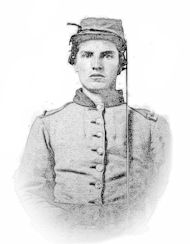
May 10th.—Bid farewell to friends and home; took train at Ringgold, Ga., at 2 P. M. Arrived at Chattanooga, 6 o’clock; remained in car-shed until 2 A. M.
(Note: picture is of an unidentified Confederate soldier.)
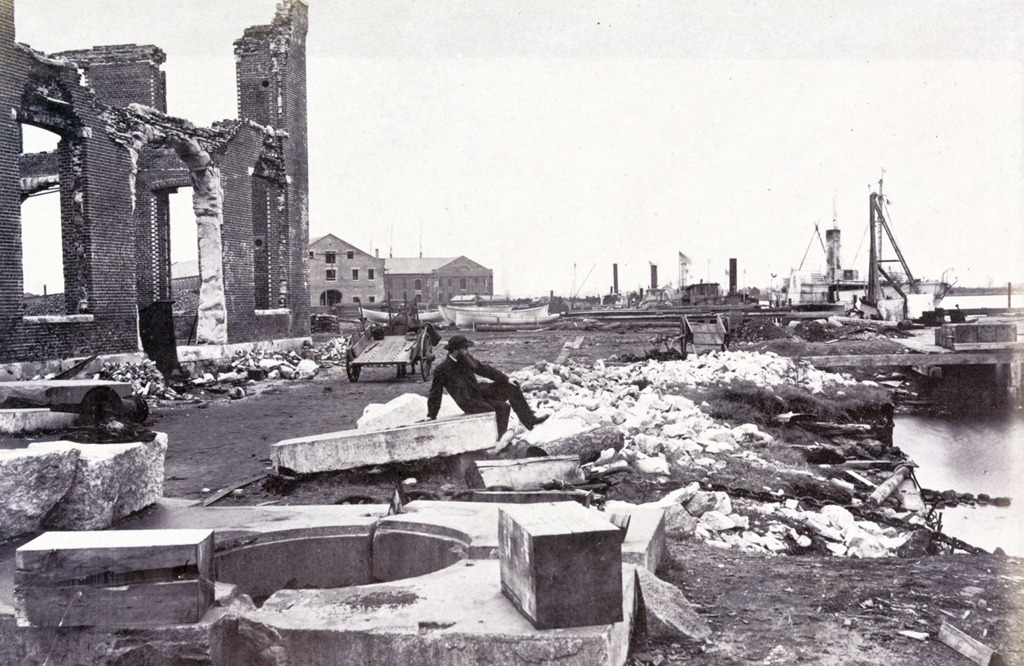
Burned by the Federal Navy when evacuated in 1861, Gosport Shipyard was burned again on May 10, 1862 when the Confederates left on May 10, 1862. It was the third time the shipyard had been burned, the first time by the British in 1779. Photo is from 1864.
Photographed by James F. Gibson.
Part of Civil War glass negative collection. Library of Congress Prints and Photographs Division Washington, D.C. 20540 USA
Record page for this image:http://www.loc.gov/pictures/item/2006685373/
 Abby Howland Woolsey to Georgy and Eliza.
8 Brevoort Place, Saturday.
My Dear Girls: How little we know where you are and what worlds of work you are doing. It is hard to keep still, I know, where so much ought to be done. . . Yesterday Charley and the Webster were to sail and we had a carriage and all went down with the traps—box of brandy, trunk of towels, etc., bundle of air-beds, bundle of fans, and a basket with a few eatables—some fresh eggs which had just arrived from Fishkill, and three or four bottles of ale, which I hope Eliza will drink; she sometimes used to take a glass of it at home. As for Georgy, I do not expect to have her take anything of that sort, after what mother tells me of the fate of the boxes of claret you took to Washington. One box was still unopened, and, so far as she knew, Georgy had never touched a drop. . . . We found Mrs. Trotter on board. The other ladies soon came —Mrs. Griffin, Miss Katharine P. Wormeley, Mrs. Blatchford and Mrs. H. J. Raymond. . . .
The vessel is a fifth-rate bed-buggy concern, I should say, and the hold where the men were put seemed miserable in spite of your pains, but for which it would have been very forlorn. Charley was so busy running hither and thither that we hadn’t much chance at him. I was sorry we had not packed a great hamper of cooked food for him and Mrs. Trotter. Another time we will do better. They expect to be back by Wednesday with as many sick as they can carry, and judging from the number they brought packed on the Ocean Queen, they will stow them with deadly closeness. We saw Dr. Grymes and liked his looks and manner. He startled us by telling us that the Ocean Queen was coming up the bay with over a thousand sick, four hundred typhoid cases. Couldn’t do without you, he said; “only ladies down there to come —of course they are on board.” Mrs. Griffin, too, was convinced of it and sent back by us a big bundle of tins she had bought for Georgy. We left the Webster at four, when they were to sail at any moment, and drove down to the pier where they said the Ocean Queen was to lie. She was not due till six, so we came home. What with the news from West Point, Va., without details, and with the idea that you were the only women on the Ocean Queen to see after the nurses and the sick, and Charley’s departure, we were sufficiently sobered and excited, a compound of both. This morning Uncle Edward reports us the Herald’s news from West Point, that it was only a skirmish and that the loss of the 16th was two killed, beside wounded. . . . At ten o’clock Dr. Buck landed on the Ocean Queen, came up to his house and sent us word that you were not on board. This morning he has been in for a moment, and says you were indefatigable and indispensable at the front; far more useful in staying than in coming up, that he didn’t know where you went when you left the Ocean Queen, but that you were “all right” with Mr. Olmsted somewhere, and taken care of. . . . Eleven hundred, Dr. Buck said, came on the Ocean Queen. So many of them are virulent fever cases, men who must die, that there is great perplexity what to do with them. The City Hospital, North building, is fast filling up, and the air is so infectious that Mrs. Buck thinks it unsafe to enter it. The Commissioners propose that these new cases should go to Ward’s Island. The government barracks on Bedloe’s and Riker’s Islands won’t be ready for some days, and I dread having the Daniel Webster or some other transport bring a thousand more before these have been decently housed. . . . Mother has driven out to Astoria with Uncle E. Carry has gone to Park Barracks with flowers and cologne sent from Astoria, and Jane is at the City Hospital with oranges for fever men. She goes into the fever ward, considering it duty, and undertakes too much for her nerves, but you needn’t tell her so. Carry and I are going this afternoon to see a “Mr. Woolsey,” who was sent to St. Luke’s, sick of fever.
 Georgy to Mother.
“Ocean Queen.”
It seems a strange thing that the sight of such misery should be accepted by us all so quietly as it was. We were simply eyes and hands for those three days. Strong men were dying about us; in nearly every ward some one was going. Yesterday one of the students called me to go with him and say whether I had taken the name of a dead man in the forward cabin the day he came in. He was a strong, handsome fellow, raving mad when brought in, and lying now, the day after, with pink cheeks and peaceful look. I had tried to get his name, and once he seemed to understand and screeched out at the top of his voice, John H. Miller, but whether it was his own name or that of some friend he wanted, I don’t know. All the record I had of him was from my diet-list, “Miller, forward cabin, port side, No. 119, beef tea and punch.”
Last night Dr. Ware came to me to know how much floor-room we had. The immense saloon of the after-cabin was filled with mattresses so thickly placed that there was hardly stepping room between them, and as I swung my lantern along the row of pale faces, it showed me another strong man dead. E. had been working hard over him, but it was useless. He opened his eyes when she called “Henry” clearly in his ear, and gave her a chance to pour brandy down his throat, but he died quietly while she was helping some one else. We are changed by all this contact with terror, else how could I deliberately turn my lantern on his face and say to the Doctor behind me, “Is that man dead?” and stand coolly, while he listened and examined and pronounced him dead. I could not have quietly said, a year ago, “That will make one more bed, Doctor.” Sick men were waiting on deck in the cold though, and every few feet of cabin floor were precious; so they took the dead man out and put him to sleep in his coffin on deck. We had to climb over another soldier lying up there, quiet as he, to get at the blankets to keep the living warm.


