May 10th. Heard this morning of the arrival of our advance at West Point. The troops had a small fight with a few rebels, but nothing to speak of; detailed companies F and G for a two days’ tour of building wharves; shortly after they left camp we were ordered to strike tents, and move forward to the ground vacated last evening by the Irish brigade. When we got there, we were obliged to detail half the regiment to police the ground before we could occupy it, the Irishmen having left it in such a villainous condition. The present site is close to the town, almost overlooking the docks; in the evening the colonel invited me to go in swimming with him. We drove down to the beach in a two-wheeled ambulance. Upon reaching a spot the colonel thought suitable, I got out and undressed, the colonel remaining inside to try the English plan, driving out far enough into the water, so that he could jump out, and swim without wading. When he got undressed and walked to the rear to plunge in, the old affair suddenly tilted up, and away went colonel and clothes, pell mell into the water! When he came to the surface and saw me laughing and the driver hiding his face, he swore like the army in Flanders, and pitched into the driver right and left; pretty soon, however, he began to laugh, too, but declared he would never bathe in a two-wheeled ambulance again. I sent the man back to camp to get him some dry clothes, so he was not very much put out after all.
May 2012

May 10.—The hospital is again filled with the badly wounded. There is scarcely an hour during which they are not coming in from skirmishes. I sat up all night to see that the nurses performed their duties properly, and assisted in bathing the wounds of the men. They all rested quite well, excepting one, who was severely wounded in the hand. He suffered a great deal. One died suddenly this morning. I gave him his toddy; he was then quite cheerful; and I went to give him his breakfast, but his bunk was empty—he was dead and gone. He was wounded in the arm. The doctor desired him to have it amputated, which he would on no account permit. The result was hemorrhage ensued, and he bled to death before assistance could be rendered. I did not learn his name, nor any thing about him.
These things are very sad. A few evenings since, Dr. Allen was conversing about the horrors with which we are surrounded. He remarked that it was hard to think that God was just in permitting them. “Shall we receive good at the hands of God, and shall we not receive evil?” We, as a nation, have been so prosperous, that we forget that it was from him that we derived our benefits. He often sends us sorrows to try our faith. He will not send us more than we are able to bear. How patiently the soldiers endure their trials! Who dare say that strength is not given them from on high? Let us do our part, and, whatever happens, not lose trust in him, “for he doeth all things well;” and, in the language of Bishop Wilmer, “May the trials through which we are passing serve to wean us from the world, and move us to set our affections on things above!” “May we bear the rod, and him who hath appointed it!” Dr. A. was some time with General Floyd, in Western Virginia, and remarked that he had seen nothing here to compare with what the men endured there. They were in the mountains, where it was impossible to get any thing for them.
We gained quite a victory yesterday. Price’s and Van Dorn’s troops were engaged. We saw them as they marched out in the morning. They crossed a bridge opposite our bed-room window.
Susan Bradford Eppes, "Through Some Eventful Years"
May 10th, 1862.—There are rumors that McClellan has been removed from Richmond and McDowell appointed instead. With this new commander we may expect more fighting. “A new broom sweeps clean,” they say. Sister Mag has made up her mind to go to the front where she can be at hand if Brother Amos should be wounded. This dreadful waiting, waiting, has almost broken her heart. In June she will take her children, Eddie and the baby girl, whom her father has never seen, and go to Richmond. Sister Mart will accompany her and, of course, there are nurses for both babies. The whole neighborhood is interested and is busy embroidering pretty things for the children. No other trimming to be had in this blockaded country. But that is the least of all the inconveniences.
The book-keeper is getting on quite well with the work and Mrs. Ansell is a really cultivated woman, she comes to every meeting of the Sewing Society and seems as patriotic as the rest. Her little son sticks to me like a burr.
May 10.—White House, on the Pamunkey River, Virginia, was occupied by a company of National cavalry, who secured seven thousand bushels of wheat and four thousand bushels of corn. The rebels had burnt the railroad bridge and town, and torn up the road for some distance towards Richmond.—N. Y. Commercial, May 12.
—The rebel schooner Maria Teresa was captured this day by the United States gunboat Unadilla.—(Doc. 32.)
—A Union meeting was held at Shepardsville, Carteret County, N. C, this day. H. R. Bell was called to the chair, and Thomas Hill was appointed secretary. The following resolutions were unanimously adopted:
Resolved, That we deeply regret the unfortunate occurrence of the present war now progressing between the Federal Government and the Southern States.
Resolved, That in our opinion said war was brought on by a few hasty politicians, and not by any act of the Federal Government.
Resolved, Further, that we believe it to be the duty of all Union-loving men to meet and speak their Union sentiments, and also to take measures to maintain and defend the Constitution of the United States.
Resolved, That we desire protection by our Federal friends.
Resolved, That since it has become necessary to appoint a Military Governor for the State of North-Carolina, we heartily concur in the appointment of the Hon. Edward Stanly, to fill that office, and agree to invite the said Edward Stanly to visit us at Shepardsville.
—A plot was discovered in Paducah, Ky., spread among the people there of secession proclivities, by which the town was to be handed over to the rebels within a week. Information was given by one of their number.—Nashville Union, May 11.
—New-Kent Court-House, Va., was occupied by the National forces under the command of General Stoneman. The rebels, on leaving the town, destroyed two buildings containing commissary and quartermaster’s stores. — Boston Transcript, May 12.
—Cumberland, Va., a small town on the Pamunkey River, was deserted by the rebels and immediately occupied by the National troops.— National Intelligencer, May 12.
— The iron-clad steamer Ironsides, was launched this morning at Kensington, Philadelphia, Pa., in the presence of an immense crowd. The christening was performed by Commodore Stewart, of the “Old Ironsides,” at whose suggestion the name of “New Ironsides,” was given. —A Naval engagement took place near Fort Pillow on the Mississippi River between a rebel fleet of eight iron-clad gunboats and a Union fleet of six. Four of the rebel boats had rams. Two of the rebel boats were blown up, and a third sunk, when the remainder retreated precipitately under the guns of Fort Pillow. The National fleet was commanded by Capt. C. H. Davis.— (Doc. 30.)
–By General Butler’s order, there were seized at the office of the Consul of the Netherlands in New-Orleans one hundred and sixty kegs, each containing five thousand dollars in specie.— (Doc. 33.)
—General Wool, with five thousand men, landed at Willoughby’s Point, in Hampton Roads, and immediately marched upon Norfolk, Va. At five miles from Norfolk he was met by a delegation of citizens, who formally surrendered the city into his hands. It was immediately occupied, and Gen. Viele made Military Governor.—(Doc. 11.)
—A Meeting of the citizens was held at Bay River, N. C, for the purpose of forming a company of Union Home Guards. F. B. Silverthorn was chosen President, and Mathias Powers Secretary. Mr. Francis T. Riggs offered the following resolution, which was passed by the meeting:
Resolved, That if any of our company betrays the trust reposed in him, by giving aid to or revealing any of the operations of this company to any rebels, without instruction to do so from the proper authorities, he or they shall be immediately apprehended, and dealt with as traitors deserve.
Over ninety-seven of the citizens signed the roll. The president of the meeting addressed them effectively, and was authorized to appoint a captain and three lieutenants for the company. The object of the meeting was to clean out the lower part of the county of all traitors whatsoever, by apprehending them and carrying them before the military authorities of the Federal government—Newbern Progress, May 24.
Camp Number 6, Giles Court-house,
May 9, 1862. A. M.
Sir: — Your dispatch of yesterday reached me about 10:30 o’clock P. M. Its suggestions and cautions will be carefully heeded. If in any important respect my reports are defective, I shall be glad to correct the fault. The novelty of my situation and the number and variety of claims upon my attention must be my apology for what may seem negligence. Our men and horses are getting worn-out with guard, picket, and patrol duty, added to the labor of gathering in forage and provisions. You say nothing of the forward movement having been disapproved, nor of abandoning or reinforcing this point. I infer that we may look for reinforcements today. It is of the utmost importance that we get prompt and large additions to our strength. The facts are these: Large amounts of forage and provisions which we might have got with a larger force are daily going to the enemy. The enemy is recovering from his panic, is near the railroad and getting reinforcements. He is already stronger than we are, at least double as strong. But all this you already know from repeated dispatches of mine and I doubt not you are doing all you can to bring up the needed additions to our force.
I learn from contrabands that there is a practicable way for foot and horse, not teams, up Walker’s Creek on this side, by which a force can pass over the mountains, five or seven miles from the road and reach the rear or turn the enemy’s position. From the general appearance of the hills near here I think that some such passage can be found. The enemy has destroyed the boats at the ferries, or removed them from this side wherever it was possible to do so. The quartermaster is rigging up mule teams and ox teams to do the extra hauling with considerable success. There is of course some grumbling among owners of wagons, etc., but I tell them it is a military necessity. The morning papers of Lynchburg are received here frequently the evening of the same day and regularly the next day. This shows how near we are to the centre of things.
Respectfully,
R. B. Hayes,
Lieutenant-colonel 23D Regiment O. V. I.,
Commanding.
P. S. — Details are constantly made from the force ready for battle to take care of prisoners, guard bridges, etc., etc., until our force here is reduced to a very small figure. Instant action is required one way or the other.
Colonel E. P. Scammon,
Commanding Third Brigade.
———-
Camp Number 6, Giles Court-house,
May 9, 1862, 10:30 (P. M.)
Sir: — You will have to hurry forward reinforcements rapidly — as rapidly as possible — to prevent trouble here. This is not a defensible point without artillery against artillery. No news of a movement by the enemy but one may be expected soon. Shall we return to the Narrows if you can’t reinforce?
Respectfully,
R. B. Hayes,
Lieutenant-colonel 23D Regiment O. V. I.,
Commanding.
P. S. — A party the other side of the river is firing on our men collecting forage and provisions.
Colonel E. P. Scammon,
Princeton.
Parisburg, [Pearisburg], May 9. Friday. — A lovely day.— No reinforcements yet; have asked for them in repeated dispatches. Strange. I shall be vigilant. Have planned the fight if it is to be done in the houses at night, and the retreat to the Narrows, if in daylight with artillery against us. The town can’t be held if we are attacked with artillery. Shameful! We have rations for thirty days for a brigade and tents and other property.
 New Orleans, May 9th [1862]. It has been long since we heard from our dear brother, for the letters I sent to his last encampment must have failed to reach him, and of late have had no means of communicating with him. I would have told him of events which have come to pass in this city at the time of their passing, but I have been too excited to take orderly note of anything. Before he sees this, if ever he does, he will have heard of the surrender of the city. A pitiful affair it has been. In the first place, Lovell, a most worthless creature, was sent here by Davis to superintend the defense of this city. He did little or nothing and the little he did was all wrong. Duncan, the really gallant defender of Fort Jackson, could get nothing that he needed, though he continually applied to Lovell. Only a few guns at the fort worked at all, but these were gallantly used for the defense of the city. The fort is uninjured and could have held out till our great ram, the Mississippi, was finished, but a traitor sent word to the commander of the Federal fleet to hasten, which he did, and our big gun, our only hope, was burned before our eyes to prevent her from falling into Federal bands. First and last then, this city, the most important one in the Confederacy, has fallen, and Yankee troops are drilling and parading in our streets. Poor New Orleans! What has become of all your promised greatness! In looking through an old trunk, I came across a letter of my father to my Uncle Thomas, in which, as far back as 1836, he prophesied a noble future for you. What would he say now to see you dismantled and lying low under the heel of the invader! I am going to write this letter of my father’s here in my journal. [See Letter, p. 17.]
Behold, what has now come to the city! Never can I forget the day that the alarm bell rang. I never felt so hopeless and forsaken. The wretched generals, left here with our troops, ran away and left them. Lovell knew not what to do; some say he was intoxicated, some say frightened. Of course the greatest confusion prevailed, and every hour, indeed almost every moment, brought its dreadful rumor. After it was known that the gunboats had actually passed, the whole city, both camp and street, was a scene of wild confusion. The women only did not seem afraid. They were all in favor of resistance, no matter how hopeless that resistance might be. The second day matters wore a more favorable aspect, and the Mayor and the City Council assumed a dignified position toward the enemy. Flag Officer Farragut demanded the unconditional surrender of the town. He was told that as brute force, and brute force only, gave him the power that he might come and take it. He then demanded that we, with our own hands, pull down the flag of Louisiana. This I am happy to say, was refused. Four days we waited, expecting to be shelled, but he concluded to waive the point; so he marched in his marines with two cannons and our flag was taken down and the old stars and stripes lifted in a dead silence. We made a great mistake here; we should have shot the man that brought down the flag, and as long as there was a house-top in the city left, it should have been hoisted. The French and English lay in the Gulf and a French frigate came up the river to protect French subjects.
Farragut allowed the women and children but forty-eight hours to leave the city, but the foreign consuls demanded a much longer time to move the people of their respective nations. If we had been staunch and dared them to shell, the Confederacy would have been saved. The brutal threat would never have been carried out, for England and France would never have allowed it. The delay would have enabled us to finish our boat, and besides a resistance would have showed the enemy and foreign nations, too, what stuff we were made of and how very much we were in earnest. I never wished anything so much in my life as for resistance here. I felt no fear—only excitement. The ladies of the town signed a paper, praying that it should never be given up. We went down to put our names on the list, and met the marines marching up to the City Hall with their cannon in front of them. The blood boiled in my veins— I felt no fear—only anger. I forgot myself and called out several times: “Gentlemen, don’t let the State Flag come down,” and, “Oh, how can you men stand it?” Mrs. Norton was afraid of me, I believe, for she hurried me off. I have forgotten to mention—at first, the Germans at the fort mutinied and turned their guns on their officers. In the first place, several gunboats had passed the fort at night because a traitor had failed to give the signal. He was tried and shot, and Duncan telegraphed to the city that no more should pass—then came a report that the Yankee vessels were out of powder and coal and they could not get back to their transports which they had expected to follow them. We were quite jubilant at the idea of keeping them in a sort of imprisonment, and this we could have done but for the German mutineers. The wives of these men were allowed to visit the fort, and they represented the uselessness of the struggle, because the city had already surrendered. They were told, too, that Duncan intended to blow up the fort over their heads rather than surrender. So they spiked their cannon and threatened the lives of their officers and then the Yankee fleet poured up. These people have complimented us highly. To quell a small “rebellion,” they have made preparations enough to conquer a world. This is a most cowardly struggle—these people can do nothing without gunboats. Beauregard in Tennessee can get no battle from them where they are protected by these huge block steamers. These passive instruments do their fighting for them. It is at best a dastardly way to fight. We should have had gunboats if the Government had been efficient, wise or earnest. We have lost our city, the key to this great valley, and my opinion is that we will never, never get it more, except by treaty. Many think otherwise. The most tantalizing rumors reach us daily (though the papers are not allowed to print our news, we hear it). We have heard that Stonewall Jackson has surprised and taken Washington City; that Beauregard has had a splendid victory in Tennessee; and our other generals have annihilated the enemy in Virginia. Sometimes we are elated, but most generally depressed.
My dear, dear brother! We are filled with anxiety for him! Even if he is spared through this fight, when and where can we see him again! I feel wretched to think of his hardships and loneliness, hearing nothing from home. I hope he is not uneasy about us—for we are to leave the city with kind friends—and sister Matilda is in a safe place. Mail communication is cut off. I hope he is not anxious because he does not hear.
This is a cruel war. These people are treated with the greatest haughtiness by the upper classes and rudeness by the lower. They know how they are hated and hang their heads. Shopkeepers refuse to sell to them, and the traitor who hurried them up the river has to have a guard. Public buildings have been seized by the troops, but so far the civil government has not been interfered with. I think their plan is to conciliate if possible. The cotton and sugar have been burned; that is one comfort, and the work of destruction still goes on on the plantations. I shall never forget the long, dreadful night when we sat with our friends and watched the flames from all sorts of valuables as the gunboats were coming up the river.
My dear brother! If I could only, only hear from him! If I could only see him for but a little while! And if I could be near enough to get to him if he were wounded—I would be content. Thoughts of the long ago fill my heart as I write, and I feel that he may not even be alive while I do so. I long so for his safety and do not care for distinction. Oh, if we were only all safe and together in some quiet land where there would be no war, no government even to make war! I long to be rid of the evil and suffering which spring from the passions of men! Clap-trap sentiments and political humbugs! I almost hate the word “Flag” even!
Mrs. Norton and all our friends are so kind to us and we are safe in their hands. Billy Ogden is with Claude, and his brother Abner, who served at Fort Jackson, is on parole. He is much grieved at the surrender of the Fort. No one can leave the city without a pass. How I am ever to get this I don’t know. Mrs. Brown told me to write tonight and she would try to get a letter through for me to Claude. I am told that a stand will be made at Vicksburg. They are working hard at batteries there. They will at least delay the gunboats until we can do something that we wish. About their having the whole river, that is of course only a question of time. Fort Pillow will fall, if it has not already done so. Our only hope now is from our soldiers in the field, and this brings me to my dear brother again and all he will have to endure. Sometimes I feel that nothing is worth such sacrifice. These States may divide and fight one another, too, sometime. This war has shaken my faith. Nothing is secure if the passions and follies of men can intermeddle. Often, though, I feel that these insolent invaders with their bragging, should be conquered—come what will. Better to die than to be under their rule. The Yankees have established strict quarantine. The people of the town are frightening them terribly with tales about the yellow fever. We are compelled to laugh at the frequent amusing accounts we hear of the way in which they are treated by boys, Irish women, and the lower classes generally. Mr. Soulé refused General Butler’s hand (they were old friends), remarking that their intercourse must now be purely official. Our Mayor has behaved with great dignity. Butler says he will be revenged for the treatment he and his troops have received here—so he will, I expect, if matters go against us in other places. There is some fear that the city will need provisions very much. The country people won’t send in anything; they are so angry about the surrender. The Texas drovers who were almost here as soon as they heard of it, sold their cattle for little or nothing just where they were and went home again. I wish we were all safe back there again. I don’t think Texas will ever be conquered.
God bless my dear brother; God protect him and let us meet once more. I do not feel anxious about sister Tilly, only him. I hope he will send us a line whenever he can. I hope he will inquire about returning soldiers and not let one come in without trying to send us a line to say he is well. Letters directed to Mrs. Chilton or Charley in Hinds County reach us. But I must be careful how I write; it may reach other eyes. Oh, to say good-night to my poor brother. Ginnie is not well. Our love to our brother from Jule.

MAY 9TH. —My family, excepting my son Custis, started to-day for Raleigh, N. C., where our youngest daughter is at school. But it is in reality another flight from the enemy. No one, scarcely, supposes that Richmond will be defended. But it must be!
Friday, 9th—We heard some very heavy firing off to the left towards Farmington. General Pope was compelled to fall back from Farmington, but has again taken the town.
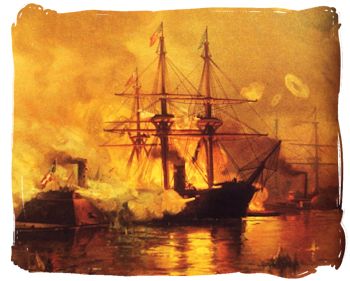
May 9th. Arrived at Baton Rouge in the afternoon, where we found the Brooklyn and Iroquois. This city is the capital of Louisiana, and a very pleasant place, with some four or five thousand inhabitants. The capitol is a beautiful building; also an asylum for the insane. There are also here the state prison and U. S. Arsenal. The city is elevated some twenty feet above the river, and the buildings roofed with slate.


