Following the American Civil War Sesquicentennial with day by day writings of the time, currently 1863.

May 2012

Parisburg [Pearisburg], Virginia, May 8, 1862. Thursday.— A perfectly splendid day. No attack or approach last night. Passed out at daylight a mile and a half in direction of enemy. Selected my ground in case of an approach of the enemy. Talked with Mr. Pendleton [and] Colonel English. Find more intelligence and culture here than anywhere else in Virginia. Today Sergeant Abbott found a Rebel picket or scouting party on the mountain overlooking the village, peering into us with a fine glass. A reconnaissance today discovered three regiments in line marching coolly and well to the front as our men crossed Walker’s Creek, ten or twelve miles from here. They are said to have three pieces of artillery and some cavalry.

We get no reinforcements today and hear of none on the way. I have asked for artillery two or three times and get none. No message even today. It is a great outrage that we are not reinforced. We are losing stores all the time which the enemy slips away,— not [to] speak of the possibility of an attack by an overwhelming force. Shameful! Who is to blame? I think we shall not be attacked, but I shall have an anxious night.

London, May 8, 1862

One always begins to doubt at the wrong time and to hesitate when one should strike hardest. Knowing this my infirmity, I have made it my habit here abroad to frown it down with energy and to persuade myself, when seeing most cause for anxiety, that the moment of suspense was nearest to its end. It needs to be here, among a people who read everything backwards that regards us, and surround us with a chaos of croaking worse than their own rookeries, to understand how hard it is always to retain one’s confidence and faith. The late indecisive military events in America are looked upon here as the sign of ultimate Southern success. I preach a very different doctrine and firmly believe that the war in its old phase is near its end. I do not see how anything but great awkwardness on our part can prevent the main southern army from being dispersed or captured in Virginia. But there is no doubt that the idea here is as strong as ever that we must ultimately fail, and unless a very few weeks show some great military result, we shall have our hands full again in this quarter. There is no fear of armed intervention, or even, I think, of immediate recognition; but a moral intervention is not impossible, or rather, it is inevitable without our triumph before July. By moral intervention I mean some combined representation on the part of the European powers, in friendly language, urging our two parties to come to an understanding. If this catches us still in Virginia, it will play mischief. The worst of it is that the Governments here are forced to it. The suffering among the people in Lancashire and in France is already very great and is increasing enormously every day without any prospect of relief for months to come. This drives them into action, and has at least the one good side that if we do gain decisive advantages so as to make the Southern chances indefinitely small, we shall have Europe at our control and can dictate terms.

On the other hand, if it is right to suppose that we shall soon end the war, I am afraid we have got to face a political struggle that will be the very deuce and all. The emancipation question has got to be settled somehow, and our accounts say that at Washington the contest is getting very bitter. The men who lead the extreme Abolitionists are a rancorous set. They have done their worst this winter to over-ride the Administration rough-shod, and it has needed all Seward’s skill to head them off. If we are completely victorious in the field, we shall see the slave-question come up again worse than ever, and Sumner and Chandler and Trumbull and the rest are just the men to force a new explosion. Gradual measures don’t suit them, and yet without their support it will be hard to carry gradual measures. I have immense confidence in Seward however, and there is said to be the most perfect confidence between him and the President, so that we shall go into the struggle with a good chance of carrying it through.

As for this country, the simple fact is that it is unanimously against us and becomes more firmly set every day. From hesitation and neutrality, people here are now fairly decided. It is acknowledged that our army is magnificent and that we have been successful and may be still more so, but the feeling is universal against us. If we succeed, it will still be the same. It is a sort of dogged, English prejudice, and there is no dealing with it.

Socially, however, we do not feel it to any unpleasant degree. People are very polite, and we seem to be in a good set and likely to get on well. The season has begun and we have engagements in plenty. I hope, with time, to get well into society, though just now I am hovering on the outskirts of it. My greatest achievement in this career came off the other night when we were invited to the old Dowager Duchess of Somerset’s, who is decidedly original, and to my unutterable horror, I found myself performing for the first time in my life, a double-shuffle in the shape of a Scotch reel, with the daughter of an unbelieving Turk for a partner. For twenty minutes I improvised a dance that would have done honor to Taglioni. When I got through, in a state of helpless exhaustion and agony of mind, I was complimented by the company on my success.

Last night who should I meet at a little reception, but our friend Russell, the Special Correspondent of the London Times. Some one offered to introduce me to him and I consented with pleasure. He was a little embarrassed, I thought, but very good natured. I said I was sorry he had returned, whereat he laughed and remarked that personally he was glad, but he regretted having lost the chance of showing his goodwill to us by describing our successes. I only was with him a moment, and he closed the conversation by saying that if I thought it would be agreeable to my father, he would like to call upon him. I assented to this the more willingly because I am told that Russell declares on all sides that he is wholly a Northerner and always has been, and that between his private opinions and his opinions as suited to the doctrines of the Times, there is a decided difference.

I think it is about time for us now to begin to expect another breeze here in London and the usual panic and expectation of departure. If you were at home I should write particulars, but as I’ve never yet had one of my letters to you acknowledged or answered since you ‘ve been at Port Royal, and as I ‘ve written pretty regularly every fortnight, there’s no great encouragement to trust secrets to paper. So much, however, is pretty well known. Since we made our great step from Kentucky into Alabama, our Government has been pressing the European Governments energetically to withdraw themselves from their belligerent position. But anyone who knows English sentiment and politics now, knows that there is not the remotest chance of any such step. The sympathy of the Administration, of the Lords, of the Commons and of the people throughout the country may be dormant perhaps; I hope it is, though I believe it’s not; but beyond a doubt it is not with our Union. I have no fear that there will be any hostile acts on the part of this country, but before Parliament closes, which may be in June, you may be sure that the Ministry will do nothing that is likely to provoke attack; least of all anything so unpopular as the throwing over of the South would be. Meanwhile the contest between the two gentlemen here is getting to be flavored with as copious dashes of vinegar as you would wish to see. About once a week the wary Chieftain sharpens a stick down to a very sharp point, and then digs it into the excellent Russell’s ribs. The first two or three times the joke was borne with well-bred politeness and calm indifference; but the truth is, the stick’s becoming so sharp that now things are being thrown round with considerable energy, and our friend Russell is not in entirely a good temper. The prospect at this moment is that the breeze will soon change into settled rough weather and perhaps we shall have a regular storm. For if we conquer in Virginia, I hope and trust that Seward will give this Government the option of eating their words, or being kicked. And I don’t know whether I should derive a keener satisfaction from seeing them forced to overthrow their whole political fabric as regards the South, at our demand, or from seeing our Minister here take his leave of the country until they are able at last to bring their stomachs down to that point without further prompting….

May 8 — At midday our pickets reported that the Yankees were advancing up the pike — only cavalry, I suppose. We went in position with our guns on a hill east of the pike and south of North River. We had a first-class position, for it thoroughly commanded the ford and its approaches on the north side of the river. The Yankees did not advance any further than Harrisonburg. We remained in position till four o’clock, then returned to camp.

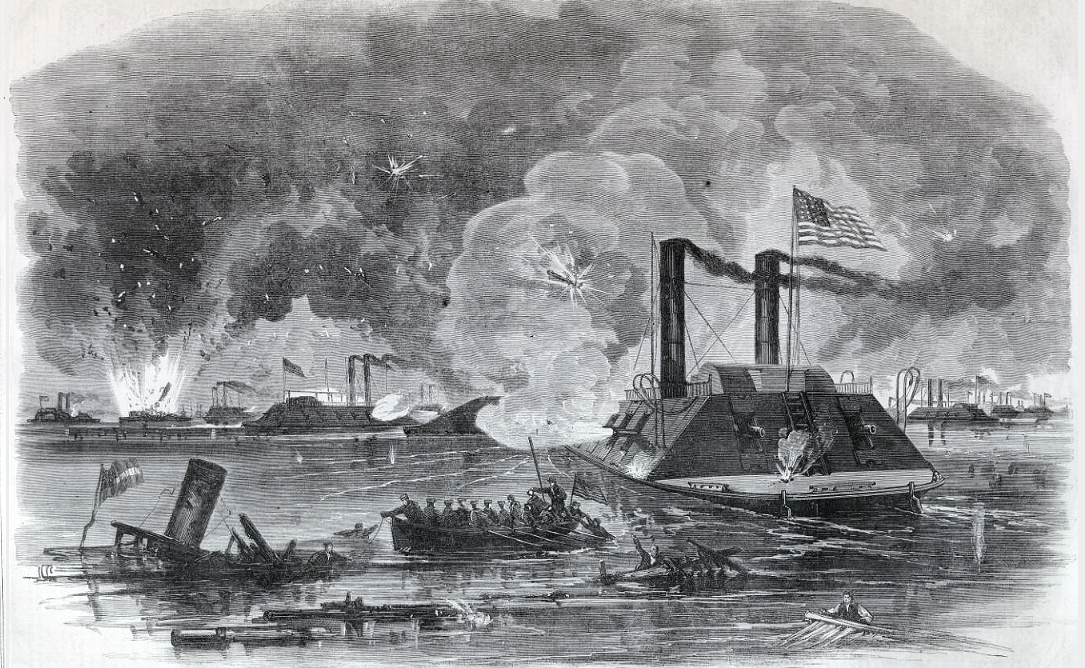
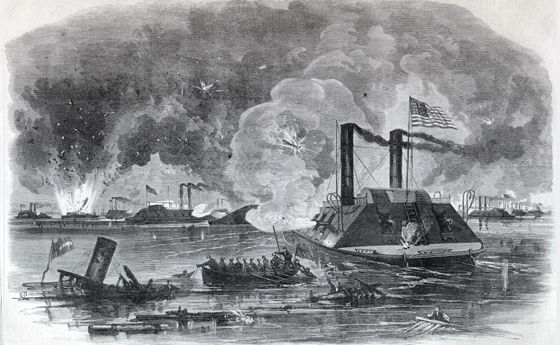
Naval Combat off Fort Wright in the Mississippi River, May 8, 1862

Naval Combat off Fort Wright in the Mississippi River, May 8, 1862, (from Harper’s Weekly, May 31, 1862.)

[update to post, 8-27-2013:  The content of this post is from the May 31, 1862 issue of Harper’s Weekly.  News articles of the day were often inaccurate and slanted in favor of “their” side of the conflict.  Please see the comment by Mark Morss after the end of this post for more info on this naval action.]

ON page 341 we illustrate the combat which took place on the Mississippi River, off Fort Wright, on 8th May. The correspondent of the Herald thus describes the scene:

The morning was one of the finest of the season, though, as is very common in this region, before sunrise a dull haze spread over the water, making it difficult to see at any great distance away. Just at daylight the mortar-boats were towed down to their positions, ready for their day’s work. This morning the gun-boat Cincinnati was sent down with them as a precautionary measure. The latter dropped anchor just abreast of the mortars, and but a short distance out in the stream. Scarcely had she swung around and become settled in her position when the look-out gave the signal, “Steamer astern!” Sure enough, by peering through the masts, a low, dark object was discovered, bearing a strong resemblance to a steam craft of some kind. It was subsequently ascertained to be the rebel ram Louisiana. All hands were beat to quarters, and the gun-boat was cleared for action immediately. The promptness of the response of the men in putting the boat in fighting shape was most remarkable. The anchor was up almost simultaneously with the issue of the order, the decks were cleared of all rubbish and every thing in the shape of obstruction, and every man was standing at his gun. By this time the rebel craft had approached near enough to be readily recognized, and just as the early sun was dispelling the haze the Cincinnati swung around and welcomed the visitor with a full broadside. As the sound of the report and its tremendous reverberations ran along the shore and reached the ears of those manning the other boats of our fleet, there was one general shout of gladness as every officer and man sprang to his feet and prepared for duty. With the report came also reinforcements to the rebel boat. Three in number, they came quickly around the point, and prepared to grapple with the spunky Yankee. The Louisiana ram carried two heavy rifled pieces, both of which, together with the guns of her consorts, were soon bearing upon the Cincinnati, and throwing in shot after shot in rapid succession. But against them all the Cincinnati boldly held her position, her sloping iron sides repelling their heaviest missiles as though they were but paper balls. This unequal contest lasted for full twenty minutes, during all of which time the rebel gun-boats were kept in check by the Cincinnati alone. The ram, however, ran up close to the Union boat, and manifested a disposition to run her down.

Just at this juncture the other iron-clad boats of our fleet came to the rescue—the Benton (flag-ship), Carondolet, Pittsburg, Cairo, and St. Louis—and relieved the Cincinnati of the necessity of giving any further immediate attention to the rebel gun-boats, thus enabling her to close in with the ram alone.

The Louisiana came along up, under full steam, until nearly upon the Cincinnati, when the latter put her head about and avoided the well-intended blow. Her crew were on deck, armed with cutlasses, boarding pikes, and carbines, fully prepared for a close hand to hand encounter. The ram, foiled in her first attempt, withdrew a short distance, and again turned upon the Union boat. This time she got her sharp bow full in upon the heavy iron sides of the Cincinnati; but her headway was not sufficient to cause any very serious damage. Before she could get away, however, Captain Stembel, commanding the Cincinnati, rushed upon the hurricane deck, and, seizing a pistol, shot the rebel pilot, killing him instantly. ‘rhe rebel crew retaliated, when a musket-ball entered the gallant Captain’s right shoulder, high up, nearly to the neck, and passed quite through. The wound was a troublesome and painful one, but not sufficiently serious to detain the Captain from his post longer than to have it dressed. In the mean time the ram had prepared for another assault, and this time evidently with the intention of boarding her antagonist. She came up under full headway, and with her steam batteries ready for immediate us. Just as she struck the Cincinnati, however, her steam apparatus collapsed, scalding a large number of her crew. Captain Stembel was also prepared with his steam battery to add to their discomfiture, and almost simultaneously with the explosion a dense volume of scalding water and steam came pouring upon the rebel crew front the deck of the gun-boat. This was too much for them to withstand, and those who were left uninjured and alive managed to get their craft away beyond the reach of further injury.

The casualties on the Cincinnati were very slight. Her gallant commander was wounded, as mentioned above. Her first master received a flesh wound in his thigh, and two seamen were slightly wounded.

As the ram drew away the iron-clad gun-boat Mallory appeared as a new antagonist. This is one of the new boats of which so much boast has been made by the rebels. She had just been completed at Memphis, and on this occasion made her first public appearance. She was a powerful craft carrying ten or twelve guns, and sheathed with heavy boiler iron over heavy timber bulkheads stuffed with cotton.

Her first manoeuvre was an attempt to run the Cincinnati down by butting against her. This was baffled by the dextrous handling of the latter boat, though several times attempted. Then she hauled alongside and opened a close fire, but received rather more than she gave. The heavy Dahlgrens of the Union craft were too much for her, and again she resorted to the battering process. Just as she was preparing to strike, with all the power of momentum acquired by a quarter of a mile’s running, the St. Louis—Union iron-clad boat—bore down upon her, and, striking her fairly amidships, nearly cut her in two. She sank almost immediately, and within two hundred feet of the vessel she was attempting herself to run down. The most of her crew must have perished, though a number were picked up by our boats. She is a total loss, having sunk in deep water.

Comparatively few of our shots were wasted. They were all admirably directed and did wonderful execution, as the condition of the rebel boats fully shows. But their execution was better apparent in the explosion and total destruction of two of the most powerful of the rebel gun-boats. The names of these I have not yet been able to ascertain.

Their destruction occurred nearly at the same time and when the engagement was at its height. Above the loud din of the cannon could occasionally be heard the shouts and cheers of the loyal crews as they discerned one and another evidence of their sure approaching final triumph. The whole scene was shut out from view by the dense volumes of smoke that settled over the fleet, the result of the heavy firing. There was something grand and inspiring in all this, even to one outside, who could only hear the din and see the smoke. But suddenly there came a report louder than, and distinguishable above, all the others; and accompanying it could be seen a volume of white smoke rolling and surging above the other smoke, and bearing on its rolling waves black masses and fragments, which again quickly disappeared. What was it? The smoke lifted and revealed the cause. A well-directed shell had struck in the magazine of a rebel boat, causing an instantaneous explosion of the shell, magazine, and boilers. The boat was blown to atoms, and her crew perished with her. It was a fearful casualty, and one that is well calculated to awaken the deepest sympathy and pity for the poor unfortunates thus suddenly sent into eternity; but “it is the fortune of war,” and the din goes on, and more destruction is attempted.

During the heat of the engagement one of the rebel rams—supposed to be the Manassas—singled out the Benton as its prey. The latter at first scarcely deigned to notice so insignificant an adversary, but continued to devote her time to the heavier gun-boats. Her powerful guns were all at work. She was kept in constant motion, first discharging her four bow guns, then hauling about and letting go her broadside of five pieces, and again bringing her stern pieces in range, and so on until the round was completed. All this time the ram danced about, endeavoring to get a chance to give her is good butt. At last the opportunity arrived, and with a powerful head of steam on the ram flew to her work. She struck the flag-ship fairly, right amidships, but was doubtless much amazed, on withdrawing, to find that she had suffered more damage herself than she had inflicted. Her nose was badly jammed, while the solid iron sides of the Benton showed no signs whatever of the assault. It was a signal discomfiture, rendered doubly annoying by the reception of a round of grape-shot from her antagonist that compelled her to get out of the way with the least possible delay.

By this time it was apparent that the enemy must withdraw quickly or be wholly destroyed. They had entered the contest with five gun-boats and three rams—eight in all. Three of their gun-boats were totally destroyed. The remaining two, as also the rams, were riddled through and through, and all appeared to be leaking badly. On the contrary, our boats, excepting the Cincinnati, appeared wholly uninjured, and were in condition to continue the action all day if necessary. Under these circumstances the rebels had no alternative, and at twenty minutes past seven—just one hour and twenty minutes after the commencement of the battle—the last of them disappeared around Craighead Point, the heavy cannonading ceased, the smoke cleared away, our boats returned to their moorings, and the battle was ended.

MAY 8TH.—Norfolk and Portsmouth are evacuated! Our army falling back! The Merrimac is to be, or has been, blown up!

Thursday, 8th—It is very warm today. Our major drilled us—the regiment—in the manual of arms. Company E went out in the evening to reinforce the pickets.

May 8th. Weighed anchor early and proceeded up the river. The same succession of beauties met the eye at every turn. In the afternoon met a gunboat from Vicksburg with news from our vessels at that place.

8th. Thursday. Marched on towards Cowskin Prairie. A little skirmish on the road. Our course lay mostly among the Ozark Hills. A rich country and beautiful scenery. Reminded me of Vermont scenes. Enjoyed the ride much. As we struck Cowskin Prairie, a little beyond Elk Mill, we saw a band of thirty armed and mounted men. When we learned they were rebels, we followed, Co. “G” pursuing on their track, and Co. “A” going around a piece of timber. They had too much of a start and escaped. Exciting time. Scouts and spies of the enemy out in every direction. The Major said after we had rallied, that our squad, who had gone three miles farther than most of them, had been within a mile of a camp of 400 men. We were fourteen miles from Marysville where Coffee with 1,000 men was reported. We were in the Cherokee nation. Fine country. Enjoyed it well.

8th.—I spent this day chiefly with other Surgeons and Assistants in getting the wounded to the river and on transports. My former estimate of the casualties was certainly not an exaggeration, and I now think the loss to the two armies is not much short of 18,000. We hear that General Franklin had a fight with the enemy near West Point this afternoon, and was repulsed, The hope that he would intercept and destroy the army is blasted.

May 8. Our city life is about over; we have orders to break up housekeeping here tomorrow and go on a rusticating tour in the country. Among the boys all is speculation as to where we are going and what our errand is.