May 8.—Nine Union regiments, under Generals Milroy and Schenck, fought fourteen thousand rebels, under General Jackson, at McDowell, in Virginia, from six till nine P.M., when they fell back to the town of Franklin in good order. (Doc. 10.)
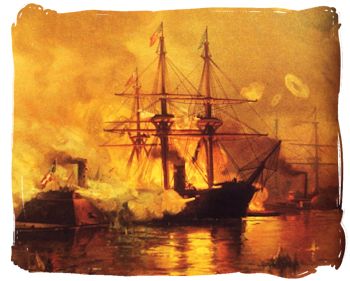
—The bombardment of the rebel batteries on Sewell’s Point and Craney Island was actively carried forward by the Monitor, the Naugatuck, and other vessels of the fleet. The Merrimac finally appeared, but as she evinced a disinclination to come out into the roadstead, and the National vessels were equally disinclined to go up to her, the combat ceased. The scene was an exciting one for some time, and was witnessed by President Lincoln and Secretary Stanton.— (Doc. 26.)
—Messrs. Richardson, Knapp, and Robinson, of Illinois; Law and Voorhees, of Indiana; Allen, White, Noble, Pendleton, Morris, and Vallandigham, of Ohio; Johnson and Ancona, of Pennsylvania, and Shields of Oregon, issued an address to the Democracy of the United States, setting forth party organization as a positive good and essential to the preservation of public liberty. —Cincinnati Gazette, May 9.
—Four companies of the Seventh Illinois cavalry, under command of Major Aplington, when reconnoitring within a mile and a half of Corinth, Miss., discovered two rebel regiments of infantry in position on both sides of the road. Major Aplington gallantly charged upon them, but fell pierced by a ball through the brain. Four of the Union troops were slightly wounded; the rebels suffered the loss of thirty killed and wounded, and four prisoners.
—The United States Senate passed a bill establishing Beaufort, S. C, as a port of entry.
—The iron-clad gunboats Galena, Aroostook, and Port Royal left Fortress Monroe and started up James River, at six o’clock this morning. Immediately after their departure, the rebel tug, F. B. White, came out from Craney Island, having left Norfolk this morning with a crew and two citizens on board, on a mission to Tannery Point, but they run over to Newport News, and surrendered to General Mansfield!—Baltimore American, May 9.
—Three brigades of General Buell’s army seized the portion of the Memphis and Charleston Railroad between Corinth and the Grand Junction, and thus cut the communication between those points.—Chicago Times, May 9.
—Governor Clark, of North-Carolina, in response to a demand of the confederate government for more troops and transportation, informed that government that it “had received all the aid from North-Carolina that it could expect, and that no more troops would be permitted to leave the State.” —N.Y. Herald, May 19.
 Georgeanna’s journal.


 7th.—Our “peaceful” Sabbath here was one of fearful strife at Williamsburg. We met and whipped the enemy Oh, that we could drive them from our land forever! Much blood spilt on both sides; our dear W. B. N. is reported “missing”—oh, that heart-sinking word! How short a time since that blessed glimpse of his bright face, as he passed through town, and now he is on his weary way to some Northern prison; at least we hope so. His poor wife and mother! Our young friend G. W. was killed! How many bright hopes were crushed in one instant by the fall of that boy! I thank God that he had no mother. General Johnston still falls back, leaving the revered Alma Mater of our fathers to be desecrated, perhaps burned. A party of Yankees landed on Sunday at the White House. That Pamunky country, so fertile, now teeming with grain almost ready for the sickle, is at their mercy; we can only hope that they have no object in destroying it, and that they will not do it wantonly. W. and S. H. and their dear inmates are painfully near them. Richmond, or the croakers of Richmond, have been in a panic for two days, because of the appearance of gun-boats on James River. I believe they will not get nearer than they are now. I sat up last night at the hospital with D. L., who is desperately ill—his mother in the Federal lines. My companion during the night was Colonel M., of Maryland. While listening to the ravings of delirium, two gentlemen came in, announcing heavy firing on the river. We had been painfully conscious of the firing before, but remembering that Drury’s Bluff was considered impregnable, I felt much more anxious about the patient than about the enemy. The gentlemen, however, were panic-stricken, and one of them seemed to think that “sunrise would find gun-boats at Rocketts.” Not believing it possible, I felt no alarm, but the apprehensions of others made me nervous and unhappy. At daybreak I saw loads of furniture passing by, showing that people were taking off their valuables.