7th. Wednesday. At 2 A. M. prepared for another day’s march. At 3 were on the way. Reached Sparlan’s, a noted secesh, at nine A. M. Fed and ate breakfast. Jayhawked his store. They said the boys destroyed a great deal of property ruthlessly. Continued the march. During the day Orff and Purington had a fuss. Orff took his men and our wagons and turned east to Neosho. After going a few miles we got trace of a band of jayhawkers. Charged after three on horses. Quite a spirited time we had, but the men had a long start, getting on a high hill and in the woods. Scoured the woods, finding some suspicious characters but without arms. Kept eight prisoners. Encamped near by in the valley. They stole a horse during the night.
May 2012
Headquarters 2d Brigade.
My dear Mother:
The “Atlantic” has just arrived bringing me two letters from which I judge all is going on well at home. I had heard from Mr. Johnson that Lilly would soon be married, but I did not give the matter much thought, willing to wait until I should hear the story from the best of all sources of information — herself. I must say I cordially approve of the measure. Prudence is without doubt most commendable, and Mr. Matthus is certainly theoretically right, still, luckily for the happiness of young couples, I believe that it is generally conceded that it is in the shop of Care and Responsibility that the best kind of prudence gets fabricated. I go in for the wedding at any rate. Shall make myself merry on the occasion if allowed to attend, and have some romantic notions that trouble is not so hard to bear when there are two to share the burden. Anyway let Lilly write me, and give me her mature reflections on the subject.
I was very much gratified to think you took the little parcel of money I sent home last. It makes me feel quite proud to think I could be of any help in such a way. I do hope Dr. Grant will get sent to Congress. He would be such an honor to my native State, and would know how to keep his political garments clean, even in a cesspool such as our National Capitol.
Of course we are all hurrahing for the evacuation of Yorktown. It so happens that the rebels have no place its equal in strength in the whole confederacy. Yet that wretched puling sheet, the _______, while professing pleasure, is covertly pursuing McClellan as usual, declaring that the work had been greatly exaggerated, and that we might have had Yorktown a month ago. My dear Mother, I have had the pleasure of seeing and knowing the pack of vagabonds that follow our armies in the employ of newspapers for the purpose of criticising our movements, and I know that truth, fairness and principle in description go only so far as the politics of their respective sheets allow. It would make you indignant could you see the characters who take upon themselves the censorship of our military movement. Such a thing as any reasonable acquaintance with what they prate about, is unnecessary and probably would interfere too much with the style of their criticism.
You may see Wm. Ely, who is now North. He is one of our Conn. boys who does his state great credit.
We had a concert here a few evenings ago, so I will enclose the programme.
Good-bye. Much love to all.
Your affec. Son,
Will.
7th.—Magruder has not surrendered. This day has been spent by the Surgeons in care of the wounded, and by the troops in rest and rejoicing, at the favorable result of the battle of the 5th, which for a good part of the day threatened us with disaster. The enemy has evacuated Williamsburg, and we are in possession. Gen. Franklin, with his corps d’armee, yesterday left Yorktown on transports, for West Point, to get in advance of the enemy and cut off his retreat to Richmond. If he will be prompt, and accomplish this, it will end the war by mid-summer. We are now receiving Gen. McClellan’s telegraphic reports of the late battle. He exaggerates. Amongst other things he says that “Hancock’s success was gained with a loss of less than twenty in killed and wounded!” Why will Gen. McClellan undertake thus to deceive the country? Is it to elevate some favorite General? Hie cannot do that without, by comparison, depreciating others. Gen. Hancock had eight regiments under his command on that day. In one of those regiments alone I counted seventy-nine killed and wounded. True, the whole eight regiments were not actively engaged in the fight. True, too, that the regiment referred to suffered more than all the rest, but there were others killed and wounded; and even if there were not, the loss to this regiment alone quadruples the number reported by Gen. McClellan. I wish he would not so.

May 7.
I Received a telegram from Mrs. Griffin today, telling me that the “Daniel Webster” steamship had arrived at New York with the first load of sick and wounded, and that if I wish to join the Hospital Transport Service, I must be in New York to-morrow morning. So I leave to-night. Have telegraphed you to that effect.

Fort Barnard, Va., May 7, 1862.
Dear Friends:
You will see we are still here and are likely to be till the end of the war.
You have got as much news as we have, probably, viz., Evacuation of Yorktown by the rebels and the taking of it by our forces. We had a large 10 in. Mortar brought here last night to practice with. We are going to fire saturday. We have also one 30 lbs. rifled parrott gun which pointed at the enemy on Munson Hill last year, but never had a chance to pop at them. By the retreating of the rebels from Yorktown it has left us entirely out of danger; they were before some 75 miles away, but now 125 miles, so you see we were perfectly safe. Do not worry, because I do not think they will trouble us at present. The cars are passing now towards Leesburg from Alexandria; they have not run much lately.
Well, about this leaving home business. If you want to go, start, and we will follow (California or Mexico). We have got plenty of dogs and I am going to hunt for a living. Am going to get a horse, rifle and gun, pack up dogs and start, and I “reckon” you had better all do the same.
There is one lady in our camp, Capt. Shatswell’s wife; she has been out since last winter—plucky. Also a negro woman who comes with milk every morning. Good-looking, but too dark complected to get too near to.
Yours,
L. B.
 Eliza Woolsey Howland to Joe Howland.
May 7th, ‘62.
My dear Joe: Down in the depths of the Ocean Queen, with a pail of freshly-made milk punch alongside of me, a jug of brandy at my feet, beef tea on the right flank, and untold stores of other things scattered about, I write a hurried note on my lap, just to tell you that we keep well, but have been so busy the past 48 hours that I have lost all track of time. You had scarcely left us the other day when our first installment of sick came aboard—150 men—before anything whatever was ready for them. We had only just taken possession of the ship, as you saw, and not an article had been unpacked or a bed made. With two spoons, and ten pounds of Indian meal (the only food on board) made into gruel, G. and I managed, however, to feed them all and got them to bed. They have come in the same way ever since, crowded upon us unprepared, and with so few to do for them; and we have now nearly 600, and more coming to-night. . . . Until to-day we have had only our small force who were detached from the Webster, and I may say without vanity that G. and I, and the two young doctors, Wheelock and Haight, have done everything. We women have attended to the feeding of the 400 or 500, and those two young fellows have had the responsibility of their medical care! Last night, however, a large party of surgeons, dressers and nurses arrived from New York, and though to-day things have been frightfully chaotic, they will settle down soon and each one will have his own work to do. . . . G. and I look after the special diet and the ordering of all the food. Beef tea is made by the ten gallons and punch by the pail. I was so busy yesterday morning that I didn’t know when you left, and only saw the last of the fleet far up York river.
 Abby Howland Woolsey to Georgy and Eliza.
New York, May 7th, 1862.
My dear Girls: I hadn’t time to write a long letter, but must send off a note to say that the Daniel Webster came to the dock at dusk yesterday. Charley went down at once, thinking there was a possible chance of your being on board, or at all events, some of the 16th sick. Mrs. Griffin, who came up to care for the men, had gone, and several of the officers had landed, but the men were to remain till morning. . . . I am thankful you were not on board, for your own sakes. Five men died and more are dying today, and will die in the act of being landed. . . . McClellan’s despatches to-day are not very hopeful. “He will do the best he can—“the “rebels out-number him greatly,” “are fighting fiercely; will contest every inch of the way; strongly intrenched,” etc., etc. Yesterday he called it a “ brilliant success.” . . . Your letter, Georgy, to Charley, of Saturday and Sunday, is received this morning. It furnishes us the missing links in the story, and will instruct Charley whom to apply to about his duties and his passage, etc. We felt that your telegram, with merely your signature, did not authorize him to go aboard and assume duty. . . . Mrs. Griffin sent us your penciled note as soon as she landed, with one from herself, saying she had left you well—“lovely and active,” I think were her expressions. She asked if I knew anything about Mrs. Trotter’s decision as to going to the front. The latter was here yesterday. She said she should love dearly to go, but she believed she couldn’t, her mother couldn’t spare her just now.
Later. . . . Charley went down yesterday and saw Mr. Strong, and was inducted as Purser of the ship Daniel Webster. Mr. Strong gave him a sum of money, and he has been on board to-day paying the medical cadets and the contrabands. Came home just now for a lunch and has gone down again to finish. He thinks he may have to sleep on board. The vessel is not cleaned up or ready yet. . . . They may get off to-morrow afternoon. Mrs. Trotter is to send up to-night to see what we have heard. She is going to join the Daniel Webster on its return trip.
 Georgeanna’s Journal.
Wilson Small.
The Merrimac is out; and the Monitor and Naugatuck are fighting her. The Galena has run up the James towards Richmond. We are lying along the dock at Yorktown quietly, where four days ago the rebels were ducking themselves in the water.
Franklin’s division has moved up to West Point with large reinforcements, and has been fighting at the point of the bayonet. Captain Hopkins steamed alongside this morning and called out the news, just down from West Point, on business, in the Mystic, Two of the 16th are killed, and Captain Curtis wounded in the chest. . . . We took on board the Small 20 to 30 from this fight. Had beds made on the cabin floor, and each man carefully put into a clean one as his stretcher came aboard, Captain Curtis among them. Several were amputations, and two died on the boat. Everything was done for them; beef tea and brandy given, and a capital surgical nurse was in charge. It was pleasant to see Mr. Olmsted come quietly into the cabin now and then. I would look round and he would be there sitting on the floor by a dying German, with his arm round his pillow—as nearly round his neck as possible—talking tenderly to him, and slipping away again quietly. He only came when the ward was quiet, and no one round to look at him.
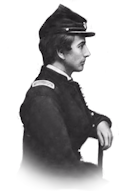
Taking our ease in Yorktown, awaiting the quartermaster’s pleasure.–Diary of Josiah Marshall Favill.
May 7th. There being no transportation for our command at present, we are quietly taking our ease, awaiting the quartermaster’s pleasure. Captains McKay and Curtiss, Doctor Dean and I rode out this morning to take a look at Yorktown and its fortifications. We found the town full of officers and soldiers, and wretchedly filthy. The works are well built and armed. We counted a lot of the cannon left behind by the rebels, amounting to about fifty; amongst them were a lot of old pieces, 32 and 42-inch ship carronades, dating back about one hundred years, but there were several modern eight-inch Columbiads, and four nine-inch Dahlgrens, which were too heavy, I suppose, to carry away. On the glacis our troops found a lot of loaded shells buried in the ground, with percussion fuses so arranged that a man stepping on one of them caused it to explode. These villainous contrivances were thickly planted all over the glacis, quite out of sight, and would have caused great loss and confusion if we had ever charged over them. The shells are mostly eight-inch ones and were expected to have done a lot of damage. We congratulated ourselves on the good taste the enemy showed in surrendering without a fight; artillery men were at work digging them up while we were looking on. In the streets were any quantity of pigs, narrow-visaged, black, vicious looking fellows, browsing about the gutters, and a few ugly, dirty, common women, who lived in shanties forming the dirty, straggling streets. It is, and must always have been, a poor spot, and yet beautifully situated with every facility for a large commerce. It is now to be transformed into a military depot and has already daily steam communication with Fortress Monroe. The wide river is full of vessels and gunboats, and thousands of men are at work building docks. Every hour in the day troops are embarking and being forwarded to West Point, which makes the docks a lively place. We were told to-day that the enemy’s rear guard evacuated Yorktown at 2:30 A. M. on the fourth, the bulk of their army having been withdrawn during the night of the third. Thus the rebels had made up their minds long before to evacuate the town when things became serious, and had been for over two weeks busily engaged sending away everything of value.
Franklin’s division sailed from here only yesterday, so the chance of its cutting off Magruder’s retreat to Richmond is rather slim.

May 7.—A beautiful day. The troops are marching in the direction of Rienzi; it is supposed that the enemy are trying to flank our army, but I do not fear while we have such vigilant generals as Beauregard and Bragg to watch them.
I had a slight quarrel with our ward-master. One of the men, lately wounded, was in a room where were some who had occupied it since the battle of Shiloh. One of them—a mere boy—was wasted to a skeleton; his back was covered with bed-sores. Poor child! he was very fretful. I observed that it annoyed the new patient, and requested Dr. Allen, who is very kind to the soldiers, to allow me to have him removed to a room by himself. He kindly gave his consent. While doing it, the ward-master objected; but as I had obtained leave, I had him removed, and he commenced to improve immediately.
I have been through the ward to see if the men are in want of any thing; but all are sound asleep under the influence of morphine. Much of that is administered; more than for their good, and must injure them. I expressed this opinion to one of the doctors; he smiled, and said it was not as bad as to let them suffer.
The moon is shining brightly; the view from my window is really beautiful. A band of music is playing in the distance, which carries my mind back to more peaceful days, and I fervently send up a prayer to Him who sitteth in the heavens, to turn the hearts of our enemies, so they may let us go in peace. I think how many of our brave men, who are now quietly resting, by to-morrow’s setting sun may be sleeping their last sleep; and I think of the lonely sentinel, walking his weary rounds, his thoughts on his home and loved ones, and pray that God may lift his thoughts from this weary world, to that paradise on high, where I trust some day will be his home. O, God, be with them all, so that, whether living or dying, they may be thine!


