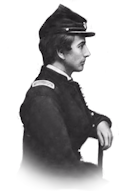
 May 4th, Sunday morning. I was just about taking my bath when an aide rode up and ordered us to fall in immediately in full marching order, tents and all, as Yorktown had been evacuated. I ran out, ordered the regiment to fall in, and announced the welcome news. The enemy evacuated the town last night, under cover of the heavy cannonading which kept us awake. They had no doubt learned that our batteries were about to open the bombardment and concluded to take time by the forelock and clear out. By nine o’clock we were in motion, marching over our works and up to the glacis in front of Yorktown. Here we stacked arms and awaited orders, close to the deep ditch of a great work. From this position we could see the country for miles and got a good idea of the place. It is naturally a strong position, and if it could not be turned, which I think rather an easy matter, would be very difficult to take. While we were waiting it began to rain again, and in almost no time the roads, fields, and slopes were knee deep in mud. Towards noon, we heard the distant firing of musketry between Stoneman’s advance and the rebel rear guard. Smith’s division of infantry is with Stoneman, in close pursuit, and it is hoped may capture some of the retreating force. About one o’clock we were ordered to fall in, and advance as rapidly as possible to the support of Smith and Stoneman. Our brigade stepped out in splendid style, notwithstanding the wretched weather and slippery roads. We passed through the town, out on the Williamsburg road, marching without interruption till long after dark, losing many of our men by the wayside. The colonel rode in front and I in rear, to keep the regiment closed up, but when it became dark it was impossible to see anything. Still we plodded along by this time up to our knees in mud. About midnight every man had disappeared around me, and to my surprise there was no longer a regiment in front. Much astonished I rode ahead, thinking I had fallen behind, and presently came up with Captain Gott and about twenty-five men, halted by the road side. He reported the regiment lost, but knowing I was in the rear, had concluded to wait until I came along. Telling him to follow, I rode ahead, and soon fell in with another party, which proved to be the colonel and a few men of the leading companies, waiting for the rest of the regiment to come up. The colonel was greatly astonished when he found the men had disappeared and concluded to turn into the field to the right and bivouac for the night, posting a guard to collect the stragglers as they came along. It is impossible to give an idea of the terrible state of the roads. Smith’s wagons were passing over it, many of which were broken down or stuck fast in holes, blocking the way, and causing infinite trouble. The roads being clay, were so sticky that a man could hardly draw his feet out when once they were in. The result was complete exhaustion, causing the men to drop out one by one along the roadside, utterly disheartened, and so we lost the greater part of our men. Those of the regiment who were with us, and those who subsequently came up, struggled manfully to get up their shelter tents, which was no easy matter. Several succeeded, however, as they always do, and before long had crawled in and were soon asleep. I sat on my horse a long time watching the men at work, wondering what I had better do. The headquarters baggage was not up, and consequently we had no shelter of any kind. The ground was knee deep in mud, and I hesitated to dismount, although so sleepy I could hardly keep awake. To add to the difficulty, Seth was lost, and there was no one to take my horse or make a shelter. I finally concluded to dismount anyway and hitched my horse to a tree, along the roadside; while I was making him fast Seth came up, and to my great delight took charge. In the meantime I stood in the mud, not knowing what to do when McKay called out “There’s the adjutant stuck in the mud.” He called me to him and pointing out his little shelter tent, invited me to share it with him. He had made a comfortable bed of rails under which the water ran away, and we were both as snug and secure from the rain as though we had been in a regular tent; what a godsend it was, and how grateful I felt to the captain. After a heavy nightcap from my canteen, we were soon asleep.
May 2012
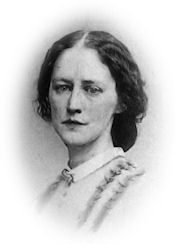 Jane Stuart Woolsey to Joe Howland.
8 Brevoort Place, 4 May
(letter continued from previous day).
Sunday.—A day of great events. At 1 P. M., Cousin William came in to tell us he had seen a man who had seen a man (literal) who had read McClellan’s telegram to his wife, announcing the evacuation of Yorktown. The man, once removed, was Barlow, and Mr. A. considered it perfectly reliable. At two the extras were out in a swarm, and Colonel Betts and one or two others came in most kindly, bringing papers and congratulations. It is a blessed respite in our anxiety about you, for we were afraid of a severe battle if there had been any battle at all. It is good news for all who have friends in the army. . . . It becomes us at any rate now to thank God and take courage and draw a much longer breath than we’ve drawn for a month.
 Mother to Georgy and Eliza.
New York, Sunday P. M.
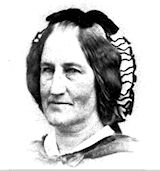
My Dear Girls: I have an unexpected opportunity of writing, or rather of getting my letter to you. Dr. Gurden Buck was telegraphed this morning, through the Sanitary Commission, to leave for Yorktown on board the “Ocean Queen,” and he is off for Baltimore at 5 o’clock this P. M., to take ship there. In the meantime just as we came in from church, a telegram arrived from you, dear E., to Charley, asking if he would like the “Clerkship” of the “Daniel Webster,” and if so to come on. . . . Charley accepts the clerkship, and will be ready when the “Daniel Webster” comes here. Right upon the top of this excitement of a telegram from Yorktown to us! comes another to Mrs. McClellan at the 5th Avenue Hotel, telling her that Yorktown has been evacuated by the rebels, leaving all their large guns, and much else besides! The newsboys are out already with their extras, and the Aspinwalls are at the door wishing to know why we don’t unfurl our flag! which is all rolled up round the stick. Cousin William has been in to tell us of the news direct from Mrs. McClellan, and the whole city is at once commencing its rejoicings. How eagerly we shall look for your account, and how anxious to know what your movements will be. Why are they telegraphing for so many surgeons from here, and Philadelphia, and other towns, when there has been no battle, as we understand? I suppose the army is to push on after the retreating rebels. . . . I wish I were down there with you, and have a great mind to offer my services to Dr. Buck as head nurse or matron of the “Daniel Webster.” . . . Jane has gone off with her Sunday treat to the hospital, of jelly and oranges; Abby and Carry have gone to church again, and Charley is out making enquiry about the boats and trying to find out whether the “Daniel Webster” is expected here, and when.
Your things are all ready to go by him, and we have offered Dr. Buck any stores he may wish. We have piles of elegantly rolled bandages which he may be glad to have.
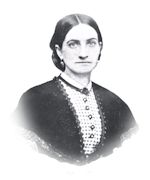
Sunday morning, May 4.—I have just seen Generals Price and Van Dorn review their troops. They were at too great a distance to distinguish the different regiments; but the sight was quite imposing, as column after column marched along, with their flags flying in the breeze. But little glitter was worn on the dress of the men; they did not need it; we all knew that they carried with them hearts that all the power of the foe could neither bend nor break, and without which all glitter and gold are mere dross. The cavalry appeared splendid; no knights of olden time rode their horses with loftier mien than did these warriors. I enjoyed the scene until the ambulances passed in review, with their white flags, denoting their use. This cast a blight over the whole.
Evening.—Our troops are returning. They offered battle to the foe, but, as usual, it was not accepted. They never will fight when there is any thing like an equal force to oppose them.
It has turned cold and rainy. We have just been looking at some of our troops, who are camping on a hill within sight of the hospital. They have no tents or shelter of any kind, and look very deplorable. It makes us miserable to look at them; but we can not aid them in any way.
I have spent the day talking and reading to the men; they like to hear us read to them, but they do not seem to care much for reading themselves. Mr. McLean of Mobile has given me a number of copies of the Illustrated London News, with a full account of the Crimean war. I thought if any thing would interest them these would; but they look at the pictures, and throw them down as unworthy of notice. They seem to have no ambition to know any thing outside of their own country. I regret this, as we are all creatures of imitation, and if we do not know how others have suffered and fought for freedom, we will not know how to imitate them. I believe with Longfellow,
“Lives of great men all remind as
We can make our lives sublime.”
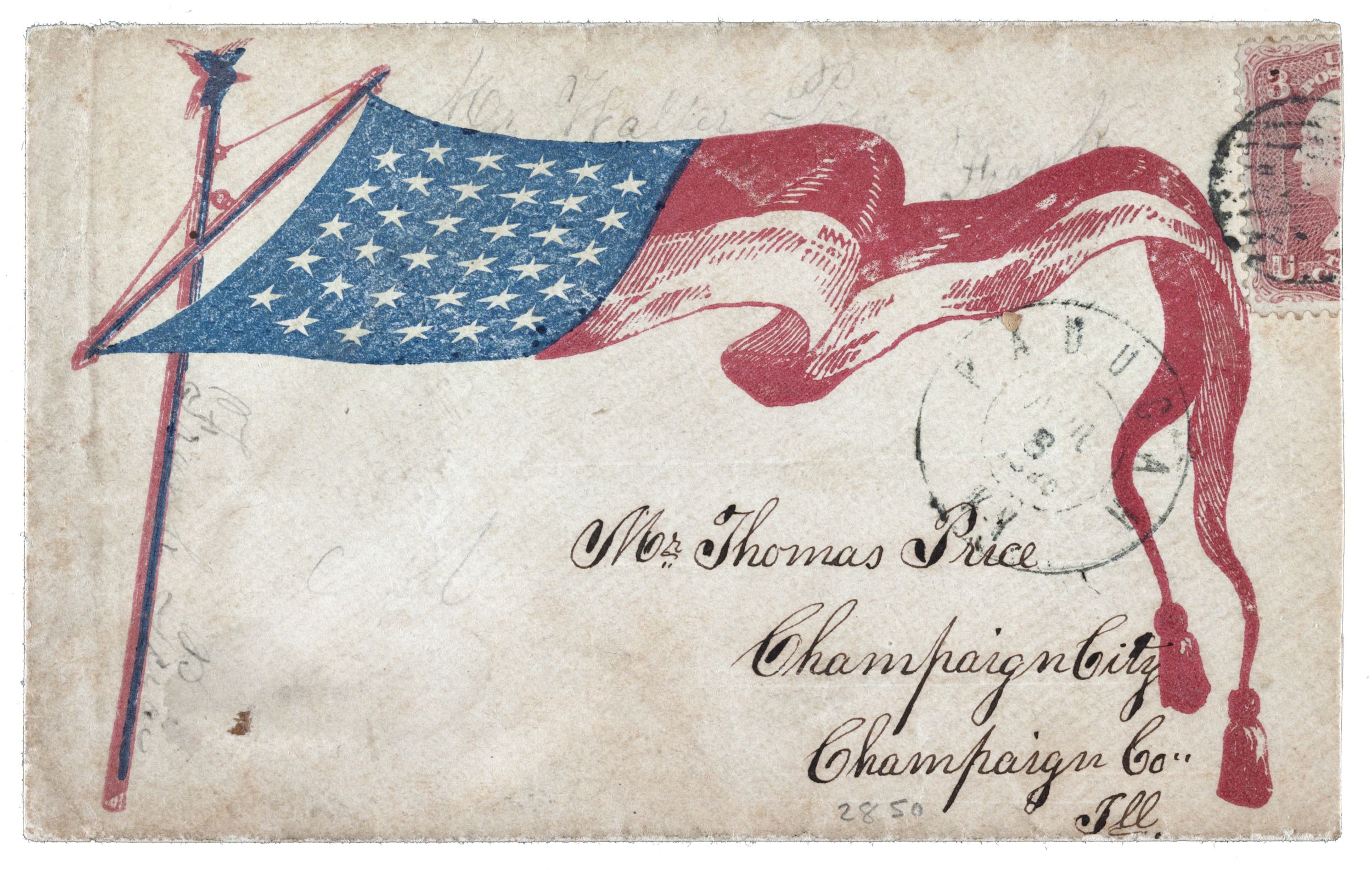
Civil War envelope showing American flag.
Addressed to Mr. Thomas Price, Champaign City, Champaign Co., Ill.; bears 3 cent stamp; postmarked Paducah, Ky.
Part of Liljenquist Family Collection of Civil War Photographs . Library of Congress Prints and Photographs Division Washington, D.C. 20540 USA
Record page for this envelope: http://www.loc.gov/pictures/item/2011648674/
May 4.—General McClellan at one o’clock this afternoon, sent the following to the War Department:
Our cavalry and horse artillery came up with the enemy’s rear-guard in their intrenchments about two miles this side of Williamsburgh. A brisk fight ensued. Just as my aid left, General Smith’s division of infantry arrived on the ground, and I presume he carried his works, though I have not yet heard.
The enemy’s rear is strong, but I have force enough up there to answer all purposes.
We have thus far seventy-one heavy guns, large amounts of tents, ammunition, etc. All along the lines their works prove to have been most formidable, and I am now fully satisfied of the correctness of the course I have pursued.
The success is brilliant, and you may rest assured its effects will be of the greatest importance. There shall be no delay in following up the enemy. The rebels have been guilty of the most murderous and barbarous conduct in placing torpedoes within the abandoned works, near Mill Springs, near the flag-staffs, magazines, telegraph-offices, in carpet-bags, barrels of flour, etc. Fortunately we have not lost many men in this manner. Some four or five have been killed and a dozen wounded. I shall make the prisoners remove them at their own peril.
—The English steamer Circassian was captured by the United States gunboat Somerset, with a cargo of munitions of war, valued at half a million dollars.—N. Y. Herald, May 23.
— Rumors of foreign intervention in American affairs still continue. The Paris correspondent of the London Daily News states that the French and English ministers at Washington have received identical instructions to attempt a moral intervention, exclusive of any idea of force. The Paris correspondent of the Independence Belge also reiterates his former statements in reference to intervention. At a meeting at Ashton under Lyne resolutions were adopted calling on the government to recognize the Confederate States. A letter from Mr. Russell to the London Times charges upon Secretary Stanton the trouble to which he was subjected; he also says that General McClellan has expressed himself strongly in reference to the Secretary’s conduct to him and to Mr. Russell also.
— A Pontoon-bridge was thrown across the Rappahannock River at Fredericksburgh, and General McDowell and staff, with an escort of cavalry, passed over by it and entered Fredericksburgh.—N. Y. Times, May 10.
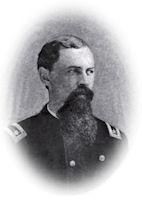
Headquarters 7th Illinois Cavalry Camp, on Hamburg and Corinth Road,
May 3, 1862.
I arrived here yesterday in safety. Stayed in Peoria the Monday night that I started, and was in Cairo at 9 p.m. Wednesday. Woke up Thursday morning on a boat at Paducah and devoted the day to admiring the Tennessee river. Stopped long enough at Fort Henry to get a good view of its well pummeled walls, and not-much-to-brag-of defences. The line of ditching without the works was the best I have ever seen, but the parapet, excepting that of the Fort proper, wasn’t to be compared to our works at Bird’s Point, which are the most inferior of ours that I have seen. The Tennessee runs through a perfect wilderness. There is not a landing on the river up to this point (Hamburg) that can begin with Copperas Creek, and indeed, although I watched closely, I did not see more than three or four points, that of themselves, showed they were boat landings, and those only by the grass being worn off the bank; and I did not see a warehouse on either bank unless, maybe, one at Savannah, where there are also, say four fine dwellings. At no other point did I see more than three houses, and very rarely, even one. Having heard so much of the richness of Middle Tennessee I cannot help talking so long of what ought to be, to it, what the Illinois river would be to us were we without railroads. I reached Hamburg yesterday afternoon (Friday) and started for my regiment, which I learned was five miles out on the Corinth way. I walked out as fast as I could, and reached there to hear that the army had moved on and were probably two miles ahead and yet going. I laid down and slept a couple of hours, borrowed a horse, and after six miles riding found them going into camp. Monstrous hilly country, this, and save a very few clearings, all heavily timbered. Pope’s army has been reinforced considerably since we arrived here. Think he has, say 30 odd thousand men. I think the ball opened just before I commenced this letter. For two days past we have had one batallion out about four miles beyond our present camp holding an important position. They have been within gunshot of the enemy all the time, but so protected that although they skirmished a good deal, but one of ours was wounded. In one little charge our boys made out they killed four and wounded a number of Rebels that they felt of. Pope’s infantry came up to-day in force and relieved them. Paine’s division was advanced and when not more than 40 yards beyond the post our cavalry held, were opened on first by musketry and immediately afterwards by artillery. There was very heavy firing for an half hour, but it has ceased since I commenced this page. Haven’t heard the result. We have orders to move forward to-morrow morning, but although we are so close to the enemy’s position, (not more than three miles) (Infantry, of course, I mean) don’t think our side will commence the attack before Monday morning, when we will see—sure—if they don’t run.
Supper.—Some of our boys have just come in with a lot of overcoats, trinkets, etc., spoils of the afternoon skirmish. They were all Illinois regiments that were engaged. A sergeant has just showed me an overcoat that he stripped off a dead secesh, who with eleven others was lying in one pile. He captured a captain who, after he had thrown down his sword, offered to give him a fist fight. The artillery firing was mostly from Rebel guns at Farmington at a regiment of our boys building a bridge. The Northern Mississippi line runs through our camp. We cannot be far from Iuka Springs, although no one that I’ve seen ever heard of the place. Report has just come that Mitchell has been driven out of Huntsville, and another that Yorktown and 45,000 prisoners are ours. Don’t believe either. Shall write you from Corinth if have luck.
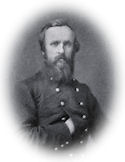
Camp 5, Princeton, May 3. Saturday. — The Forty-fifth Regiment had marched twenty miles through the rain to reach here, were very tired and straggled badly. They were regularly stampeded, panic-stricken, and routed. They report three killed in one party of stragglers. They had a cannon drawn by six horses, but our men “yelled so” and “fired so fast” that it was no place for cannon; so they wheeled it about and fled with it All queer! Company C killed eleven, Colonel Jenifer burned Rocky Gap (four houses) and continued his flight towards Wytheville. The Rebels report us two thousand cavalry and eight thousand infantry!! Got our tents today; got into a good camp overlooking the town.
Camp No. 5, Princeton, Mercer County, Virginia,
May 2, 1862.
Dearest : — I reached yesterday this town after a hard day’s march of twenty-two miles through deep, slippery mud and a heavy rain, crossing many streams which had to be waded — one, waist-deep. The men stood it bravely and good-humoredly. Today, only twelve are reported as excused from duty. Our advance company (C), Lieutenant Bottsford in command, had a severe battle. Seventy-five of them were attacked by two hundred and forty of Jenkins’ Cavalry, now Jenifer’s, with seventy-seven of Foley’s guerrillas. The battle lasted twenty minutes, when the Rebels fled, leaving their killed and wounded on the ground. One of our men was killed outright, three mortally wounded, and seventeen others more or less severely injured. The whole regiment came up in a few moments, hearing the firing. Didn’t they cheer us? As I rode up, they saluted with a “present arms.” Several were bloody with wounds as they stood in their places; one boy limped to his post who had been hit three times. As I looked at the glow of pride in their faces, my heart choked me, I could not speak, but a boy said: “All right, Colonel, we know what you mean.” The enemy’s loss was much severer than ours.
We pushed on rapidly, hearing extravagent stories of the force waiting for us at Princeton. Prisoners, apparently candid, said we would catch it there. We would have caught Lieutenant Colonel Fitzhugh and his men, if our cavalry had had experience. I don’t report to their prejudice publicly, for they are fine fellows— gentlemen, splendidly mounted and equipped. In three months they will be capital, but their caution in the face of ambuscades is entirely too great. After trying to get them ahead, I put the Twenty-third in advance and [the] cavalry in the rear, making certainly double the speed with our footmen trudging in the mud, as was made by the horsemen on their fine steeds. We caught a few and killed a few. At the houses, the wounded Rebels would be left. As we came up, the men would rush in, when the women would beg us not to kill the prisoners or the wounded. I talked with several who were badly wounded. They all seemed grateful for kind words, which I always gave them. One fine fellow, a Captain Ward, was especially grateful.
This work continued all day; I, pushing on; they, trying to keep us back. The fact being, that General Heth had sent word that he would be in Princeton by night with a force able to hold it. As we came on to a mountain a couple of miles from Princeton, we saw that the Rebels were too late. The great clouds were rolling to the sky — they were burning the town. We hurried on, saved enough for our purposes, I think, although the best buildings were gone. The women wringing their hands and crying and begging us to protect them with the fine town in flames around us, made a scene to be remembered. This was my May-day. General Heth’s forces got within four miles; he might as well have been forty [miles away]. We are in possession, and I think can hold it.
Joe and Dr. McCurdy had a busy day. They had Secesh wounded as well as our own to look after. Dr. Neal of the Second Virginia Cavalry (five companies of which are now here in my command), a friend of Joe’s, assisted them.
Saturday morning. — I intended to send this by courier this morning, but in the press of business, sending off couriers, prisoners, and expeditions, I forgot it. Telegraph is building here. Anything happening to me will be known to you at once. It now looks as if we would find no enemy to fight.
The weather yesterday and today is perfect. The mountains are in sight from all the high grounds about here, and the air pure and exhilarating. The troubles of women who have either been burnt out by Secesh or robbed of chickens and the like by us, are the chief thing this morning. One case is funny. A spoiled fat Englishwoman, with great pride and hysterics, was left with a queer old negro woman to look after her wants. Darky now thinks she is mistress. She is sulky, won’t work, etc., etc. Mistress can’t eat pork or army diet. There is no other food here. The sight of rough men is too much for her nerves! All queer.
We are now eighty-five miles from the head of navigation in time of flood and one hundred and twenty-five in ordinary times; a good way from “America,” as the soldiers say.
“I love you so much.” Kiss the dear boys. Love to Grandma. Ever so affectionately,
Yours,
R.
Mrs. Hayes.
May 3 — Remained in camp yesterday, but renewed our march this morning over the muddiest and worst road that I ever saw or dreamed of. So far, this has been a wet, rainy spring, and the roads in general are in a bad condition. Just two days ago Jackson’s trains passed over the road that we traveled on to-day, and when his trains pass over a road they generally succeed in knocking the bottom out, especially when the weather is wet.
Our road to-day hugged the base of the Blue Ridge nearly all the way, through a brushy stretch of country, with here and there low, wet swampy places. At some points the mud was too deep in the road to venture in, and we cut saplings and brush away with our pocket knives to make sort of a roadway around the bottomless mud holes.
I know that we pried our pieces and caissons out of mud holes a dozen times to-day, and at some places we made bridges with cordwood. It may seem incredible, but twice to-day I helped to pry out with fence rails a horse that was in mud up to its shoulders. I think these deep muddy places belong to the quagmire family, as it is the deepest and softest and blackest mud I ever saw. We marched and worked hard all day, and made only six miles.
This evening we are camped one mile above Port Republic, a small village situated at the confluence of North and South Rivers which form the Shenandoah.


