Following the American Civil War Sesquicentennial with day by day writings of the time, currently 1863.

May 2012

May 27th.

The cry is “Ho! for Greenwell!” Very probably this day week will see us there. I don’t want to go. If we were at peace, and were to spend a few months of the warmest season out there, none would be more eager and delighted than I: but to leave our comfortable home, and all it contains, for a rough pine cottage seventeen miles away even from this scanty civilization, is sad. It must be! We are hourly expecting two regiments of Yankees to occupy the Garrison, and some fifteen hundred of our men are awaiting them a little way off, so the fight seems inevitable. And we must go, leaving what little has already been spared us to the tender mercies of Northern volunteers, who, from the specimen of plundering they gave us two weeks ago, will hardly leave us even the shelter of our roof. O my dear Home! How can I help but cry at leaving you forever? For if this fight occurs, never again shall I pass the threshold of this house, where we have been so happy and sad, the scene of joyous meetings and mournful partings, the place where we greeted each other with glad shouts after even so short a parting, the place where Harry and father kissed us good-bye and never came back again!

I know what Lavinia has suffered this long year, by what we have suffered these last six weeks. Poor Lavinia, so far away! How easier poverty, if it must come, would be if we could bear it together! I wonder if the real fate of the boys, if we ever hear, can be so dreadful as this suspense? Still no news of them. My poor little Jimmy! And think how desperate Gibbes and George will be when they read Butler’s proclamation, and they not able to defend us! Gibbes was in our late victory of Fredericksburg, I know.

In other days, going to Greenwell was the signal for general noise and confusion. All the boys gathered their guns and fishing-tackle, and thousand and one amusements; father sent out provisions; we helped mother pack; Hal and I tumbled over the libraries to lay in a supply of reading material; and all was bustle until the carriage drove to the door at daylight one morning, and swept us off. It is not so gay this time. I wandered around this morning selecting books alone. We can only take what is necessary, the rest being left to the care of the Northern militia in general. I never knew before how many articles were perfectly “indispensable” to me. This or that little token or keepsake, piles of letters I hate to burn, many dresses, etc., I cannot take conveniently, lie around me, and I hardly know which to choose among them, yet half must be sacrificed; I can only take one trunk.

27th. Woods and I issued five days’ rations. We boys carried ours to the woman where we board.

27th.—Resumed my labors in the hospital this morning making requisitions for provisions and cooking utensils. Some of the men have now been without food, and are in a state of starvation. I have not had to-day half the help I need, and in consequence of my over-work, am sick again to-night, and have been compelled, so to report. Surgeon Jayne, of one of the Vermont regiments, is detailed to take my place.

“Knickerbocker,” May 27

Dear A., — I wish I could have you by me this delightful afternoon to look at the lovely scene, where “every prospect pleases, and only man is vile” and wretched. The “Spaulding” got off yesterday with three hundred and fifty sick on board, and we then transferred ourselves to this vessel, where we are living a life which Mr. Olmsted feels to be one of such utter discomfort that we all try to make the best of it for his sake. Still, I will admit to you that it is wearing to have no proper place to eat, sit, or sleep. No matter! our dear “Wilson Small” will be back soon, and we shall go back to our happy home life on the top of the old stove.

This boat is in disorder. Her last voyage was made in incompetent hands, — not incompetent as to care of the patients, but as to general organization. These parties are about to be detailed elsewhere, which will leave us free to go to work and reorganize the vessel. Meantime we are busy arranging the “Elm City,” which lies alongside, and was not taken by the Government after all.

We were invited to dine to-day on board the “Webster,” which arrived this morning, prompt as usual, and in perfect order. The rest have gone; but I, like a fool, am hors de combat with an aggravating pain down my leg. We all “prophylac” with exemplary regularity; the last words of our delightful Dr. Draper, as we parted from him on the gang-plank of the “Spaulding,” were: “Don’t forget your quinine!” How intimate this life makes us with those we recognize as true grit; how heartfelt our greetings and our partings with them are! Dr. Grymes and Captain Bletham brought me all my precious cases filled with supplies from dear Newport friends. The Captain says his first thought on arriving is: “Now for the ladies’ cases;” and he always brings them off in the first boat. This vessel (“Knickerbocker”) is full of Zouaves, detailed to the Commission for nurses. I can’t endure them. It might be all very well, and in keeping, to get up a regiment of negroes en Turcos; but for an American citizen to rig himself as an Arab is demoralizing.

Flat Top, May 27, 1862. Tuesday. — A warm, fine day. My cold is still very bad. I call to see Mr. French, the wounded citizen of Lieutenant Bottsford’s fight, now our Twenty-third chaplain, daily. He is in good spirits, but [the] doctors talk discouragingly of his case.

News today that General Halleck has taken Corinth and twenty thousand prisoners! Is it true? I hope so.

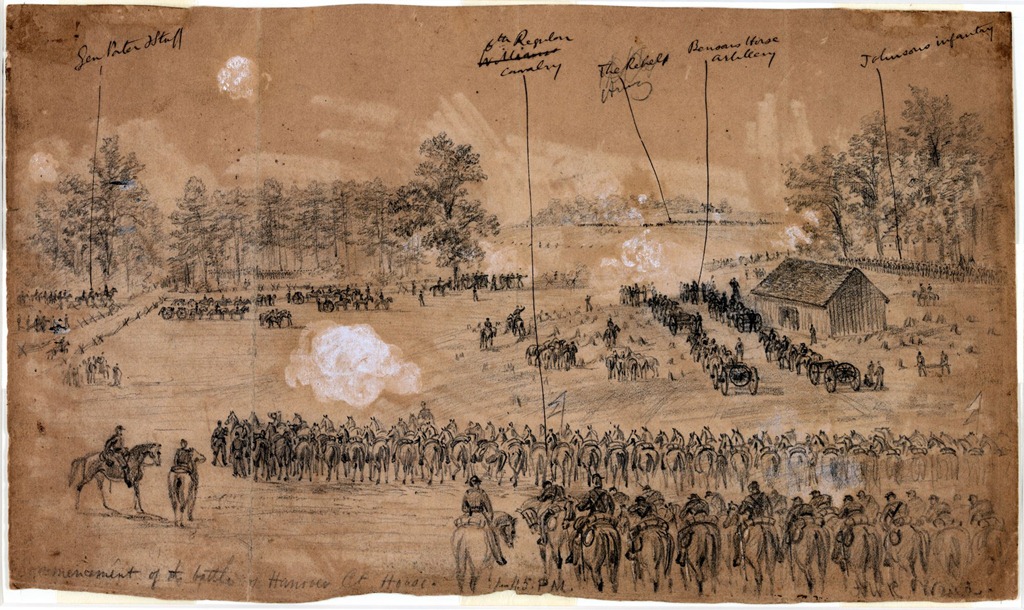
Commencement of the battle of Hanover Ct. House. 1_45 PM.

Title inscribed below image: Commencement of the battle of Hanover Ct. House. 1:45 PM.

May 27, 1862 – drawn by Alfred R. Waud.

  • Inscribed above image in black ink, left to right: Cavalry. The Rebel Army. Bensons Horse Artillery. Johnsons infantry.
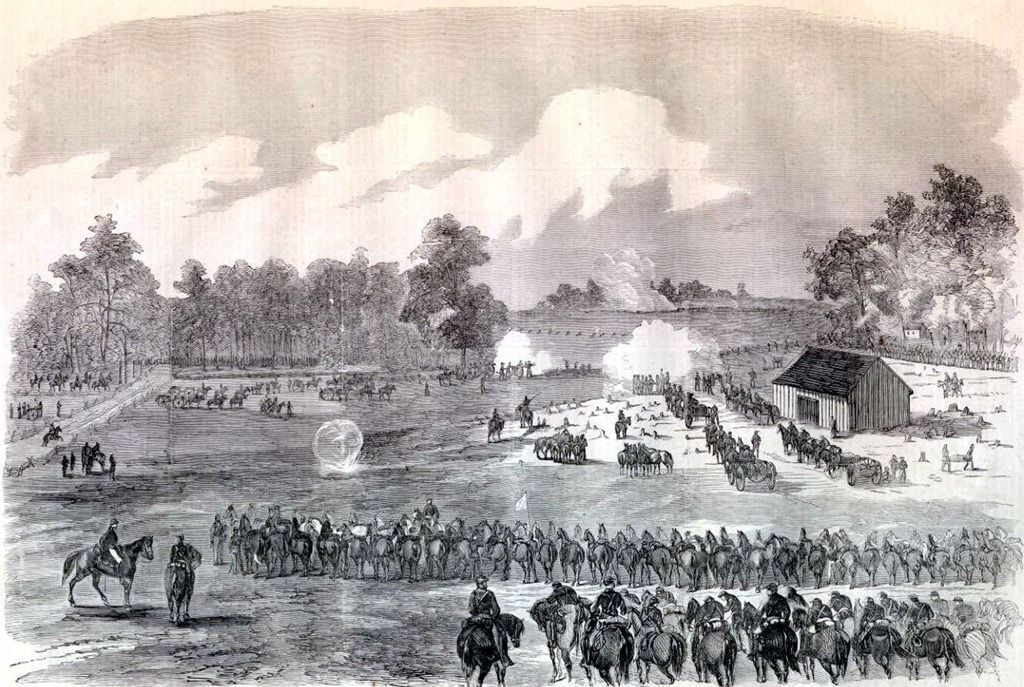
  • Published in: Harper’s Weekly, June 21, 1862, p. 397, inscribed in Harper’s “From sketches by an officer who was present.”

drawing on brown paper : pencil and Chinese white ; 21.1 x 36.2 cm.

Part of Morgan collection of Civil War drawings.  Library of Congress Prints and Photographs Division Washington, D.C. 20540 USA

Record page for this image: http://www.loc.gov/pictures/item/2004660266/

Harper’s Weekly Image:

From Harper's Weekly June 21, 1862 - The Army of the Potomac—Commencement of the Battle of Hanover Court House,

Camp on Corinth Road, Miss., May 27, 1862.
Why don’t you write me just a word, if no more? I’m almost uneasy. Not a line from home for a month. We hear that smallpox is raging in Canton, and—I want you to write. They say there is some smallpox in the center and right of the army, but think ’tis like the milk sickness of our Egypt, “a little further on.” There’s enough sickness of other kinds, so we have no room for grumbling if we can’t have that disease. The hospitals at Hamburg make almost a city. I think there can be no more sorrowful sight, real or imaginary, than that camp of the sick.

I don’t know the number of patients, somewhere in thousands, all packed in tents as closely as they can lie, and with not one-tenth the care a sick horse would get at home. I suppose the surgeons, stewards and nurses have feelings like men when they first enter the hospitals, but familarity with disease and suffering seem to make them careless and indifferent to a degree that surprises me, and I can’t but look upon it as criminal. I suppose nearly half the bad cases are typhoid fever. Yellow fever, cholera and smallpox have never been known here to the citizens. They all say this is a very healthy country, and I believe it. Our boys are suffering from the change of climate and water, and as much as anything, the sudden change in temperature. Our regiment is improving in health now rapidly. We have gained about 40 for duty within a week. We had about 250 sick last week. The 17th has some 300. I found a batch of live secesh women last Sunday. I rode up to a fine looking house to get a glass of milk (I suppose I drink more milk than any six calves in Fulton) and found eight or ten ladies at dinner, accepted a rather cool invitation to dine wid’ ’em, and did justice to their peas and fodder generally, and was much amused. Think there was more spice to that dinner than I ever before saw. One black-eyed vixen opened the ball with “I don’t see how you can hold your head up and look people in the face, engaged in the cause you are.” I told her I thought she had a free way of ‘spressing her opinion. “Yes,” says she, “I can’t use a gun but I can tongue lash you, and will every chance.” Then they all joined in, but I found that eating was my best “holt,” so they had it their own way. When I’d finished my dinner, told them “a la Buell,” that I thought their house would make, an excellent hospital, and that we’d probably bring out 80 or a 100 patients the next day for them to take care of. Scared them like the devil, all but one, and they all knew so much better places for the sick. This odd one said she had a way of “putting arsenic in some people’s feed, and she’d do it, too.” Told her we’d give her a commish as chief taster, and put her through a course of quinine, asafœtida and sich. Said she’d like to see us dare to try it, she would. They were too much for me, but I’ll never pass that place without calling. I’d give my shirt to have had Ame Babcock there. Those are the first outspoken female seceshers I have yet seen.

Deserters say that the Rebels have positively no forage or provisions in Corinth. That the Memphis and Mobile railways can barely bring enough daily, scraped from the whole length of the lines to feed the army. It is reported here that Sherman took possession of the Memphis road west of Corinth yesterday and has fortified his position. Pope got two or three men killed yesterday. There was about 5,000 of the enemy camped in the woods one and one-half miles in front of his posish, and he drove them back until they were reinforced and made him scoot again. I was out with a scout Sunday and started again last night at dark (Monday) and was out until 9 this a.m. The cause was some small bands raising the d____l on our left. We didn’t catch them. We were over to the Tennessee, Sunday, where we could see the sacred soil of Alabama. I like Alabama better than any other Southern State. She’s never done the “blowing” the others have and people here say that she’s nearer loyal than any other Southern state. They’re raising loyal companies here now. There are two full in Savannah.

General Jeff C. Davis’ division passed here to-day to join Pope’s corps. Davis stopped with us and made quite a visit. General Ash of this division goes forward to-morrow. The 21st and 38th Illinois from Stules division went out yesterday. Eleven regiments in all added to Pope’s command in two days; except the last two they were all at Pea Ridge and some at Wilson’s Creek. A splendid lot of men but not drilled equal to many regiments of the “Army Miss.”

I don’t honestly believe that we have with all our reinforcements 100,000 men here; but don’t believe the Rebels have 75,000; of course I mean effective men that can be called on the field to fight. We have just received orders to move to front to-morrow.

May 27th. Rained hard until noon; the river is rising, and the low grounds are all under water. On the 25th, the fourth corps marched forward to Seven Pines, on the main turnpike road, and is intrenching. The third corps crossed the river, and is in support of the fourth. Hooker’s division has gone to the White Oak Swamp bridge, and Kearny’s to Savage Station, on the York river railroad; this leaves Franklin. Sumner and Porter north of the river, with most of the cavalry. General headquarters are established at Gaines’ Mill and all is ready now for the great battle, as soon as the roads dry up. We hear to-night that McDowell’s army is not coming to join us, on account of the serious turn in affairs in the valley, which if true, is unfortunate for us; but we must have enough men in this fine army to win, if properly led. Courage Messieurs! who’s afraid!

Eliza Woolsey Howland to her husband, Joe.

Floating Hospital,

Off White House, May 27.

Still not a word from you for a fortnight now. I am beginning to be very hungry, — not anxious, only hungry, for letters. I only hear in indirect ways that our division was near the Chickahominy a day or two ago and was ordered to march into Richmond the next morning; and again yesterday that the whole army was to move in light marching order, leaving wagons and tents behind the Chickahominy. I dream about it all, and wonder, but know nothing. . . . We moved to the Knickerbocker from the Small and found a great state of confusion consequent upon having the Elm City emptied into it. . . . The event of this evening is the return of the old Daniel Webster, which we all look upon as a sort of home. … Dr. Grymes always invites us over “home” when he arrives in it, and we had a very nice dinner with him to-day. He rose as we came in and said, “I give you welcome where you have a right.” Mrs. Trotter returned in the Webster and Mrs. Baylies, Mrs. Bradford and Miss Mary Hamilton came down from New York this time. The two latter are to stay, and be replaced on the return trip by some of our force who want to go home. The Webster brought us more bundles and stores from home and lots of letters and papers.

May 27.—We are all packed up, and intend leaving this morning. Mrs. Glassburn and nearly all the ladies are going to Brookhaven. I intend going to Okolona, and there remain until I learn in which direction the army will move.

We have seen many sad sights and much suffering since we came to this place; still, I shall ever look back on these two months with sincere gratification, and feel that I have lived for something.

The surgeons, one and all, have proved themselves kind and attentive to the brave men whom they have had under their care. The hospital is in perfect order, ready for the reception of patients. I visited Corinth Hospital this morning; they were not thinking of leaving, and had quite a number of wounded men. There I met Mrs. Palmer of Mobile, who had a son in the Twenty-first Alabama Regiment. She had visited the camp the day before with refreshments for the soldiers. She informed me that there were numbers of sick yet in camp, and if we left, she could not conceive how they could be moved.