Saturday 23d.—Relieved by Hilliard’s Legion. Started down Powell’s Valley at 6 p. M. Marched all night.
August 2012
August 23—Went uptown to see my brother, Morris, of the 44th Georgia Regiment; but his regiment had already gone to Gordonsville, so I returned to camp.

AUGUST 23D.—Members of Congress are coming to my office every day, getting passports for their constituents. Those I have seen (Senator Brown, of Mississippi, among the rest) express a purpose not to renew the act, to expire on the 18th September, authorizing martial law.
August 23d. Up early and made a prompt start; half an hour afterwards it began to rain and soon poured down in torrents. We know a thing or two now about campaigning, and so a rain storm is something to enjoy, at least for mounted men; on the pommels of our saddles we carry, rolled and strapped, a rubber coat, leggings, and cap cover, and on the first appearance of rain get into our leggings, strapping our spurs over them, so that the feet are protected. The coat is made on purpose for mounted men and is full behind to cover the horse and blankets. When one is encased in this rubber armor, he can laugh at the wildest storm, perform his duties comfortably, and go into his quarters perfectly dry. The men are provided with ponchos, a rubber blanket with a slit in the center, through which the head is passed, and thus are fully protected, as also are their arms and accoutrements; marched steadily without interruption, arriving at noon, and encamped by the sea side,

“Where we long have pined to
Linger, where the pebble-covered shore,
Under the quiet faint kisses of the sea,
Trembles, and sparkles as with ecstacy.”

The rain ceased before we arrived, and the sun shone just as brilliantly as ever, and soon dried up the ground. There is no town proper here, nothing but a lot of little wretched shops about the wharves, but the sea view is superb. The water so deep that the largest ships can come close to the shore; all the natural elements, in fact, for a great seaport, but there is no enterprise in this part of the country; everything seems to have long since attained its maximum, and is now content to vegetate and gradually die. Our men bought out the oyster men in short order, and were soon engaged in frying, stewing, and eating raw, every variety of oyster under the sun. A small party from our headquarters took a swim in the deep blue sea during the evening and greatly enjoyed it.
On August 18, 1862, a Union recruiting party was ambushed by Sioux warriors not long after leaving New Ulm. Survivors rushed back to warn the town. The town was attacked the next day, with warriors firing from a bluff above. A second attack occurred on August 23, when New Ulm was completely encircled by the attacking Indians.
_____________________
Battle between Sioux Indians and settlers in August 1862.
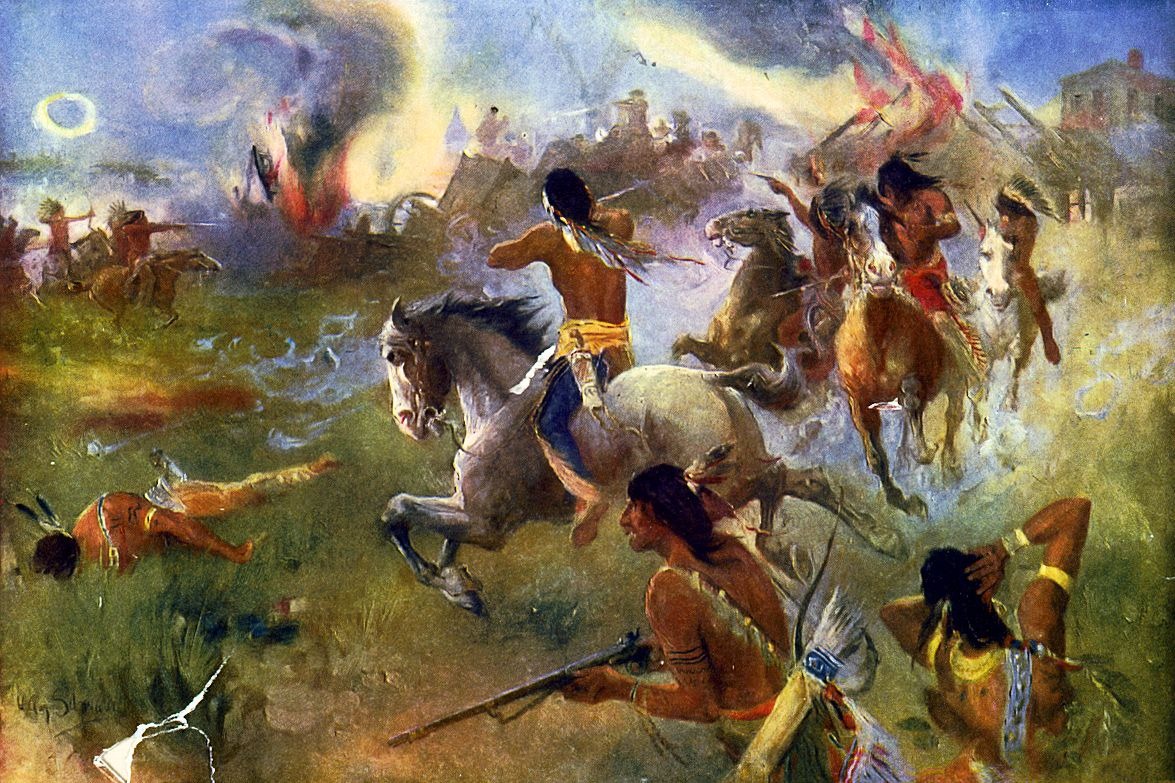
The siege of New Ulm, Minn, painted by H. Aug. Schwabe about 1902. Library of Congress image.
____________________
Battles of New Ulm (from Wikipedia)
The Battles of New Ulm were two battles in the Dakota War of 1862 in August. The settlement of New Ulm, Minnesota had 900 settlers around the time and was the largest settlement near the Sioux reservation. After the Battle of Fort Ridgely, the town was seen as a tempting target for a Sioux attack. The topography of the town also presented an advantage for the Sioux, since the land rises some 200 feet out of the Minnesota River valley in two large steps, with wooded area to provide cover for an attack.
On August 18, 1862, a recruiting party for Civil War volunteers left New Ulm, but was ambushed in Milford Township. The survivors raced back to town and warned the settlers of an impending attack. The townspeople prepared for the attack by erecting barricades on the streets and packing the women and children into any available brick buildings. The first attack came on August 19, with about 100 Sioux warriors firing on the city from the bluff behind the town. A small number of civilians returned the fire as best as they could. Later in the day, a thunderstorm discouraged the Indians from continuing their attack, and there were no chiefs present to give orders. The first battle ended with six settlers killed and five wounded.
After the first attack, Charles Eugene Flandrau reached the city as part of a detachment from St. Peter and Le Sueur. Dr. Asa W. Daniels, Dr. Otis Ayer, and Dr. William Worrall Mayo (father of William James Mayo and Charles Horace Mayo) were also part of this group. Dr. Mayo and Dr. William R. McMahan of Mankato set up a hospital in the Dacotah House and Drs. Ayer and Daniels set up a hospital in a store across the street. This undoubtedly helped in the treatment of the wounded.
Flandrau’s forces were bolstered by about a hundred men from Mankato, two companies from Le Sueur, and militias from Brown County, Nicollet County, St. Peter, Lafayette, and New Ulm. In all, Flandrau had about three hundred citizen-soldiers under his command, but most were poorly armed. Meanwhile, more than a thousand settlers were barricaded on New Ulm’s main street. On Saturday, August 23, around 9:30 in the morning, the Sioux began their second attack on the city. The Sioux were superior in numbers, and were able to encircle the entire town. The defenders of New Ulm set many buildings on fire in an attempt to create an open space without cover. Captain William B. Dodd, second in command, was killed while leading soldiers beyond one of the barricades of the city. After nightfall, Flandrau ordered that the rest of the buildings outside of the barricades to be burned. In all, 190 structures within the city were destroyed. The next morning, August 24, the Indians reappeared, fired some harmless long-range shots, and then withdrew. Flandrau convened with his officers later that day and decided to evacuate the city, due to a shortage of ammunition and food and epidemics of disease. The following morning, August 25, 2000 people, including 153 wagons and a large number of refugees, left the city and headed to Mankato, about 30 miles to the east. The procession was escorted by about 150 troops and made it through to Mankato safely.
August 23.—The United States steam sloop-of-war Adirondack struck on a coral reef near Little Abaco, W. I., and was lost. The crew were saved. —The Eighteenth regiment of Connecticut volunteers, under the command of Col. Wm. S. Ely; the One Hundred and Eleventh regiment, New York State volunteers, Colonel Jesse Segoine, and the Thirty-fifth Massachusetts, commanded by Col. Edward A. Wild, passed through New York City, en route for the scat of war.
—The schooner Louisa, while attempting to run the blockade of Charleston, S. C, was captured by the United States steamer Bienville.—A train of cars on the Memphis and Charleston Railroad, when three miles beyond Courtland, Tenn., was attacked by guerrillas numbering four hundred, who destroyed the train, which was in charge of a detachment of the Forty-second Illinois regiment. Eight rebels were killed. The Federal loss was two wounded and two missing.—This afternoon a mutiny broke out among the soldiers belonging to Spinola’s Empire brigade, at their encampment, East New-York. One man was shot and a number seriously injured. An attack was made upon the Howard House by the mutineers, who subsequently fled to Brooklyn and New York. The police was called out, and succeeded in quelling the riot. A squad of United States marines was put on guard, and order was restored. —A Passenger train on the Winchester (Va.) Railroad, when between that place and Harper’s Ferry, was fired into and stopped by a party of rebel guerrillas. The passengers were released, except four soldiers of the First Michigan, who were made prisoners. The train and its contents were completely destroyed.
—The battle on the Rappahannock between the armies under Gen. Pope and Gen. Lee, was resumed at an early hour this morning by a cannonade all along the opposing lines, which lasted for several hours. In consequence of the swollen state of the Rappahannock, the railroad bridge was in great danger of being carried away, and the advanced column of the Union army was therefore removed from the left to the right bank of the river, and the bridge was destroyed. New positions were taken, from which the old ones could be enfiladed, and on the rebels appearing in strong force for the purpose of occupying the abandoned position, a terrific cannonade was opened upon them, which drove them back into the woods with great loss. In the afternoon a portion of the rebel army succeeded in crossing the Rappahannock River, in the vicinity of Sulphur Springs, and a sharp engagement took place between them and Gen. Milroy’s brigade, the advance of Gen. Sigel’s corps, which resulted in the rebels being driven across Great Run, suffering great loss. In consequence of the success of the rebels in throwing a part of their forces across the Rappahannock, General Pope advanced his whole army from his position in the vicinity of Rappahannock Station to Warrenton and Sulphur Springs.— (Doc. 104.)
—A skirmish occurred near Big Hill, Madison County, Ky., between the Union troops under General Metcalfe and a superior force of rebels, resulting in the retreat of the Nationals to Richmond, Ky.—(Doc. 190.)
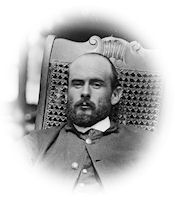
At Sea, Steam Transport McClellan
August 22, 1862
Here I am at sea once more and heading north, but not as I had hoped I might be going north about this time, leaving this conflict literally settled behind me, but only on my way to the dark and bloody ground in Virginia. Our regiment most unexpectedly received orders for the north one day last week at about the same time that I received my orders to report to General Pope. Accordingly I go north with them. As to my future, this unexpected change has set it all afloat. The war is evidently going to continue some time longer and my regiment is now going into active service. Is it wise for me now to separate myself from a Massachusetts regiment, and shall I not be more useful where I am than on an ornamental staff? These reflections puzzle me much and I do not know what will become of me. I shall try to decide for the best and I do know that we now seem to be going into the thick of the conflict….
We left the shores of South Carolina on Wednesday last, just seven months to a day from the time when I first set foot on them. I don’t think any of us felt much regret at leaving the State and certainly none of us at leaving Hilton Head. Of all the places it has ever been my fate to set foot on Hilton Head is by many degrees the meanest. Of Beaufort and Port Royal island I retain many pleasant memories, particularly of the last, than which I have never seen a more delightful island. But Hilton Head — dust, sand, government warehouses and fleas, constitute all its attractions. Thus ends my first campaign, and has n’t it been a failure! — a failure personally and publicly, nothing in itself and leading to nothing. Here I am just where I was when I started. I have seen nothing but the distant spires of Charleston and have not been promoted. I have had a bitter contest with my Captain and seen little active service….
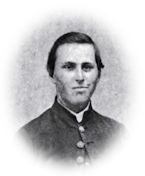
August 22d. Friday. Early this morning great crowds began to arrive in camp as we were to leave for the war. About 10 A. M. a large delegation of Norwich ladies came into camp with fine flags, National and State, which they presented to the regiment, Governor Buckingham making the presentation for the ladies from whom the flags came. The flags were received by Colonel Ely and then turned over to the color-sergeants who had been selected to carry them. Then assigned to Company C, our company. This event over, the regiment broke ranks.
About 3 P. M. the regiment broke camp, formed in line, and began our march to the city. Business was suspended. Great crowds lined the streets as the regiment marched along. Near five hundred young men from Norwich were in the regiment, leaving home for the life of a soldier in the great war. It was a very sad day in old Norwich. The boys marched on, going on board the large, fine steamer City of Boston, of the New York and New London Line. Many sad farewells as we marched on board the boat. The Norwich Brass Band volunteered its services as far as New York. About 7 P. M. the boat left the dock, going slowly down the Thames River. The music by the band, cheering by the people, roaring of cannons, and the great crowds made a scene that could not be forgotten. As the steamer rounded a bend in the river our view of Norwich was cut off and the shades of night were coming on. The lights of New London began to show up. Passing on, the steamer was soon out into Long Island Sound.
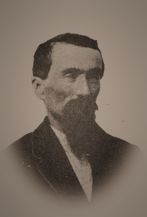
August 22 — This morning we went to the Rappahannock and drove into a large hilly field that sloped to the river. When we arrived on a rather prominent knoll in the field there was a horseman there who said to Captain Chew: “Put some of your guns in position here and fire a few shell into that piece of woods you see yonder on the other side of the river. I think perhaps there is something in there.” The piece of woods referred to was not very large, and somewhat lower in altitude than the hill we occupied, and there was nothing visible around or about the woods that indicated in the least that there was any dangerous game lurking within its peaceful borders. I unlimbered the first gun and landed a shell near about the center of the woods, which waked up the lion sure enough. The shell we fired was a twelve-pounder percussioned, and it exploded near the enemy’s lair.
The Yankees had a battery of six or eight rifled guns in position in the innocent little piece of woods, and opened fire on us with all of them immediately after our shell exploded. When I saw six or eight little piles of white smoke rising from the brush and heard the thunder of the guns, and the terrible screaming of the shell overhead, I thought the infernal regions had suddenly opened just on the other side of the river. In the twinkling of an eye our other two rifled guns whirled in battery, and for two hours we fired as fast as we could, and so did the Yanks. Their fire was terrific, and would have been unendurable, but fortunately for us the Yankee gunners aimed their guns too high and cut their fuses too long to seriously injure us much or silence our guns. Some of their shell exploded in front of our guns and some over our heads, but the great majority of them passed harmlessly over us and, with a thud, buried themselves without exploding in a hill about a hundred yards in our rear.
During the time we were engaged the Yanks fired about one thousand shell at us. I fired about one hundred rounds with the first gun. We had one man killed and two wounded. We also had two horses killed. An unexploded shell or solid shot cut in two the pole to one of our caissons. We had an extra pole and repaired the damage before we left the field. When the fight was on well General Fitzhugh Lee came on the field and rode boldly up to the battery and fearlessly sat on his horse watching the progress of the duel amid the fierce howling of shell and shrilly pings of flying fragments.
When he observed that some of our cannoneers were becoming fatigued to the exhausting point, he dismounted his horse, threw off his coat, and acted number one at one of our guns, and he performed his part well, ramming the shell home with the promptness and dexterity of a born cannoneer. Captain Pelham, the gallant and courteous young Alabamian, commander of the old Stuart Horse Artillery, kindly took my place for a while and fired my gun.
After we had fought about two hours we received orders to withdraw our pieces and go with General Stuart on a raid in the direction of Warrenton. When we retired from our position the Yankee battery was still firing, but when we came away I saw another Confederate battery drive on the field and take the same position that we vacated and open fire on the Yanks before we got out of the field.
Soon after we received orders to go with General Stuart we were on the march up the river to Waterloo Bridge. There we crossed the Rappahannock into Fauquier County and marched to Warrenton, where we arrived a little before night. We had some heavy showers this afternoon, and when we got to Warrenton we were as wet as water could make us. Just about dusk we started for Catlett’s Station, which is the first station below Warrenton Junction on the Orange and Alexandria Railroad. Soon after nightfall it commenced raining again, and shower after shower of the heaviest sort from the blackest clouds I ever saw kept pouring down till nearly midnight, while blinding flashes of lightning leaped in quick succession from the inky-hued clouds overhead and shot their fiery streams like burning rivers through the thick gloomy darkness that draped the chamber of night. At one moment the lightning’s dazzling glare rent the curtain of night and flashed its brilliant glow over the landscape, making the woods, fields, and hills appear as though they were basking in the full glory of a midday sun; the next moment the black tide of night rushed over the scene and blotted everything into nothingness. On account of the darkness, rain and deep mud we made slow progress in marching for a raid. The cavalry were all way ahead of us. We did not see or hear a sign of them anywhere, consequently toward midnight we halted in the road where the water and mud was just half knee deep. I was wet all over, and through. Cold, chilly, hungry, and sleepy all at the same time, I put myself in as small a package as I could and sat on the limber chest for three long weary hours, with wakeful dreamy visions of a good, warm, dry bed chasing one another all over me.
We were then about three miles from Catlett Station, our objective point. About midnight, or a little after, General Stuart through rain, storm, and darkness charged into the enemy’s encampment at Catlett’s, surprised the Yanks and drove them from their tents scatteringly into the darkness, captured some prisoners and about one hundred horses, and destroyed eighty wagons.
General Pope has his headquarters at Catlett’s, and I heard that General Stuart captured his uniform coat and his code of signals to-night. If General Pope wants to save his shirt he better keep his headquarters in the saddle or else he will see something of the Rebels some of these fine nights besides their backs.
When the cavalry returned from the station we struck out for the Rappahannock. The ditches, runs, and ravines along the road were all overflowing from the heavy rain in the fore part of the night. When we forded Silver Run the water came within six inches of running in the limber chests. Our return march was wearisome and slow. Long before we reached Warrenton morn unbarred the gates of day.
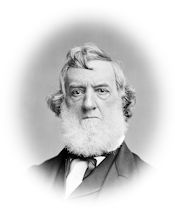
August 22, Friday. The President tells me he has a list of the number of new recruits which have reached Washington under the late call. Over 18,000 have arrived in just one week. There is wonderful and increasing enthusiasm and determination to put down this Rebellion and sustain the integrity of the Union. It is confined to no class or party or description: rich and poor, the educated and ignorant, the gentle and refined as well as the stout, coarse, and athletic, the Democrats generally as well as the Republicans, are offering themselves to the country.
Governor Dennison and Judge Swayne[1] of Ohio, with others, are urging in person the establishment of a line of armed and armored steamers on the Ohio River. The plan has been elaborated with much care, and has been before presented and pressed with some zeal. Distrust, no doubt, in regard to army management leads these men to seek naval protection. The Blairs are quoted to me as favoring the movement, and Fox has given them encouragement. It has not found favor with me at any time. It is now brought to my attention in such a way that I am compelled to take it up. I find that great names and entire communities in Ohio and Indiana, led on by the authorities of those States, are engaged in it. I told the principal agent, who, with Governor D., had a long interview with me, that my judgment and convictions were against it, for: First: I had no faith that light-draft gunboats would be a safe and reliable means of frontier river-defense. They might be auxiliary and essential aids to the army, but they cannot carry heavy armament, are frail, and in low stages of the water, with high banks which overlook the river, would not be effective and could hardly take care of themselves, though in certain cases, and especially in high water, they might greatly aid the army. Secondly: As a matter of policy it would be injudicious and positively harmful to establish a frontier line between Ohio and Kentucky, making the river the military boundary, — it would be conceding too much. If a line of boats could assist in protecting the northern banks of the Ohio they could afford little security to the southern banks, where, as in Ohio, there is, except in localities, a majority for the Union. I added that I should be opposed to any plan which proposed to establish frontier lines, therein differing from some of our best army officers; that I thought neither Ohio nor Indiana could, on deliberate consideration, wish the line of separation from hostile forces should be the northern boundary of Kentucky. It appeared to me the true course was to make their interest in this war identical with that of Kentucky, and if there were to be a line of demarcation it should be as far south as the southern boundary of Tennessee, and not the banks of the Ohio. The gentlemen seemed to be impressed with these general views.


