Monday, 18th—We are having some very hot weather. Since coming to Bolivar, each man is permitted to cook his rations in his own way, and so every man has a frying pan of some sort, and a tin peach can in which to boil his coffee. One man in our company, “Long John,” as the boys have nicknamed him, is a great coffee drinker. He carries a two-quart peach can strapped to his haversack, and every day buys up one or two rations of coffee from the boys who do not use much.
August 2012
18th. Monday. After the moon rose, so that the teams could pick their way, we started on. Moved back on the same road we went up. Col. Cloud and Warren’s forces took another route and went faster than we. Passed through “Index” and “Rose Hill” and stopped after passing the big mill. Awful place for baggage to cross. Got a little supper. Hard bread and coffee, then moved on— the dismounted men and infantry on foot. The report came in that Cloud met the enemy at Johnstown—so Blunt hastened. Mules and horses tired out. As we marched boys would fall asleep, walk on and frequently tumble down. Major Burnett said he rode the whole length of train and every mule driver but two were asleep—most in their wagons. Train moved on well.
Monday, 18th.—Took position in line of battle this A. M. Pickets skirmishing a little. Reported that General Ledbetter is on the other side of the mountain, and the Yanks are hemmed in.
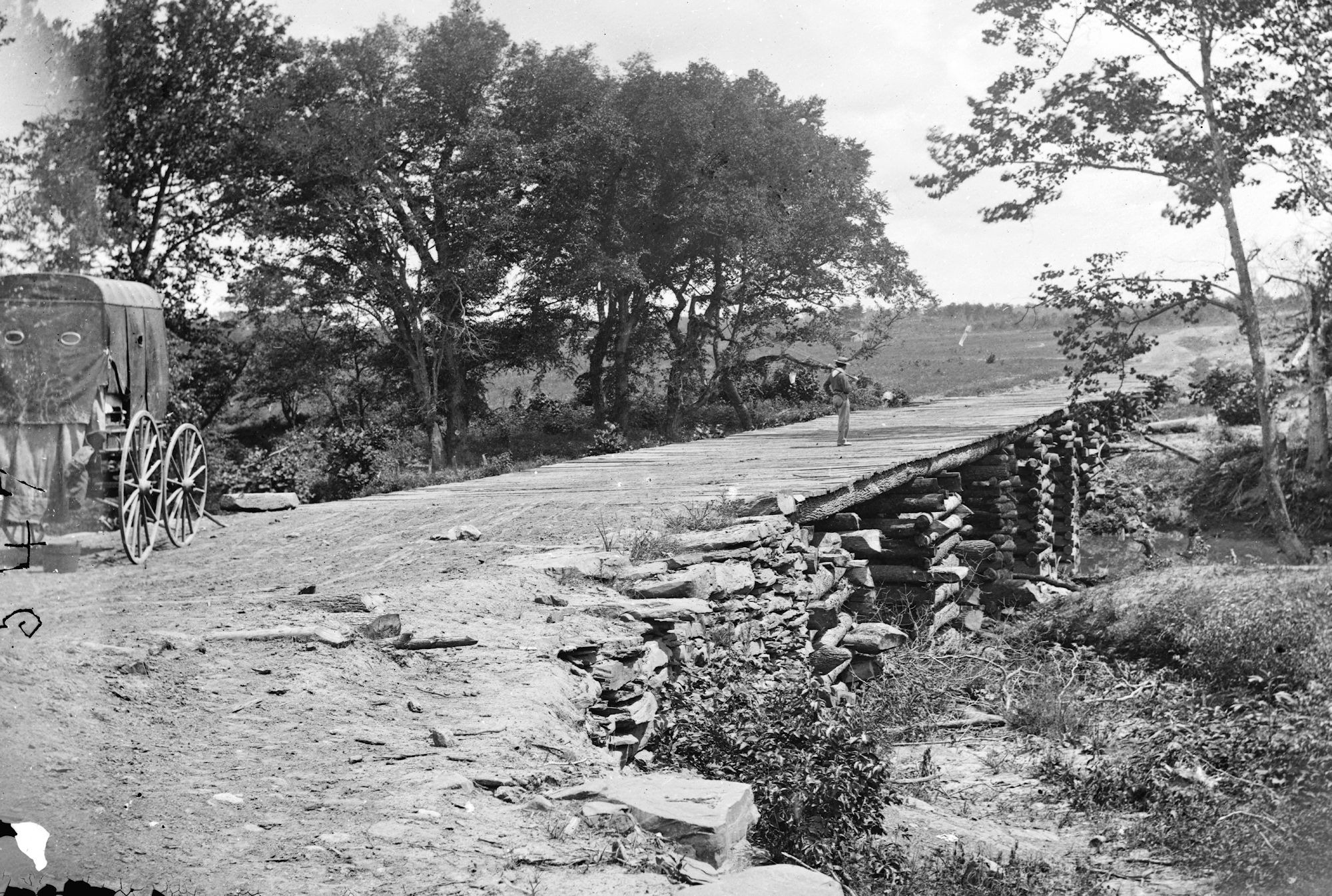
Bull Run, Va. New bridge built by McDowell’s engineers; photographer’s wagon at left.
Library of Congress image.
Photo taken by Timothy H. O’Sullivan, August, 1862.
_____________________
O’Sullivan appears to have included himself in some of his photos. I remembered having seen this particular wagon in another image recently, which turned out to have been taken in the Manassas area on July 4.
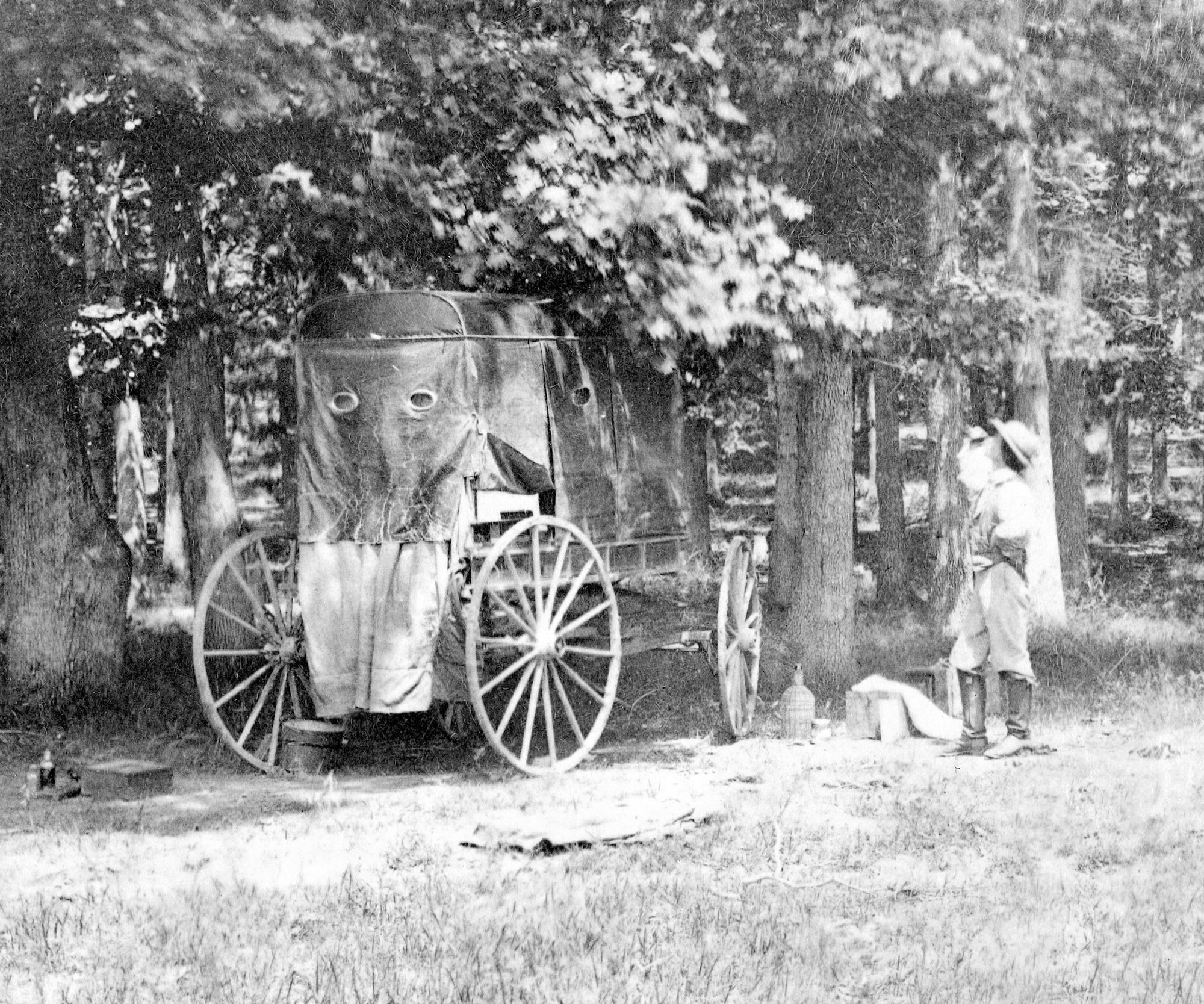
Our photographer at Manassas.
Library of Congress image.
Photo taken by Timothy H. O’Sullivan, July 4, 1862.
O’Sullivan also appears to have included himself in 2 other images that have already been published here:
Locomotive on the Orange & Alexandria Railroad in Virginia – in foreground with back to camera, dressed the same as in the top image.
Federal battery fording a tributary of the Rappahannock – on right side of image next to the same wagon as is in the above two images.
AUGUST 18TH.—From Texas, West Louisiana, and Arkansas, we shall soon have tidings. The clans are gathering, and 20,000 more, half mounted on hardy horses, will soon be marching for the prairie country of the enemy. Glorious Lee! and glorious Jackson! They are destined to roll the dark clouds away from the horizon.
August 18th. Reveille at daylight. Immediately after breakfast the troops received several days’ rations, and at 7 A. M. marched out of bivouac, going only four miles, and then for some reason not stated, pitched tents upon a splendid plantation and remained until the next morning. Poultry, fruits, and vegetables were in abundance, and we not only enjoyed a superb rest, but the best of catering. A spread at Delmonico’s could not surpass the dainties of the Fifty-seventh’s mess on this pleasant route. The country is delightful, and riding at the head of one’s regiment in company with so many good fellows, day after day, is simply glorious; a most agreeable change from camp life.
August 18.—The following orders were issued from the War Department at Washington: “Hereafter no appointments of Majors-General or Brigadiers-General will be given except to officers of the regular army, for meritorious and distinguished services during the war, or to volunteer officers who, by some successful achievement in the field, shall have displayed the military abilities required for the duties of a general officer.
“No appointment to such grades will be issued by the War Department till an examination is made to ascertain if there are any charges or evidence against the character, conduct or fitness of the appointee, and if there should be any such charges or evidence a special report will be made to the President.”
— The One Hundred and Twenty-fifth and the One Hundred and Twenty-seventh regiments of Pennsylvania arrived at Washington, D. C.
— The National pickets were fired on at Romney Road, Va., and one man mortally wounded. A force sent in pursuit overtook a party of bushwhackers near North River Mills, attacked them, and killed the notorious guerrilla, Bob Edwards. The rest escaped to the mountains. — Colonel Michael Corcoran, of the Sixty-ninth New-York militia, was appointed a Brigadier-General in the volunteer service of the United States.
— The Congress of the rebel States reassembled at Richmond, Va., when Jeff Davis delivered his annual message, addressed “to the Senate and House of Representatives of the confederate States.”—See Supplement.
— The steamers Skylark and Sallie were burned by guerrillas, at the mouth of Duck Creek, fifty miles above Fort Henry, Tenn. The Skylark was heavily laden with government stores. She got aground and an officer unloaded a portion of her stores when he was attacked by thirty rebels. The crew, being unarmed, were compelled to surrender. The guerrillas, after removing the furniture and silver ware, set fire to both the boats. The crews were released on parole.
— The rebel Colonel John H. Morgan, issued a proclamation from Hartsville, Tenn., in which he said that in consequence of the Federal Government causing his friends to pay for property destroyed by him, he would thenceforth put the law of retaliation in full force, and act upon it with vigor. For every dollar exacted from his Southern fellow-citizens, he would have two from men of known Union sentiments, and would make their persons and property responsible for the payment
— Clarksville, Tenn., garrisoned by a small number of Union troops, under command of Col. Mason, was this day surrendered to Col. Woodward and a superior force of rebel guerrilla troops, without firing a shot.—(Doc. 186.)
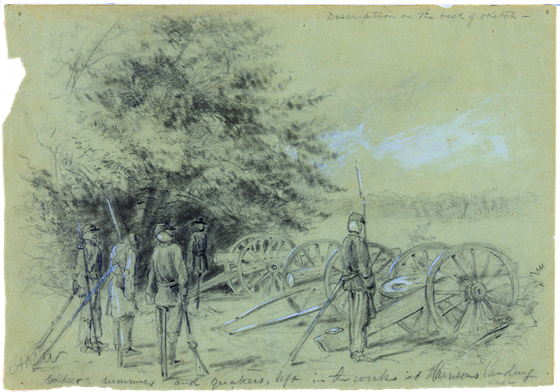
Library of Congress image.
Title: Soldier’s dummies and quakers, left in the works at Harrison’s landing.
Alfred Waud, the artist, wrote on the back, “The soldiers tell me there was a number of these bogus guns and figures, and their appearance kept the enemy from the camp for some time after it was evacuated. The photographer has a picture of these sham guns, but it was taken before the figures were set up.”
August 17th. Sunday in camp. Most of the members of the regiment were allowed to leave camp and visit homes and the city. It would be our last Sunday in the state. I was detailed for guard duty and could not leave camp. Many visitors in camp during the day. I was on duty two hours and off four during the day and night.
August 17 — This morning another load of soldiers came in from Gordonsville. I think old Stonewall is fixing to go on a big hunt before many days roll by. All the indications point that way.


