11th. Monday. Read some in the June Atlantic. Nothing especially interesting. After dinner went down for Charlie and visited Delos per engagement. Had a splendid visit, real social time. Got some lemon syrup, talked over our old experiences at home and with “B. F.” In the evening went to town to hear Lane and Blunt. Lane did well enough for a border ruffian. Blunt criticised the course of our officers in arresting Wier. Referred to the whole thing as a conspiracy. 1st Brigade did not cheer much till Gen. Salomon’s name was heard. Then the boys grew wild with excitement and cheered heartily for him. Blunt found, I guess, that Wier had enemies and Salomon friends.
August 2012
Harrison’s Landing, James River, Va.,
Monday, August 11, 1862.
Dear Brother and Sister:—
I received your letters of the 1st and 4th last night. I do not know how long I shall be permitted to write, as everything is packed up and we have marching orders. As usual, we know nothing about our destination, but I think a general movement of the army is contemplated.
Last week we spent over the river. We crossed Tuesday morning and we had a splendid time. I was mistaken in the ownership of the house that was burnt over there, of which I spoke in my last letter. It was not Edmund Ruffin’s, but belonged to another man. Ruffin’s plantation is next above the burned house. We spent most of the week on it or in the vicinity. He had a beautiful situation and an excellent farm. There are acres of corn there eighteen feet high—the largest corn I ever saw. Apple and peach orchards breaking down with their loads of fruit stand ripening in the southern sun, and southern sun means something, too. The thermometer was up to 109 last Friday, and Thursday was hotter still. We lived while we were over there. Guarding secesh property is played out and we had full liberty to “acquire” anything we could find to eat. Pigs and poultry were plenty and we could have lived on them if we had taken salt with us, but salt could not be found. Flour and meal were found, though, and if we didn’t have pancakes and hoecakes and apple sass, peaches and plums, and new potatoes and green corn, it was because we were too lazy to get them. We slept in the woods. It would have been a novel sight to you to have passed through the woods at midnight and to have seen how soldiers sleep. Lying on the ground with no covering, heads pillowed on the roots of oaks and beeches, faces upturned in the moonlight, they might have looked like inanimate objects, but the sharp note of a bugle, or the “Fall in Eighty-third” would have started them to their feet in an instant.
I wish I had the ability to describe the home of the Ruffins to you. It is the only place I have yet seen that gave much evidence that the owner is anything more than in name and pretension an F. F. V. The house itself is not very large or pretentious, but it shows that it was the abode of wealth and taste. There is an air of aristocracy and luxury about these old southern mansions that time alone can give. We never see it in the north. The grounds about this place are the most beautifully laid out of any I have ever seen. It is the realization of the imaginary residences of the heroines we read of in romance. Before the house is a beautiful clean-swept lawn, shaded by magnificent oaks and tulip trees that look as though they had seen a century’s growth at least. And then, the winding walks and avenues, shady bowers and summer houses covered with roses and drooping with graceful festoons of flowers, whose names are unknown to me, but whose beauty and fragrance I can appreciate you must see them to know their beauty. The “servants’ quarters” are not the miserable log huts with mud floors like those at the White House, but clean painted frame buildings tastefully arranged in the shade of those old trees. A little apart from the main building is a smaller one, where I imagine the master spent much of his time. It was his library, study and office. He is evidently a scholar and a writer of no mean ability. He was the editor of an agricultural periodical and had held many offices of public trust and confidence. His library was very large and valuable, mostly of agricultural works, but containing a great number of scientific and classical books. Thousands of books were carried off by our men.

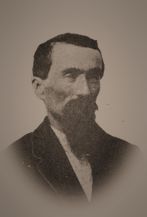
John T. Hughes (July 25, 1817 – August 11, 1862) was a colonel in the Missouri State Guard and Confederate Army during the American Civil War. He might also have been a brigadier general at the time of his death but documentation of the appointment is lacking.
Hughes returned to Missouri in the summer of 1862 to recruit for the Confederacy. At this time he may have been appointed as either an acting Confederate or Missouri State Guard brigadier general. No record of the appointment has been found but he was known as “general.”
He, his recruits, and several other recruiting or partisan bands united to attack the garrison of Independence, Missouri on August 11, 1862 with Hughes in overall command. During this battle (the First Battle of Independence), he was killed instantly by a shot to the head while leading a charge, but the city was captured. He is interred at Woodlawn Cemetery in Independence.He left behind a wife, Mary, and five young sons. (Wikipedia)
Civil War Portrait 001
AUGUST 11TH.—Our killed, wounded, and captured did not amount to more than 600. We might have captured a whole brigade at one time during the battle, but did not. They charged our batteries, not perceiving a brigade of our own lying concealed just in the rear of the guns: so, when they advanced, shouting, to within thirty yards of our troops, they rose and “let them have it.” Nine-tenths of the enemy fell, and the rest were soon dispatched, before they could get away. One of their dying officers said they would have surrendered to us, if we had demanded it. He was reminded of Pope’s beastly orders, and died with a horrible groan.
Aug. 11, 1862.—We cannot get to New Orleans. A special passport must be shown, and we are told that to apply for it would render H. very likely to be conscripted. I begged him not to try; and as we hear that active hostilities have ceased at Vicksburg, he left me this morning to return to his uncle’s and see what the prospects are there. I shall be in misery about conscription till he returns.

______
Note: To protect Mrs. Miller’s job as a teacher in New Orleans, the diary was published anonymously, edited by G. W. Cable, names were changed and initials were often used instead of full names — and even the initials differed from the real person’s initials.
August 11.—It being a fact that a number of the inhabitants of Baton Rouge, La., who had been allowed by the United States authorities to retain their private arms, were found dead and wounded on the battle-field at that place, General Butler, at New-Orleans, ordered, to prevent a repetition of such a breach of trust, that all arms in that city, of whatever description, be delivered to the military authorities.—Gen. Order No. 21.
— General Grant, commanding Department of West-Tennessee, issued an order from his headquarters at Corinth, Miss., directing that fugitive slaves coming within the lines of the army under his command, should be employed in the quartermaster’s, subsistence, and engineer’s departments. Also, when by such employment a soldier might be saved to the ranks of the army, as teamsters, cooks, hospital attendants, and nurses.
— Bayou Sara, La., was this day taken possession of by the National forces. They seized all the sugar and molasses in the place, and quartered a garrison there.
—A fight took place in the vicinity of Independence, Mo., between a body of Union troops under the command of Colonel Buell, Seventh Missouri cavalry, and a superior force of rebel guerrillas under Colonel Hughes, resulting in the defeat of the Unionists and the capture of the town by the rebels.—(Doc. 178.)
—A party of Jeff. Thompson’s rebel cavalry surprised a company of the Third Wisconsin regiment, at a point eleven miles east of Helena, Ark., but were compelled to retire after a short but destructive battle. Several rebels were captured. —Memphis Bulletin, August 14.
—A detachment of the Eleventh Illinois cavalry, sent from Bolivar, Tenn., attacked some guerrillas at Salisbury, five miles east of Grand Junction, capturing a rebel captain and twenty-seven horses and mules, and dispersing the guerrillas.
—Samuel H. Elbert, Acting Governor of Colorado Territory, issued a proclamation urging the assessors of the several counties, in view of the probability of the Colorado regiments being ordered by the United States Government for service out of the territory, to complete the enrolment of the militia in accordance with an act passed at the last session of the Territorial Legislature.
—A series of skirmishes occurred near Williamsport, Tenn., between a small body of Union troops under the command of Major Kennedy, and a superior force of rebel guerrillas, resulting in the defeat of the latter on each occasion, with considerable loss.—Gen. Negley’s Despatch.
—A fight took place near Compton’s Ferry, on the Grand River, Mo., between a force of Union cavalry under the command of Colonel Guitar, and a body of rebel guerrillas under Colonel Poindexter, resulting in the defeat of the latter, who lost one hundred men killed and wounded, two hundred prisoners, six wagons, about one hundred horses and saddles, one hundred and fifty guns, a quantity of ammunition and provisions.—(Doc. 179.)
—A skirmish took place near Reelsvillc, Callaway County, Mo., between a body of Missouri State cavalry under the command of Col. Smart, and Capt. Cobb’s rebel guerrillas, in which the latter were routed with some loss.—All the property of John Slidell, an officer of the rebel government, was confiscated by order of General Butler, at New Orleans, La.
—A skirmish took place near Kinderhook, Tenn., between a body of Union troops under the command of Colonel McGowan, and a force of rebel guerrillas under Major Anderson, resulting in the defeat of the latter, who lost seven men killed, a large number wounded, and twenty-seven prisoners.—(Doc. 180.)
August 10 — This morning when I awoke the wounded Federals were still lying on the field. Little after sunrise we started with Ashby’s old brigade of cavalry, now commanded by General Robinson, on a general reconnoissance to the right of Pope’s army. We moved off to the right of the battle-field and passed around the end of Cedar Mountain to the east side, then moved out on a beautiful level plain traversed by the Orange and Alexandria Railroad. After we went about three miles we struck the railroad and followed it about a mile and a half. We were then near General Pope’s army, and some of our cavalry that were scouting through the woods not very far from where we halted with the battery ventured unawares near Pope’s headquarters. I do not know whether our scouting party was discovered by the enemy or not, nor how close we were to the Yanks; but we were ordered to go into position with as little noise as possible and were even not allowed to talk above a whisper. Danger must have lurked near; however, I did not see it.
When we fell back from the advanced position we did it by sections; one section remained in battery until the other one retired and went into position. There must have been something dangerously close around that caused such a silent and cautious movement. When we had fallen back about a mile we remained in battery about half an hour, then returned to the hill south of the battle-ground where we were yesterday when the battle opened. We did not come back over the same route we went this morning, but flanked farther east and had to cross Cedar Mountain to get back, as the Yankee cavalry were looking and feeling for us along our morning track. I heard this morning that General Pope is getting heavy reinforcements from the direction of the Rappahannock.
I know now that the main object of our reconnoissance was to ascertain what is transpiring in Pope’s rear just at this particular time, after receiving his first military object lesson as taught by Stonewall Jackson.
We are camped this evening on a hill south of and overlooking yesterday’s fighting ground.

Library of Congress image:
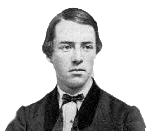
Unidentified young sailor in Union uniform with American flag in front of backdrop showing naval scene.
Donated to the Library of Congress 2010 by Tom Liljenquist; Liljenquist Family Collection of Civil War Photographs.
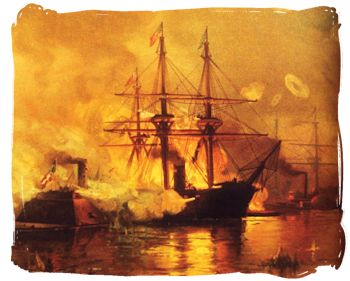
On the 10th August, Commander Wainwright died, after an illness of two weeks. His remains were placed in a metallic coffin and sent on board the U. S. steamer Miami, which steamer carried them to Washington, D. C.
Headquarters Porter’s Corps,
Camp near Harrison’s Landing [Aug., ’62].
Dear Father, — Here I am, thank Heaven, under the Stars and Stripes again, ready and willing to go at my duty. I reached here this morning at 7.30 o’clock, having left Aiken’s Landing on the James River at 4 o’clock A.M., coming down on board the steamer Ariel.
After many disappointments and delays we left the Libby Prison at Richmond yesterday at 12 o’clock. Though the sun was at its hottest heat, and pouring down its literally burning rays, and although we had to march fifteen miles on foot, I doubt if there was one officer among the one hundred and fifty who was not glad and willing to start at that precise moment in preference to any other, and undergo the fatigue and labor of the march for the sake of getting away from that vile prison. We started off at a smart pace, too much so indeed, but every one was anxious to get away as soon as possible. We marched steadily for three miles and then made a halt at a bridge. Almost every one was tired out by that time, and several were even in danger of being sun-struck. After going a quarter of a mile farther, the officer in charge found it necessary to halt at a house surrounded by trees, the officers being completely used up. He determined luckily to wait until five o’clock before starting again, by which time the sun would be less powerful. The field officers and the sick, who were in wagons, soon caught up with us, and got out to enjoy the shade. We waited till 3.30, when the sun became clouded, and the air cooler. I was completely used up, the skin being worn off my foot by the chafing of my boot. I got into one of the wagons and off we started again. Soon a strong wind came up, completely enveloping us in a cloud of dust, of a thicker and dirtier nature than I have ever known before. Soon, however, rain came, and made the travelling quite pleasant. We went by the Drewry’s Bluff road, and passed by some dozen works on that road alone, besides seeing as many more on the other side of the river. Our route lay along the river part of the way, although we were led some four miles away from our course, in order that we might not see some new works they were making. The country was rich and fertile, and was planted entirely with corn, which was in very good condition. By eight o’clock we reached Aiken’s Landing, and were transferred to the steamer without giving any parole, and without any conditions. Our exchange is complete at 12 o’clock to-day. We slept on board the steamer and started early this morning. I walked up to headquarters and was very kindly welcomed by the general and staff. The general has been very kind to me, having written me that you were all well, and relieved of all anxiety for me. He also sent me $25.50, which was very acceptable. $12.50 was in gold, worth about $25.00 in Confederate notes.
In regard to my treatment in Richmond, I met with very kind treatment from the officer in charge, Lieutenant Trabue. The first officer who had charge of us, Captain William Read, was as conceited a puppy as ever lived. He was impudent to the officers, and was consequently removed. Trabue then had charge of us and was very kind and obliging. He was removed, however, on account of the escape of five officers, three of whom made good their escape, and two were recaptured. We then were more strictly guarded and the privilege of getting spring water refused us, although this was partially restored to us again. Most of the officers who had anything to do with us, treated us personally in a very kind manner, but their government treated us quite harshly. The only food furnished us was sour bread, meat, and salt, and at times a little vinegar. The meat was made into greasy soup, entirely unfit for a human being’s stomach. If we had not had some money, we should have starved. I had only one dollar when I reached Richmond, but I met with an officer who lent me twenty-two dollars, and when that was used up, I sold my rubber coat, which cost me $6, for $15. Then I also received $25 from the general, $9.50 of which I gave to Harry Russell,[1] who was taken prisoner by Ewell or Jackson last Saturday. All Pope’s officers, 30 in number, taken on Saturday, were treated shamefully. They live in a room with the privates and are allowed nothing but bread and meat, and are not permitted to buy anything outside. No blankets are given them, but when I went away I sent Harry Russell my bed and blanket. I was not allowed to see him, but received a short note from him, in which he said he was well, and I also heard that he was well and uninjured from officers who saw him. I shall write Mr. Shaw about his being captured. Harry R. said in his note to me that Major Savage was wounded in arm and leg and taken prisoner. When I went away I sent Russell all the money I had. I will enclose the note, which I received from him. His order on Mr. Shaw was his own idea, of course, and not mine. I shall write Mr. Shaw and let him know that Harry is well.
I send you a list of the prices of articles of food in Richmond. Butter, $1 per lb. Apples, $.50 to $1.00 a doz. Eggs, $1.00 per doz. Molasses, $.75 per pint. Sugar, $.75 per lb. Cherries, 50 cts. per quart. Potatoes, 30 cts. per quart. Coffee, $2.50 per lb.; and rye coffee, $.75 per lb. Tea, $16.00 per lb.
On my way from Richmond I saw Merrimac No. 2, lying at the Rockets just below. She must be very nearly finished. She was covered like the roof of a house and will be a formidable antagonist if she ever succeeds in getting out. We were kept in the Libby Prison for a week, and were then moved to a building on 18th St., where there were splendid opportunities for escaping. I bought me a Secesh uniform and should have tried it if we had not received the news of the exchange. There were five or six Union families within a stone’s throw of our prison, and we used to converse with them by the dumb alphabet and by writing on boards, etc. The officers frequently went out nights through a hole made in a fence separating another building from ours, and came back again after walking about the city. I will give you an account of my imprisonment at greater length, in a few days.
General Porter has been away all the day and will not return till morning. Even if he should offer me a furlough I should not take it while there was any chance of a move. I think we shall move in a few days, but I think it will be towards Fortress Monroe. . . .
[1] The late Col. Henry S. Russell, for many years Fire Commissioner of Boston.


