Following the American Civil War Sesquicentennial with day by day writings of the time, currently 1863.

August 2012

August 10th, Sunday.

Is this really Sunday? Never felt less pious, or less seriously disposed! Listen to my story, and though I will, of course, fall far short of the actual terror that reigned, yet it will show it in a lukewarm light, that can at least recall the excitement to me.

To begin, then, last evening, about six o’clock, as we sat reading, sewing, and making lint in the parlor, we heard a tremendous shell whizzing past, which those who watched, said passed not five feet above the house. Of course, there was a slight stir among the unsophisticated; though we, who had passed through bombardments, sieges, and alarms of all kinds, coolly remarked, “a shell,” and kept quiet. (The latter class was not very numerous.) It was from one of the three Yankee boats that lay in the river close by (the Essex and two gunboats), which were sweeping teams, provisions, and negroes from all the plantations they stopped at from Baton Rouge up. The negroes, it is stated, are to be armed against us as in town, where all those who manned the cannon on Tuesday were, for the most part, killed; and served them right! Another shell was fired at a carriage containing Mrs. Durald and several children, under pretense of discovering if she was a guerrilla, doubtless. Fortunately, she was not hurt, however.

By the time the little émeute had subsided, determined to have a frolic, Miss Walters, Ginnie, and I got on our horses, and rode off down the Arkansas Lane, to have a gallop and a peep at the gunboats from the levee. But mother’s entreaties prevented us from going that near, as she cried that it was well known they fired at every horse or vehicle they saw in the road, seeing a thousand guerrillas in every puff of dust, and we were sure to be killed, murdered, and all sorts of bloody deaths awaited us; so to satisfy her, we took the road about a mile from the river, in full view, however. We had not gone very far before we met a Mr. Watson, a plain farmer of the neighborhood, who begged us to go back. “You’ll be fired on, ladies, sure! You don’t know the danger! Take my advice and go home as quick as possible before they shell you! They shot buggies and carriages, and of course they won’t mind horses with women! Please go home!” But Ginnie, who had taken a fancy to go on, acted as spokeswoman, and determined to go on in spite of his advice, so, nothing loath to follow her example, we thanked him, and rode on. Another met us; looked doubtful, said it was not so dangerous if the Yankees did not see the dust; but if they did, we would be pretty apt to see a shell soon after. Here was frolic! So we rode on some mile or two beyond, but failing to see anything startling, turned back again.

About two miles from here, we met Mr. Watson coming at full speed. The ladies, he said, had sent him after us in all haste; there was a report that the whole coast was to be shelled; a lady had passed, flying with her children; the carriage was ordered out; they were only waiting for us, to run, too. We did not believe a word of it, and were indignant at their credulity, as well as determined to persuade them to remain where they were, if possible. When told their plan was to run to the house formerly used as a guerrilla camp, we laughed heartily. Suppose the Yankees fired a shell into it to discover its inhabitants? The idea of choosing a spot so well known! And what fun in running to a miserable hole, when we might sleep comfortably here? I am afraid rebellion was in the air. Indeed, an impudent little negro, who threw open the gate for us, interrupted Ginnie in the midst of a tirade with a sly “Here’s the beginning of a little fuss!”

We found them all crazy with fear. I did not say much; I was too provoked to trust myself to argue with so many frightened women. I only said I saw no necessity. Ginnie resisted; but finally succumbed. Mr. Watson, whom we had enlisted on our side also, said it was by no means necessary, but if we were determined, we might go to his house, about four miles away, and stay there. It was very small, but we were welcome. We had in the mean time thrown off our riding-skirts, and stood just in our plain dresses, though the others were freshly dressed for an exodus. Before the man left, the carriage came, though by that time we had drawn half the party on our side; we said we would take supper, and decide after, so he went off.

In a few moments a rocket went up from one of the boats, which attracted our attention. Five minutes after, we saw a flash directly before us. “See it? Lightning, I expect,” said Phillie. The others all agreed; but I kept quiet, knowing that some, at least, knew what it was as well as I, and determined not to give the alarm — for I was beginning to feel foolish. Before half a minute more came a tearing, hissing sound, a sky-rocket whose music I had heard before. Instantly I remembered my running-bag, and flew upstairs to get it, escaping just in time from the scene which followed on the gallery which was afterwards most humorously described to me. But I was out of hearing of the screams of each (and yet I must have heard them); neither saw Miss Walters tumble against the wall, nor mother turn over her chair, nor the general mêlée that followed, in which Mrs. Walters, trying to scale the carriage, was pulled out by Uncle Will, who shouted to his plunging horses first, then to the other unreasoning creatures, “Woa, there! ‘T ain’t safe! Take to the fields! Take to the woods! Run to the sugar-house! Take to your heels!” in a frenzy of excitement.

I escaped all that, and was putting on my hoops and hastily catching up any article that presented itself to me in my speed, when the shell burst over the roof, and went rolling down on the gallery, according to the account of those then below. Two went far over the house, out of sight. All three were seen by Mr. Watson, who came galloping up in a few moments, crying, “Ladies, for God’s sake, leave the house!” Then I heard mother calling, “Sarah! You will be killed! Leave your clothes and run!”— and a hundred ejaculations that came too fast for me to answer except by an occasional “ Coming, if you will send me a candle!” Candle was the same as though I had demanded a hand-grenade, in mother’s opinion, for she was sure it would be the signal for a bombardment of my exposed room; so I tossed down my bundles, swept combs and hairpins into my bosom (all points up), and ravished a candle from some one. How quickly I got on, then! I saved the most useless of articles with the greatest zeal, and probably left the most serviceable ones. One single dress did my running-bag contain — a white linen cambric with a tiny pink flower — the one I wore when I told Hal good-bye for the last time. The others I left.

When I got down with my knapsack, mother, Phillie, and Mrs. Walters were —


August 10, 1862, Sunday. The last two days have been excessively warm. Thermometer on the north porch at 100 on each day. A slight breeze from the west makes this day somewhat more comfortable. News unimportant from the army, and but little from the Navy. Shall have something exciting within a few days. Sensation items are the favorite ones of the press. Alarming predictions delight their readers. Am sorry that better progress is not made in the war upon the Rebels. Our squadrons are paralyzed everywhere by the inactive and dilatory movements of the army. Vicksburg should have been taken by the first of June, but no adequate cooperating military force was furnished, and as a consequence our largest squadron in the Gulf and our flotilla in the Mississippi have been detained and injured. The most disreputable naval affair of the War was the descent of the steam ram Arkansas through both squadrons till she hauled in under the batteries of Vicksburg, and there the two flag officers abandoned the place and the ironclad ram, Farragut and his force going down to New Orleans, and Davis proceeding with his flotilla up the river. I have written them both, briefly but expressively, on the subject of the ram Arkansas. I do not blame them in regard to Vicksburg, though had Farragut obeyed his original orders and gone up the river at once after the capture of New Orleans, I think things might have been different. Butler would not, I presume, give sufficient support from the army, for he has proved prompt as well as fearless.

We have sensation articles in yesterday’s New York papers that the steamer Fingal at Savannah has been clad with iron and threatens our army and vessels. Have no word from Admiral Du Pont, who is watchful but slow to express apprehension. Am inclined to believe there is truth in the rumor that the boat has been clad with armor, but have my doubts if there is any immediate intention to attempt to pass outside. She is probably designed for river defense of the city against our gunboats; but may, if there is opportunity, assume the offensive. In the mean time the sensationalists will get up exciting alarms and terrify the public into distrust and denunciation of the Navy Department.

We have similar sensations every few days in regard to Merrimac No. 2, an armored boat at Richmond. As yet she has made no attempt to pass below the obstructions, though two or three times a week we are assured they are in sight, — “Smoke from half a dozen steam-stacks visible.” Wilkes writes he is fully prepared for her and her associates at any time, and Rodgers[1] writes to the same effect. But in a day or two some changes will take place that may affect operations on James River.

Have had to write Wilkes pretty decisively. He is very exacting towards others, but is not himself as obedient as he should be. Interposes his own authority to interrupt the execution of the orders of the Department. Wrote him that this was not permissible, that I expected his command to obey him, and it was no less imperative that he should obey the orders of the Department. He wrote for permission to dismiss from service a class of officers if they did not suit him, and as he thought them inefficient. I told him the suggestion could not be entertained, that the Department must retain the administrative control of the Navy. I have not heard from him in reply, or explanation. It is pretty evident that he will be likely to cause trouble to the Department. He has abilities but not good judgment in all respects. Will be likely to rashly assume authority, and do things that may involve himself and the country in difficulty, and hence I was glad that not I but the President and Secretary of State suggested him for that command. It is the first time that either has proposed a candidate for a command, since taking Stringham from the office of detail in 1861 to go to Pensacola. Seward’s intrigue. It was almost a necessity that something should be done for Wilkes. His act, in taking Mason and Slidell from the Trent, had given him éclat, — it was popular with the country, was considered right by the people, even if rash and irregular; but when and how to dispose of Wilkes was an embarrassment to me, until the command of the James River Flotilla was suggested. He was, however, unwilling to report to Goldsborough, and to have done so would have caused delay. But giving him an independent command caused Goldsborough to take offense, and he asked to resign the command of the squadron. To this I had no objection, for he was proving himself inefficient, — had done nothing effective since the frigates were sunk by the Merrimac, nor of himself much before.

The State Department is in constant trepidation, fearing our naval officers do not know their duties, or that they will transcend them. Both points are marked weaknesses in the management of our foreign affairs. We are insulted, wronged, and badly treated by the British authorities, especially at Nassau, and I have called the attention of the Secretary of State repeatedly to the facts, but he fears to meet them. After degrading ourselves, we shall be compelled to meet them. I am for no rash means, but I am clearly and decidedly for maintaining our rights. Almost all the aid which the Rebels have received in arms, munitions, and articles contraband have gone to them through the professedly neutral British port of Nassau. From them the Rebels have derived constant encouragement and support, from the commencement of hostilities. Our officers and people are treated with superciliousness and contempt by the authorities and inhabitants, and scarcely a favor or courtesy is extended to them while they are showered upon the Rebels. It is there that vessels are prepared to run the blockade and violate our laws, by the connivance and with the knowledge of the Colonial, and, I apprehend, the parent, government.

In reorganizing the Department there are some difficulties. I am assailed for continuing Lenthall as Naval Constructor at the head of the bureau. He has not much pliability or affability, but, though attacked and denounced as corrupt and dishonest, I have never detected any obliquity or wrong in him. His sternness and uprightness disappointed the jobbers and the corrupt, and his unaffected manner has offended others. There is an intrigue to prevent his confirmation, in which very great rogues and some honest and good men are strangely mixed up, the last being the dupes, almost the willing victims, of the former.

Admiral Foote reported for duty on Thursday, but his rooms were not prepared, and I advised him, as he was yet lame and on crutches, to delay active duty for a month or so. It is some forty years since we were school-boys together in the quiet town of Cheshire, and it has been a pleasant opportunity to me to bring out the qualities of my early friend. He left yesterday for a few weeks.

Mr. Faxon, Chief Clerk, is absent, and I am somewhat embarrassed in relation to the true disposition of the clerical force. It seems not to have occurred to Admiral Foote that he could not appoint whom he pleased in his bureau, regardless of the claims and capabilities of older and more experienced clerks on less pay. I told him I wished him to have the selection of his chief or at least one confidential clerk, but that I could not displace old and worthy employees. This he said he did not wish, though he was, I think, a little disappointed.

Davis continues in command of the flotilla on the Mississippi. Had he captured the Arkansas, I would have had him come on immediately and take charge of the Bureau of Navigation.

In reorganizing the Navy under the late act, there were nine admirals to be appointed on the retired list. The names of nine were presented, but the Senate failed to confirm or act upon them. After the adjournment of Congress, commissions were sent them under executive appointment. Of course the men superseded were dissatisfied. Aulick was the first who called, complaining that injustice was done, and desiring to know wherein his record was defective and why he had been set aside. I told him that had it been the intention of Congress that the nine senior officers should be the admirals, the act would doubtless have so stated; that as regarded himself, while, personally, our relations had been pleasant if not intimate, he had not made himself known or felt by the Department or the Government in the hour of peril; that he had, just as the Rebellion commenced, applied for six months’ leave to visit Europe, on account of alleged illness of his daughter; that he left about the time of the assault on Sumter; that he remained abroad until notified that his leave would not be extended, and never had made a suggestion for the country, or expressed any sympathy for the cause. Under these circumstances I had felt justified in advising the President to omit his name. He said he had supposed it was other influences than mine which had done him this injustice, that we had been long and well acquainted. I told him I shunned no responsibility in the case, and yet it was due to candor to say that I never had heard a word in his behalf from any one.

Commodore Mervine writes me of his disappointment, feels hurt and slighted. By the advice of Paulding, chiefly, I gave the command of the Gulf Squadron to Mervine in the spring of 1861; but he proved an utter failure. He is not wanting in patriotism, but in executive and administrative ability; is quite as great on little things as on great ones. He was long in getting out to his station, and accomplished nothing after he got there. When I detached him and appointed McKean, he was indignant and applied for a court of inquiry; but I replied that we had not the time nor men to spare, that I had called him to promote the public interest, and recalled him for the same purpose. He is a man of correct deportment and habits, and in ordinary times would float along the stream with others, but such periods as these bring out the stronger points of an officer, if he has them. I had no personal, or political, or general, feeling against him, but as there were other officers of mark and merit superior to him, they were selected. Yet I felt there could not be otherwise than a sense of slight that must be felt by himself and friends, which I could not but regret. Yet any person with whom I consulted commended the course I pursued in regard to him.

Commodore Samuel Breese was a more marked case than Mervine’s, but of much the same character. Nothing good, nothing bad, in him as an officer. A gentleman of some scholarly pretensions, some literary acquirements, but not of much vigor of mind. Paulding was his junior, and the slight, as he conceived it, almost broke poor Breese’s heart. He came immediately to Washington, accompanied by his wife, a pleasant woman, and called on me, sad and heartsore, his pride wounded, his vanity humiliated to the dust. For three nights he assured me he had not closed his eyes; morning and evening the flag of Paulding was always before him. He said Read would not live long and implored that he might have the place.

Charles Stewart, first on the list and the oldest officer in the service, wrote, requesting the permission of the President to decline the appointment. It is a singular letter, and required a singular answer, which I sent him, leaving the subject in his hands.

The Advisory Board, which had to pass on subordinate active appointments, have completed their labors the past week. I am not altogether satisfied with their action, and perhaps should not be with any board, when so much was to be done, and so many men to pass under revision. The omission of Selfridge and Porter (W. D.) were perhaps the most marked cases, and the promotion of Fleming and Poor the most objectionable.

In the action of this board I have taken no part, but scrupulously abstained from any conversation with its members, directly or indirectly. I did say to Assistant Secretary Fox that I regretted the action in the case of the elder Selfridge and Walke, and I think he must have intimated these views in regard to W., for the action of the board was subsequently reversed. But I know not how this may have been.

Had a letter last evening from Lieutenant Budd, stating that he presented me with a chair rumored to have belonged to General Washington, which was captured on the Steamer Memphis, and asking me to accept it. Admiral Paulding had written me there was such a chair, which he had carried to his house, and asking what should be done with it. The chair was private property and sent by a lady to some one abroad, for friendly feeling to the Rebels. I sent word to Admiral P. that the captors could donate it or it might be sold with the other parts of the cargo. It is, I apprehend, of little intrinsic value. If it really belonged to Washington, it seemed to me impolitic to sell it at auction as a Rebel capture; if not Washington’s, there should be no humbug. My impressions were that it might be given to Admiral P. or to the Commandant’s House at the navy yard, and I am inclined to think I will let it take the latter course, at least for the present.

Governor Buckingham was here last week, and among other matters had in view the selection of Collectors and Assessors for our State. There was great competition. The State ticket was headed by Howard, and the Congress ticket headed by Goodman. While personally friendly to all, my convictions were for the State ticket, which was moreover much the ablest. The Secretary of the Treasury gave it the preference but made three alterations.

I met Senator Dixon the next day at the Executive Mansion, he having come on to Washington with express reference to these appointments. He has written me several letters indicating much caution, but I saw at once that he was strongly committed and exceedingly disappointed. He promised to see me again, but left that P.M. to get counter support.

Intelligence reaches us this evening that the Rebel ironclad ram Arkansas has been destroyed. We have also news of a fight yesterday on the Rapidan by forces under General Pope, the Rebels commanded by Stonewall Jackson.

Was told confidentially to-day that a treaty had been brought about between Thurlow Weed and Bennett of the Herald, after a bitterness of twenty years. A letter was read to me giving the particulars. Weed had word conveyed to Bennett that he would like to make up. Bennett thereupon invited Weed to Fort Washington. Weed was shy; sent word that he was engaged the evening named, which was untrue. Bennett then sent a second invitation, which was accepted; and Weed dined and stayed for the night at Fort Washington, and the Herald directly changed its tune.


[1] Captain, afterwards Rear-Admiral, John Rodgers.

Sunday, 10th—We had company inspection this morning. We received orders to sweep the camp twice a day from now on. Our new chaplain, Chauncey H. Remington, conducted preaching services in the evening on the regimental parade ground.

Sunday, August 10, 1862, 9:30 A. M. — Captain Drake and Gilmore’s Cavalry have returned. The infantry are bathing in Bluestone. The expedition was completely successful, and was of more importance than I supposed it would be. They reached the salt well about 2:30 A. M.; found the works in full blast — a good engine pumping, two pans thirty feet long boiling, etc., etc. The salt is good; considerable salt was on hand. All the works were destroyed by fire. A canoe found at Crump’s was taken to the ferry.

I spent an anxious night. Jackson, Major Comly’s scout, reported that the salt well was guarded. This came to me after was in bed and too late to send the word to the expedition. I anticipated trouble there and felt anxious enough. I slept little, was up often. But luckily all went well. Not a man was in sight. This morning, as they were returning, the cavalry were bushwhacked, horses wounded, clothes cut, but no man hurt.

Received a “secret” order to be ready to move on one-half hour’s notice. Rode post to the ferry; set the men to preparing for one of General Pope’s minute and practical inspections.

10th. Sunday. In the morning received a little treasure from Fannie at Richfield. Finished the story of the “Woman in White,” so well told. Like the style. Inspection at ten A. M. Our staff did not go. I went to the creek and bathed. Issued rations for five days. Delos came up from town and went with me to see Charlie. Had a good visit. Heard Will’s journal read. Received a good photograph of Will. Glad to get it. Chaplain preached in the evening, on the parade. Large numbers out to hear him. Good remarks, especially in reference to his visits at home. Enjoyed it.

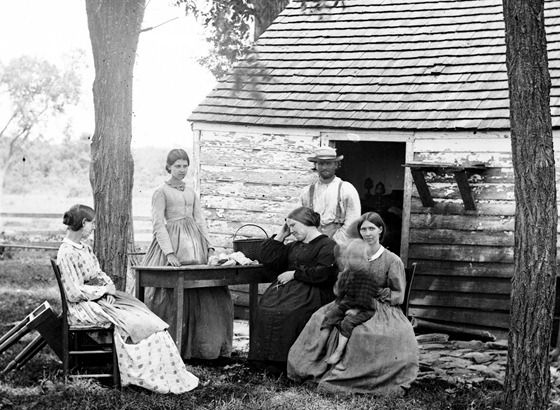
Cedar Mountain, Va. Family group before the house in which Gen. Charles S. Winder (C.S.A.) died.

Cedar Mountain, Va. Family group before the house in which Gen. Charles S. Winder (C.S.A.) died

Cedar Mountain, Virginia. Photo taken by Timothy H. O’Sullivan.

Library of Congress image.


Charles Sidney Winder (October 18, 1829 – August 9, 1862), was a career United States Army officer and a Confederate general officer in the American Civil War. On August 9, 1862, Winder led his men into battle at Cedar Mountain, on the left flank of the Confederate line. He did so despite having been ill for several days, and in defiance of a surgeon’s order to rest. He was personally directing the fire of a battery when a Union shell struck him in his left side, horribly mangling him. Borne to the rear on a stretcher, Winder died later that evening.  (Wikipedia)

AUGUST 10TH.—Jackson struck Pope yesterday! It was a terrible blow, for the numbers engaged. Several thousand of the enemy were killed, wounded, and taken prisoners. Among the latter is Gen. Prince, who arrived in this city this morning. He affected to be ignorant of Pope’s brutal orders, and of the President’s retaliatory order concerning the commissioned officers of Pope’s army taken in battle. When Prince was informed that he and the fifty or sixty others taken with him were not to be treated as prisoners of war, but as felons, he vented his execrations upon Pope. They were sent into close confinement.

New York, August 10, 1862.

My Dear Sir,—I have the honor to acknowledge the receipt of your esteemed favor. Its contents bear the stamp of that statesmanship and patriotism which I know to have guided all your actions in the trials which this wicked rebellion has brought upon our once so happy country.

I share entirely your views with regard not only to the duty, but also the policy of the revolted States to return to their allegiance without allowing their unequal struggle against the power of the United States to increase in violence and exasperation, as it necessarily must. Still I think that we might, perhaps, find means to remove the difficulties which the miseries of civil war and the terrorism conjured up by the leaders of the rebellion, have placed in the way of conservative men, who otherwise would most gladly return to the Union.

The words conquest and subjugation have been used to good effect by our opponents. They are words repugnant to the American ear, and while the rebel leaders can keep up to their misguided followers the idea that the North means conquest and subjugation, I fear that there is very little hope for any Union demonstration in the revolted States, however great the dissatisfaction against the Richmond government might be.

My own conviction has always been, that sooner or later we would have to come to a national convention for the reconstruction of one government over all the States. I cannot see by what other means, even after a complete defeat of the rebel armies, a restoration of the Union can be effected.

My impression is, that such a solution would, at the proper time, be acceptable to the majority of the Southern people, and I sent to Mr. Weed the letter which procured me the honor of receiving your note, for the very reason that I saw in it an indication of the writer’s desire for a reconstruction of the Union. He is a very wealthy and influential planter, and I have every reason to believe that a large number of his class share his views.

A few weeks ago, and previous to the receipt of that letter, I had written to Mr. Weed, giving him my candid views on our present situation and the means which I thought the government ought to adopt. I do not know whether he communicated to you my letter, but as you have been kind enough to evince a flattering confidence in the earnestness of my intentions, which must plead for the shortcoming of my judgment, I take the liberty of inclosing you herewith a copy of my letter to Mr. Weed, hoping that you may deem it worthy of your perusal.

The present moment may, perhaps, not be a propitious one for carrying on a negotiation in the manner in which I suggest. As soon, however, as we shall have again a large army in the field, such as we are sure to have under your energetic measures for recruiting, then I hope that vou may find in your wisdom the means of opening negotiations with our misguided fellow-citizens of the South.

They must become convinced that we are fighting only for the Union, and that we cannot, in our own self-defence, as a nation, admit any other solution but the Union. I am certain that ere long reason must prevail over sectional passion, provided that your strong hand will equally crush the Secessionists of the South and the fanatical disorganizer s of the North, who are both equally dangerous to the country and its institutions.

August 10.—Edwin M. Stanton, Secretary of War, issued the following order at Washington, D. C.: “The temporary restrictions upon travelling, deemed necessary to prevent evasions of liability to be drafted into the militia, were not intended to apply to couriers with despatches to and from the legations of friendly Powers in the United States. All authorities, civil and military, are consequently required to allow such couriers to pass freely, without let or investigation.”

— The national steamer Freeborn arrived at Washington, D. C, bringing twenty-five prisoners, five sail-boats, a number of canoes, and a lot of merchandise, which were captured on Friday and Saturday nights last near Blackiston Islands. The prisoners had been engaged in regular commerce between Maryland and Virginia, taking over salt, etc., and bringing back wheat. — Commander Richard Wainwright, U.S.N., died at New Orleans, La.

— A Rebel steamer was this day captured at the mouth of the Savannah River, Ga., by a Union tug-boat, and towed under the guns of Fort Pulaski.— The town of Donaldsonville, La., was this day partially destroyed by a party of men from the United States sloop-of-war Brooklyn.— (Doc. 177.)

August 9 — The band that played last night belongs to General Anderson’s Brigade.

This morning we were ordered to the front, which lies in the direction of Culpeper Court House. We started early, and even then the road was already crowded with baggage and ordnance wagons all headed toward Culpeper. At nine o’clock we crossed the Rapidan River, which is the boundary between Orange and Madison counties. We forded the Rapidan at Madison Mills, and passed through a corner of Madison County, then crossed the Robinson River into Culpeper County.

About three o’clock this afternoon we sighted the enemy nine miles from Culpeper Court House. Jackson’s batteries were ordered to the immediate front, took position and opened fire on the enemy right away. I think this initiatory fire was for the sole purpose of inducing this great and pompous man, Pope (who is just from the West, and boasts that he has never seen anything of the Rebels but their backs), to disclose his intentions and feel his front. The enemy was prompt in replying to Jackson’s batteries, and the cannonading soon after became general along the front, and opened the battle of Cedar Mountain.

From the way the trains were running last night and bringing troops from the direction of Richmond, and from the bustle and stir in the infantry camps, I thought that Jackson was fixing to butcher, but I had no idea that the eventful sword measuring that of the mighty Pope would be drawn so soon. I have no idea what kind of timber is in the make-up of this military giant from the West who has been feeding on eagle meat, but unless he is awfully superior to the Yankee generals that operated in the Shenandoah Valley a few months ago and butted up against old Stonewall, he will find that by the time he bumps against the sticking qualities of Jackson’s bayonets, and receives a few practical object lessons in flanking from the master of that art, he will be ready to soar to Washington and whisper to the Secretary of War that he (Pope) believes and is under the serious impression that he has had a peep at something of the Rebels on the fields of Virginia that did not exactly look altogether like their backs.

The field where the battle of Cedar Mountain was fought is a plain about two miles long and half a mile wide, skirted on each side with woods. On the southeast side is a large hill, or rather a little mountain, covered with timber. Nearly at the summit of the little mountain Jackson had a battery which did good and effective work during the fight.

At the northern extremity of the plain General Pope had his line of battle, at the edge of a beautiful field rather sloping to the south. Our infantry was thrown out on the right and left in the woods, and advanced on the enemy’s line at least a part of the way under shelter of the woods.

Our infantry debouched from the woods about half a mile from Pope’s battle line and drove in the heavy skirmish line in its front, then advancing in splendid order and battle array on the enemy’s main line, and soon after the storm of musketry began to rage furiously along both lines with the same fearful, terrific roar, only more of it, that I heard at Port Republic.

In the meantime our infantry on the extreme left advanced in quick time and promptly assaulted the enemy’s right, which was composed of splendid troops that fought well and stubbornly clung to their position with obstinate tenacity and such undaunted courage that eventually they charged Jackson’s left with a determined onslaught that caused an Alabama regiment to waver and about ready to do that which would permit them to fight some other day. They had already commenced to let Pope have a sly glance at their backs, which was a dangerous exhibition just at this juncture, as it came very near stampeding our whole left wing. I was near the place where this mixing affair occurred, and saw our men come rearward in a sort of wild, conglomerate, stampedy mass.

Just then, and in time to prevent a disastrous wavering and general stampede, General D. H. Hill, with drawn sword, appeared among the apparently disorganized troops, and with urgent appeals and persuasive demeanor he succeeded in rallying the wavering and started it in order toward the front.

After a strengthening plaster had been applied to the weak and shaky place in his line, by the ubiquitous and invincible Stonewall in person, the left wing again advanced with redoubled courage, and in turn swept back the Yankee line beyond its first position. The battle was now in full bloom all along the line. Jackson’s batteries on the mountain side were still thundering away and doing good work, while on our right a continued blaze of fire flashed along the opposing lines of infantry and the musketry raged with terrifying fury. The surrounding air was full of flying messengers that gathered in with a dull thud many inhabitants for the silent city of the dead. I saw our wounded pass to the rear. . Some were able to walk and others were carried back on stretchers — among the latter General Winder, who commanded the old Stonewall Brigade, mortally wounded.

The battle lasted till about sunset, when the musketry ceased; but there was some artillery firing till nearly midnight. Our forces drove the enemy about four miles, and we held the battle-field.

At dark the first gun was ordered forward, and we went down on the field and bivouacked right where an Ohio regiment that was charged by a North Carolina regiment this afternoon occupied the Yankee line. Before the terrible fire of the Yanks slackened and their line began to waver and sullenly fall back under the severe pressure of Jackson’s war machine, here the conflict had been desperate and severe; but as the gallant North Carolinians debouched from the woods they fired a volley into the Ohioans at close range, then rushed down, the hill firing as they went, and before they reached the Ohioans close enough to work on them with cold steel the Buckeye boys had retired with thinned ranks.

The Federal dead lay all around our bivouac, and I heard the pitiful groans of the wounded and the low weakly murmurs of the dying. When I lay down on blood-stained sod to snatch a few hours of sleep it was then two hours after midnight, and the desultory artillery fire that was kept up in the fore part of the night had fully died away and the dogs of war were silent once more.

The sudden and abrupt vicissitudes of sanguinary war rush a man rough-shod from one end of the scale of human experience to the other. Last night I was lulled to sleep, as it were, by the enlivening and inspiring strains of a band playing “Home, Sweet Home”; to-day I heard the hideous roar of battle, and to-night I am kept awake by the constant and pitiful murmur of the wounded and groans of the dying without any “Sweet Home ” in it.

If this cruel war lasts seventy-five years, and the, Yanks don’t kill me before it ends, I hope that I will never be compelled to bivouac on another fresh battlefield.

The same silvery moon that flooded the hills of Orange last night hangs again in an unclouded sky and bathes the plains of Culpeper with a sea of mellow light, and the battle-field lies in a weird silvery glow nearly as light as day. The moonbeams that played last night with velvety fingers, penciling with silvery sheen the silent hieroglyphics of Hope that flashed over the cheeks of sleeping soldiers as they dreamed of home and loved ones far away, to-night silently falls and lingers on many upturned faces that are as cold as marble and wearing the pallid and ghastly hue that can alone be painted by the Angel of Death.

I wonder where that band is that played “Home, Sweet Home” last night. I wish it would come right here and play “Come, Ye Disconsolate,” so as to drown this constant wailing of the wounded.

Our battery was not engaged to-day, but we were under fire of the enemy’s batteries about twenty minutes.