Following the American Civil War Sesquicentennial with day by day writings of the time, currently 1863.

August 2012

August 9th.

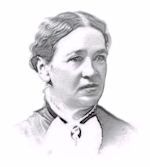
To our great surprise, Charlie came in this morning from the other side. He was in the battle, and General Carter, and dozens of others that we did not think of. See the mountain reduced to a mole-hill! He says, though the fight was desperate, we lost only eighty-five killed, and less than a hundred and fifty wounded! And we had only twenty-five hundred against the Yankees’ four thousand five hundred. There is no truth in our having held the Garrison even for a moment, though we drove them down to the river in a panic. The majority ran like fine fellows, but a Maine regiment fought like devils. He says Will and Thompson Bird set fire to the Yankee camp with the greatest alacrity, as though it were rare fun. General Williams was killed as he passed Piper’s, by a shot from a window, supposed to have been fired by a citizen. Some one from town told him that the Federals were breaking in the houses, destroying the furniture, and tearing the clothes of the women and children in shreds, like maniacs. O my home! I wonder if they have entered ours? What a jolly time they would have over all the letters I left in my desk! Butler has ordered them to burn Baton Rouge if forced to evacuate it. Looks as though he was not so sure of holding it.

Miss Turner told Miriam that her mother attempted to enter town after the fight to save some things, when the gallant Colonel Dudley put a pistol to her head, called her an old she-devil, and told her he would blow her d— brains out if she moved a step; that anyhow, none but we d— women had put the men up to fighting, and we were the ones who were to blame for the fuss. There is no name he did not call us.
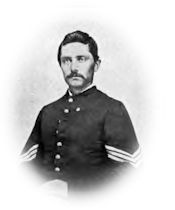

Saturday, 9th—The weather is very hot and during the day the men not on duty keep close to camp. There are some fine orchards in this locality and we get plenty of fruit now, as all orchard guards have been removed. The men are given passes and every day four or five from each company go out to get fruit.

About July 1, 1862, my father was stricken with paralysis. My sister, Mrs. Susie Adams, and myself were hurriedly summoned to Canada. The doctor said that his condition was critical, and we left immediately. Upon our arrival we found my father somewhat improved, and his convalescence continued from that time until he was entirely well. We remained in Canada about three weeks.

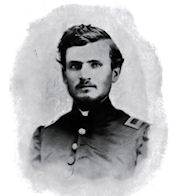
On the 9th day of August, 1862, Captain Lyon was Field Officer of the day, and on account of the sickness of so many of the officers he was obliged to do double duty. The day was fearfully hot and he became very much exhausted. In the afternoon when he returned to camp he felt so weary that he lay down on the ground in his tent. He remembered that Colonel Murphy came into his tent and told him that he had been commissioned Colonel of the 13th Regiment, but it made no particular impression upon his mind. He also remembered that the Lieutenant came into his tent and looked at him, and later that he brought Dr. Murta to him.[1] The following letter, dated August 17, 1862, was received from our brother-in-law, A. S. Northrup:

I have just returned from the 8th Regiment on a visit to Wm. P. Lyon. Colonel Lyon, of the 13th, he is now. Found him rather poorly. He has been sick about a week, but the surgeon says that he is now on the gain.

I should judge from what I learned that he has been quite sick, but the doctor says that there is no danger but that he will get along now. He is relieved from duty in the 8th and will join his regiment, the 13th, at Columbus as soon as able. His disease, the doctor says, is a slow, dull kind of fever. It will take time for him to get over it, but he does not apprehend any danger at all. I think he is a little worried about himself, especially as the 8th is about moving some seventy miles to Tuscumbia, Ala., and his surgeon thinks he had better go with them, for a while at least, as they understand his case and think it would be better than to put him into strange hands. It is not certain that the regiment will go farther than Iuka, about 25 miles on the Memphis and Charleston R. R. William went on the cars. I happened there just in time to see him a little while and help him aboard. I took his cot into the car, so that he could lounge at leisure. When I left him he seemed very comfortable indeed. I tried to get him to come and stay with me until he got able to join his regiment, but he thought he would enjoy himself better to wait until he was able to be about some. I shall expect him in about a week. I should not much wonder if you should see him in Wisconsin in less than a month, as he will hardly be fit for duty in less than two months. William’s company feel like orphans, almost. I find he was a regular pet in the whole regiment. He will receive the very best of attention, and I do not think there is any cause of alarm, as the doctor says that all he requires now is good nursing.


[1] This was the last of my service with the 8th Regiment. While I was ill the regiment moved down to Tuseumbla, past Iuka. I went over to Corinth on my recovery and resigned as a Captain of the 8th. Bartlett took the place of Captain of Company K. Smith had been made Captain of Company B. He was a fine soldier and popular. I went home for a month on leave of absence. A few days after I left Price came and the rebels were whipped. There was a good deal of fighting about there then. After I left, the 8th was in the fight that is called the last battle before Corinth. When I felt able to go on duty again I went to Madison and mustered in as Colonel of the 13th and went back South. I found my regiment at Fort Henry.—W. P. L.

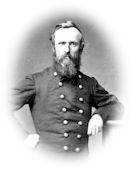
August 9. Saturday. — Am planning an expedition to go to Salt Well and destroy it; also to catch old Crump if he is at home. Jacobs, Company G, a scout, went up yesterday to Crump’s Bottom. Reports favorably. All safe now. Curious, quiet fellow, Jacobs. He takes no grub, wears moccasins; passes himself for a guerrilla of the Rebels, eats blackberries when he can’t get food; slips stealthily through the woods, and finds out all that is going.

Old Andy Stairwalt, a fat, queer-looking old fifer with a thin voice, and afflicted with a palpitation of the heart (!) —a great old coward, otherwise a worthy man — was one of the first men who reached here from the ferry after the attack of Wednesday. He was impressed that the enemy were in great force. I asked him if they fired their cannon rapidly. “Oh, yes,” said he, “very rapidly; they fired twice before I left the camp”!

Sad news. The dispatch tells us that “General Bob McCook was murdered by guerrillas while riding in front of his brigade in Tennessee.” He always said he did not expect to survive the war. He was a brave man, honest, rough, “an uncut diamond.” A good friend of mine; we have slept together through several stormy nights. I messed with him in his quarters on Mount Sewell. Would that he could have died in battle! Gallant spirit, hail and farewell!

I send out today Company E, thirty-nine men, K, twenty-seven men, H, about thirty men, and a squad of men from A, I, and C of twenty-seven men, and about twenty-five cavalry to stop the salt well in Mercer, twenty miles above here. Total force about one hundred and fifty men. They go up to Crump’s Bottom, catch him if they can, take his canoe and the ferry-boat and destroy the Mercer salt well. This is the programme.

A charming affectionate letter from my dear wife. She speaks of her feelings on the night before the regiment left for the seat of war, a year ago the 24th of July.[1] Dear Lucy, God grant you as much happiness as you deserve and your cup will indeed be full! She speaks of the blue-eyed beautiful youngest. He is almost eight months old. A letter from mother Hayes, more cheerful than usual, religious and affectionate. She is past seventy, and fears she will not live to see the end of the war. I trust she will, and to welcome me home again as of old she used to from college.


[1] Mrs. Hayes had written from Chillicothe, August 2: “The 24th of July a year ago was a happy, and yet, oh, sad night, and yet the thought that I was with you to the last moment of that sad parting sends such a thrill of joy through my heart. I think of it so often. ‘Twas bitter to know that when morning dawned, instead of joy and happiness, ‘twould bring such heavy sorrow, such bitter tears. We stood and gazed after the cars holding all that was dearest to us, but I was a soldier’s wife, I must not cry yet. While standing there, an old woman spoke to Mother, asking who was gone; then she turned to me, ‘You had better take a good cry, my dear, ’twill lighten your heart.’ How freshly everything comes before me now!”

9th. Saturday. In the morning had to give up the book which I had borrowed from Robinson. Accomplished very little during the day. Tried to write Will but could not think fast enough, so threw aside paper and ink. Sale of cattle confiscated at the fort. Archie attended. Stock mostly bought by Babcock and Company, who are getting rich from the government. So are many of Kansas officers interested in the many contracts made for the troops, purposely kept here in Kansas. 9th and Battery arrived.

Written from the Sea islands of South Carolina.

[Diary] 9th.

. . . Ellen and I took the little children into the creek to bathe, having dressed them in some of the “theatricals” that came down here. There was more fun and mud than cleanliness.

Hunter’s negro regiment disbanded! Hunter almost broke his heart pleading for pay for them, and now that he sees he cannot obtain it, he disbands “for a time,” he says, and sends the men to “gather crop.”

Thursday, 9th.—Moved a quarter of a mile to good water. Drew two months’ wages to-day, $22.00. Remaining here until the 13th, had some time for letter-writing. Some letter paper and envelopes had been captured in the fight; I got hold of some of it; the envelopes were pretty small, but on the left-hand corner was printed “The Girl I Left Behind Me;” so I proceeded to write to one I had left behind me and I wrote so much that when I got it into that small envelope it looked about as full as a “stuffed toad;” I got a very nice answer to that letter, but it wasn’t very long until the girl married an old bachelor. A lady told me after the war was over, that she read that letter. No doubt she enjoyed reading it for it was a “goodun.”


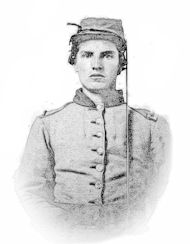
(Note: picture is of an unidentified Confederate soldier.)

AUGUST 9TH.—Jackson and Ewell are waiting and watching. Pope will expose himself soon.

Battlefield of Cedar Mountain, August 9th,1862

The battle at Cedar Mountain, Aug. 9th, 1862 Charge of Crawford’s Brigade on the right.

Published by Currier & Ives, [between 1862 and 1872]

Print caption: Between the Corps d’armée of Genl. Banks, constituting a part of the Army of Virginia, under Genl. Pope and a vastly superior number of the Rebels under Elwell and “Stonewall” Jackson, the Rebels were finally repulsed, and the Field occupied by the Federal Army.

Library of Congress Prints and Photographs Division image

August 9th. Heat fearful; troops neglecting everything not absolutely necessary. At dress parade the following circular was read at the head of each regiment:

Headquarters First Division, Second Corps,

Camp Near Harrison’s Landing, August 7, 1862.

Circular.

The general commanding the division desires to express to the command his appreciation of their successful efforts in bringing back the division to the high standard which it held previous to the recent battles.

This division has now a high reputation for valor and for endurance, and also for subordination, without which the other soldierly qualities are valueless. You are again called upon to hold yourselves ready to meet an enemy in arms against his own country and his own flag!

Soldiers of the First Division, you are ready.

W. H. French,
Brigadier-General Commanding Division.

About noon, a tall, fine looking young officer called upon me and claimed acquaintance on account of similarity of names. He is a captain, not over twenty-three or four years old, and comes from Little Falls, New York, where his family of Favills have been established since 1690, I think he said; found him very agreeable and enjoyed the interview.