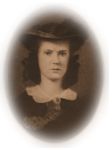
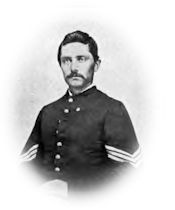
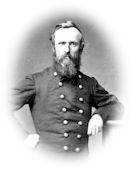
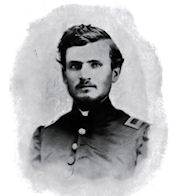
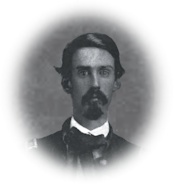
Westover Landing, Va. Lts. Wright and John W. Ford of Averell’s Cavalry
by photographer Alexander Gardner in August 1862 at Westover Landing, Va..
Library of Congress image from Civil War glass negative collection.
Westover Landing, Va. Lts. Wright and John W. Ford of Averell’s Cavalry
by photographer Alexander Gardner in August 1862 at Westover Landing, Va..
Library of Congress image from Civil War glass negative collection.
August 6.—Col. Thomas C. Johnson, aid to the rebel Gen. Price, at Quitman, Miss., issued the following call to the people of that State:
“I am in your midst for the purpose of procuring shoes and yarn-socks for Gen. Price’s army. Some of his veterans—men who have been in six or eight pitched battles and twenty skirmishes— are to-day destitute of these two articles, necessary even in camp, but indispensable when the army takes the field. As this army now guards the gates to the entrance of the Mississippi, preliminary to driving the enemy northward, Gen. Price desires that the patriotic men of this State should furnish the shoes, and her glorious women the yarn-socks. If possible, he would like every white woman in the State to knit at least one pair of socks for his army. While I make this appeal, I think it is proper to add, that I do not ask a donation, but am prepared to pay a liberal price for both shoes and yarn-socks. I shall be pleased to contract with tanners and shoe-manufacturers for shoes now on hand, or to be made hereafter; and will be obliged to any person who will let me know where I can make contracts.
“For socks, all yarn, white or colored, of good size and length in the leg and foot, I will pay seventy-five cents per pair. They may be sent to me or Dr. France at this place, where they will be paid for, or may be left with the station-agent of the nearest depot of any of the three railroads now in our possession, and some time soon I will call or send an agent to get them and pay for them.”
—At Point Pleasant, Mo., a skirmish occurred between the citizens of that place and the State troops, on account of a difficulty growing out of the enrolment act.—A large war meeting was held at Scranton, Pa., at which speeches were made by Galusha A. Grow and W. W. Ketchum.—A skirmish took place near Montevallo, Mo., between a force of Union troops under the command of Major Montgomery, and a small party of rebel guerrillas, resulting in the rout of the latter with great loss.—Springfield (Mo.) Journal, Aug. 11.
—W. D. Porter, commanding a division of the Mississippi gunboat flotilla, with the gunboat Essex, attacked the rebel iron-clad Arkansas, at a point about four miles above Baton Rouge, La., and after a short engagement succeeded in destroying her.—(Doc. 91.)
—Charles A. Carroll, a rebel colonel commanding North-west Arkansas, at Fort Smith, issued general orders compelling all persons in the counties of Benton, Washington, Madison, Carroll, and Newton, between the ages of eighteen and thirty-five to attach themselves at once to the companies raised by him, and declaring “that the oaths administered by the Federals were without legal authority, having no binding efficacy with any civilized people; and a citizen who would think of regarding such iniquitous oaths would be as infamous as those who administered them; and any such would be dealt with as they deserve, understanding at the same time, that the confederate officers everywhere would protect citizens in this their first duty to their country by every means of retaliation necessary to the end in view.” —General Order*.
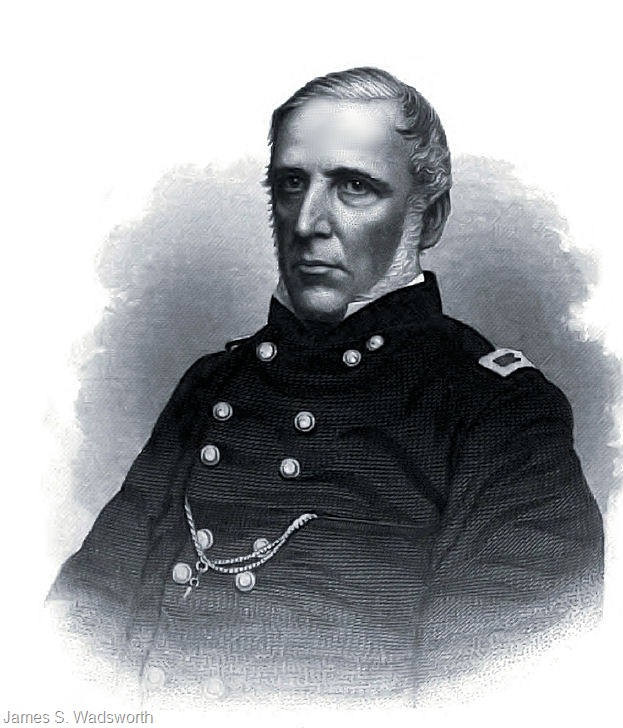
—At Harrisburgh, Pa., Gen. Wadsworth, by direction of the War Department, arrested the editors and publishers of the Patriot and Union, charged with issuing treasonable posters, calculated to retard and embarrass recruiting throughout Pennsylvania.
—Brigadier-general Robert L. McCook, died from wounds received from a party of guerrillas, who attacked him while proceeding in an ambulance from Athens, Ala., to the National camp near Dechard, Tenn.—(Doc. 172.)
—A Reconnoissance was made from General Burnside’s army by two forces, one under command of Gen. Gibbon, and the other under Acting Brig.-Gen. Cutler, for the purpose of breaking the railroad communication with Richmond, Va. The first advanced as far as the Mattapony River, where they were met by a force of Gen. Stuart’s rebel cavalry, when a skirmish ensued, resulting in the retreat of the rebels. Gen. Hatch having joined Gen. Gibbon, the two forces crossed the river and advanced seven miles, but learning that a large rebel force was on his right, and fearing lest he should be cut off, Gen. Gibbon retraced his steps and returned to camp without having accomplished the object for which he was sent The column under Gen. Cutler was more successful. It advanced to Frederickshall Station, and tore up a section of the railroad, destroyed the water-tanks, five thousand bushels of grain and a quantity of whisky; cut the telegraph-wires and blew up the road-bed. One detachment was sent above and another below the station, both doing great damage. On returning to camp, a large bridge on the Pamunky River was burned to prevent the rebels from following. The expedition was considered satisfactory, and returned to camp with a loss of one killed and seventy-two taken prisoners.
—Yesterday and to-day a series of sharp skirmishes occurred near Tazewell, Tenn., between a body of Union troops under the command of Col. De Courccy, and a superior force of rebels, resulting on each occasion, in a repulse of the latter with considerable loss.—(Doc. 173.)
—An enthusiastic war meeting was held at Washington, D. C, at which patriotic resolutions were adopted and speeches made by President Lincoln, Gen. Shields, and others.—(Doc. 174.)
James Samuel Wadsworth (October 30, 1807 – May 8, 1864) was a philanthropist, politician, and a Union general in the American Civil War. He was killed in battle during the Battle of the Wilderness of 1864. (Wikipedia)
August 5th.
About half-past nine, as we got up from the breakfast table, a guerrilla told us the ram Arkansas was lying a few miles below, on her way to cooperate with Breckinridge, whose advance guard had already driven the pickets into Baton Rouge. Then we all grew wild with excitement.
Such exclamations! such delight that the dreadful moment had at last arrived! And yet you could see each stop as we rejoiced, to offer up a prayer for the preservation of those who were risking their lives at that moment. Reason, and all else, was thrown aside, and we determined to participate in the danger, if there was any to be incurred. Mother threatened us with shot and shell and bloody murder, but the loud report of half a dozen cannon in slow succession only made us more determined to see the fun, so Lilly Nolan and Miss Walters got on horseback, and Phillie, Ginnie, Miriam, and I started off in the broiling sun, leaving word for the carriage to overtake us. When we once got in, the driver, being as crazy as we, fairly made his horses run along the road to catch a glimpse of our Ram. When, miles below, she came in sight, we could no longer remain in the carriage, but mounted the levee, and ran along on foot until we reached her, when we crossed to the outer levee, and there she lay at our feet.
And nothing in her after all! There lay a heavy, clumsy, rusty, ugly flatboat with a great square box in the centre, while great cannon put their noses out at the sides, and in front. The decks were crowded with men, rough and dirty, jabbering and hastily eating their breakfast. That was the great Arkansas! God bless and protect her, and the brave men she carries.
While there, a young man came up, and in answer to Phillie’s inquiries about her father — who, having gone to town yesterday to report, being paroled, had written last night to say no passes were granted to leave town — the young fellow informed her so pleasantly that her father was a prisoner, held as hostage for Mr. Castle. Poor Phillie had to cry; so, to be still more agreeable, he told her, Yes, he had been sent to a boat lying at the landing, and ran the greatest risk, as the ram would probably sink the said boat in a few hours. How I hated the fool for his relish of evil tidings!
But never mind our wild expedition, or what came of it. Am I not patient! Ever since I commenced to write, the sound of a furious bombardment has been ringing in my ears; and beyond an occasional run to see the shells fly through the air (their white smoke, rather) I have not said a word of it. The girls have all crowded on the little balcony up here, towards town, and their shrieks of “There it goes!” “Listen!” “Look at them!” rise above the sound of the cannon, and occasionally draw me out, too. But I sit here listening, and wonder which report precedes the knocking down of our home; which shell is killing some one I know and love. Poor Tiche and Dophy! — where are they? And oh, I hope they did not leave my birdie Jimmy to die in his cage. I charged them to let him loose if they could not carry him. Dophy will be so frightened. I hope they are out of danger. Oh, my dear home! shall I ever see you again? And the Brunots! Oh, how I hope they are safe. These loud cannon make me heartsick, and yet I am so excited! How rapidly they answer each other! I am told the attack commenced at five this morning, and lasted three hours. Those girls are shouting that Baton Rouge must be on fire, from the volume of smoke in that direction. How they scream as the balls go up, to show it to each other. I think I’ll take a look, too.
We are all going four or five miles through this warm sun to be nearer the scene of action. Any one might know there was no white man on the premises. There is the carriage! Oh, I am so seasick! What will I be before we get back?
Tuesday, 5th—The Eleventh Iowa drew two months’ pay today. I received $26. We are able to purchase most any kind of goods needed, right here at Bolivar only two miles from camp.
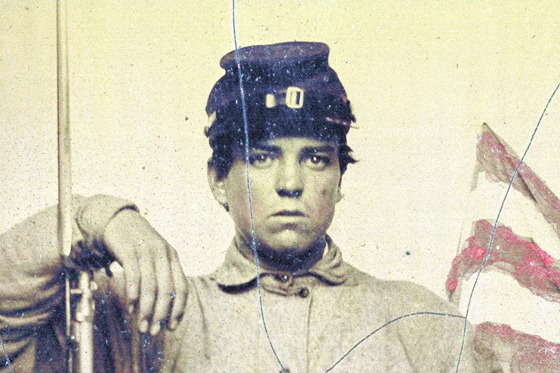
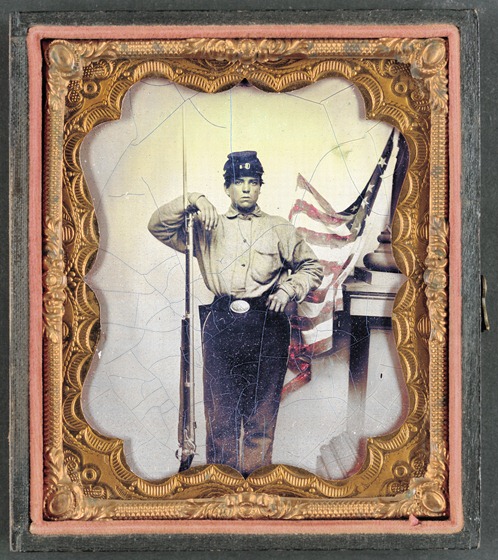
Library of Congress image:Unidentified soldier in Union uniform with bayoneted musket in front of painted backdrop showing American flag and column pedestal, donated to the Library of Congress 2012 by Tom Liljenquist; Liljenquist Family Collection of Civil War Photographs.
August 5, 1862. Tuesday. — Target practice continues. I did a thing that worried me this A. M. I saw two soldiers sitting on post. It was contrary to orders. I directed that they should carry knapsacks one hour. I do not often punish. They turned out to be two good quiet soldiers. But the order was given before I knew who they were. One of them felt badly, wanted to be excused; but the order was out and I had it executed. I trust it will cure the evil. . . .
5th. Tuesday. In the morning did little of everything. Wrote to Fannies A. and H. in answer to letter received almost three months since. In the afternoon the service for the burial of three men was performed. Lt. Pike drilled the escort. It seemed his whole ambition to get the men well drilled. He had an escort drilling for one very sick man who had not yet died. Maj. M. and Adj. W. boarding with us. In the evening attended a variety performance up town. Very good for barren Fort Scott. Got home about midnight. Received no letters, a little disappointed. Mr. Hawkins returned yesterday.
Headquarters Stevens’ Div.
9th Army Corps, Steamer “Elm City,”
Aug. 5th, 1862.
My dear Mother:
Here we are at length at Acquia Creek. Our destination is Fredericksburg. Please direct your letters to that place in future. We are exchanging at every move disease for health. Our present position is one of the healthiest in Virginia, so, dear Mother, give yourself no alarm.
I received two letters from you previous to leaving Newport News, one written after Lilly’s marriage, which had travelled down to Hilton Head, and the other a letter containing an account of the kindly manner all speak of me at home. For the latter I am grateful indeed, though I feel a little puzzled at its extent. The first day I landed at Newport News, as I was riding toward our camping ground, a nice, handsome-looking young fellow stopped me, saying, “How are you, Will?” I stopped, examined his face, talked, and tried to discover who my friend was. After running through the probabilities, I said, “Why, this is Charley Breed!” “Yes,” said he, “you are a good deal changed, but I recognized you at once.” So we parted, promising soon to meet again. But duty intervened, and the other day I read that he was dead.
I received likewise a letter from Edward Stedman, via Hilton Head, with kind words of encouragement for me.
I have nothing more to write. Don’t mind.
Instead of “Speed the Plow,” “Speed the Bayonet,” and all will be right again. Vwe la guerre and down with the rebellion. If the South wishes to secede, they must wait until they ask it of the North, not with threats, but in fear and trembling.
Good-bye, dear mother,
Truly your affec.
Will,
Capt. & A. A. A. G.
which means that the Assistant Adjutant-General is sick and has gone home, and that I am acting in his place until his leave of absence expires.
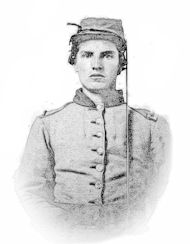 Tuesday, 5th.—At 2 P. M., started forward; soon came to Clinch River; advance guard skirmishing a little some distance out. Saw one Federal prisoner. Clinch River was about one hundred and fifty yards wide; no bridge; ordered to wade through. Now came a ridiculous but laughable scene, 1,800 breechesless men wading in water three feet deep and more, trying to keep dry shirts. One agreed to pay another fifty cents to carry him over; so, mounting on his back, they started in, but before getting half-way across fell, and both went under together. Camped at 10 P. M., four miles from Tazewell.
(Note: picture is of an unidentified Confederate soldier.)
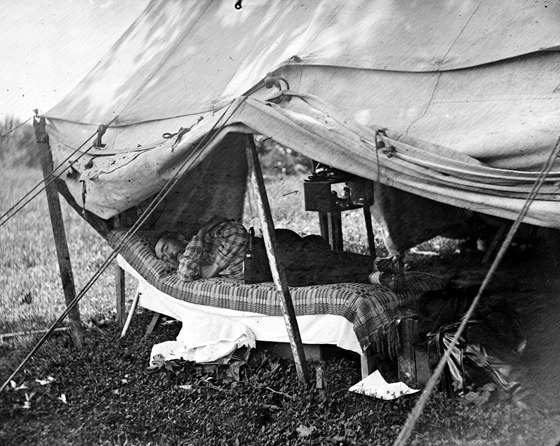
Lt. Col. Samuel W. Owen, 3d Pennsylvania Cavalry, caught napping by photographer Alexander Gardner in August 1862 at Westover Landing, Va..
Library of Congress image from Civil War glass negative collection.
________
From Antietam on the Web:
Before the Antietam Campaign:
A tailor by trade, with a successful business in Washington DC, Owen was among the first in Federal service at the outbreak of War in April 1861. His Independent Company of (DC militia) cavalry helped man the defenses of Washington DC before the arrival of the first regiments from the Northern States. In July he enrolled in the newly forming 3rd Pennsylvania Cavalry in Washington, mustering into Federal service as their Lieutenant Colonel on 19 August 1861 for three years. Due to the frequent absence and eventual promotion of Colonel William Averell, Owen was in effective command of the Regiment for much of his service. He was in action on the Peninsula Campaign of 1862, and commanded the 3rd Pennsylvania after 6 July when the Colonel took over the Brigade.
In the Antietam Campaign:
Owen was in command of the regiment on the Maryland Campaign; Colonel Averell absent with the “Chickahominy Fever” (malaria).
The remainder of the War:
He resigned his commission soon after Antietam, on 25 October 1862.
 Follow on facebook
 RSS
 email