Written from the Sea islands of South Carolina.
[Diary] August 4.
Bad news to-night. Halleck is made General-in-Chief of the Army. There has been a meeting in New York of conservative men who sent a petition to Lincoln for emancipation.
Written from the Sea islands of South Carolina.
[Diary] August 4.
Bad news to-night. Halleck is made General-in-Chief of the Army. There has been a meeting in New York of conservative men who sent a petition to Lincoln for emancipation.
Monday, August 4th.—Regiment ordered in the direction of Tazewell; marched fifteen miles; made me very sore marching to-day.
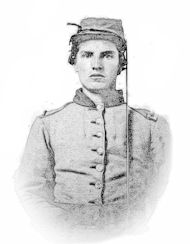
(Note: picture is of an unidentified Confederate soldier.)
August 4TH.—Lee is making herculean efforts for an “on to Washington,” while the enemy think he merely designs a defense of Richmond. Troops are on the move, all the way from Florida to Gordonsville.

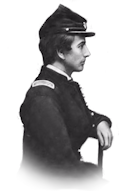
Maj. Myers, Lieuts. Stryker, and Norton, Harrison’s Landing, Virginia, August 1862. (10th Pa. Reserves); photo taken by Alexander Gardner in August 1862. Library of Congress Civil War glass negative collection.
Library of Congress image.
August 4th. General Hooker, with his division, made a reconnoissance to Malvern Hill to-day and drove in the enemy’s pickets. In the evening had a brigade drill. While taking our supper under the awning in front of our tent our old friend, the genial paymaster of the division, Major Potter, arrived. He always puts up with us, and makes himself delightfully agreeable. He gives us the gossip of the capital and such army news as is not to be had in the field; in the evening we initiated him into some more of the mysteries of camp life.
August 4. [Mobile] —Paid a visit with Mrs. G. to the General Hospital; she took the patients some buttermilk, and nice wheat and corn bread. We offered our services, but there were enough ladies in attendance already, and we were not needed. We walked around and saw the patients; one man was dying, but the others seemed to be doing well.
We then went down town; there we met Mr. Candelish and Mr. Goddard, members of the Twenty-first Alabama Regiment. It has come from Tupelo to recruit . They informed us the army had left for Tennessee.
August 4.—Gen. James H. Lane, having been appointed by the Government to raise and organize an army in the Department of Kansas, issued a proclamation from his headquarters at Leavenworth City, calling upon the inhabitants of Kansas, Nebraska, Colorado, and Dakota to aid him in the work by volunteering into its ranks.
—In England an important debate took place in the House of Lords, on the propriety of recognizing the Southern Confederacy.
—Governor Sprague, of Rhode Island, issued an order calling upon the colored citizens to enlist into the Sixth regiment of that State, then forming. The regiment was to be composed entirely of colored persons.
—A skirmish took place near Sparta, Tenn., between a small party of Union troops, under the command of Col. Wynkoop, and a superior force of rebels, resulting, after a fight of nearly an hour’s duration, in the retreat of the Nationals. —(Doc. 169.)
—Enthusiastic war meetings were held at Providence, R. I., and Erie, Pa.—Great excitement existed in the Union fleet at Port Royal, S. C, in expectation of the rebel ram Georgia making her appearance among them.
—An order directing “that a draft of three hundred thousand militia be immediately called into the service of the United States, to serve for nine months, unless sooner discharged,” was this day issued from the War Department.—(Doc. 170.)
—In order to provide for the suffering poor of New-Orleans, Gen. Butler issued an order assessing the secessionists of that city, who subscribed to the rebel defence fund, and the cotton brokers who counselled the planters not to bring their staple to market. The amount assessed was three hundred and forty-one thousand nine hundred and sixteen dollars. The Citizens’ Bank of Louisiana, which subscribed three hundred and six thousand four hundred dollars to the defence fund, was assessed seventy-six thousand six hundred dollars.—General Order No. 55.
—A fight took place on the White River, Mo., forty miles from Forsyth, between Col. Lawther and his band of rebels and a party of National troops, under the command of Capt. Birch, of the Fourteenth Missouri State troops, resulting in the defeat of the rebels, with a loss of three killed and seven wounded.
August 4.—The girls just returned from a visit to Mrs. A. of several days, which they enjoyed greatly. Every thing there very bright and cheerful, except the hearts of the parents—they yearn for their sons on the field of danger! A battle is now expected between Jackson and Pope.
August 3— Remained in camp. A train laden with soldiers passed here to-day, going to Gordonsville.
August 3, 1862.
For some days I have been expecting that every mail would bring me a letter from home, but have been disappointed. I am sure a letter is on the way, and that you would not suffer two weeks to pass without writing to me. I wrote to you some ten days ago, just after I got here. It may be this did not reach you, and you do not know where I am. I am getting to feel used to the army and to the idea of staying in it until I see the end of the war, or it sees the end of me. The work entrusted to me is highly honorable and very agreeable. I think it will be sufficient to keep me employed and make me as happy as I have ever been in the service. The only objection to it is that my labor is gratuitous and I draw no pay. I shall try and make my expense account as small as possible. The army is more quiet than I have ever known it. The enemy have considerable force some thirty or forty miles from us, amounting possibly to 30,000 men. Their cavalry and ours are occasionally skirmishing, and yesterday had quite a severe engagement with one of our regiments at Orange C. H. They are said to have had some three regiments against our one, and, so far as I can learn, we got the worst of it. No very serious damage, however, as our killed and wounded are only fifteen.
To-day—Sunday—is very quiet, and reminds me much of a Sunday at home, the usual work being suspended. Formerly everything went on as usual on any day, but now the drills and ordinary work of the week are suspended on Sunday. Whilst employment here will make me contented, for there is no use in grieving about what must be borne, yet I heartily wish that I was at home with you and our dear little children. Affection and sympathy attract me towards home as the dearest place on earth, but duty to my country and respect for my own manhood require that I should forego this happiness until the war ends—as end it must, sooner or later. I trust, darling, that you will be as contented and happy as you can under the circumstances. The inconveniences to which you are subjected are just the same which all other ladies have to bear. You, at least, have all the comforts of home and necessaries of life, whilst the wife and little ones of many a gallant man in the service are exiles from their homes or without the necessaries of life. It is a poor consolation for your own troubles that others have worse; but it is alike the dictate of piety and virtue to bear them in patience, and thus show that you merit a better fate. The war must end some day. “We may never live to see it. But we owe to ourselves to cherish the hope that we may one day live happily together again, and there will be bright sunshine after the storm which now envelops us.
 Follow on facebook
 RSS
 email