Following the American Civil War Sesquicentennial with day by day writings of the time, currently 1863.

Wednesday, December 12, 2012

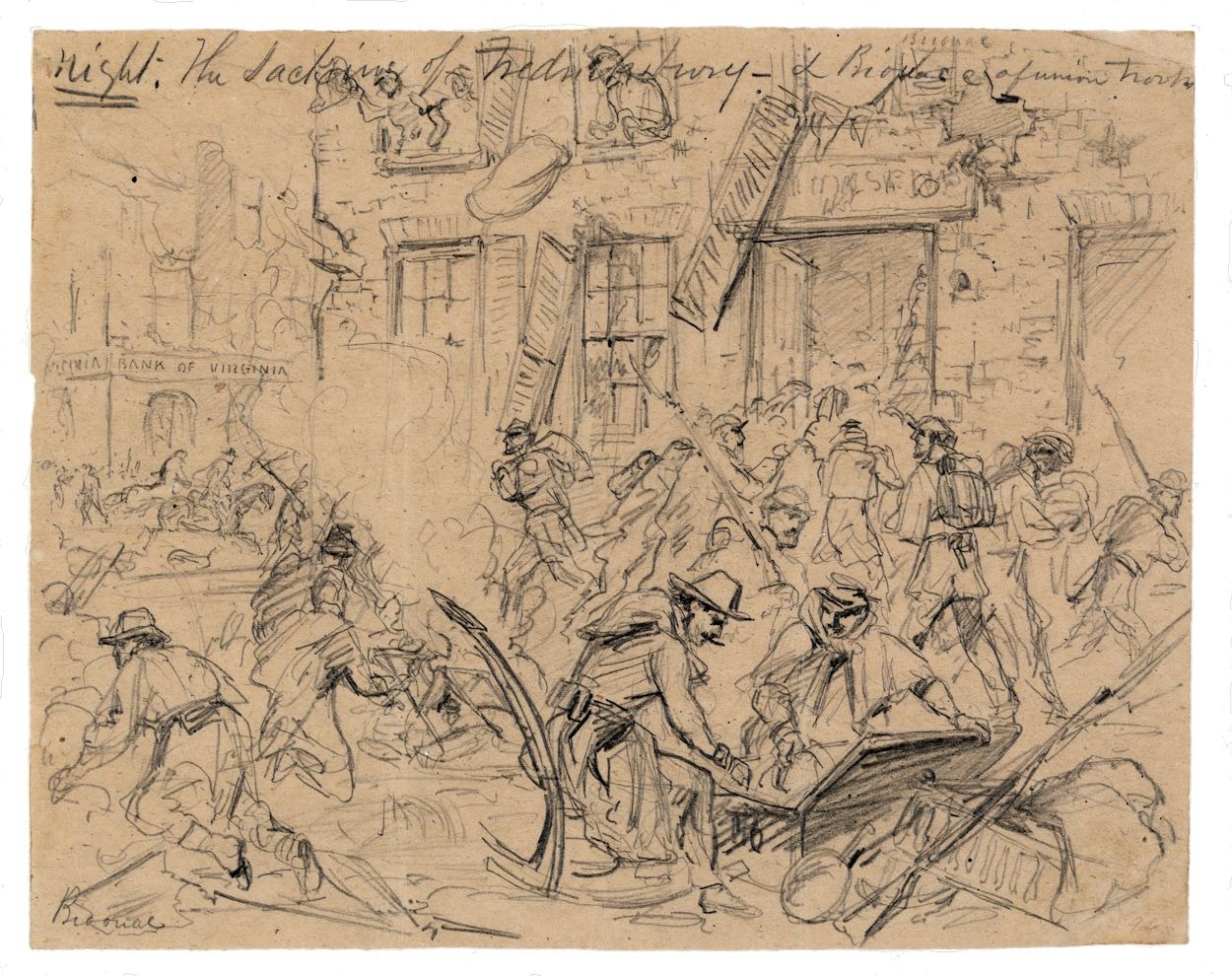
The sacking of Fredericksburg- December 12

Summary: Street scene of soldiers plundering, buildings in shambles–some on fire.

Described on verso: Friday Night in Fredericksburg. This night the city was in the wildest confusion sacked by the union troops = houses burned down furniture scattered in the streets = men pillaging in all directions a fit scene for the French revolution and a discrace[sic]to the Union Arms[?] this is my view of what I saw. Lumley.

Artist: Arthur Lumley.

Library if Congress image.

December 12th. We lay on the Phillips farm until about 8 A. M., then crossed over the pontoon bridge at the Lacy house and marched to the lower part of the town, directly opposite the old ferry dock, our left resting on the steamboat wharf; here we stacked arms, and the men keeping reasonably near to their pieces, were allowed to move about as they pleased. Brigade headquarters were established on the piazza of an old ramshackle house, at the corner of a deep cut, leading up to the town, and here we lay and watched the bursting of the rebel shells, which occasionally exploded over our heads, and the moving columns of the army as they kept continuously crossing over; we all felt shaky about coming events and there was very little hilarity. Our new regiment, the Twenty-seventh Connecticut, had its equanimity sadly disturbed by a shell bursting in its ranks killing several of its men, which almost paralyzed them. The strangest thing is that the enemy does not shell the place thoroughly, now that it is packed full of men; we expected them to do so every minute, but were luckily disappointed.

The arrangement of troops to-night is as follows: Franklin on the left, our corps next on the right, then the Ninth and Sixth, and on the extreme right the First. It became foggy again about sunset, when we posted a very heavy picket line entirely around the town, just on the outskirts, with strong reserves, and made every preparation for a night attack. All the troops across lay in the streets, getting such rest as they could. We spent the night on the piazza of the old house, and were anything but comfortable.

The heights, in rear of the town, are bristling with guns and rifle pits, and entrenchments cover the entire face of the whole range. Why we should be compelled to charge at the very strongest point in the enemy’s position is an enigma that no one can solve; one thing alone is certain, that by tomorrow at this time many of our old comrades will have fought their last fight, whatever may be the result.

DECEMBER 12TH.—The enemy have possession of Fredericksburg, and succeeded in crossing a large portion of their force three miles below, on their pontoon bridge. Up to 3 P.M. to-day, we have no other intelligence but that “they are fighting.” We shall know more, probably, before night.

The President has passed through East Tennessee on his way to Mississippi.

Lieut.-Col. Nat Tyler, publisher of the Enquirer, the organ of the government, was in my office this morning, denouncing Mr. Memminger, Secretary of the Treasury. He says Mr. M.’s head is as worthless as a pin’s-head. He also denounced the rules of admission to our Secretary, adopted by Mr. R. G. H. Kean, Chief of the Bureau, and asked for a copy of them, that he might deounce them in his paper. It appears that Mr. Jacques is to say who can see the Secretary; and to do this, he must catechize each applicant as to the nature of his business. This is deemed insulting by some of the hot bloods, and will make friend Mr. J.’s position rather a disagreeable and derogatory one.

December 12.—A skirmish took place near Corinth, Miss., between a body of Union troops, under Colonel Sweeney, Fifty-second Illinois, and a rebel force, commanded by Colonel Roddy, resulting in a rebel loss of eleven killed, thirty wounded, and forty prisoners. The Union party lost one killed and two prisoners.—One thousand seven hundred and fifty paroled Union prisoners, captured by the rebel guerrilla chief, John H. Morgan, arrived at Nashville, Tenn., this day.

—A Reconnoissance was this day made by a strong force of Union troops, under the command of General Ferry, to the Blackwater River, Va. The rebels were discovered, in great strength, all along the river in the vicinity of Zuni. After an artillery fight of three or four hours, in which the rebels were driven back, the National force returned to their camp at Suffolk.—(Doc. 71.)

—This afternoon the gunboat Essex, accompanied by the transport Winona, while making a reconnoissance of the fortifications at Port Hudson, was fired upon by a party of rebel artillerists, under the command of Captain Boone, and compelled to retire.—About day-break this morning, a large body of General Stuart’s rebel cavalry entered Dumfries, Va., and captured thirty-five National pickets and sutlers. After destroying the telegraph and several Government wagons, they retreated, and the town was soon after occupied by the Union troops, under Brigadier-General Steinwehr.—A skirmish took place on the Kinston road, about fourteen miles from Newborn, N. C, between the advance column of the expeditionary forces, under General Foster, and a small body of rebels, resulting in a rout of the latter with some loss.—(Doc. 73.)

—The rebel salt-works, at Yellville, Ark., were completely destroyed by a body of Union troops, under the command of Captain Milton Birch. Six thousand dollars’ worth of saltpetre was destroyed. The works cost the rebels thirty thousand dollars.—(Doc. 70.)

—Brigadier-general D. S. Stanley, with a strong force of National cavalry, made a descent from Nashville, this morning, upon Franklin, Tenn., and after routing the rebels from the town, destroying mills and other property useful to them, returned to his camp, having lost but one man. Five rebels, including one lieutenant, were killed, ten wounded, twelve taken prisoners, and a large number of horses were captured.—Fredericksburgh, Va., was occupied by the National troops, under General Burnside.