Following the American Civil War Sesquicentennial with day by day writings of the time, currently 1863.

December 2012

December 25th, 1862.—We reached home on the 24th but it is not like Christmas. No frolicking for anybody as Cousin Martha died yesterday morning and will be buried here tomorrow. Everybody loved her and grieves that she has gone.

Aunt Sue is in trouble, for little Mary Eliza is sick unto death and Father and Mother are with her today. She has typhoid pneumonia and she has always been delicate. Father has seven sick soldiers but none of them in danger at present, although he thought two of them would surely die the first part of the week. He has been fortunate so far, for he has not lost a single patient.

Brother Amos stood the trip very well and can handle his crutches better than at first. He can walk about in the house but has to have help to go down the steps. There are so many poor crippled soldiers. Oh, if this terrible war was over!

DECEMBER 25TH, CHRISTMAS DAY.—Northern papers show that there is much distraction in the North; that both Seward and Chase, who had resigned their positions, were with difficulty persuaded to resume them. This news, coupled with the recent victory, and some reported successes in the West (Van Dorn’s capture of Holly Springs), produces some effect on the spirits of the people here; and we have a merrier Christmas than the last one.

It is said the Federal Congress is about to provide for the organization of 100 regiments of negroes. This does not occasion anxiety here. The slaves, once armed, would cut their way back to their masters. The only possible way to restore the Union if indeed it be possible—is to withdraw all the Federal troops, and maintain an effective blockade. There might possibly ensue dissensions among our politicians and States, detrimental to any required unity of purpose. But the Yankees, with all their smart­ness, cannot perceive this. They can never appeal us with horrors, for we have fed upon nothing else for so long a period, that we have become accustomed to them. And they have not men enough to subjugate us and hold us in subjugation. Two millions would not suffice!

The boys are firing Chinese crackers everywhere, and no little gunpowder is consumed in commemoration of the day.But turkeys are selling at $11 each! Shoes for $25 per pair. Salt, however, has fallen from $I.50 to 33 cents per pound. Fresh meats sell at from 35 to 50 cents per pound.

A silver (lever) watch, which had been lying in my trunk for two years, and which cost me $25, sold at auction yesterday for $75. This sufficed for fuel for a month, and a Christmas dinner. At the end of another month, my poor family must be scattered again, as this house will be occupied by its owner. I have advertised for boarding in the country, but get no response. It would require $300 per month to board my family here, and that is more than my income. What shall we do? Trust in God!

December 25.—A skirmish took place at Green’s Chapel, near Munfordville, Ky., between a detachment of Union troops, under the command of Colonel Gray, and the advance-guard of the rebel forces under General J. H. Morgan, which resulted in the latter falling back on the main body, with a loss of nine killed, twenty-two wounded, and five prisoners.—(Doc. 88.)

—The rebel schooner Break-o’-Day, with a cargo of cotton, ran the blockade of Mobile, Ala.— Colonel Shanks, in command of the Twelfth Kentucky cavalry, attacked the rear-guard of the rebel forces, under General Morgan, at Bear Wallow, Ky., killing one, wounding two, and taking ten or twelve officers and men prisoners, with no loss to his own force.—(Doc. 88.)

—A skirmish took place at Bacon Creek, near Munfordville, Ky., between a company of the Second Michigan, Captain Dickey, and the advance-guard of the rebel forces, under General Morgan, resulting in a retreat of the Unionists, with a loss of twenty-one men and two officers taken prisoners.—(Doc. 88.)

2ith.—My resignation is accepted. I am no longer a surgeon in the army, and to-morrow I leave the camp for a home.

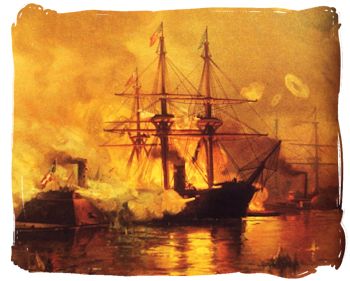
December 24th. To-day Major-General Butler and Brigadier-General Shepley visited the ship. At eleven A. M., General Butler left the ship in the barge, and went on board the steamer S. R. Spaulding, which is to convey him North. Saluted him with thirteen guns; also cheered ship. The Spaulding went down the river as soon as General Butler arrived on board. At three P. M., French Admiral visited the ship.

One year has nearly elapsed since we weighed anchor at Philadelphia, and in that space of time Admiral Farragut has accomplished what perhaps no other man in the U. S. Navy could have done, viz., opened the way to New Orleans. True, Vicksburg is yet in the way of the free navigation of the Mississippi river, yet that fact detracts not one iota from the credit due to the brave old man. The original object of the expedition was simply the reduction of Forts Jackson and St. Philip, and the fortifications supposed to be placed on the river up to the city of New Orleans; but after the splendid success that crowned the efforts of the fleet, the Government issued the order that Vicksburg should be attacked, which was accordingly done, the fleet passing and repassing it; and it was patent to every intelligent eye, that had there been troops sent to garrison the place, the batteries opposed to us could easily have been carried under the fire that would have been brought to bear from the shipping. Porter’s iron fleet then formed a junction with us, and as this was their proper district we withdrew, having cleared the Mississippi river for the distance of four hundred miles, and thereby thrown open to commerce an immense district of the richest portion of the South.

Of the smaller places that were conquered under the direction of Admiral Farragut no mention need here be made, the crowning deed was done in the first battle, and besides, are not “all these mentioned in the Chronicles.”

In the selection of the officers in charge of the different departments of the expedition, Government has been very fortunate. They all thoroughly understood their work, and heartily co-operated in their efforts to overcome the enemy. The crews of the vessels are men that do honor to their commanders,—hardy, brave and willing, they need no urging, and are entitled to the motto, Semper paratus.

The expedition has been so fortunate as not to encounter that infectious disease, yellow fever,—more to be feared by unacclimated persons than the fiercest battles. The excellent sanitary regulations of the fleet, by Dr. Foltz, has caused the mortality from disease to be less than the most sanguine could have hoped. The loss of life in battle has been very small, all things being taken into consideration, although the expedition has been the most fortunate of the war, owing, under Providence, to Rear-Admiral Farragut, and his meritorious and intelligent officers.
December 24— I got a twenty-four hour leave of absence yesterday and went home. This morning as I was leaving home for camp a member of the battery came after me to go on a scout down the Valley. The battery started from camp immediately after I arrived there. We marched all day. Camped this evening at Tom’s Brook, six miles below Woodstock.

December 24, Wednesday. Congress has adjourned over until the 5th of January. It is as well, perhaps, though I should not have advised it. But the few real business men, of honest intentions, will dispatch matters about as well and fast without as with them. The demagogues in Congress disgrace the body and the country. Noisy and loud professions, with no useful policy or end, exhibit themselves daily.

Most of the Members will go home. Dixon says the feeling North is strong and emphatic against Stanton, and that the intrigue against Seward was to cover and shield Stanton. Others say the same. Doolittle, though less full and explicit, has this opinion. Fox tells me that Grimes declares his object was an onslaught on Stanton. If so, it was a strange method. Grimes went over the whole debate in caucus with F.; said he believed opposition manifested itself in some degree towards every member of the Cabinet but myself; that towards one or two only slight exhibitions of dislike appeared, and most were well sustained. All who spoke were complimentary of me and the naval management, but Hale, while he uttered no complaint, was greatly annoyed with the compliments of myself and the quiet but efficient conduct of the Navy.

Wednesday, 24th—Nothing of importance. It is quite cold and our extra clothing, underwear, is in storage at La Grange, Tennessee. There is no chance to draw new clothing now.

Wednesday, 24th. Went and saw the boys and Col. Abbey. Moved my things over to his quarters. Spent the day looking around and seeing the boys. In the evening wrote to Fannie Andrews.

Lumpkin’s Mill, Wednesday, Dec. 24. A day of fasting to Quinby’s Division, the rations having run out yesterday and none having arrived. I ate parched corn and drank coffee. Marched to Lumpkin’s Mill, went into camp 1 P. M. Drew rations in the evening. A heifer found.