
Memphis, Sunday, Feb. 22. Cold. Froze the mud in the morning. Excused from duty, being on the sick list. Cold.
February 2013

Md. Heights, Feb. 22, 1863.
Dear Family:
Yours found us all well. This is the anniversary of the birth of Geo. Washington. We had an order yesterday to hold divine service at 10 o’clk A.M. together with a dress parade; but we had a severe snow storm last night and it has snowed ever since, the hardest we have had. Sergt. R. applied for a furlough; but the Major refused to forward it, on the ground that several had received them and have not been heard from since. T. is trying to get one; went over to see the Gen’l yesterday, but got no definite answer.
Capt. has not been heard from since keeping a hotel! The news seems to be a little more encouraging; we must have a defeat or victory at Vicksburg and along the Charleston coast. The papers speak of English and French mediation in our affairs, but I don’t know as it will amount to any thing. Last night they spoke of the French Army in Mexico; they have had several defeats and I guess they will have to work hard to get a good substantial position any where in Mexico. The boys say that Capt. Bradley and Genl. McClellan are their men. What do they think of the way Gov. Andrew used Genl. McClellan on his late visit to Massachusetts? The boys don’t have a very good opinion of his doings; in fact he is not liked amongst the troops. Now I will give Mother a little news, or rather answer some of her kind questions. I kept money enough to pay up old bills and a little on hand. We both kept $5 a piece; you see Jere only draws $12 a month to my $13. We fare as well as can be expected; in fact we have all we can eat and more too. Draw fresh beef and no salt or corned, keep twelve days rations ahead. To give you an idea of what we have (and you must judge the cooking; but we think it good, Cyrus Messer is cook now). Well first, we have coffee, Bread, fresh beef, with some that we salt, Bread of the best quality, potatoes, dried apples and molasses, and a soup twice a week; have vinegar, salt &c. as much as we want. I should like to write to all of my relations; but some times I don’t feel like answering letters and then it stops. I hope I shall be able to correspond with Home, as I may well call it, once a week. Love to all.
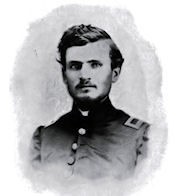
Leverett Bradley, Jr.
More Snow Storms.
Camp Near Wolf Run Shoals, Va.,
February 22, 1863.
Dear Free Press:
I beg leave to withdraw my opinion that the back-bone of the winter if not of the rebellion was broken, in this region. The time is coming, undoubtedly, when both will be shattered; but at present the dorsal columns of the season and of secession are not fractured—distinctly not. I am writing in the midst of the hardest snow storm we have seen in Virginia, and one that would not disgrace the bleakest hillside in Old Vermont. The diary of the weather for six days past may be interesting as a sample of a Virginia winter: Tuesday, a fall of from ten to twelve inches of heavy snow. Wednesday, snow settling fast, and affording material for some tall snow-balling in the afternoon. [Mem. The left wing led by Company C, after a hot battle with the right wing, rallied for a charge, engaged them at half pop-gun range and drove them into their entrenchments;—casualties, two bloody noses and three or four contused eyes from percussion snow balls. N. B. Wounded all doing well.] Thursday, pouring rain, which carried off the remainder of the snow. Friday, high wind, drying the mud rapidly. Saturday, warm, bright sunshine,—air like May ; bluebirds and robins singing, men all out “policing” up the quarters and camp, and enjoying the sweet breath of spring. Sunday opens dark and cold, with a heavy storm of fine dry snow falling at the rate of an inch an hour, drifted as it falls by a cutting east wind, and closes at nightfall with not much short of eighteen inches of snow on a level, and promise of a cold snap of several days’ duration.
Picket service is decidedly rough at such a time, and some mothers’ hearts I know of would ache could they see their boys out on the picket line, cowering under their booths of pine branches through which the snow and wind find easy entrance, and holding their wet and chilled hands and feet to the fires which struggle for mastery with the storm and at best can only avail to surround them with circles of sposh and mud. But we keep up good heart amid sun or storm, and before this reaches the eyes of our friends, sunshine and mild weather will have returned to us.
It may be thought, perhaps, that there is no need of keeping men out on picket at such a time; but our surroundings here have taught us that constant vigilance, by night and day in all weathers, is the price of safety. We are in the enemy’s country, if it is but twenty-five miles from Washington. The inhabitants of this region are all “secesh.” As wherever we have been in Virginia, the young and able bodied men are all gone. The old men are just quiet and civil enough when in the presence of our soldiers to keep themselves from arrest; but render what aid and comfort they give to any one, to the other side. The women are “secesh” without exception; the little girls sing rebel songs, and the hoopless, dirty and illiterate young ladies of these F. F. V.’s boast that their brothers and sweethearts are in the rebel army, and chuckle over the time coming, when the roads settle, when Stonewall Jackson will rout us out of here in a hurry. One or two skirmishes of the Michigan cavalry with White’s rebel cavalry have occurred near us recently, in one of which our side lost fifteen men, and a cavalry picket was cut off but two days ago within three miles of our camp. Our position at this post is, however, a tolerably strong one; we have here, with our two regiments, the Third Connecticut battery, Captain Sterling, six brass guns manned by a fine set of fellows; and we are now connected by telegraph with Fairfax Station and Washington, so that reinforcements could be quickly sent out if we should be attacked. I think we could make a stout fight by ourselves if necessary, and hold the post against a much superior force.
I was about to submit some patriotic considertions in view of the fact that this is Washington’s birthday, but I spare you.
The regiment has sustained a serious loss in the resignation of Captain Landon of the Rutland company, who has been compelled by business interests to retire from the service. He was an excellent officer and will be much missed by his brother officers.
Our new assistant surgeon, Dr. Ross, has arrived and entered upon his duties.
Yours, B.
Sunday Feb 22nd 1863.
Another severe Snow Storm. All day long has it fell and tonight it is deeper than it has been before this winter and it is cold and freezing. Bitter weather for the poor soldiers in the field, as well as for the poor horses in the service. I have not been to church nor hardly out of the house today, have been reading and writing most of the day. Capt Thornett has spent an hour or so in my room, he has given me a little of his history. He is a man near forty and has been a long time in the British Army. Served in India and through the Crimean War. His Father was a Naval officer, his Mother is still living in “Kent,” spends half the year in France with a daughter. At the age of 16 she was in Brussels during the Battle of Waterloo and was at the Celebrated Ball described by Byron, “There was a sound of revelry at night.” I obtained the Sunday morning Chronicle but there is no news. We are waiting, waiting. We must have Victories. I shall be much disappointed and pained if we do not. It seems now as tho a defeat would be ruin to us. Vicksburg, Savannah, Charleston & Wilmington are all invested by our troops. Rosecrans has 100,000 men in Tenn. and Hooker must have near that number near Fredericksburgh V.A. O for pleasant dry weather, and good roads.
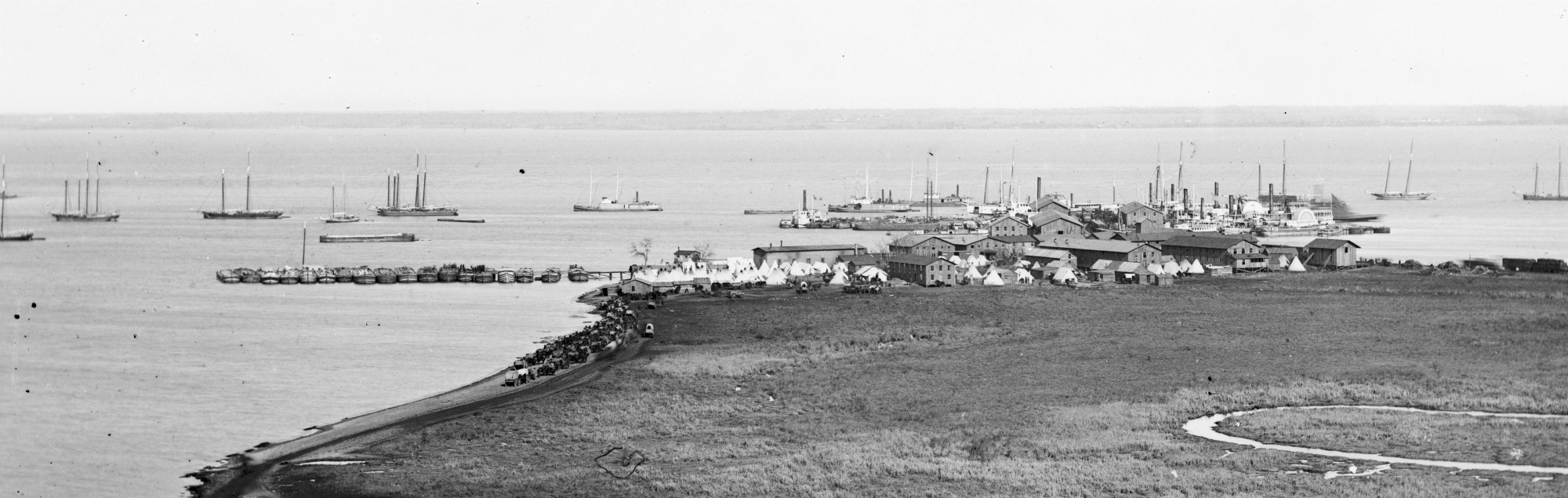
Aquia Creek Landing, Virginia. View of Federal supply depot from a distance. (Click on image to view larger version.)
Photograph by Alexander Gardner.
Library of Congress image.

FEBRUARY 22D. —This is the anniversary of the birth of Washington, and of the inauguration of President Davis, upon the installation of the permanent government of the Confederate States. It is the ugliest day I ever saw. Snow fell all night, and was falling fast all day, with a northwest wind howling furiously. The snow is now nearly a foot deep, and the weather very cold.
My communication to the President, proposing an appeal to the people to furnish the army with meat and clothing (voluntary contributions), was transmitted to the Secretary of War yesterday, without remark, other than the simple reference. The plan will not be adopted, in all probability, for the Secretary will consult the Commissary and Quartermaster-General, and they will oppose any interference with the business of their departments. Red tape will win the day, even if our cause be lost. Oar soldiers must be fed and clothed according to the “rules and regulations,” or suffer and perish for the want of food and clothing!
I have some curiosity to learn what the President has indorsed, or may indorse, on the paper sent him by Mr. Lyons, signed by half the members of Congress. Will he simply refer it to the Secretary? Then what will the Secretary do? My friends in Congress will likewise be curious to learn the result.
February 22.—Colonel F. M. Cornyn, Tenth Missouri cavalry, in command of a detachment of Union troops, made a successful scouting expedition to Florence and Tuscumbia, Ala. He assessed the wealthy slaveholders in sums of five hundred dollars and upwards, carried off fifty bales of cotton, a large number of horses and mules, sixty negroes, and a number of prisoners.—(Doc. 123.)
—A captain and eight privates belonging to the Fifty-seventh rebel regiment of Virginia, were captured near Gatesville, Va., by a small force of Union troops.—The expedition through the Yazoo Pass reached Moon Lake this day.— See Supplement.

February 21.—Mr. Nolan and Mr. Kelly are dead; one died on the 16th and the other on the 17th. They were members of the Eleventh or Sixteenth Louisiana Regiment. Both were unmarried.
We have had heavy rains ever since I returned, which is the cause of a great deal of sickness. The hospital is filled with patients who come in every day; many die, whom neither Mrs. W. nor myself ever see.
Our room is a front one, and a hall some ten feet wide divides quite a large ward from us, which is filled with typhoid and pneumonia cases. I counted seven men in the ward, blistered severely. Though the room is so near ours, we have no time to spend in it. Many a time through the night we hear the men cough and groan, but we can not even allow our minds to dwell on these things, as it would unfit us for our duties. We visit the wards at least twice a day; but many of the patients are brought in at night, and are dead before morning.
A staircase leading to the floor above is near our room. On going up it, I am often met by men carrying a litter, with a white sheet over it. I know its contents without asking. Often the bearers have not the least idea of the inmate’s name.
Had a man die in Dr. Hopping’s ward; his name was Brittle Jones. He was a fine-looking man, and a patient sufferer. He talked a great deal of his wife, and asked me to write to her; said they had only been married a week when he left home. She lives in Jacksonville, Ala.
We have three white girls, who have come from Mobile, as laundresses. I can not but wonder at some persons, these war times. We gave these girls a very nice room. The beds in them were new, but hospital style, like what we have ourselves. They told me if they could not get better they would not stay. I begged them to give it a trial, and I would endeavor to improve matters. It is so difficult to get servants, that we are thankful to do any thing for them. We have men as laundresses, as well as in other capacities; but their help is very uncertain, as not a day passes without an order from General Bragg “to send all the men to the front.”
The girls brought me a present of a very large prayer-book, from Rev. Dr. Massey, in Mobile, which is very acceptable.

Feb. 21. — Suspense, — suspense for ever. Every day we expect news of a movement; but it does not come. They are signalling now; they are signalling night and day from one of the half-ruined towers of the capitol, by flag and fire. The old tower is perfectly garrulous with the ships and the stations down the river. Scarcely an hour of the day goes by but I hear volleys of musketry, the cries of platoons of men as they charge, “the noise of the captains and the shouting;” for drill goes vigorously forward. The streets of the town are full of armed men.
The other day, I saw Nims’s Battery at drill. The cannons and caissons are all out. I pass in front of the muzzles as they are drawn up, — hard things to face. There, as usual, is the bugler, covered in front with broad bars of red, like St. Lawrence escaped from his broiling before his martyrdom was completed,—he is there; but to-day Capt. Nims does his own bugling. “Toot, toot,” a chain of notes, and away they all go on a gallop; “toot, toot,” now they halt and unlimber; “toot, toot,” off again, by the right flank, swords waving, harness jingling, horses kicking with excitement, — all done- to a little chain of clear bugle-notes. Prompt they are, as if those notes were linked on in some way to that great rattling battery; and strong enough to swing the whole affair right or left, horses, guns, and all; then jerk each man off his seat, as they come to a halt, and bring him up standing. Rather ungracious business, Capt. Nims, blowing your own trumpet; but you do it very well.
I write on the cluttered-up table, — the two blinds nailed together. Where once, for all I know, some sweet Southern belle sent glances through the slats, now the quinine mixture of Private Grimes (accidentally upset) strains through on to the floor.
In hospital-life I see the good and bad side of human nature. There are shirks, — but I believe I know one or two, — foul-mouthed often indeed, and altogether too rough, one would think, ever to be fledged out with angels’ plumage. They will go home from here (if they live) to a bed on the straw in a barn-loft, or to a cot in a shanty in the woods, where they are getting out timber for some saw-mill; but, in view of their substantial goodness, I know not why, some night, these surroundings should not “like a lily bloom,” as well as the chamber of Abou Ben Adhem, and an angel write them down, as ” those who love their fellow-men,” near the head of God’s list, thoroughly unsanctified though they seem, as judged by all conventional standards.
21st. In the morning we issued rations for eight days. Then cleaned out and chopped wood. Thede came bringing a line from home. Seemed to have had a good time. Glad to see him again. He will be a great deal of company for me. Fannie Turner came.


