Sunday, 15th—Moved camp out seven miles on Franklin pike near Berlin. I went out to Mr. Sewell’s and got dinner; piruted around and came back to Camp with two dozen eggs.
February 2013
February 15.—A party of the One Hundred and Twenty-third Illinois regiment, under the command of Colonel James Monroe, in company with twenty of Stokes’s Tennessee cavalry, encountered a body of rebel cavalry belonging to Gen. J. H. Morgan’s force, at a point near Cainesville, Tenn., and after a sharp conflict completely routed them, killing twenty, wounding a large number, and taking six prisoners. He also captured fifty horses and destroyed three hundred stands of arms. During the action three of Colonel Monroe’s men were wounded.—Cincinnati Gazette.
—A detachment of fourteen men of the Second Minnesota volunteers, under the command of Sergeant L. N. Holmes, while escorting a wagon-train near Nolensville, Tenn., were attacked by a party of rebel guerrilla cavalry, numbering one hundred and thirty-five men. The small Union party stood firm, and returned the rebel fire with such effect, that in a few minutes they had killed eight, wounded twenty, and taken four of their number prisoners, beside killing eight horses and capturing four. The rest of the rebel party retreated.—Nashville Union.
—A fight took place at Arkadelphia, Ark., between a small party of Unionists under the command of Captain Brown, which lasted from sunrise until noon, when the rebels were routed, with a loss of fourteen killed and twelve wounded. Captain Brown lost two killed and twelve wounded.—General Hooker issued an order to the army of the Potomac, announcing that the order of the War Department authorizing the enlistment of volunteers into the regular service had been rescinded.
February 14th.—About midnight several cannons fired; the alarm was given; but we did not get to trenches till all was quiet. It is thought gunboat passed.
Return After A Furlough.
Camp Near Wolf Run Shoals, Va.,
February 7, 1863.[1]
Dear Free Press:
Once more in camp! For your humble servant, after eighteen days’ absence on furlough, the change is from the snows of Vermont to the mud of Virginia; from the peace and comfort of New England homes to the insecurity and desolation of this part of the field of war; from sleeping between sheets and eating at tables and other luxuries of civilization, to tent life and camp fare. For the Twelfth, also, the change within the three weeks past is not a slight one. It has exchanged the broad stretches and open region of Fairfax Court House, for a rough and broken country, wooded with scrub oaks and second growth pines growing on worn out tobacco fields, and scantily peopled with scattered “secesh” farmers. Near us, several hundred feet below the level of our camps, runs the Occoquan river, a muddy stream about as large as the Winooski. Across it, on the heights beyond, are earthworks thrown up by Beauregard’s soldiers last winter, now untenanted.
Our camp is on a knoll from which the men have cleared the pine trees. It is much narrower in its limits than our former fine camp near Fairfax, and it is less attractive in almost every particular.
The first battalion drill since the regiment left Camp Fairfax, came off to-day. The men have had all they could do in digging rifle pits, picket duty, constructing corduroy roads,—of which they have made miles between this and Fairfax Station,—and the labor of clearing and making camp; and between rain and snow and mud have had the roughest time they have as yet known. Their spirits are good, however, and as I write, the music of a guitar and violin and well attuned manly voices, serenading the ladies whose presence in camp I have heretofore mentioned, reaches me on the evening air, and tells of light hearts and good cheer.
Quartermaster Sergeant George H. Bigelow has been appointed first lieutenant in Company B, and detailed as quartermaster of the regiment, and private George I. Hagar, of Company C, has been made sergeant major of the regiment, in place of Sergeant Major Redington, promoted.
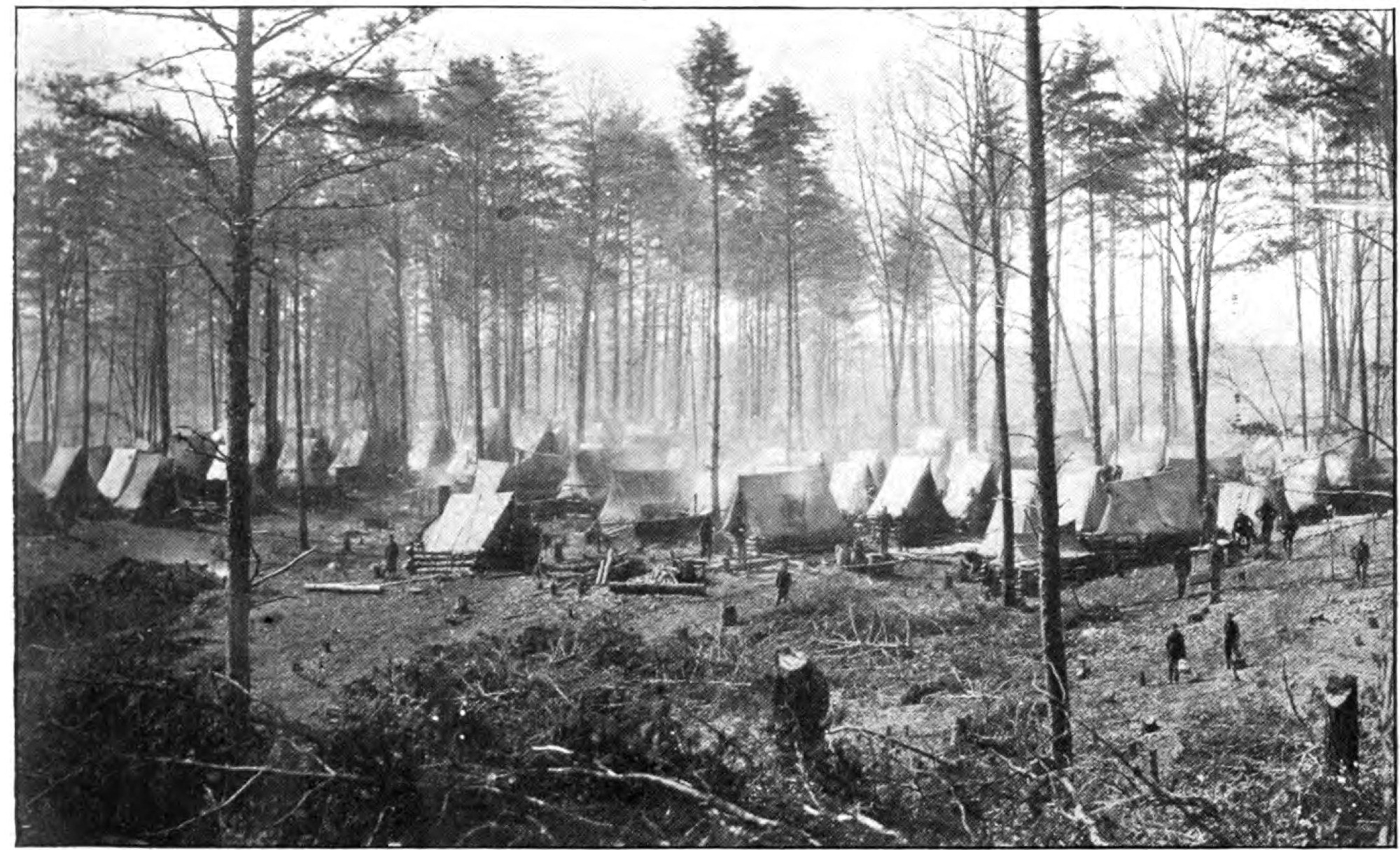 Camp Near Wolf Run Shoals, Va. February, 1863.
February 14.
The Twelfth and Thirteenth regiments have here nearly ten miles of picket line to guard. There have been skirmishes between the cavalry outposts, sights of rebel patrols, and rumors of coming attack from rebel cavalry, enough to keep us somewhat on the alert; but the long roll has not sounded, nor has hostile shot been fired by us. Colonel Blunt has been practicing the men at target firing, and they are making sensible progress in the modern method of administering the “blue pills” which are the only cure for rebellion. Yesterday and the day before, fatigue parties crossed the river and destroyed the earthworks on the heights commanding our camps; but while the roads are in their present condition we can hardly be in great danger from rebel artillery. The mud in the roads, where they are not corduroyed, varies from deep to bottomless, and the rains are frequent enough to keep the roads from settling. A week of sunshine, however, would again enable armies to move.
The weather is quite mild. It is raining as I write, with the thermometer at 58°, and the mercury has been as high as 70° in the sunshine in our camp during the past week. The backbone of the winter, if not of the rebellion, is broken in this region. We shall probably not have more than one more right cold spell, and shall henceforth expect much warm weather.
The health of the regiment has improved and may now be called pretty good, though many of us suffer from the disturbing effect of the water, which is not as good here as we have found in our former camps. Company C is called the healthiest company in the regiment.
The Second Vermont brigade is now, as you know, a portion of the Twenty-second Army Corps,—heretofore called the Reserve Corps, Defences of Washington—under command of Major General Heintzleman, and the Twelfth and Thirteenth Vermont are on the outer line of the new “Department of Washington.”
Yours, B.
[1] During the month preceding this date, the writer was promoted to a vacant lieutenancy, and received a furlough for twenty days, to enable him to return to Vermont, whither he was called by his duties as President of the Vermont and Boston Telegraph Co., Postmaster of Burlington, and editor of the Free Press.
February 14, Saturday. The New York Tribune of yesterday has an allusion to correspondence between Seward and myself relative to the British-African Slave Treaty, which indicates a purpose to get us by the ears.
Washington Saturday Feb 14th 1863.
Another fine day but a little cooler than yesterday. Mrs Schram of Pok’eepsie called on me today at the office and as Mr Newton is a quaker, she “thee” and “thoud” him out of all the seeds, bulbs, and Plants she desired. Lieut Bemis also called on me. I was on the Ave after leaving the office an hour or two reading in Book Store and looking over an old Library of Books for sale tonight at McGuires Auction Rooms. This is a great City for old books and sometimes rare old Books can be obtained cheap. Old private Libraries are sent over from England every year and sold at auction. I do not consider myself Safe at a Book Auction as it is very difficult for me to resist the temptation to buy more than I can afford. I used to take pride having a select Library of books in my house. But I have been shifting about so much for the past dozen years that my books have got scattered a good deal, but I think that I have got now as many as I ever had, perhaps more. Genl “Tom Thumb” and Lady have left the City. Genl Fremont is here requesting a Command again. No War news of any importance, all is quiet as yet. I called at Mr Schrams again tonight, his Mother expects to leave for home Monday. Called also at Maj Williamss. Mrs W. is geting better. Aleck Tower has been released from Richmond, was here, went home yesterday.
Saturday, 14th. Was kept quite busy in the forenoon, issuing bread and beef for two days. Thede got a pass from Capt. L. and left for a visit of a week at home. I wish I could be there with him. Home is dearer to me now than ever. Will God ever bring us all home on earth again? If not, may He in Heaven.
Saturday, 14th—A heavy rain all night stopped our digging for a time, and the fatigue party did not begin work on the canal until 1 o’clock in the afternoon. It is terribly muddy and the water hinders our digging; we wheeled out more water than mud. The following strange epitaph I noticed on a tombstone in a cemetery located in a grove near the town of Lake Providence:
.
“Remember man, as you pass by,
As you are now, so once was I,
As I now am, so you must be,
Prepare for death and follow me.”
Memphis, Saturday, Feb. 14. Six months in the service. Another rainy day. Signed the pay rolls again, the first ones being objectionable and returned.
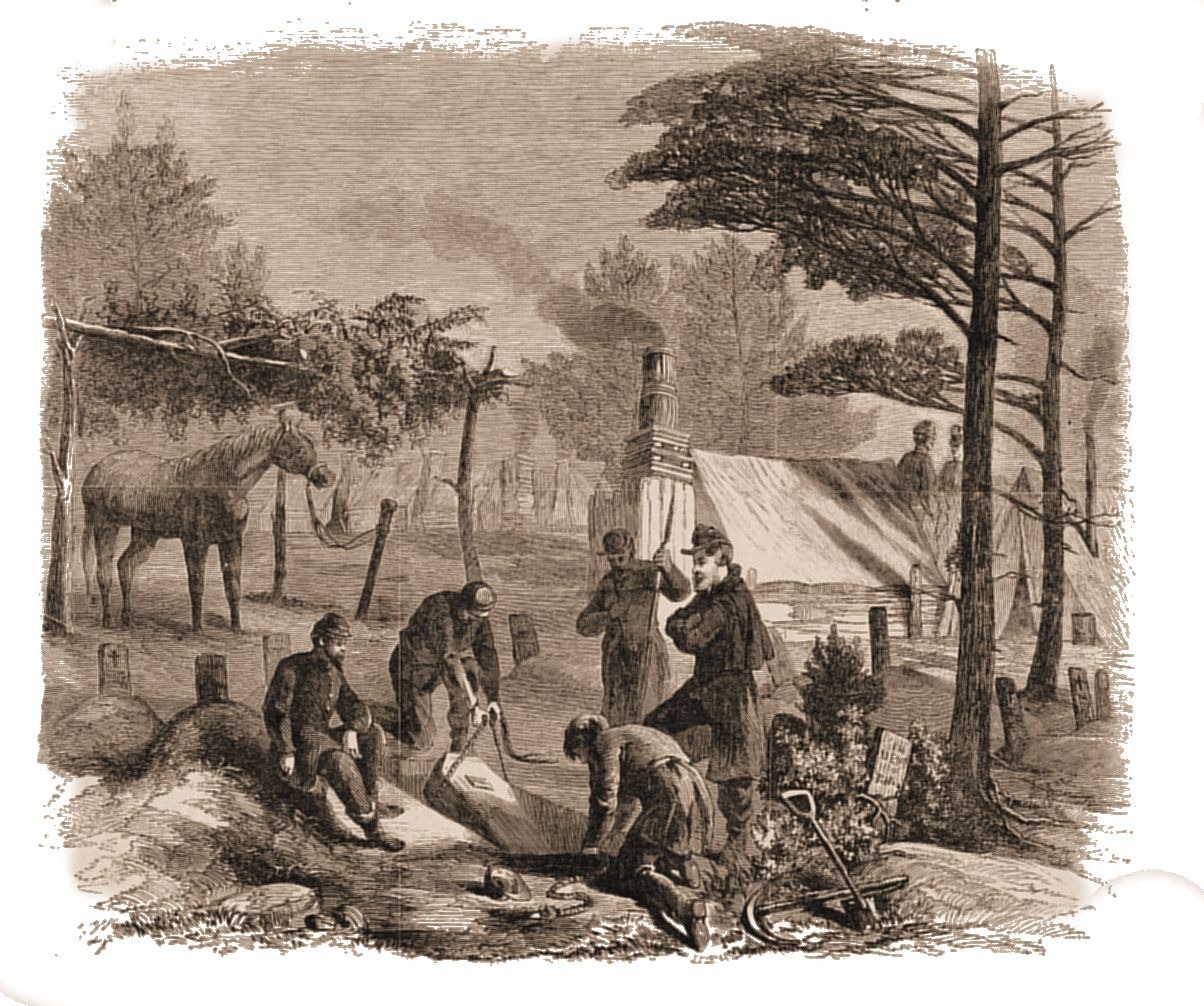
Graveyard in the Camp.
The picture we publish on this page represents a graveyard near Falmouth, Virginia, and immediately contiguous to the soldiers’ tents. One would think that such a view must tutor the hearts of our gallant fellows to a sepulchral gloom; but a soldier’s experience has rubbed that fine sentimental and womanly enamel from their hearts , and they stand ready to take their places in the same spot at the call of duty.
Our Artist says: “I send an exact sketch of a graveyard in camp. It is very remarkable to a stranger, when first visiting the army, to notice the proximity of the burial grounds to the tents of the soldiers. Sometimes, as in the present instance, it is close beside the encampment; sometimes on the slope of a hill among the pine stumps, the grim remains of a lordly forest. A friend’s, perhaps a brother’s hand is seen in the homely decoration on the grave – a piece of a cedar or a pine bough planted at the head, and a few of the poles placed around, are all that show where a patriot warrior takes his last sleep.”
(Published in the March 21, 1863 issue of Frank Leslie’s Illustrated Newspaper.)


