
Sunday, 8th. Spent the day very quietly in camp. Finished “Tom Brown” and read some in “Sermons on the New Life,” and in my Bible. Archie called for me to go to town with him, but I had some invoices, etc., to make out, so stayed in camp.
February 2013

After the funeral, I felt much prostrated; but it was best to keep employed. Robert and I kept our familiar quarters, where at night we could be warm and dry: an important matter now; for at evening it grows very cold, and much rain falls. Water was convenient, too, for the washing which it was necessary to do; and I could pack at leisure the things I wished to send North. In a few days, all this was done. I took my farewell of the apartment where Ed. died, now stripped to its bare walls; and, not being quite in condition to go into the woods to camp, I accepted the doctor’s invitation, and spent a day or two last week in his private room. In one corner lay the stretchers, ready for the wounded men; in another, a patient sick of fever. By night, I could hear the shouts of the delirious patients from the corridors.
I saw three bodies lying together on the roof of the veranda of the building, overlooking the street. A little breath of air came; and the covering was turned down from the face of one, a member of our company,— his, and yet not his, — a fine fellow, a favorite of Ed.’s, at whose feet he now sleeps. One of the others belonged to us too, — a boy I knew well. He will never see again his pretty cottage-home under the trees by the Connecticut. The chaplain was sick the day of the funeral: so I conducted the service for these two at one time, after dark, under the moon. We were forced to bury them hurriedly, for it was late; and I fear with less of a feeling of solemnity than we once had at such occasions. I believe it is true, that the edge of sensibility grows dull through use, even in the case of these sad experiences. Funerals have been so frequent of late, sometimes three or four a day, that they lose their impressiveness in part.
Pray Heaven the sickness is spending itself! There are signs that it is so. It has raged, for the most part, among the youths under twenty, whose immature fibre appears to afford more congenial harbor for the pestilence than the frames of the older men. Almost all the deaths have been among the boys. The death-list is really not as large as is often the case in camps. We do not suffer as some Maine regiments are suffering close by us; but it is large enough to cast a shadow, and make us all feel the insecurity of life.
My record has been almost entirely of deaths and hospitals the last few weeks; but now let me turn from these things. We are, after all, not a gloomy set; though skies are so dull, and health so uncertain. The spirits of the men are often high, and there is much fun going forward. A great character in the camp is one Tibbs, a fellow with many crotchets in his brain, —too many for it to remain in a normal, healthy state, — and who really, perhaps, ought hardly to have been passed at the medical examination; but he is a fellow of infinite jest, and his pranks and sayings keep up the spirits of the regiment. He has wit; and when that fails, in his blunt talk, he blunders often into capital hits, hitting right and left, sparing no one, from the colonel down. The other day, a large hollow tree had been cut down, and a group of officers stood looking at the hollow. Tibbs came up beside them, and peered with his queer whiskered face into the hole. “That’s a big hollow, Tibbs,” said one of the group of officers. “Well, yes,” said Tibbs; “and next time we have the long roll, if ‘taint full of officers, I guess I’ll come here and hide.” By all odds, the most amusing thing I have seen since I became a soldier was Tibbs’s parody of Col. Birge, of the Thirteenth Connecticut, a veteran regiment, which often went through its admirable drill close by our camp, and whose commander at such times threw himself with unusual energy into his work. I heard great laughter and shouting on the parade-ground one morning, and, looking out, saw Tibbs mounted on a very lean and long-eared jackass, which he would cudgel until the animal gave up his obstinacy and went off at an ungainly gallop. Tibbs was excited by the motion, and roared his orders in all parts of the field. Now it was, “Close column by division, on second division, right in front!” Then whack would go the stick, and Tibbs, eager as if in battle, would gallop off to the other side of the field. “Head of column, to the left! ” “Deploy column on first company! ” &c., &c. It was an admirable caricature of the efficiency of Col. Birge, who was always at full gallop, keeping his regiment on the double-quick. Tibbs drilled his imaginary command for some time; when some one, perhaps a sergeant, shocked at the indecorum, started after him at full speed. But Tibbs’s time had not yet come. As the pursuer approached, Tibbs’s ungainly steed reared and brayed; and, while dodging his heels, the pursuer measured his length in the mud, leaving Tibbs the cavalier, in his shabby uniform, to go on caracoling, and shouting his orders.

Sunday, 8th—Orders came for the detail of men to quit the work of repairing the levee and for our entire division immediately to embark on the transports. The Eleventh and Thirteenth Regiments went on board the “Empress” and loaded all their supplies after night; at the last moment the Tenth Ohio was ordered to take passage with us.
Memphis, Sunday, Feb. 8. Warm and cloudy day. Reveille at one hour before daylight. Prepared to march, and started at 7 A. M., the 48th going on the railroad, and we took the south road. The roads were very muddy, the frequent frosts had made them soft, and we had very hard work to get along with the balky horses that we had. Came into camp at 12 M. about a mile southeast of town on a hill covered with trees, very handsome. Busy in building racks and ‘”shebangs”. All the lumber under guard.

Boat Howitzer Battery, Md. Heights,
Feb. 8, 1863.
Dear Mother and Father:
Yours found us all well. I started the money last Wednesday $196 (one hundred and ninety six). George Bricket sent $32 which you will please deliver to uncle Frank; he paid me for sending it. It cost $1.50 for sending it; kept $1 out and paid the rest from my own. I shall keep dunning for the rest of those notes till I get it. Should not be surprised if we got paid again soon. The boys have all paid up their bills well. H. deserted, has not been heard from since pay day; most likely will keep clear and not get caught. We have an order to stop the Artillery practice and we have got a shelf fixed so we can take Shell of all kinds to pieces. There is an examination of Sergt’s for promotion; it is an order from Col. S. He will recommend them to Gov. Andrew. An Ex Capt. D. is at the Hooks on a spree and some of the boys go down and have one with him. There is a time coming when the men of Co. B will have a chance to speak their thoughts and minds and they will do it. The men still think a great deal of Capt. Bradley, or, as they call him, “Snap it up.” Your name is spoken a great many times a day, and many are the wishes that you were commander now. I may stand a chance yet. My duty is much harder than at Craig, on account of commanding the post. Have to make out returns of ammunition every Monday morning, &C. Much love to all.
Leverett, Jr.
Washington Sunday Feb’y 8th 1863.
A most delightful bright and warm day but wet and muddy crossings. I attended divine service at the Capitol again this morning, heard Dr Stockton. He was not as tedious as usual. There was a very good congregation present, a large portion Strangers. They go to the Capitol for the novelty of the thing. An elegant piece of Sculpture, a full length life size Washington in beautiful marble, stands fronting Leutzes picture of the Emigrants. It is by Powers and as a work of art it seems could hardly be excelled. The chiseling is most exquisite. Went up to the “Stone Hospital” again today after dinner. Robert White who I saw last Sunday has had his foot taken off just above the ancle. He appears to be doing well. Another NY Soldier, Rufus Chandler from Livingston Co. NY, with whom I talked that day some time died the next day. Rogers from Conn. 27th Regt, a Student at Yale, was in the fight at Fredericksburgh, got hit four times by bullets, twice wounded severely and twice slightly. I was there about two hours talking with the “boys.” I walked up there and back making a walk of near six miles altogether today. Met Edd Dickerson this morning. Alex Tower is still a prisoner in Richmond but will be back soon as arrangements have been made for the Exchange of the Sutlers. I have been over to Charleys an hour or two this evening. They all seem very well and very fond of each other and of the baby which is very pretty. The weather is warm enough to sit without a fire. It is past eleven and I must to bed.
February 8th, 1863.
We are under marching orders again—ready to move at a minute’s notice. The Ninth Army Corps is detached from the Army of the Potomac and is ordered to report to General Dix, at Fortress Monroe. The supposition is we go on an expedition somewhere —rumor says Vicksburg. The first detachment has gone, and we are awaiting the return of the transports. The men are well pleased with the idea of going farther south. For myself, I say any place but this. When we came here the country was a wilderness, covered with a heavy growth of scrub pine. Now it is a desert with scarcely a tree, and not a fence rail for miles in any direction.
It seems that Richmond has lost its strategic importance, and the “decisive blow” which was to have fallen there has been transferred to five other points, viz: Vicksburg, Port Hudson, Rosa’s and Foster’s expeditions, and Charleston. “If these prove successful,” say the Washington papers, “the rebellion will end in thirty days.” God grant them all success.. When I survey the past history of the war I can see but little in the immediate future to encourage hope. The conviction is forced upon me that if the North subdue the South, the war has but just begun. It can and will be done, but time and persevering effort only will accomplish it. The people are too impatient. They demand important victories now, while some fortified place—Vicksburg, for instance—can only be taken by siege, and siege means weeks and months of waiting.
Government, urged on by the people, acts as if the salvation of the country depends on all this being accomplished before the fourth of March. But I see nothing but failure in haste.
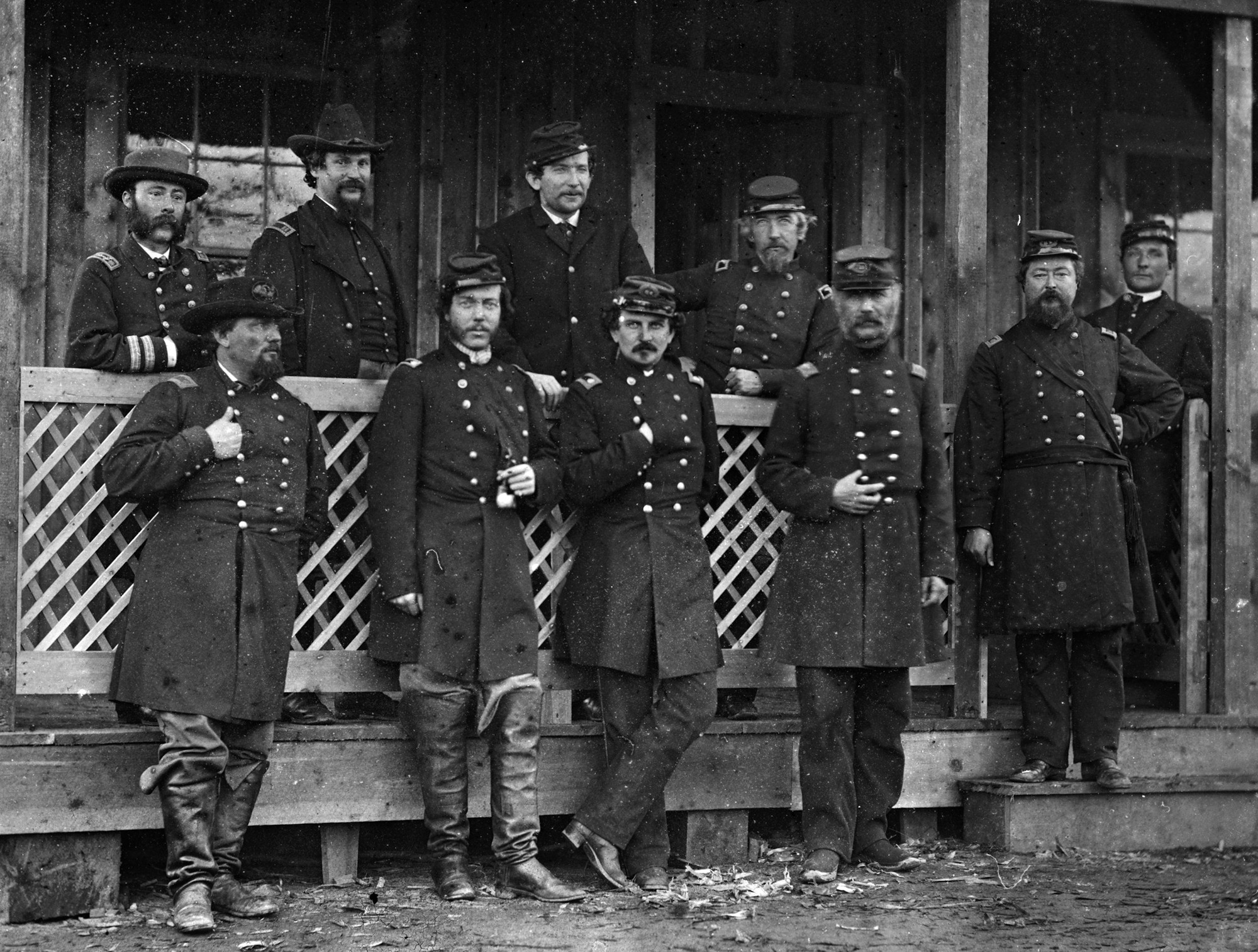
Aquia Creek, Virginia. Group standing in front of hospital, photographed by by Alexander Gardner.
Library of Congress image.

FEBRUARY 8TH.—From intelligence received yesterday evening, it is probable the Alabama, Harriet Lane, and Florida have met off the West Indies, and turned upon the U.S. steamer Brooklyn. The account says a large steamer was seen on fire, and three others were delivering broadsides into her. The United States press thought the burning steamer was the Florida.
From Charleston or Savannah we shall soon have stirring news. They may overpower our forces, but our power there will be completely exhausted before resistance ceases. There will be no more “giving up,” as with New Orleans, Norfolk, etc. Yet there is a feverish anxiety regarding Vicksburg. Pemberton permitted one iron-clad gun-boat to pass, and all our boats below are now at its mercy.
The House of Representatives, at Washington, has passed the “negro soldier bill.” This will prove a “Pandora’s Box,” and the Federals may rue the day that such a measure was adopted.
February 8.—Colonel W. R. Penick, from his headquarters at Independence, Mo., sent a detachment of fifty men from the Fifth cavalry of Missouri volunteers, under the command of Lieutenant D. A. Colvin, in pursuit of a guerrilla camp, which he ascertained existed in the vicinity. His scout came up with the enemy at two o’clock this afternoon, when a running fight commenced, which lasted about thirty minutes, and resulted in the rout of the guerrillas, with eight killed, two wounded, and all their arms captured. To test the fighting qualities of the negro, Colonel Penick sent a contraband with the party at his own request. The negro was severely wounded in the shoulder, but expressed “his willingness to again fight the bushwhackers as soon as he should recover.”—Colonel Penick’s Report.
—The expedition under Generals Davis and Morgan, sent from Nashville, Tenn., in pursuit of Forrest and Wheeler’s rebel force, who were retreating to the West, returned this evening. Seven miles east of Charlotte, thirty rebel prisoners were captured, among whom were Colonel Carroll, and Major Rembrant, of Forrest’s staff.— Lebanon, Tenn., was entered and occupied by the National forces, who succeeded in capturing six hundred rebels, most of them belonging to the command of General Morgan.—The work of cutting the canal at Vicksburgh continued rapidly, a large force being engaged upon it night and day.—Rear-Admiral Porter reported the capture of three rebel transport steamers on the Red River, Ark., by the Queen of the West, under the command of Colonel Ellet.—The circulation of the Chicago Times newspaper was prohibited in the command of General Hurlbut, by a general order issued at Memphis, Tenn.


