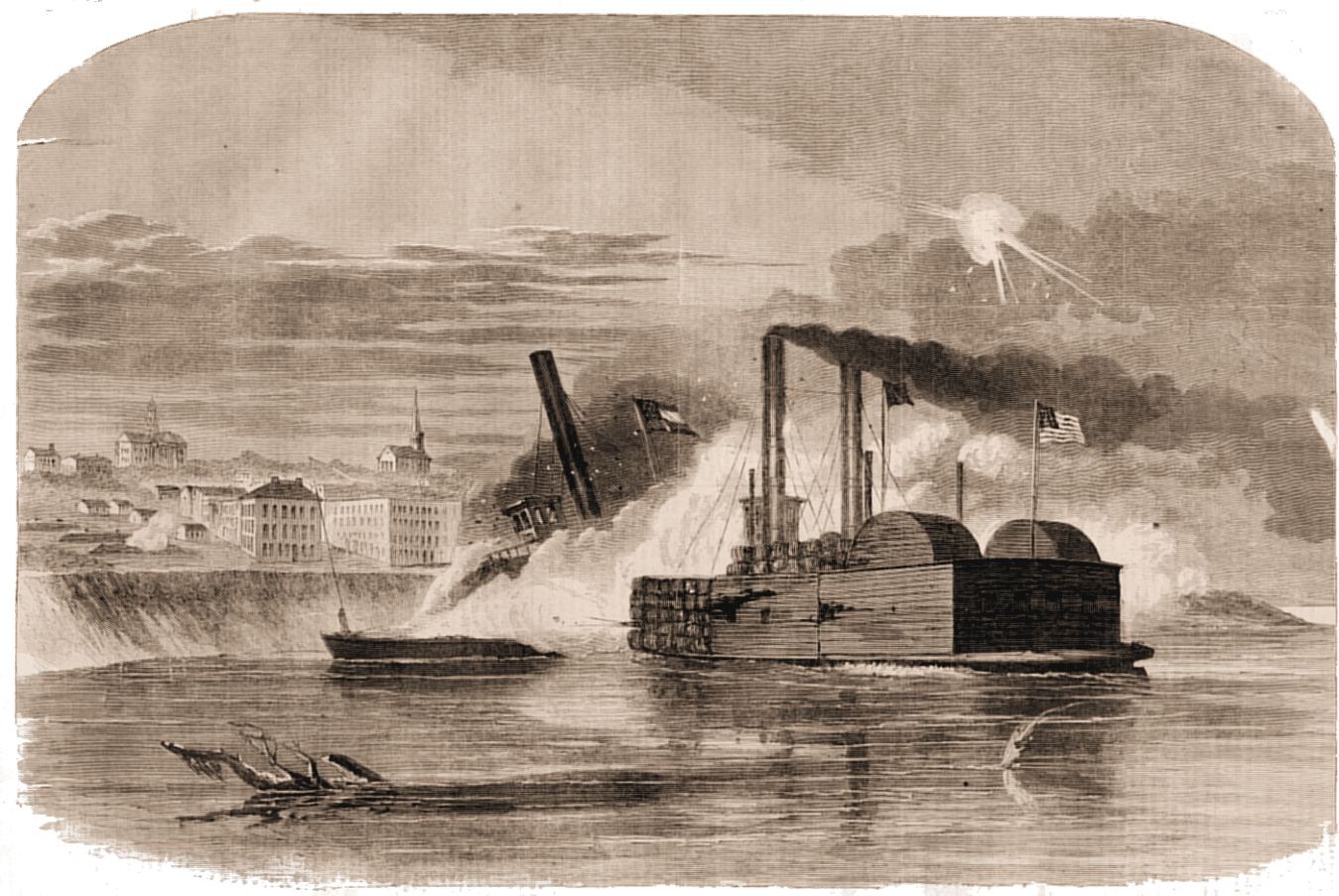
The Federal Ram “Queen of the West” Attacking the Rebel Gun-Boat “Vicksburg” Off Vicksburg.
Harper’s Weekly, February 28, 1863
_______
THE “QUEEN OF THE WEST.”
WE illustrate on page 132 the attack of the Federal ram Queen of the West upon the rebel ram Vicksburg, off the city of Vicksburg, on February 2. The following letter to the Herald gives a graphic account of the affair:
MISSISSIPPI RIVER, NEAR VICKSBURG, Feb. 2, 1863.
A very exciting scene was witnessed here this morning. The Union ram Queen of the West, Captain E. W. Sutherland, ran the blockade of the rebel batteries at Vicksburg. Colonel Charles P. Ellet, commander of the ram fleet, was on board of her, and directed all her movements. The event has created great excitement in this vicinity. When the rebels saw the ram run into the rebel steamer, near the city, and then pass down the river uninjured, they were not less astonished than chagrined, because it was believed, by them at least, that no Union steamboat could safely pass their formidable batteries.
The following is a partial list of the officers on board the ram: Colonel Charles R. Ellet, in command; E. W. Sutherland, Captain; J. E. Tuthill, First Lieutenant; Sims Edison, Master; J. C. Duncan, Master; Reuben Townsend, Engineer.
The Queen of the West had been previously provided with all the arrangements deemed necessary to insure the complete success of the dangerous undertaking. Three hundred bales of cotton had been procured further up the river and placed on board, particularly about the machinery, in order to save her from any serious injury by shot and shell from the rebel batteries. Rear-Admiral Porter had given orders that she should proceed down to Vicksburg, destroy the rebel steamboat City of Vicksburg, lying opposite the city, and then run past the lower rebel batteries. The Colonel was directed to keep close to the right bank going down, to have all his lights on board extinguished—as it was intended that she should run the gauntlet in the darkness—and, having safely passed the batteries, to anchor below the mouth of the canal and there wait for further orders.
The Colonel started with the ram from above the bend at half past four o’clock this morning. Soon after getting under way he discovered that the change made in the position of the wheel—which was removed from its former position to a narrow place behind the bulwarks—rendered it almost impossible to steer the boat with sufficient accuracy. Consequently an hour was spent in effecting the necessary alterations. It was about six o’clock, just as the sun was rising, when the ram rounded the point of land lying opposite Vicksburg. She had only men enough on board to work her, it having been arranged that the remainder of the crew would cross the point of land and get on board of her below after she had passed the batteries. When rounding the point she was distinctly seen by the rebels. They immediately opened a heavy fire from several of their batteries, which crown the crests of the bluffs about the city. The Queen slowly and steadily proceeded down the river under a heavy fire from those batteries, until she reached a point opposite the spot where the steamboat City of Vicksburg was lying. Colonel Ellet says that steamboat was lying in almost the same position as was the rebel ram Arkansas when he ran into her with that same Queen of the West. If the rebel steamboat should be struck as the ram was running down the river, the prow, instead of penetrating her, would be inclined to glance, and the full force of the blow would thus be lost. Wishing to make the shock as effective as possible, when the ram had reached the proper position the Colonel turned her partly around, so as to face the city, and then made across the river straight for the fated steamboat. The rebels, who had crowded on the banks, scampered off in the most affrighted manner from the shore and sought safety in the city. The ram still went steadily on to the execution of her destructive errand. She struck the rebel steamboat forward of the wheel-house; but at the moment of collision the current caught the stern of the ram and swung her round so rapidly that nearly all the momentum of the blow was lost. To set the rebel steamboat on fire was part of the arrangement. That portion of the programme was intrusted to Sergeant J. H. Campbell. He was directed to fire the forward guns loaded with combustible balls saturated with turpentine. As the ram swung round he was ordered to fire them. Just at that moment a 64-pound shot from one of the rebel batteries came crashing into the barricade of cotton near him; but the brave Sergeant did not hesitate a moment in the execution of the order. The guns were fired, a tremendous blaze was vomited forth from them, and the rebel steam-boat was in flames.
About the same time the ram was found to be on fire. A shell from shore had set her on fire near the starboard wheel, while the discharge of the guns with the combustible balls had fired the cotton on her bow. Both steam-boats were thus ablaze at the same time. The flames spread rapidly on both vessels. The smoke from the front of the ram rushed into her engine-room and threatened to suffocate the engineers. Those on board the rebel steam-boat did all they could do to extinguish the flames on their boat. This they soon accomplished. Colonel Ellet had intended to strike the rebel steamboat in the stern, and thus finish the work of demolition; but the spreading flames on the Queen of the West made it necessary for him to attend to the safety of his own vessel. He therefore ran down stream, and set all hands on board at work extinguishing the flames. Though the cotton had been wet before starting, the fire was extending rapidly, and several burning bales were thrown overboard in order to save the ram. She then anchored below the mouth of the canal, where she awaited further orders.
All this time, both when approaching the city and leaving it, the rebel batteries were blazing away at the Queen of the West with light and heavy guns. Some of our guns on shore replied to them. When the ram was near the Mississippi shore several regiments of rebels opened on her with musketry from rifle-pits on the bank, and, as opportunity offered, the guns planted in the streets of Vicksburg so as to rake the river fired on her also. It was a very exciting scene. About one hundred and twenty shots were fired from the batteries; but the ram was struck only twelve times, and sustained no injury from the musketry. She was struck twice in the bull above the water-line, the cabin was considerably smashed, and one casemated gun was dismounted and destroyed.
Thus the Queen of the West ran the blockade of Vicksburg by daylight, damaged the rebel steamboat opposite the city, and she herself sustained no material injury. Afterward the rebels endeavored to get steam up on board the City of Vicksburg; but, although she was not sunk, appearances indicate that she has been damaged seriously.