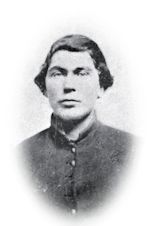
Near Helena, Sunday, April 12. A fine day. Expected to leave, but instead we took our horses off. Troops going down the river nearly all day, about twenty transports loaded. Took a ride in the afternoon, enjoyed it much, though all alone. On guard in the night. Quite cold.
Friday, April 12, 2013
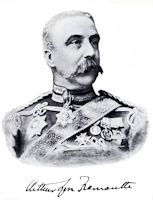
12th April (Sunday).—I took an affectionate leave of Don Pablo, Behnsen, Oetling, & Co., all of whom were in rather weak health on account of last night’s supper.
The excellent Maloney insisted on providing me with preserved meats and brandy for my arduous journey through Texas. I feel extremely grateful for the kindness of all these gentlemen, who rendered my stay in Matamoros very agreeable. The hotel would have been intolerable.
I crossed to Brownsville at 3 P.m., where I was hospitably received by my friend Ituria, who confesses to having made a deal of money lately by cotton speculations. I attended evening parade, and saw General Bee, Colonels Luckett, Buchel, Duff, and ——. The latter (who hanged Mongomery) improves on acquaintance. General Bee took me for a drive in his ambulance, and introduced me to Major Leon Smith, who captured the Harriet Lane. The latter pressed me most vehemently to wait until General Magruder’s arrival, and he promised, if I did so, that I should be sent to San Antonio in a first-rate ambulance. Major Leon Smith is a seafaring man by profession, and was put by General Magruder in command of one of the small steamers which captured the Harriet Lane at Galveston, the crews of the steamers being composed of Texan cavalry soldiers. He told me that the resistance offered after boarding was feeble; and he declared that, had not the remainder of the Yankee vessels escaped unfairly under flag of truce, they would likewise have been taken.
After the Harriet Lane had been captured, she was fired into by the other ships; and Major Smith told me that, his blood being up, he sent the ex-master of the Harriet Lane to Commodore Renshaw, with a message that, unless the firing was stopped, he would massaCREE the captured crew. After hearing this, Commodore Renshaw blew up his ship, with himself in her, after having given an order to the remainder, sauve qui peut.
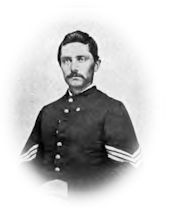
Sunday, 12th—Eight gunboats went down the river today. The boys feel quite lively and are anxious to get into action again. We had company inspection in the morning and regimental inspection in the afternoon, with dress parade at 5 o’clock. Some of the men of our regiment were caught in a trap today. They went up into a pigeon house a short distance from camp and were having a game of “chuck luck” when someone informed the officer of the day, who took some guards, surrounded the house, entered and made a quick dive for the rubber poncho, taking all the money lying on the figures, almost $200, and arresting all the participants. He put the fellows in the guardhouse and turned over the money to the hospital steward.
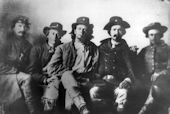
Sunday, 12th—Rained last night. Very pleasant this morning. I remained quiet to-day. Three or four soldiers came by; found our Brigade had come back about Spring Creek.

Sunday Night, April 12th—Mr. —— administered the Sacrament here to-day, the first time it was ever administered by Episcopalians in Ashland. There were fifty communicants, the large majority of them refugees. Our society here has been greatly improved by the refugees from Fredericksburg. The hotel is full. The G’s have rented the last vacant cottage, and are boarding others. The R’s, with their three pretty young daughters and son, occupy the ball-room of the hotel. The dressing-room makes a pleasant chamber, and the long dancing-room, partitioned off into rooms by the suspension of their handsome crimson damask curtains, is very pretty; and, for spring and summer use, makes very comfortable apartments. They saved some of their furniture, and are nicely fixed for refugees, who must do the best they can, and be thankful it is no worse. The C’s seem very happy in the old billiard-rooms; the large room answers the double purpose of dining-room and parlour, and the smaller rooms, which I am afraid were once used for card-playing when this place was a summer resort, are now put to a better use, as sleeping apartments and kitchen for three most agreeable families. One family in the opposite cottage has interested us very much. Mr. Wade (the husband) was an Englishman, who had been in office in Washington; he resigned and came South on the breaking out of the war, placed his family in Richmond, and joined our army; he was not young or healthy, and soon was broken down by the service; he was then made clerk in the Quartermaster’s Department, and removed his family to Ashland for cheapness. He was very highly educated and gentlemanly, and his coming here seems to me very mysterious. Soon after his removal to this place he grew worse and died. His wife and five children were left penniless and friendless. They seemed to have no acquaintances, however slight. The villagers, from their limited resources, raised a sum for her present support, and after much difficulty procured her a situation in the Note-signing Department. She goes into the city every morning on the cars, as do several other ladies to the duties of their offices, leaving her children to the care of a faithful coloured nurse, whom she never saw until two months ago. We have taught her the art of making soap of concentrated ley, and often when she gets on the train, a basket may be seen in the freight-train filled with soap, which she sells to the grocers or commissaries. She is an interesting-looking woman, Northern born and educated. Her father, she says, is a Colonel in the Yankee army. She wrote to him again and again, and one of our gentlemen did the same, representing her case. After long silence he has written to her a short letter, which she showed me, inviting her, in rather an indifferent manner, to come to Georgetown, where her mother is now staying, but remits her no money to pay her passage or to support her here. Our gentlemen have interested Mr. Lawley, an Englishman of some note in Richmond, in her case; and her husband having been a British subject, he may be enabled to get her a passport and a free passage on the flag-of-truce boat.
Camp Winder, April 12, 1863.
Your letter of April 7th came to hand yesterday, bringing the welcome intelligence of all well at home. I will spend part of this quiet Sabbath in writing to you in answer to it. It is a very pleasant and warm April day, —so pleasant that our log church has been abandoned and the chaplains had service in the open air. I witnessed to-day what I never saw before: the sacrament administered in the army. It was, indeed, a solemn and impressive scene; a congregation composed entirely of men, standing around in the circle of which the chaplain was the center, receiving the bread and wine in renewal of their vows and fellowship as Christians.
A number were admitted for the first time to the sacrament, and received into the church. The whole assembly wore such an air of seriousness and devotion as I have seldom witnessed before. There was no excitement, but an exhibition of earnest devotion in the discharge of the highest duty on earth. Far away from wife, mother and sister, separated from them perhaps forever in this world, they met, this mild April Sabbath, in the open air, some of them for the first time, and others to renew their sacramental vows of faith in Christ and fresh exertion to deserve his mercy. Men like these, however gloomy the future may be, look to it pleasantly and happily, contented to receive whatever of good or ill God has in store for them with the supplication, “Thy will be done!” Relying with implicit faith upon his mercy, the future is stripped of its gloom and becomes all bright, beautiful and happy. To such men death is no enemy, but a messenger expected from God sooner or later, and welcome as the quick path to a holier and happier life. With such soldiers in our army and such men at home, we might bid defiance to all the boasted numbers and strength of our enemies and feel sure of victory. But it is sadly true that the mass of our men here and at home are not of this type. Very many of our officers and soldiers— very many more, I think, of our people at home—have grown worse instead of better by the calamity which has fallen upon us. It is strange that it should be so; strange that adversity makes us no wiser and better; that our depravity grows deeper and darker in proportion to the severity of affliction. How little we know of the future! Last Sunday I thought another week could not pass without more blood. The reasons which prevented it during the winter—the weather and the roads—no longer exist. We have for some days had good weather and good roads, and no reason why the enemy should not advance, if so disposed. I place but little confidence in my judgment as to what will happen; but I have rather come to the conclusion that the enemy does not mean to attack us here. There is nothing which seems to indicate an advance. I am inclined to believe we have nearly as many men at our command here as they have opposed to us, and I think it likely they know it.
Their balloons go up every day, and from these they have a full view of the location of all of our troops; I suppose we shall have some activity after a while. If they do not move, we shall, I think. Whenever the struggle comes, I feel sure of success—that God will bless us with another signal victory. We have a just cause and a splendid army, and I trust that our next engagement may be attended with such signal success that much will be accomplished towards closing the war. I look to the future with much confidence. Many of us must go down in the struggle, never to rise again. Such may be my fate. Sometimes I try never to let my hopes fix upon anything beyond the war, such is the uncertainty of surviving it. Then I find myself happy in the dream and hope of the time when it will all be over, and I shall be with you again, to spend the rest of life in peace and quiet. God will that it may be so! If not, I am content. Sooner or later we must separate in this life, and it will be whenever God so wills it. Despondency and despair under such circumstances is foolish and sinful. Far better to be contented and complaisant, ready to do our duty and submit in patience to our fate, whatever it may be.
And now, darling, good-bye. Give my love to Matthew and Galla, and a kiss to little Frank. Write often, and believe me, dearest, ever yours.
April 12.—Information having been received by General King, commanding at Yorktown, Va., of the presence of a large body of cavalry in Gloucester County, Colonel A. H. Grimshaw, Fourth Delaware volunteers, in command of the post at Gloucester Point,, was ordered to send out a detachment of infantry for the purpose of reconnoitring the enemy’s position, and, if possible, driving him from some mills which he was reported to occupy, about ten miles beyond the Union lines. Lieutenant-Colonel Tevis, Fourth Delaware, started out at two P.M., with one hundred and fifty volunteers from his own regiment, and having ascertained the force of the rebels to be about two hundred cavalry, under the command of Colonel Goodwin, pushed forward to attack them. The enemy fell back, leaving, however, two of their pickets in the hands of the Nationals. They were ridden down and captured by Colonel Tevis, Lieutenant Tower and Dr. Hopkins, surgeon of the regiment. The detachment returned to camp about nine o’clock P.M., having burned a saw-mill and two large gristmills, filled with grain and flour, for the use of the rebels in Richmond. The prisoners belonged to Fitz-Hugh Lee’s regiment, the Fifth Virginia cavalry. They were well armed, and carried printed orders, signed by J. E. B. Stuart, to seize a number of horses for the use of their regiment, “to replace those killed or disabled during the last campaign.”—Philadelphia Inquirer.
—Lieutenant-Colonel Edgar A. Kimball, of Hawkins’s Zouaves, Ninth regiment of New York volunteers, was killed by General Michael Corcoran, at a point near Suffolk, Va.

by John Beauchamp Jones
APRIL 12TH.—Gen. Van Dorn, it is reported, has captured or destroyed another gun-boat in the West.
Night before last another riot was looked for in this city by the mayor, and two battalions of Gen. Elzey’s troops were ordered into the city. If the President could only see the necessity of placing this city under the command of a native Southern general, he might avoid much obloquy. The Smiths, Winders, and Elzeys, who are really foreigners, since the men from their States are not liable to conscription (vide Judge Campbell’s decision), are very obnoxious to the people. Virginians can never be reconciled to the presence of a mercenary Swiss guard, and will not submit to imported masters.
Notwithstanding the Enquirer urges it, and Mr. Barksdale, of Mississippi, persistently advocates it, Congress still refuses to confer additional powers on the President. Twice, within the last week, Congress has voted down the proposition to clothe the President with power to suspend the writ of habeas corpus. Congress has likewise refused to reconsider the vote postponing the consideration of the bill to create a Court of Claims. Judge S____ was here, working for it, but was doomed to disappointment.
A few nights since, a full Federal band came within a hundred yards of our men, the Rappahannock only separating them, and played “Dixie.” Our men cheered them lustily. Then they played “Yankee Doodle,” when the Yankees cheered. After this they played “Home, sweet Home !” and all parties cheered them. There may be something significant in this. The pickets have orders not to fire on each other, when no demonstration is in progress.
Our members of Congress get salaries of $2750. A cobbler (free negro), who mends shoes for my family, told me yesterday that he earned $10 per day, or $3000 per annum. [click to continue…]

April 12. — Captain Clapp came over this morning with his servant and relieved me as assistant adjutant-general. Lieutenant Van Brocklin went out with a detail of 500 men to repair roads near Bank’s Ford. The detail of 250 men that came from the 15th Regiment was half an hour late, much to the disgust of the general. He had two officers placed in arrest, and fumed and fretted the whole day long. Day pleasant.


