April 19. — The general had some of the new pontoon boats of Waterman’s put together, and sent for General Hooker to see them, but the general could not come. A detail of eight or ten men was made from each regiment, composed of the best mechanics, to see the boats put together. The general and Captain Comstock went down to the river, where General Franklin crossed in December. This is the first time we have had any hint in regard to the army’s crossing at this place. General B. says we have got to butt against the enemy somewhere, and that we might as well cross here as anywhere. Major Cassin’s trains moved to near the Wallace House. John Perry and Abbott were here to-day.
April 2013

Millikens Bend, Sunday, April 19. Had severe storm of wind and rain last night, which gave us a wet bed. Had special muster at 9 A. M. Detailed to go after rations in the tempest. Exercised horses in the afternoon.
Sunday, 19th—Rained last night; beautiful spring morning this. Rained again all morning till 12 o’clock and cleared off.
April 19—Nothing to-day but rest, which we needed very much.
Evacuation.
April 19. The steamer Thomas Collyer arrived last night, bringing dispatches of some kind, but just what we were unable to find out. This morning, however, the mystery was cleared up. The 12th New York battery was on the wharf, the 40th Massachusetts and the other detached companies were breaking camp, preparatory to going aboard the boat. This meant evacuation and going to the relief of Foster. The 25th of course is to be the last to leave, and we cast the last sad, lingering look on Plymouth. That is always our style; the first in and last out, and never lost a battle. But just here, the uncertainty of all things human is again illustrated. Just as the troops were aboard, the old Massasoit comes puffing up the river, bringing the welcome news that Foster has run the blockade and the order of evacuation is countermanded. Cheer after cheer rends the air, smiles light up every countenance and hope takes the place of despair. But won’t there be larks now, though? If there is anybody hanging around Washington who does not belong there, they had better be getting away.
Colonel Sisson.
It seems that after Spinola’s abortion and the troops’ return to Newbern, the brave Col. Sisson of the 5th Rhode Island was so disgusted with the whole thing that he proposed going with his regiment alone to Foster’s relief. He and his regiment went aboard the steamer Escort, and on the evening of the 13th, under cover of a heavy fire from the gunboats on the batteries at Hill’s Point, seven miles below Washington, he successfully ran the blockade, arriving at Washington with his troops and supplies. The next evening, with Gen. Foster aboard, he again ran the guantlet, landing the general safely in Newbern. But it is said the Escort looked like a pepper-box from the shot holes made in her while running the gauntlet. On this perilous trip only one man (the pilot) was killed. The little garrison at Washington held out bravely. It consisted of only eight companies of the 27th and the 44th Massachusetts regiments, two companies of the 1st North Carolina, one company of the 3d New York cavalry and one New York battery, aided by two or three gunboats on the river. Against this small force was opposed some 12,000 of the enemy as near as we can learn. After Gen. Foster got away they did not seem to care to wait for his return, but folded their tents and silently stole away.

by John Beauchamp Jones
APRIL 19TH, SUNDAY.—It is now said Longstreet captured two transports, instead of gun-boats, and 600 prisoners.
Mr. Benjamin reports that the enemy’s gun-boats, which passed Vicksburg, have recaptured the Queen of the West! It must be so, since he says so.
Mr. Baldwin, the other day, in Congress, asserted a fact, on his own knowledge, that an innocent man had been confined in prison nearly two years, in consequence of a mistake of one of Gen. Winder’s subordinates in writing his name, which was Simons; he wrote it Simmons!
April 19.—Yesterday, three regiments of infantry and one of cavalry left Memphis, Tenn., on a reconnoitring expedition, and when near Nonconnah, the cavalry came up on a detachment of Blythe’s rebel cavalry; a fight ensued, resulting in the repulse of the rebels. This morning the cavalry again attacked the rebels, and succeeded in driving them across the Coldwater River in great confusion, killing twenty, wounding forty, and capturing a large number. After crossing the river the rebels received reinforcements, and the Nationals fell back to Hernando. Being reenforced there by infantry and artillery, under Colonel Bryant, the Unionists again moved on the Coldwater, and attacked the rebels on the opposite side of the river, continuing the contest until sundown, and losing five killed and fifteen wounded.
—Major-general Dix, in a despatch to the War Department, said: “I deem it due to the forces at Suffolk to notice briefly their gallant conduct during the last six days. On Tuesday General Peck’s right was attacked, and the enemy’s advance was gallantly met by Colonel Foster’s light troops, driving him back to the line of his pickets. Anderson’s division was engaged at the same time on the water-front with our gunboats and batteries, and suffered materially. On Wednesday a rebel battery of twenty-pounder rifled guns was effectually silenced, and an attack on the Smith Briggs, an armed quartermaster’s boat, was repulsed. Repeated attempts have been made on our lines, but have all been foiled. The storming of the enemy’s battery near the west branch of the Nansemond by General Getty and the gunboats, under Lieutenant Lamson, of the navy, and the capture of six guns and two hundred prisoners, closes the operations of the six days against the enemy’s large force very satisfactorily.” The Eighty-ninth New-York and the Eighth Connecticut were the storming party. —See Supplement.
Saturday, April 18th. I spent a very uncomfortable night; a dull, steady pain all night; had taken twenty drops of laudanum; had no matches and did not wish to disturb my companions; I did not sleep more than an hour; my friends left this morning for Alexandria via Shreveport; I could have gone with them if my physician, Dr. Johnson, had kept his promise and given me medicine yesterday evening that would have insured a night’s rest, but he was detained in the country by an urgent case; General Chambers thinks Texas ought to give three hundred and twenty acres of land for every new born boy; the doctor came in about 8 o’clock in the morning, left three pills for me to take at intervals of two hours and a powder to be taken at bed time; I am getting on very well and will leave here on Monday, I think; I have just discovered that my pocketbook is lost, containing about sixty dollars; I am satisfied that I lost it off the top of the stage between here and the twelve mile stand this side of Rusk; I have had advertisements struck off to this effect, headed, “Lost! Lost!! the Last Red!!!” and asked the stage driver to have them posted on the road every five or six miles; since my pocketbook is gone I feel bound to accept the kind invitation of Mrs. Brownnigg, formerly Octavia Calhoun, to take a room in her house; she has just sent me a nice breakfast, and I have sent her word that I will come down.
I am at Mrs. Brownnigg’s in a comfortable room; do not feel as if I were in the way as there is plenty of house room; Mrs. Bacon, formerly Anna Haralson, is here; she arrived yesterday and started to Georgia with Mr. Bacon, but became disgusted with the trip; she and Mrs. Brownnigg both treat me as kindly as though I were a brother, and I know my precious wife would feel very well satisfied if I could receive such treatment every time I am away from her, but there is no attention that approaches the gentle and delicate touch of a wife’s hand, and there is no wife whose tenderness and sympathy can equal that of my Mary; I must forego the pleasure of her gentle words and smiles for a season, until the kindness of Providence brings us together again; I am located as well here as I could possibly be at home and may God and good angels guard my benefactors.
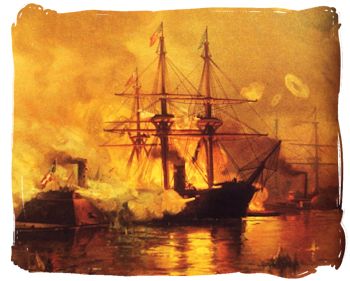
April 18th. Warm weather; nothing worthy of mention has occurred during these twenty-four hours; at anchor off mouth of Red River. Col. Ackelon’s plantation and residence a little distance ahead of us on the left bank of the river; it is a beautiful place; the Colonel I believe to be a good Union man; the Admiral’s, Captain’s, and ward room and forward officer’s table are supplied with the fruits and vegetables of the season, grown upon his place. I believe he has five inland plantations, making, with the one fronting upon the river, six, and is very wealthy; he owns at least one thousand negroes; he is afflicted with the gout; is a man in the prime of life, and a cripple; he owns a beautiful mansion in Nashville, Tenn., which his wife is living in at present; our officers have often gone ashore and dined with him, and he has been on board and paid his respects to Admiral Farragut and Commodore Palmer several times; be has also been so kind as to allow us to bury some of our men who have been so unfortunate as to get killed by the enemy, or die of fever contracted in this southern clime.
18th. Got started at sunrise. Rode along with Drake a good deal of the way. Had to leave some rations. Met a messenger for more forces. Fear of rebels crossing the Cumberland. Very warm and sultry at noon. We stopped twice and napped. Very rough and sterile country. Houses deserted generally. Got into camp at sundown. Slept with Thede and C. G. Had a good visit with Henry Drake on religion. Did me good.


