April 16th. The routine of camp life abruptly terminated to-day by receipt of orders to prepare for immediate service. We could scarcely believe that we were really going to leave our comfortable winter quarters and again take the field, but there it was, in black and white. “Troops to prepare at once eight days’ rations and one hundred and sixty rounds of ammunition to be issued.” The order was to leave extra clothing, camp equipage, etc., behind, the extra five days’ rations to be carried in knapsacks instead of clothing, etc.
We hear that General Hooker proposes to open the campaign by turning the flanks of the enemy, drawing him out of his entrenchments, and fighting him in the open. If the operation is successful, our camp equipage can easily be brought up whilst in case of a reverse we can simply fall back again to our starting place.
by John Beauchamp Jones
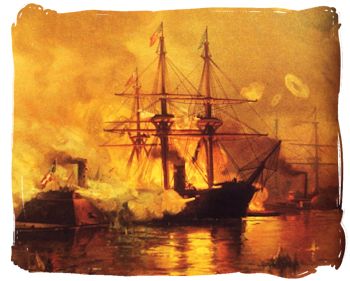
APRIL 16TH—The Federal papers have heard of the failure to take Charleston, and the sinking of the Keokuk; and yet they strive to mollify the disaster, and represent that but little damage was sustained by the rest of the fleet. Those that escaped, they say, have proved themselves invulnerable. The Keokuk had ninety shots on the water line. No wonder it sunk!
Gen. Longstreet has invested Suffolk, this side of Norfolk, after destroying one gun-boat and crippling another in the NansemondRiver. Unless the enemy get reinforcements, the garrison at Suffolk may be forced to surrender. Perhaps our general may storm their works!
I learn, to-day, that the remaining eye of the President is failing. Total blindness would incapacitate him for the executive office. A fearful thing to contemplate!
April 16.—A fleet of eight National gunboats and several transports, under the command of Admiral Porter, passed the rebel batteries at Vicksburgh, to-night, without any material damage, except the loss by fire of one of the transports, laden with commissary stores and forage.— (Doc. 169)
—A party of Indians attacked a detachment of eighteen soldiers at Medalia, thirty miles from Mankato, Minnesota, killing one and wounding two, besides killing a boy and two men belonging to the settlement.—The British steamer Gertrude was captured off Harbor Island, W. I., by the National gunboat Vanderbilt.
April 16.— Day was pleasant. Rode over to General Howard’s headquarters, and showed him an order from General Benham to inspect the pontoon train. He was very polite and sent an aide with me to Hope Landing, where the train was. Got down there and saw Captain Lee, Quartermaster, and Mr. Waterman, a civilian, who has charge of the train. The train consists of 22 wagons, with 8 boats, which are taken apart on the march and put together again when needed. One boat consists of some 35 to 40 pieces. The pieces are all tongued and grooved, and then bolted together. The stringers arc 33 feet long, and the bays 25 feet in length. The chess are common plank, and average some 15 inches in width, and 15 feet in length. The boats are 18 feet long and 8 feet wide. I should think that they would be liable to leak on account of the numerous joints. It takes some fifteen minutes to put a boat together. The horses are very poor indeed, and very green. The train is in charge of Mr. Waterman, who receives $150 a month, and 16 mechanics, who have from $2 to $2.50 [a day]. Got back to camp about 2 P.M.
Wednesday, April 15th.
I went to the supper table last night too sick to eat anything; left the table and laid down on a lounge until the hotel keeper could show me a room; I retired early and slept well; got up this morning all right, but did not go to the breakfast table; took a lunch from my own haversack; walked out in town; went to the ten-pin alley and spent an hour rolling; had not played a game before for eight years, and enjoyed it very much; smoked a cigar, a notable scarcity in these times, and returned to the hotel, where I wrote a letter to Judge Devine, and one to my dear wife; may heaven’s choicest blessings rest upon her and my sweet children; went to the dinner table and found the landlady apologizing for some defect and two young females discussing the merits of the Episcopal and Baptist faith; got through dinner somehow and walked down to the quartermaster’s office; got the Vicksburg Whig; stretched myself out on the counter; read and took a nap; got up; went to the armory and would have enjoyed looking over the work very much but felt sick; it produces four Mississippi rifles per day at $30.00 a piece on contract with the state; I am now sitting at the foot of the hill below the armory.
April 15th. This morning, at six o’clock, hove up anchor, and steamed down the river; at ten o’clock, brought ship to anchor five miles above Port Hudson, for the purpose of communicating from masthead, by army signals, with vessels of lower fleet; signalizing from masthead, during the day, with U. S. sloop-of-war Richmond. At six o’clock, Mr. Gabaudan, Admiral’s Secretary, returned on board, in company with some army officers, across the point of land, from lower fleet, after an absence of seven days, upon business of great importance with Major-General Banks at New Orleans. He brought cheering army news. Gen. Augur, with a large force of Banks’s men, was in the rear of Port Hudson, cutting off their possibility of receiving supplies from that quarter, while we had blockaded the mouth of Red River, keeping them from transporting any provisions or stores from Texas out of this stream, and thence down the Mississippi; so the reader must admit that, unless they have a large quantity of beeves and provisions, this rebel stronghold must soon surrender to our arms. Starvation, when it begins, will do the work, which will be better than our being hasty, fighting, and losing thousands of valuable lives.
Camp White, April 15, Evening.
Dearest: — Your short business letter came this afternoon. I do not yet know about your coming here during the campaigning season. If we fortify, probably all right; if not, I don’t know.
Lieutenant Ellen is married. His wife sent me a fine big wedding cake and two cans of fruit. Good wife, I guess, by the proofs sent me.
You speak of Jim Ware. What does he think of the prospects? I understand Jim in a letter to Dr. Joe says Dr. Ware gives it up. Is this so?
I send you more photographs. The major’s resignation was not accepted and he is now taking hold of things with energy.
We are having further disasters, I suspect, at Charleston and in North Carolina. But they are not vital. The small results (adverse results, I mean,) likely to follow are further proofs of our growing strength.
What a capital speech Everett has made. He quite redeems himself.
Always say something about the boys — their sayings and doings.
Affectionately ever,
R.
Mrs. Hayes.
April. Having been an inmate in the hospital for three months, at my own request, I was allowed to join my company, located at Fort Marshall, east end of Baltimore. Reported to Lieutenant Merwin, commanding company. He would not allow me to go on duty. Wished me to remain at Regimental Hospital for a while until I could get stronger.
15th. Rainy during the night and drizzling in the morning. Went on, leaving the teams. Drew ammunition. Rode along some with A. B. then with Chester. Passed through Nicholasville and Lancaster. Crossed the Kentucky River. Mountains for several miles. Grand scenery. Reminded me of the Alleghanies. Reached Stanford, 45 miles, about 10 P. M. Went on two miles.
April 15 — Commenced raining last night and rained all day, with a cold wind from the north. This morning a dispatch came from headquarters that the Yankees were advancing with a heavy force from the direction of Fredericksburg. We broke camp immediately after the dispatch was received and started our wagons up the Valley pike. We went one mile east of New Market on the Sperryville pike and put our battery in position ready for fight. The Sixth, Seventh, and Eleventh Regiments of Virginia Cavalry were there also, ready for the fray at the first appearance of anything in the shape of an enemy. The dispatch this morning about the Yankees advancing in heavy force was a big, heavy, false report. We remained in battery about two hours, saw no Yankees, then moved up the Valley pike to Mount Tabor Church, eight miles below Harrisonburg, and camped. It rained very hard all day and nearly everything we have is thoroughly saturated. There was not a dry stitch on me when we stopped to camp.