April 15. — It rained heavily during the night, and also this morning, putting an effectual check on all movements for some time. The rain continued all day. Supplies were forwarded to the cavalry. Had an order to inspect the pontoon train in General Howard’s corps as soon as the rain held up, but had no chance to go as the rain continued all clay. Every one feels blue on account of the cavalry, whose movements the rain must seriously interfere with.
April 2013
April 14th. Nothing has occurred or come under my notice this day worthy of especial mention. After the rain and thunder storm of last evening, the air is quite cool and agreeable—quite a relief from that of yesterday, so close, &c.
Tuesday, April 14th.
Left Palestine about 5 o’clock a. m., in a two-horse wagon; same company, with the addition of Mr. Mathus of the First Texas. The ride to Rusk would have been insupportably dull but for good company; nothing but red clay hills and deep gullies, ornamented with pine and oak. It, however, brought up some pleasing reminiscences of old South Carolina and my boyhood days—the season when ambitious hopes, burned in my breast and I determined I would be a man—little dreaming then that I would have the satisfaction of striking a blow in the holiest cause that ever fired the breast of man, and illustrating by action the feelings which glowed and burned in my little heart, on reading the stories of Wallace and of Tell.
We reached Rusk about 4 o’clock in the afternoon without an incident of interest, and found W. G. Thomas to be the quartermaster there. He appears to be an accommodating and clever officer and refunded our transportation which we had paid out at Palestine.
To-day is the fifth anniversary of my wedding day, and I have thought often of my dear wife and little ones and wished I could be with them, but I am resolved not to remain quietly at home another moment while a foe is on our soil.
April 14. — This day I have seen a bloody battle fought, and now write sitting among furrows cut up by the wheels of the batteries. A little way to the right, in the edge of the wood, lie the unburied dead. There, too, lie the castaway guns and all the wreck and waste of such a field. A few rods to the left, the surgeons, all this forenoon, have been dressing wounds. The pursuit of the enemy is going forward. We only wait the order to advance. Occasionally the strong, fresh south wind brings to us the crash of a volley, or an explosion in the advance. A huge vapory column builds itself up into the air; then the breeze dissipates the unsubstantial tower from base to cornice.
April 14 — Turned over all our tents to-day, which means that we are to take the weather raw all through the campaign, with nothing to shelter us from storm and rain, sunshine and dew.
Tuesday, April 14th.
Ah! another delightful glimpse of society has been offered to our charmed view. Such a treat has not often fallen to our lot. Good Mrs. Greyson, in her anxiety to make all around her happy, determined we should have a dance. I should say “Miriam”; for Mrs. Bull and Mrs. Ivy never indulge in such amusements, and I can’t; so it must have been for Miriam alone. Such a crew! The two ladies above mentioned and I almost laughed ourselves into hysterics. Poor Miriam, with a tall, slender Texan who looked as though he had chopped wood all his life, moved through the dance like the lady in “Comus”; only, now and then a burst of laughter at the odd mistakes threatened to overcome her dignity. We who were fortunately exempt from the ordeal, laughed unrestrainedly at the mêlée. One danced entirely with his arms; his feet had very little to do with the time. One hopped through with a most dolorous expression of intense absorption in the arduous task. Another never changed a benign smile that had appeared on entering, but preserved it unimpaired through every accident. One female, apparently of the tender age of thirty, wore a yellow muslin, with her hair combed rigidly à la chinoise, and tightly fastened at the back of her head in a knot whose circumference must have been fully equal to that of a dollar. In addition to other charms, she bore her neck and chin in a very peculiar manner, as though she were looking over the fence, Mr. Christmas remarked. Mr. Christmas had ridden all the way from Ponchatoula to see us, and if it had not been for him, Mr. Worthington, and Dr. Capdevielle, who came in after a while, I think I should have expired, and even Miriam would have given up in despair. The Doctor was an old friend of Harry’s, though we never met him before.

Kentucky
14th. Ordered on to Stanford. Started right away after breakfast. Passed many large massive residences along the road. Excellent fences and beautiful farms. Saw a great many negroes, generally well dressed, but very wishful. Drew and issued rations at Lexington in the evening. Saw West Hospital. Rode through the city, twelve or fifteen thousand. H. Clay’s monument, 150 ft. high.
April 14, Tuesday.
Little of interest to-day at council.
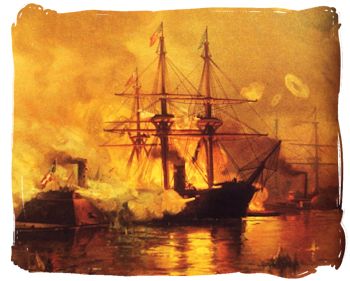
The War Department, which early in the War claimed that the armed force on the Western rivers should be subject to military control, became involved in difficulty. Naval officers, naval guns, naval men, and naval discipline were wanted and so far as could be done were given, but Congress merely ordered that the armed vessels should be transferred to the Navy. This law had given offense to the War Department, and when the transfer was made, the “ram fleet,” as it was called, was withheld. This was, as I said to Stanton, in disregard of the law and would be likely to lead to difficulty, for, while there might be cooperation, there could not be separate commands without conflict.
The ram fleet was commanded by the family of Ellett, brave, venturous, intelligent engineers, not always discreet or wise, but with many daring and excellent qualities. They had under them a set of courageous and picked men, furnished by the military, styled the Marine Brigade, and did some dashing service, but refused to come under naval orders, or to recognize the Admiral in command of the Mississippi Squadron. The result was, as I anticipated might be the case, an arrest and suspension of Brigadier-General H. W. Ellett from the command of the ram fleet.
Stanton is very laudatory of the Elletts, and violent in his denunciations of Porter, whom he ridicules as a “gas bag and fussy fellow, blowing his own trumpet and stealing credit which belongs to others.” There is some truth in what he says of the Elletts and also of Porter, but the latter with all his verbosity has courage and energy as well as the Elletts.
Providence, La., Tuesday, April 14. Cold and rainy all day, making it rather disagreeable. Spent the day in our quarters over the horses. Read the Covenant, mused and slept most of the day. At about 9 P. M. we neared what appeared like a city with its hundreds of lamps, but proved to be Providence with the lighted steamboats tied close.

Tuesday, 14th—Another rainy day. I went to town two miles up the river this morning in a canoe, with the cook of Company K (I am taking cooking lessons from him) to buy provisions. I bought ten pounds of ham and other things for $3.95. I wrote a letter home to Albert Downing and enclosed $10.00 in it. General Quimby’s Division landed at Lake Providence this afternoon. It is reported that the expedition that was trying to find a way to get the army past Haines’s Bluff on the Yazoo river has been forced to give it up on account of the floods. The river is flooded for a hundred miles up from the mouth, and four miles on either side. It is thought that they will have to run the fleet past the batteries at Vicksburg and march the army down the Louisiana side and then across the river on high ground below Vicksburg.


