May 24, Sunday. We have had gratifying intelligence from the Southwest for several days past, particularly in the vicinity of Vicksburg. It is pretty certain that Grant will capture the place, and it is hoped Pemberton’s army also. There is a rumor that the stars and stripes wave over Vicksburg, but the telegraph-wires are broken and communication interrupted.
May 2013
Sunday, May 24th.
Left Richmond yesterday about 6:30 o’clock a. m. Found a number of the Texas Brigade and a few of my regiment on the cars and soon became acquainted with them. The trip was monotonous, as usual, until we reached Gordonsville, where the crowd was so great that twenty of us had to stand on the platform. General J. E. B. Stuart was aboard and appeared to be very fond of ladies and flowers. He is of medium size, well formed, fair complexion, blue eyes, whiskers and mustache of sun-burnt reddish color, usually accompanying fair skin. I had quite a pleasant time on the platform watching the attempts of the proscribed to get a seat in the cars and their repulse by the provost guard. The cars were for the accommodation of ladies and commissioned officers. I never knew soldiers of any grade to be put in the same category with women before. I happened, however, to meet Tom Lipscomb, my old college classmate, who is now a major, who managed to get me in under his wing. We had a long talk about Columbia and old college days. He informed me that Lamar Stark, my wife’s brother, was a prisoner confined in the old capitol in Washington city. We reached Mitchell’s Station at 4 o’clock p. m.; walked five miles, a hot walk, to camp on the Rapidan, near Raccoon Ford. My regiment, the Fourth Texas, has a delightful camping place in a grove of large chestnut trees, on a hillside. We have no tents and the ground is hard and rocky, but we are all satisfied, and one day’s observation has led me to believe that no army on earth can whip these men. They may be cut to pieces and killed, but routed and whipped, never! I called on Colonel B. F. Carter this morning and had quite a pleasant interview. He is a calm, determined man, and one of the finest officers in the division. To-day was the regular time for inspection and review. One barefooted and ragged hero came to Colonel Carter’s Tent with the inquiry, “Colonel, do you want the barefooted men to turn out today?” to which the Colonel replied negatively, with a smile. I went out to the review which took place in an open field about 600 yards from camp. There were some ladies on horseback on the field. Their presence was cheering and grateful. They were all dressed in black, as were more than two thirds of the women in the Confederacy. On returning to camp I called on Major Bass, of the First Texas, and gave him $25.00, which I had received for him from Lieutenant Ochiltree, at Shreveport, Louisiana, to be handed to Bass if I did not need it.
I received two haversacks to-day, miserably weak and slazy, made of thin cotton cloth. I have only taken a change of underwear, towel, soap and Bible and Milton’s Paradise Lost. I have sent all the rest to Richmond with my carpet sack, to be left at Mrs. Mary E. Fisher’s, on Franklin street, half way between Sixth and Seventh.
I wrote a letter to mother and one to wife to-day and read the 104th Psalm. I opened to it by chance, and it contained just what I felt.
24th. In the morning early issued potatoes and beef. Thede felt a little better. After breakfast got water and helped him bathe. Bathed myself and changed clothes. Read Independents and Congregationalist. Word that chaplain would preach at 5 p. M. but ne’er a sermon. Report came that Grant had defeated Pemberton. Wrote home. Made thickened milk. Slept with Thede.
MAY 24TH.—Sunday; and how little like the Sabbath day it seems. Cannon are still sending their messengers of death into the enemy’s lines, as on week days, and the minnie balls sing the same song, while the shovel throws up as much dirt as on any other day. What a relief it would be if, by common consent, both armies should cease firing to-day. It is our regiment’s turn to watch at the front, so before daylight we moved up and took our position. We placed our muskets across the rifle pits, pointing towards the fort, and then lay down and ran our eyes over the gun, with finger on trigger, ready to fire at anything we might see moving. For hours not a movement was seen, 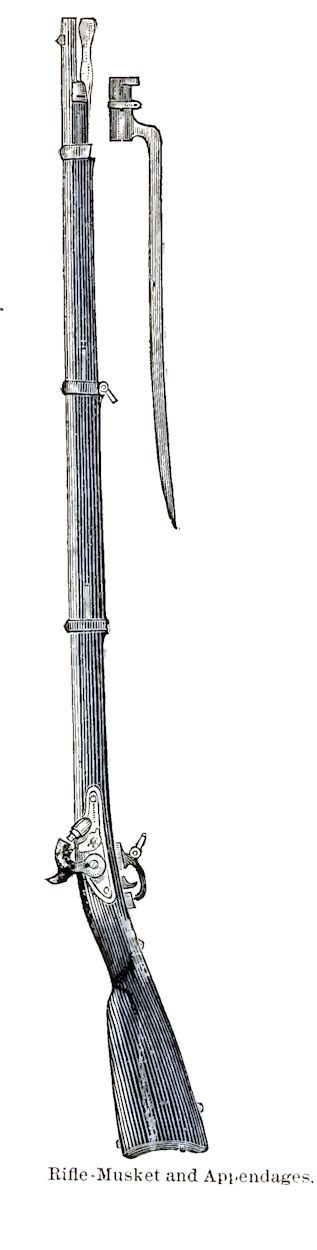 till finally an old half-starved mule meandered too close to our lines, when off went a hundred or more muskets, and down fell the poor mule. This little incident, for a few minutes, broke the monotony. A coat and hat were elevated on a stick above our rifle pits, and in an instant they were riddled with bullets from the enemy. The rebels were a little excited at the ruse, and probably thought, after their firing, there must be one less Yankee in our camp. In their eagerness a few of them raised their heads a little above their breastworks, when a hundred bullets flew at them from our side. They all dropped instantly, and we could not tell whether they were hit or not. The rebels, as well as ourselves, occasionally hold up a hat by way of diversion. A shell from an enemy’s gun dropped into our camp rather unexpectedly, and bursted near a group, wounding several, but only slightly, though the doctor thinks one of the wounded will not be able to sit down comfortably for a few days. I suppose, then, he can go on picket, or walk around and enjoy the country.
Sunday, 24th—To-night went down near Redman’s; run into Yankee pickets, and started back. Came cross railroad and out to Sherwin’s, got breakfast and on to Boss Meadows. From there to Hughe’s Shop; got two shoes and nails made. Went down to Essick’s and got supper and on top Mountain and staid all night.
24th May (Sunday).—We reached Meridian at 7.30 A.M., with sound limbs, and only five hours late.
We left for Mobile at 9 A.M., and arrived there at 7.15 P.M. This part of the line was in very good order.
We were delayed a short time owing to a “difficulty” which had occurred in the up-train. The difficulty was this. The engineer had shot a passenger, and then unhitched his engine, cut the telegraph, and bolted up the line, leaving his train planted on a single track. He had allowed our train to pass by shunting himself, until we had done so without any suspicion. The news of this occurrence caused really hardly any excitement amongst my fellow-travellers; but I heard one man remark, that “it was mighty mean to leave a train to be run into like that.” We avoided this catastrophe by singular good fortune.[1]
The universal practice of carrying arms in the South is undoubtedly the cause of occasional loss of life, and is much to be regretted; but, on the other hand, this custom renders altercations and quarrels of very rare occurrence, for people are naturally careful what they say when a bullet may be the probable reply.
By the intercession of Captain Brown, I was allowed to travel in the ladies’ car. It was cleaner and more convenient, barring the squalling of the numerous children, who were terrified into good behaviour by threats from their negro nurses of being given to the Yankees.
I put up at the principal hotel at Mobile—viz., the “Battlehouse.” The living appeared to be very good by comparison, and cost $8 a-day. In consequence of the fabulous value of boots, they must not be left outside the door of one’s room, from danger of annexation by a needy and unscrupulous warrior.
[1] I cut this out of a Mobile paper two days after:— “attempt To Commit Murder.—We learn that while the uptrain on the Mobile and Ohio Railroad was near Beaver Meadow, one of the employees, named Thomas Fitzgerald, went into one of the passenger cars and shot Lieutenant H. A. Knowles with a pistol, the ball entering his left shoulder, going out at the back of his neck, making a very dangerous wound. Fitzgerald then uncoupled the locomotive from the train and started off. When a few miles above Beaver Meadows he stopped and cut the telegraph wires, and then proceeded up the road. When near Lauderdale station he came in collision with the down-train, smashing the engine, and doing considerable damage to several of the cars.2 It is thought he there took to the woods; at any rate he has made good his escape so far, as nothing of him has yet been heard. The shooting, as we are informed, was that of revenge. It will be remembered that a few months ago Knowles and a brother of Thomas Fitzgerald, named Jack, had a renconter at Enterprise about a lady, and during which Knowles killed Jack Fitzgerald; afterwards it is stated that Thomas threatened to revenge the death of his brother; so on Sunday morning Knowles was on the train, as stated, going up to Enterprise to stand his trial. Thomas learning that he was on the train, hunted him up and shot him. Knowles, we learn, is now lying in a very critical condition.”
2 This is a mistake
Mo. Heights, May 24, 1863.
Dear Friends:
Yours found us all well. Was sorry to hear that Aunt D. was so near her end; but hers has been a life of sickness. We might say her last moments on earth would be the happiest she ever enjoyed for years. But to change the topic to the great cry of the nation, when is the war to be settled? I must say the matters look pretty blue. We must gain a victory soon, in some quarter and a great victory at that. If the papers speak the truth, the feelings of the people North are a little disloyal; I don’t mean in Mass., but more particularly the “Empire State,” especially on the Vallandigham case. He is a traitor and why not give him his dues? I see that he was not to be sent to Fort Warren but through our lines to the south. I hope Gov. Seymour will soon follow him; he certainly does no good to our cause, but on the contrary a great deal of harm. The weather has been very hot, but if there is a breeze we get it. It is beginning to get hard on us again, to have to go half way down the mountain for water, and if we don’t have rain soon, shall have to go to the foot. It is not very pleasant crawling up the mountain with a few canteens and a scorching sun sending its burning rays on to the back. Lieut. H. has returned to Co. H for duty; while here he won the enthusiasm of the men; if the men did not know the drill, he would take hold and show them and not damn them. The feelings of the Co. are worse than they have ever been before. I have no doubt if they had a leader to carry out any thing, some change might take place in the Company. There are fears that Harper’s Ferry will be attacked. The rebs have shown themselves rather plucky lately. I wish you would send me out my spanish book; we are having a small class in the barracks I stop in. Have got one man that can speak well. I have some one ask me every day how you are and if I think you will come out here this summer. What do you think of it? I remain, Your obt. servant,
L. B., Jr.
May 24—Laid here all day, it being Sunday.
Before Vicksburg, Sunday, May 24. Up and ready as ordered, but with the sun we unharnessed, watered and fed, then lay quiet all day. Washed and changed clothes, and Oh! what a relief. Truly water is a boon. Grant seems to be willing to allow the inhabitants of Vicksburg the Sunday for devotion. There has been but very little fighting to-day, little artillery firing. 4th Division passed in from Haynes Bluff for Warrenton.
Received a good mail which gladdened all our hearts. Oh! blessed white-winged messenger, how my mind has been occupied all day by sweet thoughts and hopes inspired by thy visits! Letters up to the 10th. Wrote a short and hurried letter home. Learned through the State Journal that a friend and former teacher, E. C. Hungerford, had fallen in the fight on the Rappahannock. It is another severe blow to his brother Tommy. How many, many more will this cruel war require to satisfy its victims. Wounded passing all day in ambulances to the river. Sergt. J. B. Jackson and L. N. Keeler gone. Sick.
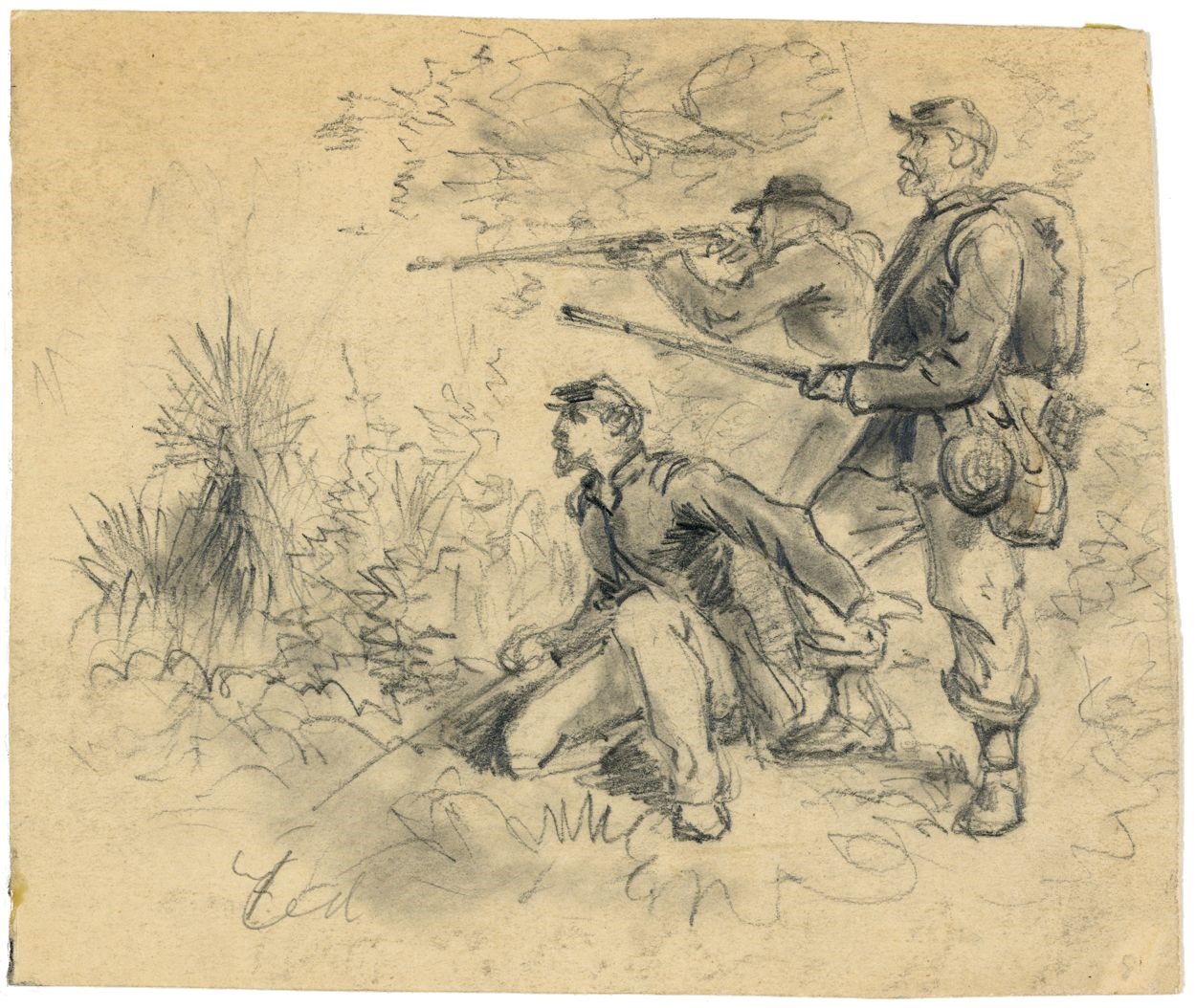
Drawing by Alfred R. Waud; no date given; drawing on cream paper : pencil ; 10.2 x 12.2 cm. (sheet); Library of Congress image.
__________
 Note: This image has been digitally adjusted for fade correction, color, contrast, and saturation enhancement and selected spot removal.


