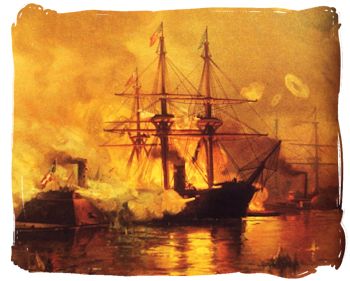
May 24th. Commences with pleasant weather. Light winds from S. E. Transports in sight coming down the river, and cavalry and infantry landing at the levee at Bayou Sara from four to eight A. M.; at eight thirty A. M. hove up anchor, got under way and steamed down the river; at nine thirty A. M. rounded to above Port Hudson, and fired a shell from the Sawyer rifle on poop, into the rebel batteries, to let them know we had come down to see them once more; at nine forty A. M. came to anchor five miles above Port Hudson. Received from the Albatross five rebel prisoners, hard looking fellows, on board, and kindly cared for them. These unfortunates were captured on a point of land opposite the rebel Gibraltar No. 2 of the Mississippi; at ten thirty A. M. called all hands to muster and performed Divine service. Heavy firing going on at Port Hudson. Received some more rebel prisoners this morning from the Albatross; they proved to be an officer and two privates belonging to a signal corps, they having been captured the day before by some of our pickets. Heavy firing heard in rear of Port Hudson. The mortar schooners below, engaged the rebel batteries also, from two thirty until four P. M. From four to six P. M., heavy cannonading between lower fleet and rebel batteries at Port Hudson, during this watch; also our army in rear of Port Hudson, engaged with the enemy; at six P. M. inspected crew at quarters. Received a mail on board from below.
May 2013
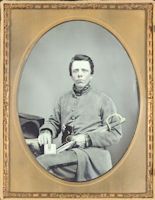
May 24 — Sharp shooting and cannonading as usual this morning — continued all day —
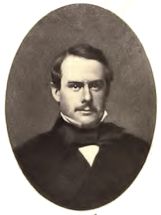
Charles Francis Adams, Jr., to his father
Potomac Creek Bridge, Va.
May 24, 1863
Yours and Henry’s of May 1st with the accompanying volumes of Cust reached me last evening. One of your May letters is still missing. The volumes of Cust are most acceptable. They are written with more spirit than I should expect in so old a man, and his military characters of leading Generals are really in their way admirable — pen and ink sketches of the best class. It is really a most useful book for me and a most admirable selection. If I remain long a soldier it will be of no small use in my education. Did I thank you for “The Golden Treasury “? It’s strange. I laughed as I opened it, it seemed such an odd book for a camp and the field; but strangely enough I find that I read it more than any book I have, and that it is more eagerly picked up by my friends. It is very pleasant to lie down in all this dust and heat and to read some charming little thing of Suckling’s and Herrick’s.
I laughed heartily over your and Henry’s accounts of Earl Russell’s diplomacy and the John Bull diplomacy. How strange, and he a man who will figure in history. John Bull backed you right down and made you explain and eat your humble pie, and every one admired his bold position and laughed at your humiliation; and then comes the secret history and Bottom, that roaring lion, becomes Bottom the sucking dove, and winks at the alarmed Plenipotentiary and says, “it is only I, Bottom the joiner.” And so after all, that high toned descendant of all the Bedfords is no better than some men we do not admire nearer home. But I cannot but wonder at Russell’s course. Any day may force him into real collision with you; the danger of this is imminent; and if it comes, what a terrible handle he has given you… You could expose him to two continents, and your silence now would make the exposure more galling. It seems to me that the noble Earl is now under heavy bonds for his good behavior for the remainder of your term. I think the last part of that term is going to be far more pleasant than the first.
I am very hopeful and sanguine, though no longer confident. In spite of a wretched policy in Washington which perpetually divides and dissipates our strength; and in spite of the acknowledged mediocrity of our Generals, our sheer strength is carrying through this war. In this Army of the Potomac affairs are today truly deplorable, and yet I lose and the army loses no heart — all underneath is so sound and good. We know, we feel, that our misfortunes are accidents and that we must work through them and the real excellence which we daily see and feel must come to the surface. The truth in regard to the late battles is gradually creeping out, and the whole army — Cavalry, Artillery, Infantry and Engineers — feel and know that they won the one decided victory of the war and that Hooker threw it away. Hooker today, I think, stands lower in the estimation of the army than ever did the redoubtable John Pope; but what can we do? Sickles, Butterfield and Hooker are the disgrace and bane of this army; they are our three humbugs, intriguers and demagogues. Let them be disposed of and the army would be well satisfied to be led by any of the corps commanders. We do not need geniuses; we have had enough of brilliant generals; and give us in the due course of promotion an honest, faithful, common-sensed and hard-fighting soldier, not stupid, and we feel sure of success. There are plenty to choose from — Sedgwick, Meade, Reynolds, Slocum and Stoneman, any of them would satisfy. I do not dare to discuss our western prospects. If Vicksburg falls, I care very little what becomes of Richmond, and Grant seems to be doing well. I am sanguine but not as confident, for I cannot forget how McClellan was within four miles of Richmond when the reinforcements of the enemy poured in. Grant must be quick, for if we do not soon hear of the capture of Vicksburg, or of some point necessitating its final fall, I fear we shall hear a different and older story. However, let us hope for the best and fight it out.
Since I last wrote a week ago, nothing of moment has turned. We are still in this hot, exposed, dusty and carrion-scented camp and, as sure as fate will all be sick unless we move out of this region of poisoned atmosphere. We are under orders for early tomorrow morning and I do hope we shall get away. Anything is better, and already all the impetus of my four weeks campaign has expended itself.
We have been going through a course of cleanliness and inspection, getting the men and arms clean and neat, and bringing up our discipline. In hot weather this is very charming and when accompanied by the miserable slavery which is one of the traditions of discipline in this regiment, it makes a camp life of monotony, varied by ham and hard bread (literally my only fare for weeks past) in itself not attractive, as adventitiously disagreeable as may be. On the 9th of April last I had permission to leave camp and dined at General Devens’. On the 17th of May, after four weeks of field duty and not one hour of the whole six weeks off duty, I asked permission of Colonel Curtis to ride over to dine with an old friend at General Sedgwick’s, it being a Sunday afternoon. After much hemming and hawing I was point-blank refused on some miserable reason, such as that I was the only officer in my company here, or something of that sort. With old schoolmates and acquaintances within sight by the dozen, Paul Revere, Sam Quincy and such as they, I have never seen one of them and, for all the good they do me, they might as well be with you. Of course such a system as this, while it does stop gadding on the part of officers, does not tend to make life pleasant or one’s duties agreeable, and, proverbially timid as I am, I think I would rather fight three battles a week and be in the field, than thus rot and rust in camp. Curtis is a good officer and a better fellow and as strict in his own duty as in ours; but while I decidedly admire his faculty of saying “no” to his most intimate associates here, it certainly does not serve to make our pork and hard-bread more palatable. So here I am, attending daily to the needs of my men and horses, duly seeing that hair is short and clothes are clean, paying great attention to belts and sabres, inspecting pistols and policing quarters and so, not very intellectually and indeed with some sense of fatigue, playing my part in the struggle. . . .
The papers have just come with the news of Grant’s successes. This, if all be true, settles in our favor the material issue of the war, and, in a military point of view, I do not see how it can fail, with the recognized energy of our western Generals, to make the destruction of the confederacy as a military power a mere question of time. Our raids would seem to show that the Confederates have no reserve strength. If this be so, their line is like a chain the strength of which is equal to the strength of the weakest link. Broken at Vicksburg they must fall in Tennessee and can be forced out of Virginia. We shall see. Meanwhile let me congratulate you. The fall of Vicksburg will not tend, I imagine, to aggravate your diplomatic troubles.
May 24.—Austin, Mississippi, was visited and burned by the forces under General Ellet, commanding the ram fleet in the department of the Mississippi.—(Doc. 202.)
—A wagon-train, laden with commissary stores, with an escort of thirty colored troops, under the command of a white officer, were captured near Shawnee Creek, Kansas, by a gang of rebel guerrillas.—Leavenworth Conservative.
— The schooner Joe Planner was captured while trying to run the blockade of Mobile, Ala., by the gunboat Pembina.—Major-Generals A. P. Hill and R. S. Ewell, of the rebel army, were appointed Lieutenant-Generals. — General Curtis relinquished the command of the Department of the West of the army of the United States, and General Schofield assumed it, and issued orders to that effect.
—Considerable excitement existed in England regarding the depredations of the rebel privateer Alabama—the cargoes of three of the vessels captured and destroyed by her on the South American coast being British property.

23rd.—We tremble for Vicksburg; an immense army has been sent against it; we await its fate with breathless anxiety.
May 23d. After an uneventful ride we arrived at Sandy Hook at four o’clock this morning, getting our first view of the Potomac River. Orders received to turn out and form in line for a march. The road was along the side of the Ohio and Chesapeake Canal, under the Maryland Heights. The march continued on over the iron railroad bridge crossing the Potomac River into Harper’s Ferry. Here we first put foot on what was called the sacred soil of Virginia. Harper’s Ferry was historical ground. Here John Brown started an insurrection to liberate the slaves. Our march through the town was by way of Shenandoah Street, then by file left into a large open lot in town. Here we prepared our breakfast. Later we were allowed to visit the town and the points of interest. The old brick fire-engine house, known as John Brown’s Fort was one of the points of interest. Saw where the bricks had been knocked out for port-holes to fire through. A government arsenal had been located here. Destroyed by the rebels, only the old walls remained standing. Some severe fighting had taken place in this side hill town. At 5 P. M. we left the town on the march for Winchester. After a march of eight miles camped for the night in woods. Not being strong, after my illness, I was obliged to fall out by the roadside. Lieutenant Merwin wished me to return to the hospital. I answered no, I would rather die in the field, I wanted to stay with the boys. The Lieutenant was very kind to me, he taking my knapsack and the boys my equipment. After a short rest and a bath in a brook I was able to follow on, finding the regiment in camp for the night near Charlestown.

Saturday, 23d — We started this morning at daylight and marched five miles to General McPherson’s headquarters at the center of the army. Here we lay until 4 o’clock in the afternoon, when we marched back to our old place on the extreme left. The rebels again commenced to shell us, but the shells went over our heads. The Eleventh Iowa went on picket. Our men are shelling the rebels from all sides, and they are falling back behind their fortifications. When passing the headquarters of the Seventeenth Army Corps today, I saw a most dreadful sight at the field hospital ; there was a pile, all that a six-mule team could haul, of legs and arms thrown from the amputating tables in a shed nearby, where the wounded were being cared for.

May 23. — Rode along our picket line this morning, beginning near Mrs. Gray’s, and going from there to the extreme left. Saw nothing new. Day sultry and warm.
May 23 — I was at Dayton to-day and attended the funeral of a Maryland cavalryman who was buried by his comrades, with the honors of war. True, no sister’s tear-drop moistened his grave, yet the funeral rites were sanctified by the presence of woman, for many ladies of Dayton were at the burial, to pay their last sad respects to a departed defender.
May 23, Saturday. Met the President, Stanton, and Halleck at the War Department. Fox was with me. Neither Du Pont nor General Hunter has answered the President’s dispatch to them a month since. Halleck does not favor an attack on Charleston unless by the Navy. The army will second, so far as it can. Fox, who commanded the first military expedition to Sumter, is for a renewed attack, and wants the Navy to take the brunt. Stanton wants the matter prosecuted. I have very little confidence in success under the present admiral. It is evident that Du Pont is against doing anything, — that he is demoralizing others, and doing no good in that direction. If anything is to be done, we must have a new commander. Du Pont has talents and capability, but we are to have the benefit of neither at Charleston. The old army infirmity of this war, dilatory action, affects Du Pont. Commendation and encouragement, instead of stimulating him, have raised the mountain of difficulty higher daily. He is nursing Du Pont, whose fame he fears may suffer, and has sought sympathy by imparting his fears and doubts to his subordinates, until all are impressed with his apprehensions. The capture of Charleston by such a chief is an impossibility, whatever may be accomplished by another. This being the case, I have doubts of renewing the attack immediately, notwithstanding the zeal of Stanton and Fox. I certainly would not without some change of officers.
Having no faith, the commander can accomplish no work. In the struggle of war, there must sometimes be risks to accomplish results, but it is clear we can expect no great risks from Du Pont at Charleston. The difficulties increase daily [as] his imagination dwells on the subject. Under any circumstances we shall be likely to have trouble with him. He has remarkable address, is courtly, the head of a formidable clique, the most formidable in the Navy, loves intrigue, is jesuitical, and I have reason to believe is not always frank and sincere. It was finally concluded to delay proceedings until the arrival of General Gilmore, who should be put in possession of our views.
Sumner brought me this P.M. a report in manuscript of the case of the Peterhoff mail. I have read it and notice that the attorney, Delafield Smith, takes the opportunity to say, I doubt not at whose suggestion, that there is no report that the public mails have ever been opened and examined. He does not say there is any report they were not, or that there is any report whatever on the subject. All letters and papers deemed necessary are always examined. Upton well said in reply to Smith that the question had never been raised. Much time was spent in arguing this point respecting the mails. It was reported to Seward, and that point was seized upon, and the question raised, which led the President to call on me for a record of a case where public mails had been searched. Seward’s man, Delafield Smith, having learned through Archibald, the British Consul, that the Secretary of State had given up our undoubted right to search the mails, set up the pettifogging pretense that there was no report that captured mails ever had been examined, which Judge Betts did not regard, and Upton correctly said the point had never been raised. The court never asked permission of the Executive to try a prize case; there is no report that they ever asked or did not ask; the right was no more questioned than the right to search the mails.


