Following the American Civil War Sesquicentennial with day by day writings of the time, currently 1863.

May 2013

MAY 22ND. —Last night mortar-shells, fired from the boats on the river in front of the city across Point Louisiana, fell thick over all parts of Vicksburg, and at three o’clock this morning every cannon along our line belched its shot at the enemy. Nothing could be heard at the time but the thundering of great guns—one hundred cannons sent crashing into the town —parrot, shrapnell, cannister, grape and solid shot—until it seemed impossible that anything could withstand such a fearful hailstorm. It was indeed a terrible spectacle—awfully grand.
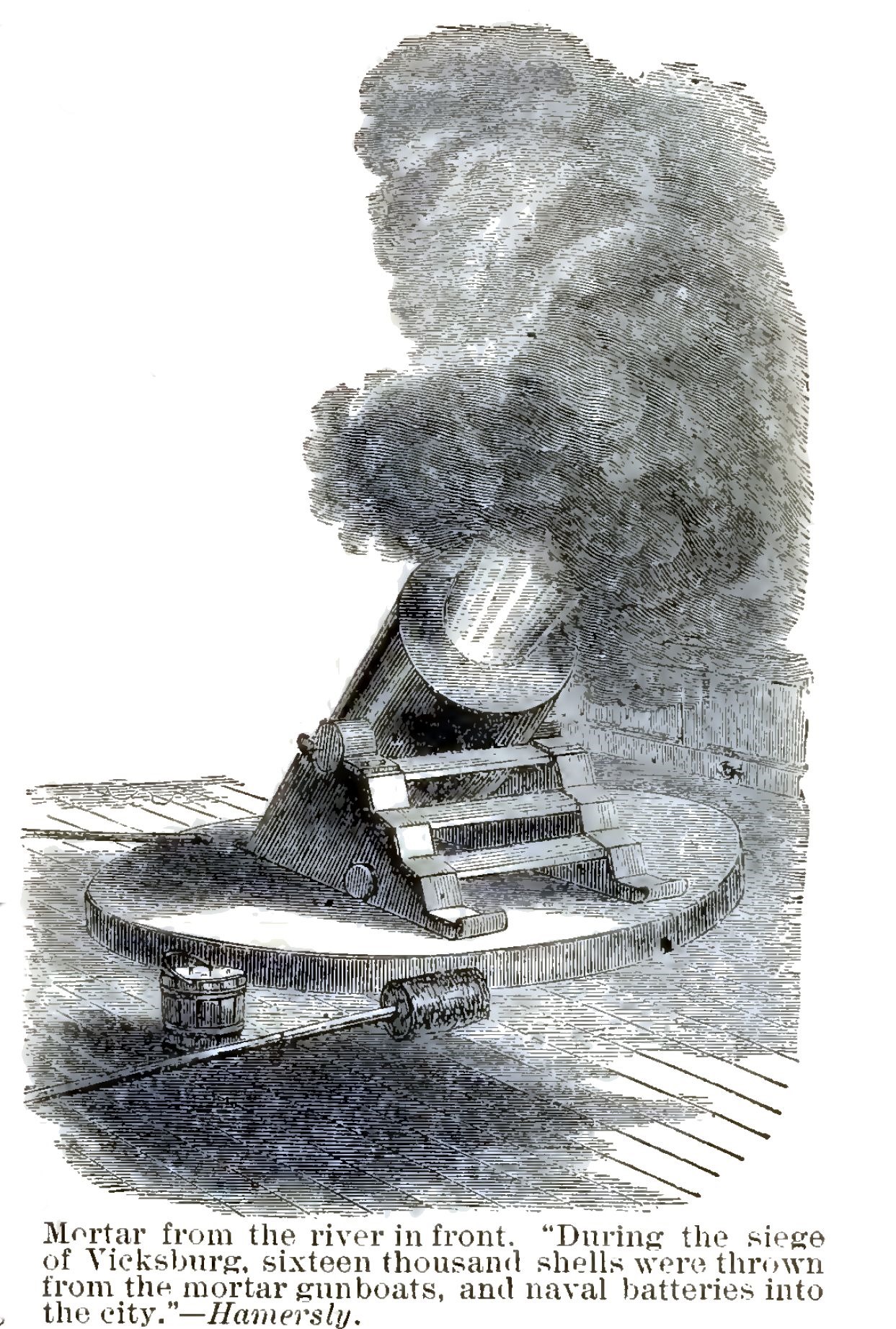
Mortor from the river in front. “During the siege of Vicksburg, sixteen thousand shells were thrown from the naval batteries into the city”— Hamersly

At ten o’clock we had orders to advance. The boys were expecting the order and were busy divesting themselves of watches, rings, pictures and other keepsakes, which were being placed in the custody of the cooks, who were not expected to go into action. I never saw such a scene before, nor do I ever want to see it again. The instructions left with the keepsakes were varied. For instance, “This watch I want you to send to my father if I never return”—”I am going to Vicksburg, and if I do not get back just send these little trifles home, will you?”—proper addresses for the sending of the articles being left with them. Not a bit of sadness or fear appears in the talk or faces of the boys, but they thought it timely and proper to dispose of what they had accordingly. This was done while we awaited orders, which at last came in earnest, and in obedience to them we moved up and took our place in the rifle pits within a hundred yards of Fort Hill, where we had orders to keep a diligent watch, and to fire at the first head that dared to show itself. The air was so thick with the smoke of cannon that we could hardly see a hundred yards before us. The line to our right and left was completely hidden from view except as revealed by the flash of guns, and the occasional bursting of shells through the dense clouds. About eleven o’clock came a signal for the entire line to charge upon the works of the enemy. Our boys were all ready, and in an instant leaped forward to find victory or defeat. The seventh Missouri took the lead with ladders which they placed against the fort, and then gave way for others to scale them. Those who climbed to the top of the fort met cold steel, and, when at length it was found impossible to enter the fort that way, the command was given to fall back, which was done under a perfect hail of lead from the enemy. The rebels, in their excitement and haste to fire at our retreating force, thrust their heads a little too high above their cover,—an advantage we were quick to seize with well aimed volleys. In this charge a severe loss was met by our division, and nothing gained. What success was met by the rest of the line I can not say, but I hope it was better than ours. Thus ended another day of bloody fight in vain, except for an increase of the knowledge which has been steadily growing lately, that a regular siege will be required to take Vicksburg. This day will be eventful on the page of history, for its duties have been severe, and many a brave patriot bit the dust under the storm of deadly fire that assailed us.
May 22—Marched twenty miles to-day, and halted at 6 P.M.

Before Vicksburg, Friday, May 22. First Section of caissons have gone to the landing for ammunition. Howitzers ordered out. 8 A. M. Advanced to the line of caissons, when we were ordered to prepare to support a grand charge to be made at 10 o’clock all along the line. Two of McAllister’s 24-pounder howitzers to go with us. The limbers were stripped No.’s 5 and 7, to have charge of canister in haversack. It was a warm place to go, and we anticipated hot work. At the hour the infantry advanced. Most of the enemy’s guns had been silenced for the time by the unceasing cannonading kept up from all points for an hour before the charge, but when they came up to the front of the fort they met the infantry in force, and then a terrible struggle ensued until darkness put an end to the scene. Both parties stubbornly held their own. Our line was right under their fort with the flag stuck on the corner and neither party could remove it. On the knoll by the siege guns was a sight truly sublime and terrible. For miles to the left the field of conflict could be seen extending to McClernand’s Corps, artillery smoke rolling in volumes from the brow of the ridge a quarter of a mile to the fortifications, and the sharp crack and puff of the musketry immediately under them. At sundown our line was obliged to fall back for the night. Doubtless many a poor fellow lay on the field groaning from pain. 8 P. M. ordered to return to our camp and report to the same place at half past five in the morning. First Section still in their old position, having been actively engaged all day.

Railroar Redoubt, May 22, 1863

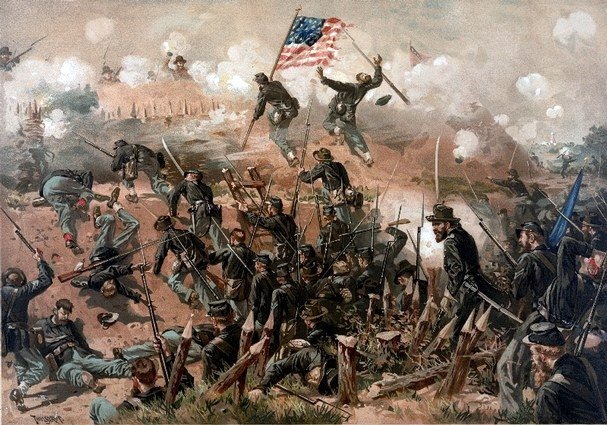
VICKSBURG May 22, 1863 – Climbing into a hail of Confederate minie balls and grapeshot, a sergeant of the 22nd Iowa advances to plant a flag atop the Confederate breastworks at Vicksburg. The attackers were driven back with heavy loss each time such an advance was attempted. Undaunted by his failure on the 19th, but realizing that he had been too hasty, Gen. Ulysses Grant made a more thorough reconnaissance of the Vicksburg defenses prior to ordering another assault. Early on the morning of May 22, Union artillery opened fire, and for four hours bombarded the city’s defenses. Then, at 10:00 a.m. the guns fell silent along the entire Federal, and Union infantry was thrown forward along a three-mile front. Sherman attacked once again down the Graveyard Road, Gen. James McPherson in the center along the Jackson Road, and Gen. John McClernand on the south along the Baldwin Ferry Road and each side of the Southern Railroad of Mississippi. Although flags of all three corps were planted at different points along the exterior slopes of the Confederate fortifications, and Gen. McClernand’s troops were able to make a short-lived penetration at Railroad Redoubt, the Federals were again driven back, sustaining losses in excess of 3,000 men.

The Commercial Appeal, Memphis, Tennessee

Tour Stop 13 – Railroad Redoubt

The Railroad Redoubt was a Confederate fortification built to protect a vital entrance to the city — in this case the Southern Railroad of Mississippi.

On May 22, General Grant ordered a second major assault against the formidable Confederate positions. Union forces began their carefully planned attack with a fierce artillery bombardment, followed by the advance of the infantry.

Unlike other points along the Confederate defense line, the blue-clad soldiers found that the redoubt’s southeast angle had been partially destroyed by the artillery bombardment. Union soldiers commanded by Sgt. Joseph E. Griffith of the 22d Iowa were able to exploit this brief breakthrough and quickly entered the redoubt in an attempt to storm the Confederate earthworks. The Confederates counterattacked and called up reinforcements. Waul’s Texas Legion arrived to drive out the Federals and “seal the breach.”

Although Union forces sustained heavy losses, Griffith managed to withdraw, taking a dozen prisoners with him. By evening, the Federals had returned to their lines. There were no further attacks on the Railroad Redoubt, and mining operations commenced. By the time of the surrender on July 4, 1863, approach trenches had reached the redoubt’s outer ditch.

National Park Service,
Vicksburg National Military Park


This painting, by Thure de Thulstrup, is attributed online to several different engagements at Vicksburg, including two different National Park Service pages.

by John Beauchamp Jones

MAY 22D.—A letter from Gen. Howell Cobb, declining the offer of the Secretary of War, of the position of Quartermaster-General, was received to-day. His wife is ill, and he prefers to remain with her; besides, he doubts his qualifications—he, who was Secretary of the Treasury of the United States! He says, moreover, referring to the imperfect ordnance stores of his brigade, that there can be no remedy for this so long as Col. G. is the Chief of the Bureau of Ordnance. So Col. Myers is to be disposed of at last, and Col. G. has but an uncertain tenure.

We have sad rumors from Vicksburg. Pemberton, it is said, was flanked by Grant, and lost 30 guns, which he abandoned in his retreat. Where Johnston is, is not stated. But, it is said, Vicksburg is closely invested, and that the invaders are closing in on all sides. There is much gloom and despondency in the city among those who credit these unofficial reports. It would be a terrible blow, but not necessarily a fatal one, for the war could be prolonged indefinitely.

I met with Robt. Tyler to-day, who offers to wager something that Gen. Stuart will be in Philadelphia in a fortnight, and he said there was a proposition to stop the publication of newspapers, if the President would agree to it, as they gave information to the enemy, and at such a time as this did no good whatever. He thinks they are on the eve of revolution in the North, and referred to Gov. Seymour’s letter, read at a public meeting in New York.

May 22.—A brief skirmish took place near Middleton, Tenn., between a detachment of the One Hundred and Third Illinois, with a company of Tennessee Unionists, and a scouting-party of eighteen men of the Second Mississippi rebel regiment, under the command of Captain S. Street. terminating in the capture of eleven rebels, six of whom were badly wounded, and the escape of the rest.

—A force of Union troops under the command of Colonel J. Kilpatrick, returned today to Gloucester Point, after a raid into Gloucester and Mathew counties, Va., in conjunction with the gunboat Commodore Morris, Lieutenant Commanding Gillis, and a transport, in the North and East Rivers. The parties were absent two days, during which time they captured a large number of horses, mules, and cattle; five mills filled to their utmost capacity with flour and grain, were burned, and a large quantity of corn and wheat collected in storehouses, was also destroyed.

—The Bureau for colored troops was established in the department of the Adjutant-General of the army of the United States.—A reconnoissance under Col. J. R. Jones, of the Fifty-eighth Pennsylvania regiment from Newbern, N. C, was made to Gum Swamp, resulting in the surprise and capture of a large number of rebels. In the fight which occurred, Colonel Jones was killed (Doc. 199.)

—The English schooner Handy was captured by the National gunboat Octorara.—The Baptist Missionary Union, in session at Cleveland, Ohio, adopted a series of resolutions, characterizing the war as just and holy, declaring their belief that the authors of the rebellion had inflicted the death-blow to slavery in the District of Columbia and the rebel States; believing the war to be completely successful, and exhorting the Union to sustain the Administration by its prayers, influence, and personal sacrifices.

—The rebel steamer Beauregard, under the command of Captain Louis M. Coxetter, successfully ran the blockade into Charleston, S. C.

—The British and Foreign Anti-Slavery Society held its anniversary in London this day. Lord Brougham declined to preside, “as such a course seemed to him to be inconsistent with British neutrality.” A letter from Mr. Adams, the American Minister, was read, conveying the thanks of President Lincoln for the proceedings in January last, and resolutions were adopted expressing strong sympathy with the success of the emancipation policy.—Mr. Vallandigham, from the military prison at Cincinnati, addressed a letter to the Democracy of Ohio.—The legitimate business between the cities of Washington and Georgetown, D. C, being “daily and flagrantly abused,” an order was issued by the Secretary of War regulating the trade to and from those cities.—General Orders No. 141.

—To-day the Union forces under General Grant made a general assault on the whole line of the rebel fortifications at Vicksburg ; but, after a desperate and most obstinate conflict of more than eight hours’ duration, they were repulsed at all points, and were compelled to retire discomfited, (Doc. 200.)

22d May (Friday).—The bombardment at Vicksburg was very heavy and continuous this morning.

I had a long conversation with General Johnston, who told me that the principal evils which a Confederate general had to contend against consisted in the difficulty of making combinations, owing to uncertainty about the time which the troops would take to march a certain distance, on account of their straggling propensities.

But from what I have seen and heard as yet, it appears to me that the Confederates possess certain great qualities as soldiers, such as individual bravery and natural aptitude in the use of firearms, strong, determined patriotism, and boundless confidence in their favourite generals, and in themselves. They are sober of necessity, as there is literally no liquor to be got. They have sufficient good sense to know that a certain amount of discipline is absolutely necessary; and I believe that instances of insubordination are extremely rare. They possess the great advantage of being led by men of talent and education as soldiers who thoroughly understand the people they have to lead, as well as those they have to beat. These generals, such as Lee, Johnston, Beauregard, or Longstreet, they would follow anywhere, and obey implicitly. But, on the other hand, many of their officers, looking forward to future political advancement, owing to their present military rank, will not punish their men, or are afraid of making themselves obnoxious by enforcing rigid discipline. The men are constantly in the habit of throwing away their knapsacks and blankets on a long march, if not carried for them, and though actuated by the strongest and purest patriotism, can often not be got to consider their obligations as soldiers. In the early part of the war they were often, when victorious, nearly as disorganised as the beaten, and many would coolly walk off home, under the impression that they had performed their share. But they are becoming better in these respects as the war goes on.[1]

All this would account for the trifling benefits derived by the Confederates from their numerous victories.

General Johnston told me that Grant had displayed more vigour than he had expected, by crossing the river below Vicksburg, seizing Jackson by vastly superior force, and, after cutting off communications, investing the fortress thoroughly, so as to take it if possible before a sufficient force could be got to relieve it. His army is estimated at 75,000 men, and General Johnston has very little opinion of the defences of Vicksburg on the land side. He said the garrison consisted of about 20,000 men.

News has been received that the Yankees were getting up the Yazoo river; and this morning General Walker’s division left at 6 A.M. for Yazoo city.

The General with his Staff and myself rode into Canton, six miles, and lodged in the house of a planter who owned 700 slaves.

Dr Yandell is a wonderful mimic, and amused us much by taking off the marriage ceremony, as performed by General Polk in Tennesse—General Morgan of Kentucky notoriety being the bridegroom.[2]

One of Henderson’s scouts caused much hilarity amongst the General’s Staff this afternoon. He had brought in a Yankee prisoner, and apologised to General Johnston for doing so, saying, “I found him in a negro quarter, and he surrendered so quick, I couldn’t kill him.” There can be no doubt that the conduct of the Federals in captured cities tends to create a strong indisposition on the part of the Confederates to take prisoners, particularly amongst these wild Mississippians.

General Johnston told me this evening that altogether he had been wounded ten times. He was the senior officer of the old army who joined the Confederates, and he commanded the Virginian army until he was severely wounded at the battle of “Seven Pines.”[3]


[1] After having lived with the veterans of Bragg and Lee, I was able to form a still higher estimate of Confederate soldiers. Their obedience and forbearance in success, their discipline under disaster, their patience under suffering, under hardships, or when wounded, and their boundless devotion to their country under all circumstances, are beyond all praise.

[2] When I was introduced to General Polk in Tennessee I recognised him at once by Dr Yandell’s imitation, which was most wonderfully accurate.

[3] Called “Fairoaks” by the Yankees.

Thursday, 21st.—Sharp-shooters pegging away. W. F. White slightly wounded in head by Minnie ball; heavy cannonading all day.

Thursday, 21st — Early this morning, at 6 o’clock, we moved up the river and entering the Yazoo river we reached Haines’s Bluff, where we landed and stacked arms. Here we remained several hours awaiting orders. General Sherman has just taken Haines’s Bluff and now is uniting with General Grant’s forces in surrounding Vicksburg. At 4 o’clock we again took boat, returning down the river to Young’s Point, where we landed, and marching across the point again took the boats. We passed on down the river below Vicksburg to Warrington, Mississippi, where we landed, and marching out about five miles, went into camp for the night.

May 21. — Started James for Washington to get me some mess things. Egbert and I began our mess to-day. Went over to General Barnes’s in the afternoon, and saw the presentation of a sword, etc. The affair passed off very successfully. The lieutenant colonel of the 118th Pennsylvania made the presentation speech, and General Barnes answered, reading from manuscript. General Meade, General Benham, and all the officers of the brigade were there. The good things of this life were there in abundance. All kinds of punches, champagne, etc., were freely circulated. The grounds were beautifully decorated with flags and banners. Over the entrance were two American flags, with two white flags with the coat-of-arms of Massachusetts intertwined. I got back to camp about 10 o’clock, having stopped on the way at General Sedgwick’s. Weather warm and pleasant.