Following the American Civil War Sesquicentennial with day by day writings of the time, currently 1863.

May 2013

23d May (Saturday). — General Johnston, Major Eustis, and myself, left Canton at 6 A.M. on a locomotive for Jackson.

On the way we talked a good deal about “Stonewall” Jackson. General Johnston said that although this extraordinary man did not possess any great qualifications as a strategist, and was perhaps unfit for the independent command of a large army; yet he was gifted with wonderful courage and determination, and a perfect faith in Providence that he was destined to destroy his enemy. He was much indebted to General Ewell in the valley campaigns. Stonewall Jackson was also most fortunate in commanding the flower of the Virginian troops, and in being opposed to the most incapable Federal commanders, such as Fremont and Banks.

Before we had proceeded twelve miles we were forced to stop and collect wood from the roadside to feed our engine, and the General worked with so much energy as to cause his “Seven Pines” wound to give him pain.

We were put out at a spot where the railroad was destroyed, at about four miles from Jackson. A carriage ought to have been in waiting for us, but by some mistake it had not arrived, so we had to foot it. I was obliged to carry my heavy saddlebags. Major Eustis very kindly took my knapsack, and the General carried the cloaks. In this order we reached Jackson, much exhausted, at 9.30 A.M.

General Loring came and reported himself soon after. He is a stout man with one arm. His division had arrived at Jackson from Crystal Springs about 6000 strong; Evans’s brigade, about 3000, had also arrived from Charleston; and Maxey’s brigade was in the act of marching into Jackson. I calculate, therefore, that General Johnston must now have nearly 25,000 men between Jackson and the Yazoo.

I took an affectionate farewell of him and his officers, and he returned to Canton at 3 P.M. I shall be much surprised if he is not heard of before long. That portion of his troops which I saw, though they had been beaten and forced to retreat, were in excellent spirits, full of confidence, and clamouring to be led against only double their numbers.

I renewed my acquaintance with Dr Russell, for whose timely protection I shall always feel myself much indebted. I also sent my love to Smythe by several different people.

At 3.30 P.M. I left Jackson in a Government ambulance, in company with Captain Brown of General Johnston’s Staff, who was extremely useful to me. I had taken the precaution of furnishing myself with a pass from Colonel Ewell, the adjutant-general, which I afterwards discovered was absolutely necessary, as I was asked for it continually, and on the railroad every person’s passport was rigidly examined.

We drove to the nearest point at which the railroad was in working order, a distance of nearly five miles.

We then got into the cars at 6 P.M. for Meridian. This piece of railroad was in a most dangerous state, and enjoys the reputation of being the very worst of all the bad railroads in the South. It was completely worn out, and could not be repaired. Accidents are of almost daily occurrence, and a nasty one had happened the day before.

After we had proceeded five miles, our engine ran off the track, which caused a stoppage of three hours. All male passengers had to get out to push along the cars.
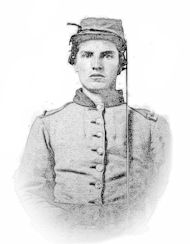
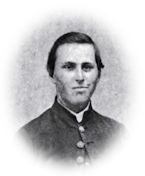
Friday, 22d.—12 M. Federals charged S. D. Lee’s Alabama brigade. Being on reserve, we were sent through a perfect shower of shot and shell to re-inforce. Heavy fighting; Feds driven back; captured three or four stands of colors and several prisoners. General Lee’s aid killed by shell, within twenty feet of us. D. Brown wounded. Gunboats attacked river batteries, but were driven off; pretty hot times on all sides; great many Federals killed to-day in the several charges made; not very many Rebels killed, but several wounded. 8 P. M., ordered back to our place on reserve.

May 22d. We bid farewell to Fort Marshall and Baltimore. Marched across the city to the Camden Street railway station, Baltimore and Ohio R. R. After a long wait a train of box cars ready to receive us, into which we were packed and started on our journey. A slow tiresome ride in the old cars.

Friday, 22d — This morning we moved out a short distance from our bivouac and formed a line of battle. The rebels commenced throwing shells at us, and continued it all day; but as their guns were aimed too high, our greatest danger was from the falling limbs of trees hit by their shells. Four companies, including Company E, were sent out on the skirmish line. Company B had one man killed 1 and one wounded. We withdrew after dark and moved five miles farther on toward the right wing of the army and bivouacked in a cottonfield for the night. We were in heavy timber all day, which with the rough land, all hills and gullies, afforded us some protection. We are on the extreme left of Grant’s army, which almost encircles Vicksburg.

May 22. — Captain Wadsworth went down the Peninsula this morning. Day warm and sun shining. Lieutenant Smith of the t2th Infantry was here this afternoon.

Mrs. Lyon’s Diary.

May 22.—A large party of us went on board a gunboat. It was very interesting to see how they work the guns.

May 22, Friday. Information is received that Grant has beaten Pemberton after a hard fight of nine hours. It is said to have taken place on the 15th inst.

Had an interview with Admiral Lardner, who goes out to take charge of the West India Squadron. He is prudent, but, I fear, not so efficient as the duty assigned him requires. Wilkes has accomplished but little, has interfered with and defeated some Navy plans, but has not committed the indiscretions towards neutrals which I feared he would, and of which he is charged.

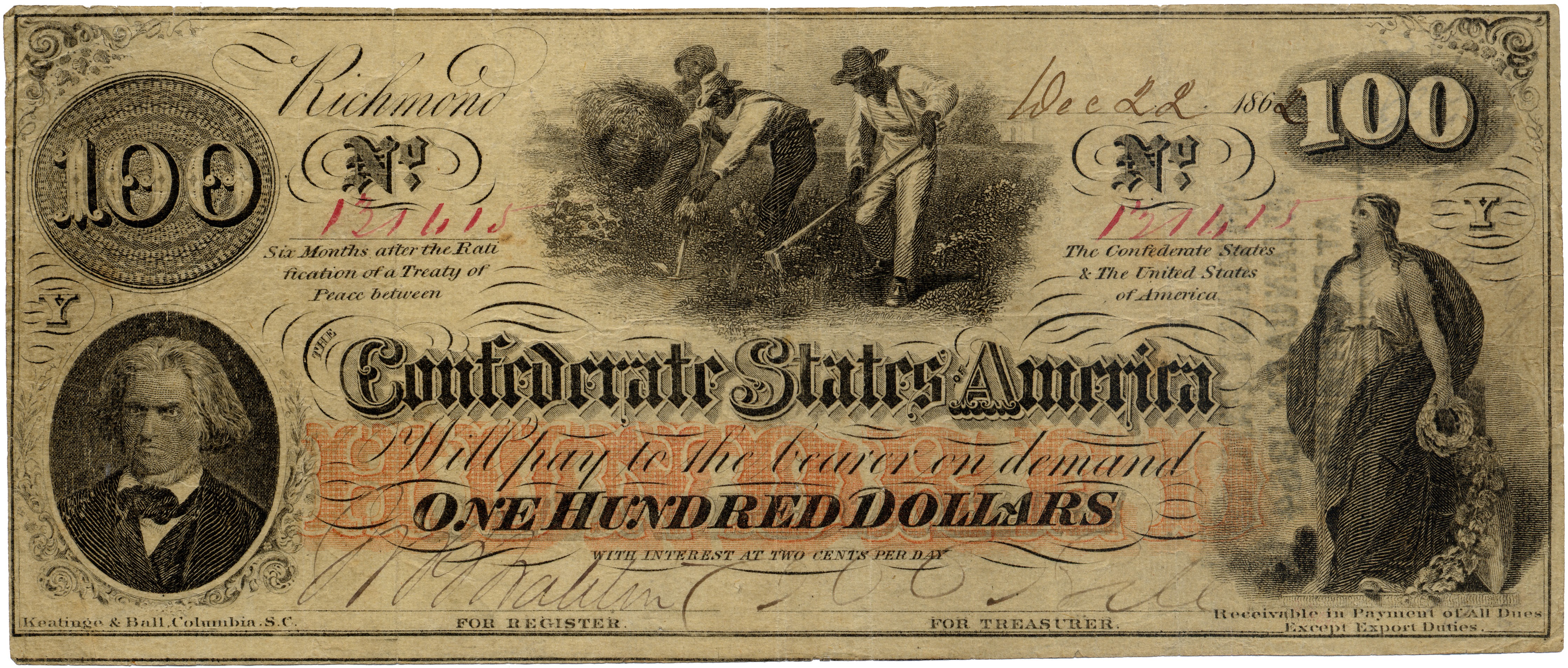
100 dollars confederate – Six Months after the Ratification of a Treaty of Peace between The Confederate States & The United States of America The Confederate States of America Will pay to the bearer on demand One Hundred Dollars, with interest at two cents per day.

Slaves hoeing cotton in the center with John C. Calhoun on the left and Columbia on the right.

The wording on the bill reads: “Six Months after the Ratification of a Treaty of Peace between The Confederate States & The United States of America The Confederate States of America Will pay to the bearer on demand One Hundred Dollars, with interest at two cents per day.”

22nd. After breakfast sleeked up. Charlie blacked my boots. Bill shaved me. Played two games of chess with Capt. N. Even games. Wrote to Sarah. Received two papers. Very warm day— uncomfortable. Major Purington’s horse died. Seems to have very bad luck.

Friday. 22nd—Came cross the pike to Meadows, fed our horses. I, Jim and Lamb started back to Kentucky. We came cross pike to Mr. Hodges and got supper, then cross railroad and out through Mitehellville to Norris ten miles from railroad; staid all day and to-night.