
Wednesday, 20th — This morning found us going up the river, when about 10 o’clock we landed three miles below Vicksburg. The rebels commenced throwing shells our way and we dropped down the river to a point six miles below the city. But at 4 o’clock we returned to the place we had reached in the morning, and landing on the west bank marched across the point of land just opposite Vicksburg. Here we boarded the boats again and awaited orders. The mortar boats are throwing shells into the town. Our armies about Vicksburg have taken a great many prisoners. It is reported that our men have taken Haines’s Bluff, and that General Grant has commenced action all the way around his line of battle.
May 2013

May 20.—Last evening a friend sent me word that my brother was in the Gilmer Hospital. (It is now on the same hill as the Academy). I went there immediately, and was glad to find that he had not much the matter with him. He has a carbuncle on his arm, caused by bad food. A change of air and diet would, I feel certain, benefit him more than any thing else.
I staid all night with Mrs. Gorman, the matron of the hospital; it is a perfect treat to visit there. The hospital buildings are newly put up; they are composed of four or five two-story wards, each large enough for about fifty patients. Each ward has a small room attached to it, used as a distributing-room and pantry, and another, used as a bath-room. I went through Dr. Cannon’s ward. (Dr. Cannon is the same whom I met in Corinth.) Every thing about it was in perfect order. The bunks had on white comforts, not the least soiled, although they had been in use some time. The view from the upper part of these wards is perfectly entrancing; the trees are magnificent. I called Dr. Cannon’s attention to the scene, and asked him if there was any thing in England to equal it (he is an Englishman). He said he had seen nothing to surpass it, and that he considered the view from his window one of the finest in the world.
This morning, before leaving, I paid a visit to the Academy Hospital, which is but a short distance from the other. They both belong to General Polk’s corps. Both have been put up since we came to Chattanooga. The Academy has been finished some time. It is perfect in every department. The wards are but one story high, each holding about twenty-five patients. They have a small distributing room for every two of these wards. The food is brought from the kitchen to them, and distributed by a ward matron.
They have very few patients at present . The wards are fixed up very nicely, having been newly whitewashed, and Mrs. N. has them very tastefully dressed with evergreens. The attendants sleep in tents, some of which are fixed up as nicely as any house. I visited one belonging to the druggist’s wife, who is one of the matrons. There was a place dug in the ground about three feet deep, the sides bricked around, and floored with planks, on which was a carpet . It had a chimney and fire-place; the tent-cloth was put over all, and gutters around, to keep out the rain. A very nice lady has charge of the linen room. In this hospital the patients have their clothes washed as soon as they come in. The wash-house is a little ways from the rest of the hospital; in it are large boilers, built on brick, and an ironing-room, and a shed for drying the clothes in wet weather.
There is one great drawback which we all have: the water used has to be carried from the river in barrels. The wards are at least twenty yards apart. Mrs. N. tells me that Dr. Hawthorne, the surgeon, is one of the best managers she has ever been with; but I have been told one thing about him, that proves that he is not a humane man; I refer to his method of punishing the men by bucking and gagging; sometimes he puts a bayonet in their mouth instead of a stick, and ties it so tightly that the blood gushes out. Many a time he has made the men stay in this position twenty-four hours, giving them neither food nor water. I do not think there is any necessity for going to such extremes. We have as good discipline in our hospital as there is any need for, and nothing of that kind is ever resorted to.
On my way back this morning, I called on Mrs. Brewer, and had an introduction to Major-General McCown, who is now under arrest for disobedience of orders, or, as a lady the other day told me, for giving his men coffee! I found him very pleasant in conversation; he told us he had experienced nothing here in comparison with what he had endured in other campaigns. I think he had been in the regular army, and had been at Salt Lake, or on some expedition against the Indians.
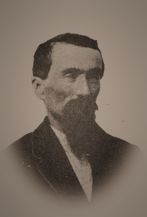
May 20 — Moved camp again to-day, back to Dayton, from where we moved yesterday.
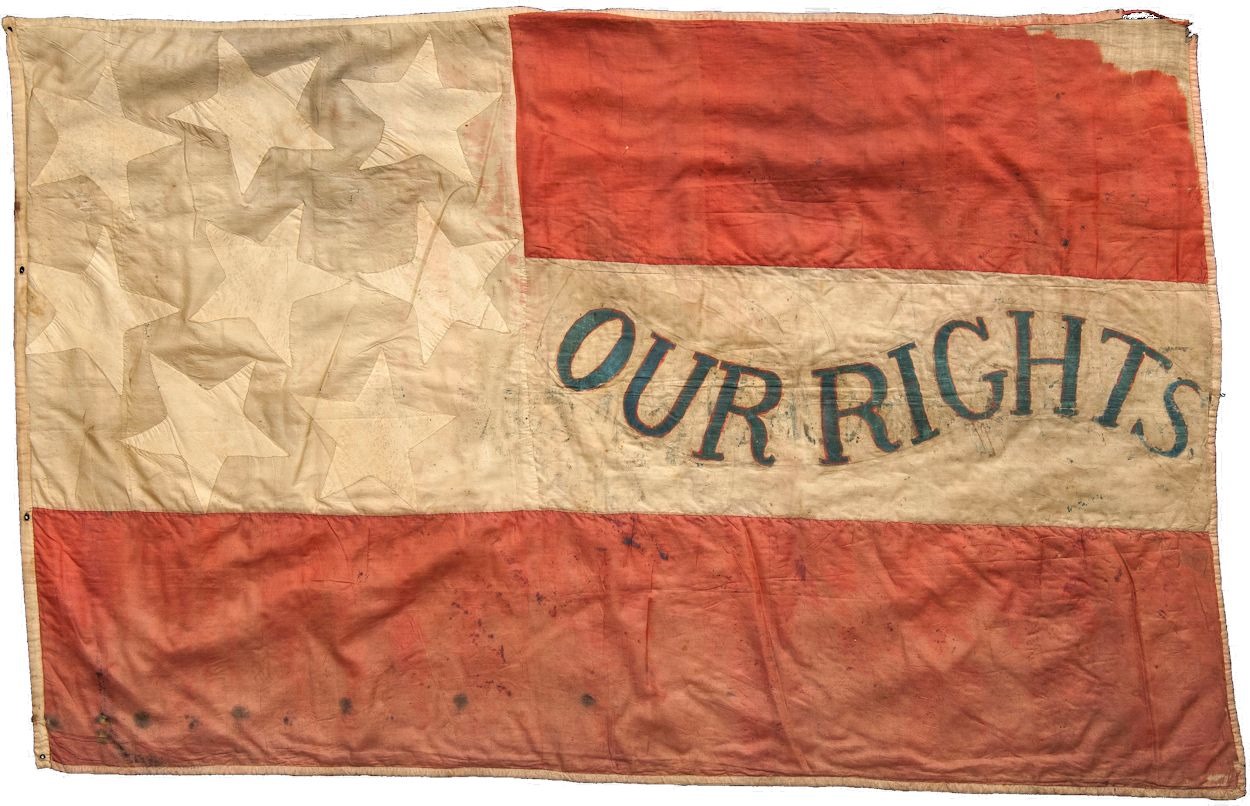
Confederate flag captured by the 4th Minnesota at the Battle of Jackson, Mississippi.
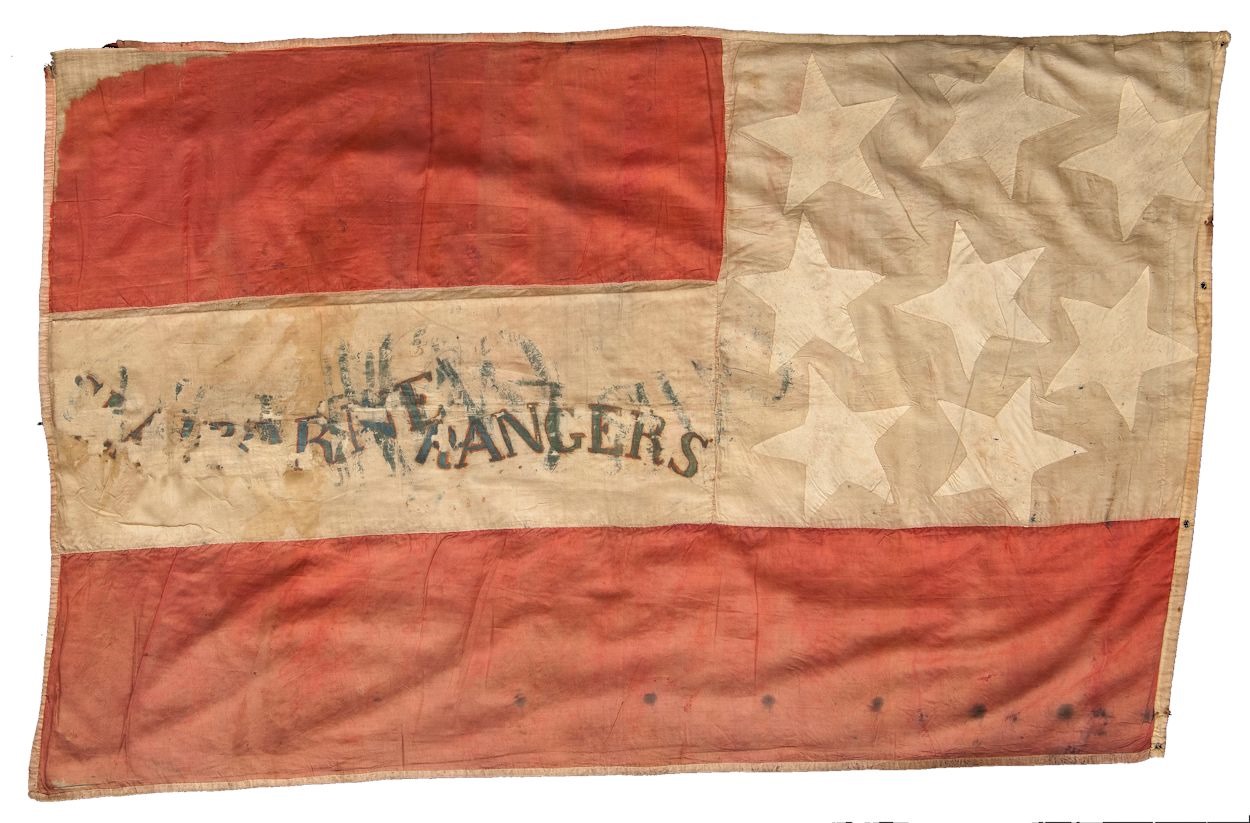
A newspaper correspondent says: “Captain L. B. Martin, of the 4th Minnesota, A. A. G. to Colonel Sanborn, seized the flag of the 59th Indiana Infantry, rode rapidly beyond the skirmishers (Company H of 4th Minnesota, Lieutenant George A. Clark), and raised it over the dome of the capitol. Lieutenant Donaldson of the 4th, also riding in advance, captured a flag made of silk; on one side was inscribed ‘Claiborne Rangers,’ and on the other ‘Our Rights.’ – Concise History of the State of Minnesota
Minnesota Historical Society image.
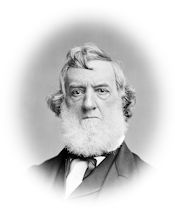
May 20, Wednesday. Admiral Lee has been here for two or three days consulting in regard to Wilmington. The blockade of Cape Fear is difficult and gives infinite trouble, but the War Department has manifested no desire to relieve us and prevent that means of Rebel communication. To-day we had a long conference. Lee has seen General Totten, and the conclusion is that the army must capture the place, assisted by the Navy, which will cover the landing. The practice of relying upon the Navy to do the principal fighting when forts or batteries are to be taken has had a bad effect in some respects and is vitiating the army.
Admiral Du Pont sends forward charges against Chief Engineer Stimers, who, on his passage from Charleston to New York after the late demonstration, expressed an opinion that Sumter might have been passed or taken. Du Pont requested Stimers to be sent to Port Royal for trial. Every officer under Du Pont has expressed a different opinion from Stimers and they would constitute the court. It is a strange request, and it would be quite as strange were I to comply with it. I would not trust Stimers, or any one whom Du Pont wished to make a victim, in his power. If not a little deranged, D. is a shrewd and selfish man. I think he is morbidly diseased. Drayton expresses this opinion. His conduct and influence have been unfortunate in many respects on his subordinates. Instead of sending Stimers to Port Royal to be sacrificed, I will order a court of inquiry at New York, where the facts may be elicited without prejudice or partiality. The alleged offense hardly justifies an inquiry in form, but nothing less will satisfy Du Pont, who wants a victim. More than this, he wants to lay his failure at Charleston on the ironclads, and with such a court as he would organise, and such witnesses as he has already trained, he would procure both Stimers and vessels to be condemned. It would be best for the ends of truth and justice to have an inquiry away from all partisanship, and from all unfair influences and management.
Letter No. I.
On The Rapidan, May 20th, 1863.
My Precious Wife:
I am at last safely encamped with the Fourth Texas Regiment in a beautiful grove of chestnut on a hillside about one mile from Raccoon Ford on the Rapidan about seventy-five or eighty miles from Richmond, and must say that I feel better and happier and of a clearer conscience than since the war commenced.
We have no tents and few blankets, mine being lost, you know, and being replaced by a light one which Aunt Mary Stark gave me. The ground is hard but the weather is pleasant and water fine.
I did not believe I could feel so well satisfied so far from you, but, thank God, that I have a full and perfect faith on one point, viz: that whatever may await me, heaven will protect you and the children. I have not felt uneasy for a moment on that subject, and this morning I took out my Bible and opened it by chance and found the (104th) one hundred and fourth Psalm on the mighty power and providence of God. Can you not trust in such a power and enjoy yourself and feel satisfied? I do not want you to be sad a moment on my account.
I am perfectly well and have bacon, bread and a clear conscience. I have consummated the desire of my heart in connecting myself with this brigade. I intend to remain with it until it returns to Texas under a reign of peace, or I expect not to return at all. All of the Waco boys are well except Allen Killingsworth. I am afraid he is dangerously sick. He was in the hospital a month ago and came out too soon. He has a high fever and flux and is very weak this morning.
Billy Dunklin and all the rest are well. We have been encamped at this place for a week and may be ordered to move at any moment. I knew everything the brigade was doing when I was at home and on the way here, but am unable to find out anything about it now. We know less than anybody else. Tom Williams is the same old Tom. The whole brigade is in fine spirits, and it really does seem strange to see men who have lost so many friends seem so careless and happy. They sometimes talk almost like bullies at a street corner, except with a mild, calm air of determination and no swagger. The usual feeling seems to be, “We can’t be whipped, but we may all be killed.” I am satisfied that an imprudent leader could carry them to destruction. I met Tom Lipscomb yesterday on the cars. He is a major in Hampton’s Brigade, in Butler’s Regiment. Your brother, Lamar Stark, has been scouting in the enemies lines for more than six months. A few days ago he got into a fight; he was captured and Gillespie Thornwell was killed. Lamar is now a prisoner in the Old Capitol at Washington. Some of them have been enchanged already by lot, but Lamar was not drawn. He is well treated and will doubtless be exchanged soon. I learned this from Lipscomb, who got it from returned prisoners; so do not despond about him.
If you ever get my letter in which I make some suggestions about your coming to Columbia, you must let them be qualified by any change in the condition of our affairs in the West. Leave the servants by all means, all of them, and do not go more than $500.00 in debt. If you try it, write to me from Jackson, Mississippi. As soon as I get too sick to march or get wounded I will come to Columbia. You and Bro. Burleson, Mrs. Pearre, Miss Lambden, Dr. McDonald and Mrs. Carter must pray for me.
Your husband, faithfully ever,
John C. West.
May 20, 1863. – General Reynolds had an order issued this morning announcing me as acting aide. I rode over to the Engineer Brigade in the afternoon, and from there to the Fifth Corps, to witness the presentation of a horse, etc., to General Barnes, but found that the affair was postponed till to-morrow. Day warm and pleasant.
Wednesday, May 20th.
I spent yesterday morning writing to my precious wife. I wrote two letters; one to take the chances and uncertainties of the mails; the other reserved until I can find some one going across the Mississippi River. I called on Mrs. Bachman and there met Mrs. Carroll and her daughter. Mrs. Bachman spoke of Mary as of a sister; she is a sweet, good woman and was anxious to do something for my comfort. She gave me a letter to Captain Bachman and also one for some of her cousins in Virginia; wanted me to leave all my extra clothing with Miss Nannie Norton in Richmond; said that Wat Taylor had left his things there. Mrs. Bachman’s paintings are enchanting to me. What a useful and delightful accomplishment painting is. By it we can leave such precious and enduring mementoes of ourselves, when all other memories have faded in the oblivion of a shadowy past. I spent the afternoon with mother only, and began to feel like I had somebody to love me this side of the Mississippi. For all that I hold dearest is west of the river. Mother (Mrs. Stark) has treated me as her own son. She has furnished me with clothing, which I needed; has given me $40.00 and appears anxious to do more for me. I went out to auntie’s, at Stark Hill, late in the afternoon and bade them good bye; talked as if they were parting with one who had a right to their affections; all this nerves me very much and added to the approval of my own conscience makes me more willing and ready to suffer whatever may be in store for me and let my trials be what they may. May God save my wife and children from affliction. Let all the evil which may perchance be in store for them be meted out to me. After supper last night mother went up stairs with me and we concluded that it would be best to carry only a change of clothing and leave the rest in Columbia with her, to be sent as I needed them. She packed my things and spoke so kindly and affectionately to me that I love her next to Mary. It is now. 6 o’clock on Wednesday morning. I am waiting for Decca to get ready to go to the depot with me; she is going as far as Winsboro to pay a visit to Jennie Preston Means.

20th. After breakfast Mike and I took out the horses to graze. Went with Co. G. Took a book along to read, “The Slave Power,” by Cairnes. Very sensible. Got dinner at a house. Avoided the order by having dinner on the porch. Returned about 3 P. M. Mike got a chicken. An excellent letter from Sarah Felton.
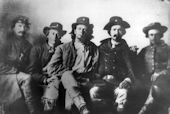
Wednesday, 20th,—Down to Hughes, got my horse shod, came back, and nine of us started. Came up near Epperson Springs, found the Yanks were there and at Scottsville too strong for us. Got supper at Stinson’s, a regular tory. Lamb swapped horses with him. Then started for New Row. Came across to Bracken’s, got breakfast, three of the boys had left us.


