MAY 20TH.—When I awoke this morning I offered thanks to God that my life had been spared thus far. We slept on our arms—something unusual. This day has been busily spent in making cautious advances toward the works of the enemy, and, although our progress seems to have been very little, we are content to approach step by step, for the task is difficult and dangerous. Bullets are flying over our heads, and it is quite common to see the boys trying to dodge them. A few have succeeded in stopping these bullets, but they had to leave at once for the hospital. A blanket displayed by its owner was called a map of the confederacy, on account of the holes in it made by bullets at Raymond and Champion Hills. It is good enough yet for warmth, but will not do to hold water. We are ragged and dirty, for we have had no change of clothes for over a month. But we have the promise of new suits soon. If we were to enter Vicksburg to-morrow, some of our nice young fellows would feel ashamed to march before the young ladies there. We can see the court house in the city with a confederate flag floating over it. What fun it will be to take that down, and hoist in its stead the old stars and stripes. Then yonder is the Mississippi river again; we want to jump into that once more and have a good bath. The hills back of Vicksburg, and in fact all round the city seem quite steep and barren, and to run in parallels, affording our troops good shelter from batteries and secret approaches. It is upon these hills opposite the town that our tents are pitched. We must cut back into the hills to escape the shower of bullets, for we like to feel secure, when asleep or off duty. A great many of the balls that come over are what are called “spent,” that is, have not force enough left to do any harm. We do not feel quite as safe awake or asleep as we did before we got so near the city. However, we manage to sleep pretty much unconcerned as to danger. Our regiment is detailed to watch at the rifle pits in front to-night.
May 2013
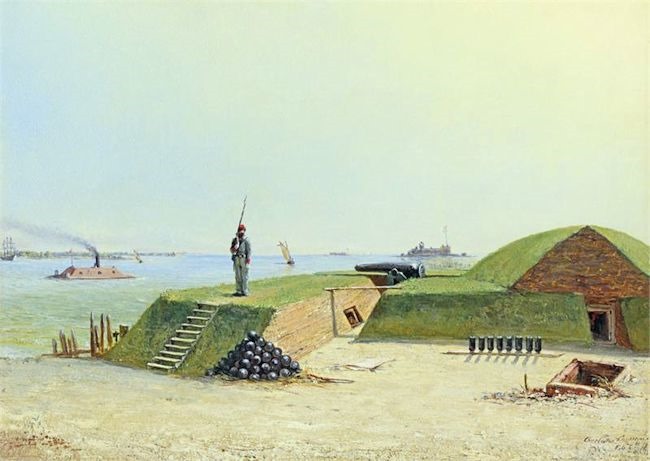
Battery Laurens Street in Charleston by Conrad Wise Chapman. Fort Sumter is on the horizon.
May 20th. Another pleasant day dawns upon a sleeping world; at seven thirty A. M. finished coaling ship; have been engaged at it since yesterday at one o’clock in the afternoon, and working all night received some seventy-three or seventy-five tons on board; at ten thirty A. M. the U. S. steam ram Gen. Price came down and out of Red river, and communicated with us. Cast off the coal schooner and dropped her astern; at twelve M. steamer Price got under way and went down the Mississippi river; at three P. M. the iron-clad Lafayette got under way and steamed up Red river; at three forty-five P. M. the Empire Parish came out of Red river, and took the coal barge and schooner in tow; sent Lieut. Hall, of U. S. A. Signal Corps, and his two men on board of her, and she went up Red river; at eleven thirty P. M. the steamer Gen. Price came up the Mississippi river, and anchored near us. These are all the departures and arrivals of this day.
by John Beauchamp Jones
MAY 20th.—Reports from the West say we lost 3000 and the enemy 6000 men in the battle of the 15th inst., when Pemberton fell back over the Black River. Our forces numbered only 12,000, Grant’s three times that number. Something decisive must occur before Vicksburg in a few days.
Mr. J. W. Henry writes from New’s Ferry, that parties of cavalry, going about the country, professing to belong to our Gen. Stuart’s corps, are probably Yankee spies making observations preparatory for another raid. The city councils are organizing the citizens for local defense, thinking it probable another dash may be made.
Gen. Dix threatens to hang the citizens of Williamsburg if they co-operate with Gen. Wise in his frequent attacks on the Federals. Gen. Wise replies, threatening to hang Gen. Dix if he carries his threat into execution, and should fall into his hands, in a more summary manner than John Brown was hung for making his raid in Virginia.
Butter is worth $4 per pound. A sheep is worth $50. A cow $500.
May 20.—On Sunday last, the seventeenth, the National pickets stationed on the road between Fayetteville and Raleigh, Va., were attacked and surrounded by a force of rebels, but, after a short fight they escaped all but one, the skirmishing continuing until noon, when the National pickets were driven in. Yesterday the attack was renewed and kept up until to-day, when the rebels were repulsed with slight loss.—(Doc. 195.)
—Colonel William A. Phillips, commanding the Indian brigade, had a severe fight with the rebels, belonging to the army of General Price, near Fort Gibson, Ark. The rebels crossed the Arkansas River, near the fort, when they were attacked by Colonel Phillips and driven back, with a loss of one major and several men killed.— (Doc. 196.)
—The steamships Margaret and Jessie, the Annie and the Kate, arrived at Charleston, S. C, from Nassau, with “valuable cargoes,” having run the blockade.—The schooner Sea Bird was captured and burned by the rebels, while aground at the mouth of the Neuse River, N. C.—The steamer Eagle, having just left the harbor of Nassau, N. P., with a cargo intended for the rebels, was captured by the National gunboat Octorora.— Charleston Courier.
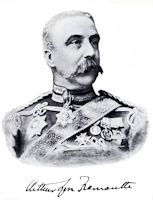
20th May (Wednesday).—At 3 A.M. we were awoke by a great bombardment going on at Vicksburg, which lasted about three hours[1]
The assembly was beaten at 7 A.M. by an old nigger, performing on a cracked drum, and its sound was hailed by the soldiers with loud yells.
General Gist, his Staff, and I, breakfasted with Mr Robinson, whose house is charming, and beautifully furnished, and had not been visited by the Yankees.
We had a crazy old planter, named ——, with us, who insisted upon accompanying the column, mounted on a miserable animal which had been left him by the enemy as not being worth carrying away. The small remains of this poor old man’s sense had been shattered by the Yankees a few days ago; they cleaned him completely out, taking his horses, mules, cows, and pigs, and stealing his clothes and anything they wanted, destroying what they could not carry away. But what “riled” him most was that he had been visited by a Federal officer, disguised in the Confederate uniform.
Poor old ——, full of rebel zeal, had, on being invited to do so, mounted en croupe behind this officer, and unbosomed himself to him; his fury and rage may be imagined at finding himself shortly afterwards in the very midst of the Federal camp; but the Yankee General McPherson ordered him to be released; and it appears that the reason of his being kidnapped, was to extract from him a large quantity of gold, which he was supposed to have hidden somewhere.
This Mr (or Major[2]) —— took a great fancy to me, and insisted on picking some of the silk of Indian corn, which he requested I would present to Queen Victoria to show her how far advanced the crops were in Mississippi It was almost painful to hear the manner in which this poor old man gloated over the bodies of the dead Yankees at Jackson, and of his intense desire to see more of them put to death.
The column reached the village or town of Livingston at 11 A.M., where I was introduced to a militia general and his pretty daughter; the latter had been married two days before to a wounded Confederate officer, but the happy couple were just on the point of starting for the Yazoo river, as they were afraid of being disturbed in their felicity by the Yankees.
I now heard every one speaking of the fall of Vicksburg as very possible, and its jeopardy was laid at the door of General Pemberton, for whom no language could be too strong. He was freely called a coward and a traitor. He has the misfortune to be a Northerner by birth, which was against him in the opinion of all here.
General Gist and I cantered on in front of the column, and reached General Johnston’s bivouac at 6 P.M.
General Johnston received me with much kindness, when I presented my letters of introduction, and stated my object in visiting the Confederate armies.
In appearance General Joseph E. Johnston (commonly called Joe Johnston) is rather below the middle height, spare, soldier-like, and well set up; his features are good, and he has lately taken to wear a greyish beard. He is a Virginian by birth, and appears to be about fifty-seven years old. He talks in a calm, deliberate, and confident manner; to me he was extremely affable, but he certainly possesses the power of keeping people at a distance when he chooses, and his officers evidently stand in great awe of him. He lives very plainly, and at present his only cooking-utensils consisted of an old coffee-pot and frying-pan—both very inferior articles. There was only one fork (one prong deficient) between himself and Staff, and this was handed to me ceremoniously as the “guest.”
He has undoubtedly acquired the entire confidence of all the officers and soldiers under him. Many of the officers told me they did not consider him inferior as a general to Lee or any one else.
He told me that Vicksburg was certainly in a critical situation, and was now closely invested by Grant. He said that he (Johnston) had 11,000 men with him (which includes Gist’s), hardly any cavalry, and only sixteen pieces of cannon; but if he could get adequate reinforcements, he stated his intention of endeavouring to relieve Vicksburg.
I also made the acquaintance of the Georgian General Walker, a fierce and very warlike fire-eater, who was furious at having been obliged to evacuate Jackson after having only destroyed four hundred Yankees. He told me, “I know I couldn’t hold the place, but I did want to kill a few more of the rascals.”
At 9 P.M. I returned with General Gist to his camp, as my baggage was there. On the road we were met by several natives, who complained that soldiers were quartering themselves upon them and eating everything.
The bivouacs are extremely pretty at night, the dense woods being lit up by innumerable camp fires.
[1] I afterwards learnt that this bombardment preceded one of the unsuccessful assaults.
[2] Nearly every man in this part of the country has a military title.
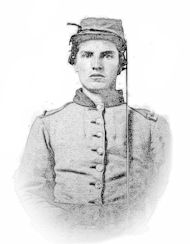
Tuesday, 19th.—We are surrounded; considerable cannonading on Chickasaw Bayou. Federal Regiment reported captured on the left. Our division on right wing occupying from the railroad to the river. Yankees charged, but were driven back with loss. Sharp shooting our artillery.
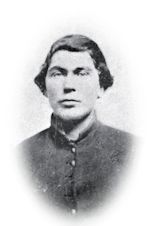
Before Vicksburg, Miss., Tuesday, May 19. We are lying in the reserve of the battle line before Vicksburg, having been pushed forward at double quick. General Grant gave them till 11 A. M. to surrender, but they did not avail of it. Firing is going on with Parrott pieces in front but not very brisk. 1 P. M. The 1st Section (Rifled) have gone to the left with Lieutenant Clark. The other pieces were brought into action in front, and laying in the reserve. Brisk cannonading all around with sharp musketry at times—McArthur has taken a fort and guns. Sherman drove them about a mile on the right. McClernand holds his own on the left. Both wings said to have joined the Mississippi. Pontoon train passed to the right in great hurry at 4 P. M. to be thrown toward the Yazoo.
Darkness closed hostilities and we limbered up and passed to the front about a mile, and planted our battery on a hill, very steep and high, doubling teams to go up. Relieved the 11th Ohio who had been engaged all day against a fort, using up all their ammunition. Cannoneers silently set to work levelling off a position; the horses unhitched and tied under a gin house. We lay down on the bare, rough ground, clothes all on, but it prevented not our sleeping.
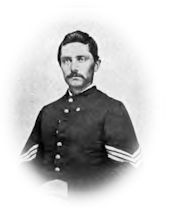
Tuesday, 19th — All is quiet here at Grand Gulf. We heard some heavy cannonading up at Vicksburg. The Third Brigade of General Lauman’s Division arrived this afternoon, and about 10 o’clock our brigade (the Third of the Sixth Division) and the Third Brigade of Lauman’s received orders to embark at once for Vicksburg. The Eleventh and the Thirteenth got on board the “Queen Forest.”
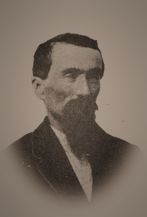
May 19 — This was a beautiful day. Nature has her grand glories on exhibition now, with azure skies and balmy air. Spring, the smiling young dame, is decorating the landscape with new beauties every day, and the fair face of nature reveals a thousand unimagined beauties to those whose admiration has ripened into love for the beautiful children of the sunshine that unfold and display their charming beauties with a thousand lovely tints as they drink deep at the fount of gold that unlocked their treasure of fragrance and unclasped their enchanting loveliness.
We moved camp to-day, and are now camped two miles below Harrisonburg, and at the same place where we camped last June just after the battle of Port Republic.


