Following the American Civil War Sesquicentennial with day by day writings of the time, currently 1863.

May 2013

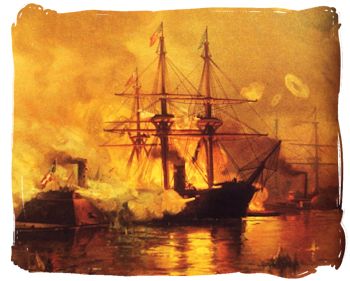
battle of big black river bridge

The Battle of Black River Bridge, May 17, 1863 – Sketched by Mr. Theodore R. Davis.

__________

The Fight at the Black River Bridge.

“Head-Quarters Of Major-General McPherson,

Commanding 17th Corps Army Tennessee,

Camp Near Vicksburg, May 18, 1863.

“We had fought the battle of Champion’s Hill, and at night lain down as tired as mortals ever are; yet the next day, finding the enemy, we, before dinner, captured his works, seventeen guns, and over two thousand prisoners.

“The brigade of Colonel Lawler was ordered to advance upon the right, and the division of General A. J. Smith upon the left, which they did, as illustrated by my sketch.”

Mr. Theodore R. Davis, Published

in Harper’s Weekly, June 20, 1863.

MAY 17TH.—On the road to Vicksburg, resolved to capture the city or get badly whipped. We have not known defeat since we left Fort Donelson, and we propose to keep our good record up. We have seen hard times on some hotly contested fields, but mean to have nothing but victory, if possible, on our banner.

The advance of our army has made a grand sweep, pell-mell, over the rebel works at Big Black River, routing the foe and capturing twenty-five hundred prisoners with twenty-nine cannon. Their rifle pits were quite numerous, but they were all on low ground, so that when the word was given the Yankees rushed over them with the greatest ease. The rebs may be drawing us into a trap, but as yet we have not a moments’ fear of the result, for when Grant tells us to go over a thing we go, and feel safe in going. Even in time of peace we would not wish the great curtain that hides the future to be rolled away, nor do soldiers now ask to know what lies before them. But every day brings new scenes fraught with dangers, hair-breadth escapes or death, after which the ranks close and move on undaunted. And our love of country still grows as we go.

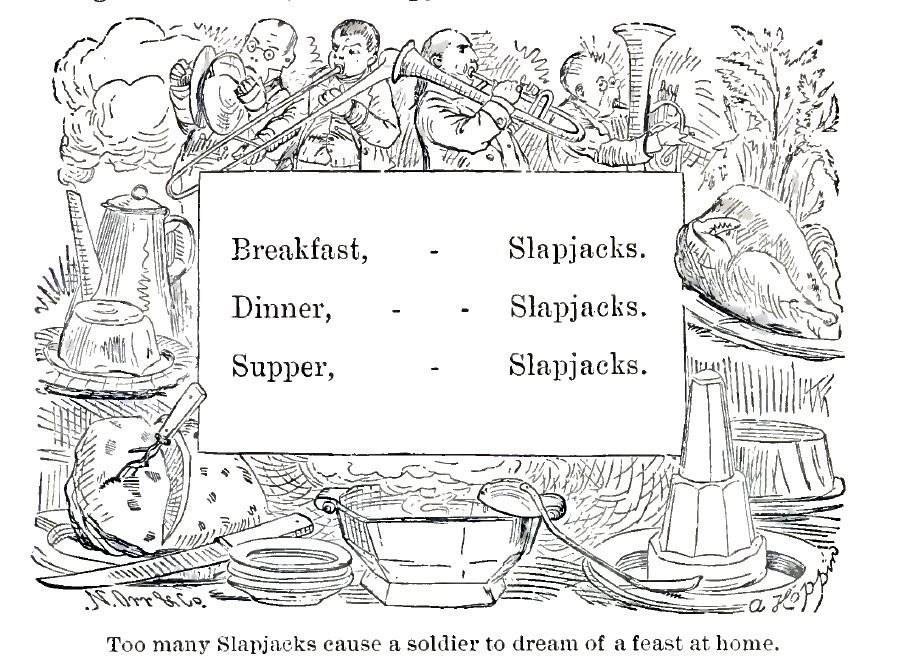
We camped within a few miles of Black River, perfectly satisfied, though we have had no hand in the slaughter to-day. We rather expected to be halted a few days at the river, where the enemy would surely be strongly fortified, and where, as they could certainly spare the greater part of their forces from Vicksburg, if they would but bring them out, they could make a desperate stand. We are now fighting hard for our grub, since we have nothing left but flour, and slapjacks lie too heavy on a soldier’s stomach. But there is great consolation in reflecting that behind us Uncle Sam keeps piled a bountiful supply all ready to be issued as soon as we can find a proper halting place.

Too many Slapjacks cause a soldier to dream of a feast at home.

May 17th. Commences with calm, warm weather; at ten A. M. inspected ship and crew; and at ten thirty A. M. called all hands to muster, and performed Divine service on the quarter-deck; at four thirty P. M. the Albatross came down the Mississippi with a coal barge in tow, and anchored ahead of us. She had been up to Grand Gulf. The Sachem got under way and went up Red river. Light breezes from the northward and westward.

May 17th, 1863.—Hardly was our scanty breakfast over this morning when a hurried ring drew us both to the door. Mr. J., one of H.’s assistants, stood there in high excitement.

“Well, Mr. L., they are upon us; the Yankees will be here by this evening.”

“What do you mean?”

“That Pemberton has been whipped at Baker’s Creek and Big Black, and his army are running back here as fast as they can come and the Yanks after them, in such numbers nothing can stop them. Hasn’t Pemberton acted like a fool?”

“He may not be the only one to blame,” replied H.

“They’re coming along the Big B. road, and my folks went down there to be safe, you know; now they’re right in it. I hear you can’t see the armies for the dust; never was anything else known like it. But I must go and try to bring my folks back here.”

What struck us both was the absence of that concern to be expected, and a sort of relief or suppressed pleasure. After twelve some worn-out-looking men sat down under the window.

“What is the news?” I inquired.

“Retreat, retreat!” they said, in broken English—they were Louisiana Acadians.

About 3 o’clock the rush began. I shall never forget that woful sight of a beaten, demoralized army that came rushing back,—humanity in the last throes of endurance. Wan, hollow-eyed, ragged, footsore, bloody, the men limped along unarmed, but followed by siege-guns, ambulances, gun-carriages, and wagons in aimless confusion. At twilight two or three bands on the court-house hill and other points began playing Dixie, Bonnie Blue Flag, and so on, and drums began to beat all about; I suppose they were rallying the scattered army.

______

Note: To protect Mrs. Miller’s job as a teacher in New Orleans, the diary was published anonymously, edited by G. W. Cable, names were changed and initials were often used instead of full names — and even the initials differed from the real person’s initials.

by John Beauchamp Jones

MAY 17TH.—The last few days have been cool and dry; fine weather for campaigning. And yet we hear of no demonstrations apparently, though I believe Lee’s army is moving.

Mr. Lamar, of Savannah (formerly president of the Bank of the Republic, New York), writes that he and others are organizing an Exporting and Importing Company, and desires the government to take an interest in it. So far the heads of bureaus decline, and of course the Secretary will do nothing. But the Secretary has already engaged with Mr. Crenshaw in a similar enterprise, and so informed Mr. Mason, at London.

About 10 A.M., some 2500 men of all arms arrived at “double quick,” having left Ashland, eighteen miles distant, at 5 o’clock this morning. That was brisk marching. The guns were sent down on the railroad. The government has information that Gen. Keyes, with a full division of infantry and a brigade of cavalry, had marched up to West Point, to threaten Richmond. The troops, however, which arrived from Ashland, had been taken from the batteries here, and did not belong to Gen. Lee’s army.

Messrs. Davenport & Co., Mobile, charge Gen. Buckner with permitting 1000 bales of cotton to be shipped to New Orleans.

The president of the Fredericksburg Road states, in a letter to the Secretary, that, after the battle, by military authority, the cars were appropriated by the Federal officers (prisoners), while our wounded soldiers had to remain and await the return of the trains.

Hon. Mr. Dargin, of Alabama, writes to the Secretary, to procure from the President a disavowal of the “organship” of the Enquirer, as that paper, under the belief that it speaks for the government, is likely to inflict much mischief on the country. He alluded to the bitter articles against the Democrats and peace men of the North, who would soon have been able to embarrass, if not to check the operations of the Republican war party. He says now, that they will write against us, and deal destruction wherever they penetrate the land.
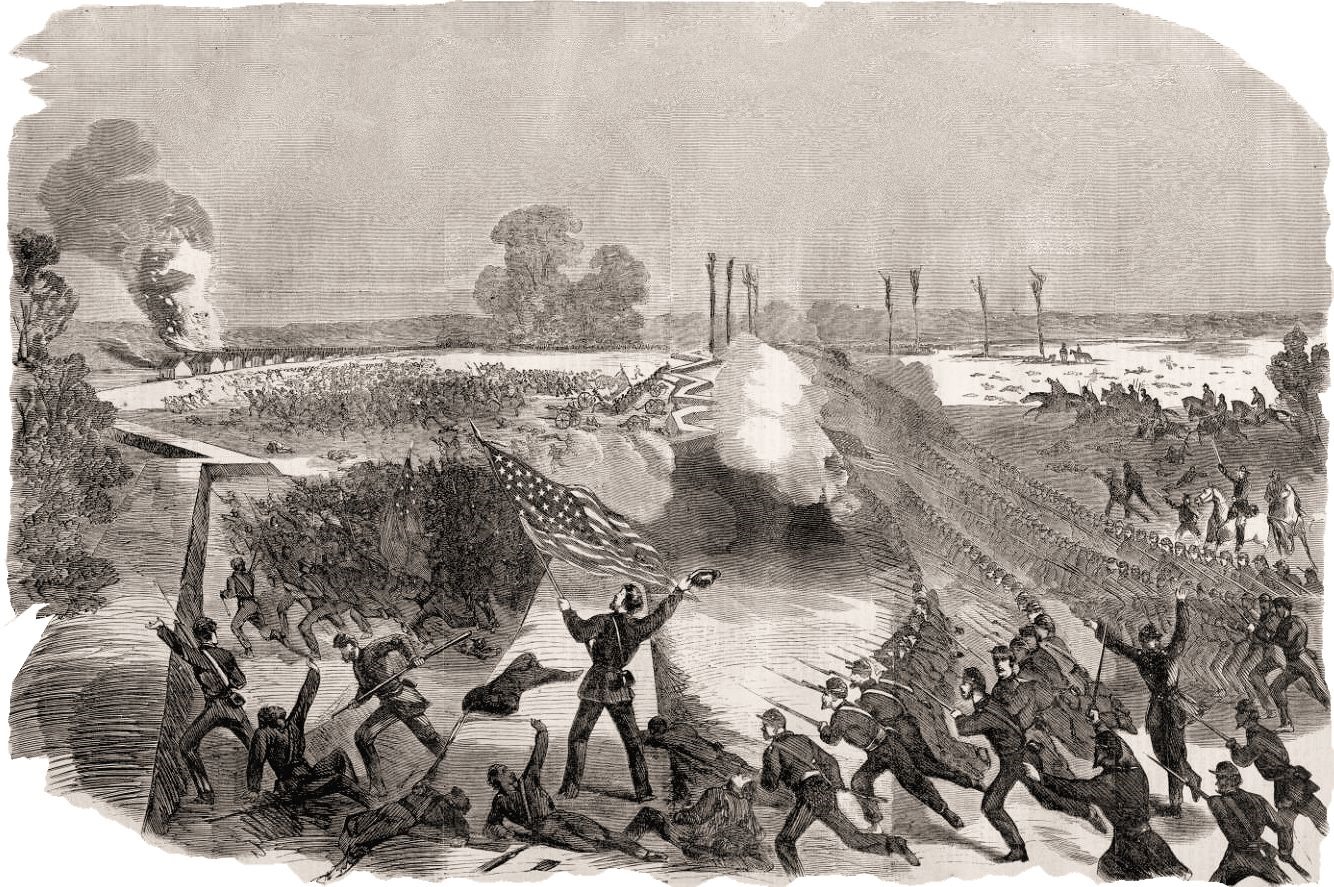
—At daylight this morning the National army, under General Grant, moved on from Champion Hill to the Big Black River, Miss., where a battle was fought with the rebels, under Pemberton, and they were again defeated and driven into their intrenchments around Vicksburgh with great loss of men and munitions of war.—(Doc. 193.)

—Jackson, Miss., was evacuated by the National forces, belonging to the army of General Grant.

—The schooner Isabel, attempting to run the blockade at Mobile, was run ashore close under the walls of Fort Morgan, and Master’s Mate Dyer, of the R. R. Cuyler, was sent with boats, either to bring her off or burn her. They were just in time to capture sixteen men, being her crew and some passengers. Finding it impossible to get the schooner off, he set fire to her and then pulled for his own ship. By this time the alarm had been given and the rebels in the fort were on the alert Mr. Dyer, finding that the schooner did not break out in a blaze, as he expected, turned back toward the fort, and effectually did his work. — The rebel schooner Ripple, was captured by the National gunboat Kanawha, blockading the port of Pensacola, Fla.—Rebel guerrillas visited Burning Springs, Wirt County, Va., where they burned oil-works and committed other depredations.

—Yesterday a company of the First New-York cavalry having been captured at Charlestown, Va., by a gang of guerrillas, under the leadership of Captain Mosby, the regiment left Berrysville today, under the command of Major Adams, in pursuit of the rebels. They were overtaken at Berry’s Ford, on the Rappahannock, and, after a brief skirmish, the rebels were completely routed and the prisoners recaptured.

Battle of Champion Hill, Miss.

Saturday, 16th.—7 A. M., drew some raw beef; were beginning to barbecue it, when, just at 8 o’clock, a few cannons were fired near us very unexpectedly. Formed immediately and marched back about two miles; skirmishing began before our lines were formed, and it was soon ascertained that the Federals were moving on us in heavy force. 10 A. M., battle opened with great fury on our left; our line was immediately moved to the left in quick time; formed under heavy fire, and in less than five minutes were charged with perhaps two lines of battle. The 34th Georgia was on our right, in a very awkward position, and being struck first, and having no support, after one or two volleys, broke and fled in wild confusion. The Federals pressed through the gap, and on our front at the same moment. Our boys, seeing this, became panic stricken, and in less than ten minutes, the whole brigade was in the wildest confusion. With the exception of about two hundred men, all efforts to rally the brigade were in vain. Having lost all their artillery and about one-fourth of their men, killed or captured, and the Yankees’ triumphant yells in rapid pursuit, whizzing Minnie balls and shells exploding in their midst, were not very soothing antidotes to their agitated feelings. Soon the whole of Stevenson’s Division was in retreat. Reinforcements came, but too late to be’ of much service, and soon we left the field, after having lost about four thousand prisoners and thirty pieces of artillery. Brother I. L., seriously wounded in right breast, called to me in the retreat, saying, “I am killed,” but was walking on. Just then I was ordered into line; the next moment he was out of my sight, in the woods, and I did not see him again until I arrived at home after the siege was over, when he was able to meet me at Tunnel Hill with a buggy. That was the greatest sorrow of my life, that I let him get out of my sight that day, and I spent the remainder of the day as we retreated seeking for him, but all to no avail. Colonel McConnell was also wounded, and this is what I wrote that day. Don’t know whether either of them came through or not. Army falling back to Big Black River. Many of our brigade killed, and great many captured. Some of Company F were captured on the line. William Graham supposed to be killed. In my hurry to get away, my hat fell off, and as I had paid $15.00 for it, I thought I had best not leave it, and picked it up. Just then some Yankee came at me and stuck his bayonet in my gun and knocked off my little finger nail, but I didn’t stop to thank him for it, and so hurried on after the other boys.

Near Clinton, Saturday, May 16. Started at 7 A. M. Heavy firing in front, and at 10 A. M. we came up to the scene of action. They were engaged by Osterhaus’s, Hovey’s and Logan’s Divisions. “We were immediately called forward and took a position on a knoll where we had a good view. They were in thick timber. Logan’s Division managed to get on their right flank, driving them with rapidity, but at the same time they were driving the line on the left and came near penetrating our center, many of our men having used all their ammunition, and the amount of stragglers falling back without order becoming dangerous. It was a dangerous moment. All eyes were anxiously looking, almost trembling, for the result; but at last there comes Colonel Holmes with his Brigade on double quick, which soon checked their progress, and the artillery were brought into position, McAllister’s 24-pounder howitzers on the left, with Quinby’s on the right and center. The infantry fell back at double quick as we opened fire on them, shelling the woods—38 pieces in all, belching away in fearful rapidity. Kept it up for one hour. When we ceased firing, they had left and all was still. The fight continued about five hours, the musketry having been exceedingly hot. We took seventeen pieces of artillery and about 2,000 prisoners.

After the battle intelligence reached us that Vicksburg was occupied by our forces, and that the troops of that place had met us in force with the hope of saving Jackson, which was met with cheer after cheer, although it was almost too good to believe. We marched after them, and going across the battlefield it was a sickening sight, many of the regiments having been literally cut to pieces. For four miles the road was scattered with dead rebels and caissons etc. Came into camp at 11 P. M. and soon dropped asleep after a clear victory. We suffered no loss save one man wounded by a premature discharge of piece.

May 16th.—We were aroused this morning before daylight, by reports that the Yankees were making a raid, and were very near this place. We all dressed hastily, and the gentlemen went out to devise means to stop the trains which were to pass through. Though within five miles of us, they became aware that notice had been given of their purpose, and they immediately turned their steps to some more private place, where they might rob and plunder without molestation. The miserable poltroons, when on one of their raids, will become frightened by the sudden rising of a covey of partridges, and be diverted from their course; then they will ride bravely to a house, where they know they will only find women and children; order meals to be prepared; search the house; take the valuables; feed their horses at the barns; take off the horses from the stables; shoot the pigs, sheep, and other stock, and leave them dead in the fields; rob the poultry-yards; then, after regaling themselves on the meals which have been prepared by force, with the threats of bayonets and pistols, they ride off, having pocketed the silver spoons and forks, which may have unwittingly been left in their way.

I have been in Richmond for two days past, nursing the wounded of our little hospital. Some of them are very severely injured, yet they are the most cheerful invalids I ever saw. It is remarked in all the hospitals that the cheerfulness of the wounded in proportion to their suffering is much greater than that of the sick. Under my care, yesterday, was one poor fellow, with a ball embedded in his neck; another with an amputated leg; one with a hole in his breast, through which a bullet had passed; another with a shattered arm; and others with slighter wounds; yet all showed indomitable spirit; evinced a readiness to be amused or interested in every thing around them; asked that the morning papers might be read to them, and gloried in their late victory; and expressed an anxiety to get well, that they may have another “chance at them fellows” The Yankees are said to have landed at West Point, and are thence sending out raiding parties over the country. Colonel Davis, who led the party here on the third, has been severely wounded by a scouting party, sent out by General Wise towards Tunstall’s Station. It is said he has lost his leg. So may it be!

16th May (Saturday).—We started a little before daylight, our team looking so very mean that we expressed doubts as to their lasting—to Mr Nelson’s great indignation.

We breakfasted at another little farmhouse on some unusually tough bacon, and coffee made of sweet potatoes. The natives, under all their misery, were red-hot in favour of fighting for independence to the last, and I constantly hear the words, “This is the most unjust war ever waged upon a people by mortal man.”

At 11 A.m. we met a great crowd of negroes, who had been run into the swamps to be out of the way of the Yankees, and they were now returning to Louisiana.

At 2 P.M. a wounded soldier gave us the deplorable information that the enemy really was on the railroad between Jackson and Brookhaven, and that Jackson itself was in his hands. This news staggered us all, and Nelson became alarmed for the safety of his wretched animals; but we all determined to go on at all hazards and see what turned up.

We halted for dinner at a farmhouse in which were seven virgins seated all of a row. They were all good-looking, but shy and bashful to a degree I never before witnessed. All the young women in this country seem to be either uncommonly free-spoken, or else extremely shy.

The further we went the more certain became the news of the fall of Jackson.

We passed the night in the verandah of an old farmer. He told us that Grierson’s Yankee raid had captured him about three weeks ago. He thought the Yankees were about 1500 strong; they took all good horses, leaving their worn-out ones behind. They destroyed railroad, Government property, and arms, and paroled all men, both old and young, but they committed no barbarities. In this manner they traversed all the State of Mississippi without meeting any resistance. They were fine looking men from the Northwestern States.