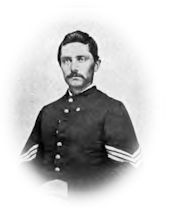
Saturday, 16th—The weather has been quite warm for several days. Troops are arriving every day and some of them are going to the front. It is reported that our men are shelling the rebels at Vicksburg and are getting no reply. We received a dispatch from General Grant this afternoon, saying that his head-quarters is in the State House at Jackson, Mississippi. The troops are in fine spirits.
May 2013
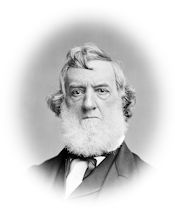
May 16, Saturday. Saw Seward this morning respecting Wilkes. After talking over the subject, he said he cared nothing about Wilkes, that if he was removed he would be made a martyr, and both he (S.) and myself would be blamed and abused by the people, who knew not the cause that influenced and governed us. He then for the first time alluded to the removal of Butler, which he said was a necessity to appease France. Nevertheless France was not satisfied, yet Butler’s removal had occasioned great discontent and called down much censure. If I could stand the recall of Wilkes, he thought he could. I answered him that any abuse of me in the discharge of my duty and when I knew I was right would never influence my course. In this case I could better stand his recall than the responsibility of sending him into the Pacific, where he would have great power and be the representative of the Government; for he is erratic, impulsive, opinionated, somewhat arbitrary towards his subordinates, and is always disinclined to obey orders which he receives if they do not comport with his own notions. His special mission, in his present command, had been to capture the Alabama. In this he had totally failed, while zealous to catch blockade-runners and get prize money. Had he not been in the West Indies, we might have captured her, but he had seized the Vanderhilt, which had specific orders and destination and gone off with her prize-hunting, thereby defeating our plans. Seward wished me to detach him because he had not taken the Alabama and give that as the reason. I care to assign no reasons, — none but the true ones, and it is not politic to state them.
When I was about leaving, Seward asked as a favor that I would address him a proposition that the matter of the Mont Blanc should be left to Admiral Bailey alone. The whole pecuniary interest involved did not, he said, exceed six or eight hundred dollars, and it would greatly relieve him at a pinch, if I would do him this favor, and harm no one, for the vessel had been seized sleeping at anchor within a mile of the Cays, and was retained by the court. I asked what he had to do with it anyway. He gave me no satisfactory answer, but went into the trouble he had in keeping the Englishmen quiet and his present difficulties. All of which, I take it, means he has loosely committed himself, meddled with what was none of his business, made inconsiderate promises to Lord Lyons, and wishes me, who have had nothing to do with it, but have objected to the whole proceeding, to now propose that Admiral Bailey shall be sole referee. This will enable him to cover up his own error and leave it to be inferred that I have prompted it, as B. is a naval officer.
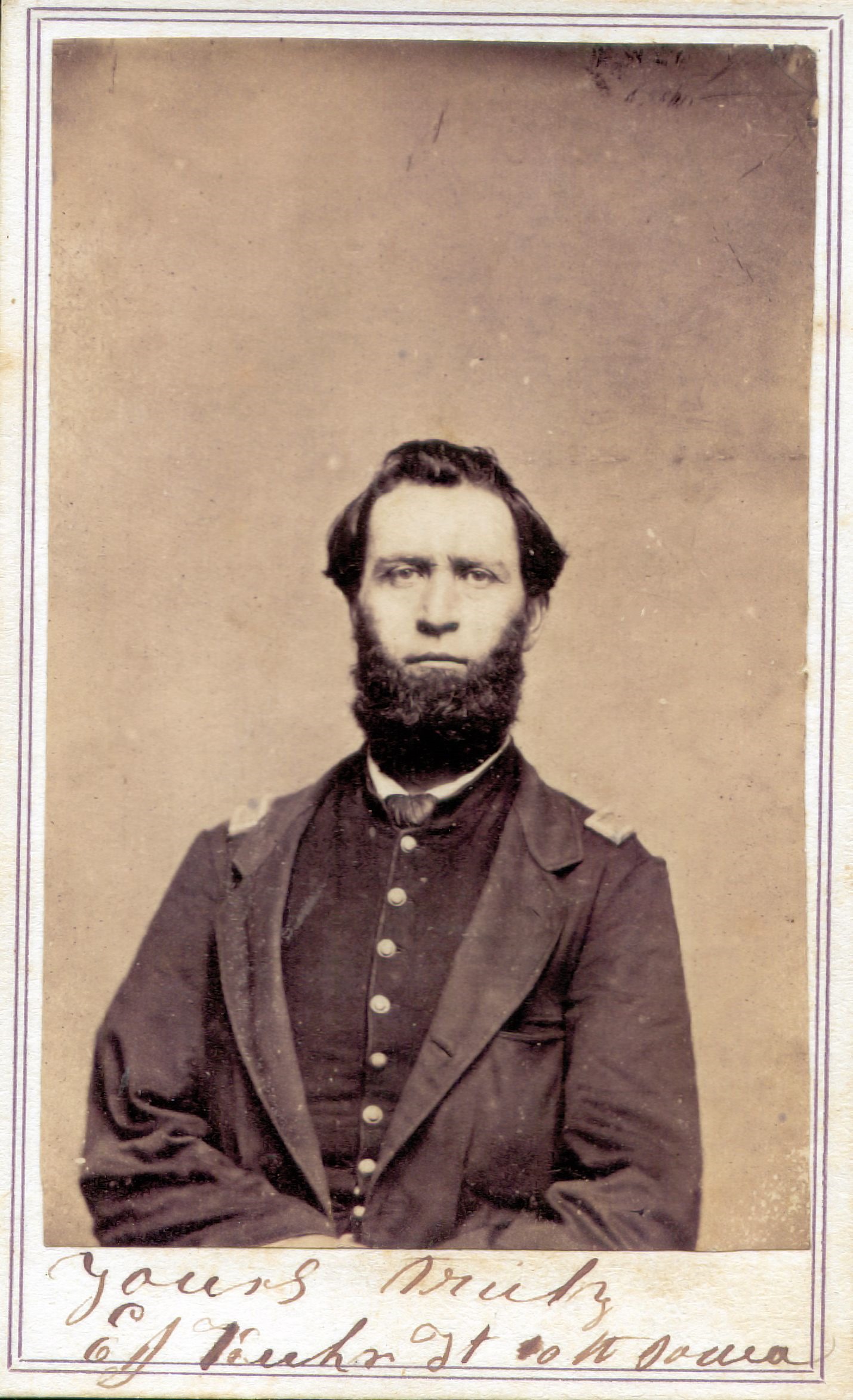
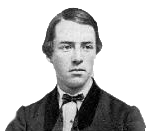
Captain Elbert J Kuhn, Indianola, Iowa, Company G, 10th Iowa Infantry.
Promoted: Captain Jan. 27, 1863.
Wounded in both thighs on May 16, 1863, Battle of Champion Hills, Miss.; Resigned Nov. 6, 1864.
Sheriff, Warren County, 1867 – 71
Born Feb. 20, 1825, Tennessee
Died: Mar. 1, 1907
Civil War Portrait 034
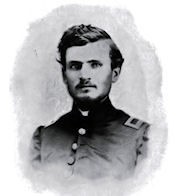
16th. Played at chess in the morning with Chester and Case. Co. returned from scouting. About noon rations came. Issued to the boys. Rushed them through rapidly. Had a shave and spent the evening in quarters. Read the Cincinnati Commercial. Wrote to Lucy Randall and Fred Allen.
May 16. — Captains Clapp and Strang came back from Washington. Went over to Captain Starr’s in the afternoon, and also to headquarters. Day breezy and pleasant.
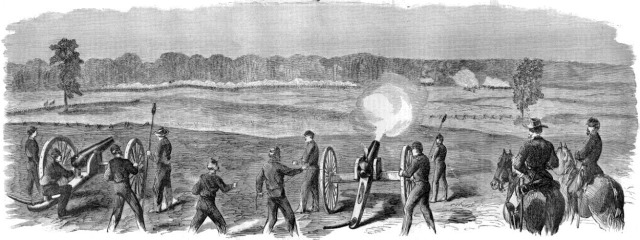
Battle of Champion Hill, May 16, 1863 – Sketched by Mr. Theodore Davis.
__________
“Head-quarters of Major-General McPherson,
Commanding 17th Corps Army Tennessee,
Near Black River, May 17, 1863.
“The division of General Hovey being in advance, discovered the enemy in force, posted in excellent position upon the crest of a hill covered with forest and undergrowth. General Hovey deployed his division, that of General Logan forming upon his right. The line advanced, preceded by a heavy line of skirmishers, and was soon heavily engaged.
“The batteries of Captains Rogers and De Solyer opened with good effect. Captain Rogers’s battery, posted in a good but exposed position, was soon charged upon; the enemy being severely repulsed by three regiments of Gen. John E. Smith’s brigade and the guns of De Solyer’s battery.
“An attempt to check our advance and flank our right was observed by General McPherson, who sent the brigade of General Stevenson and two batteries to meet it. After a short and sharp engagement, the fight at this time being severe along the whole line, General Stevenson charged with his brigade, driving the enemy and capturing their battery. The mass of the rebel troops seemed now to have been thrown against our left, and General Hovey, being forced to retire, was at once supported by General Crocker, who sent from his division two regiments of Colonel Sandborne’s brigade, and the brigades of Colonels Boomer and Holmes. These troops held the rebels in check, and shortly advanced, driving the enemy, capturing 1600 prisoners and a battery.
“A general advance, now ordered by General Grant, who had been upon the field during the entire day, many times in exposed positions, found the enemy in full retreat toward Edwards’s Depot, General McPherson sending in pursuit General Stevenson’s brigade, with De Solyer’s battery, followed by General Carr’s division. In this retreat the rebels lost General Tighlman, killed by a shell.
“The enemy lost nearly two thousand prisoners and thirteen guns.”
published in Harper’s Weekly issue of June 20, 1863
MAY 16TH.—We rolled out of bed this morning early, and had our breakfast of slapjacks made of flour, salt and water, which lie on a man’s stomach like cakes of lead—for we are out of all rations but flour and salt, though we hope soon for some variety. We heard heavy firing about eleven o’clock. Our division reached Champion Hill about two P. M., and filed into a field on the right of the road. We were drawn up in a line facing the woods through which ran the road we had just left. It was by this road the rebels came out of Vicksburg to whip us. We had orders to lie down. The command was obeyed with alacrity, for bullets were already whizzing over our heads. I never hugged Dixie‘s soil as close as I have to-day. We crowded together as tight as we could, fairly plowing our faces into the ground. Occasionally a ball would pick its man in spite of precaution, and he would have to slip to the rear. Soon we got orders to rise up, and in an instant every man was on his feet. If the former order was well obeyed, the latter was equally so. The enemy charged out of the woods in front of us in a solid line, and as they were climbing the fence between us, which separated the open field from the timber, DeGolier’s battery, stationed in our front, opened on them with grape and canister, and completely annihilated men and fence, and forced the enemy to fall back. Such terrible execution by a battery I never saw. It seemed as if every shell burst just as it reached the fence, and rails and rebs flew into the air together. They, finding our center too strong, renewed their charge on our left, and succeeded in driving it a short distance, but their success was only for a moment, for our boys rallied, and with reinforcements drove them in turn. We now charged into the woods and drove them a little ways, and as we charged over the spot so lately occupied by the foe, we saw the destruction caused by our battery, the ground being covered thickly with rebel grey. When we reached the woods we were exposed to a galling fire, and were at one time nearly surrounded, but we fought there hard until our ammunition was exhausted, when we fixed bayonets and prepared to hold our ground. A fresh supply of ammunition soon came up, when we felt all was well with us again. Meanwhile the right of our line succeeded in getting around to their left, when the enemy retreated towards Vicksburg, lest they should be cut off.
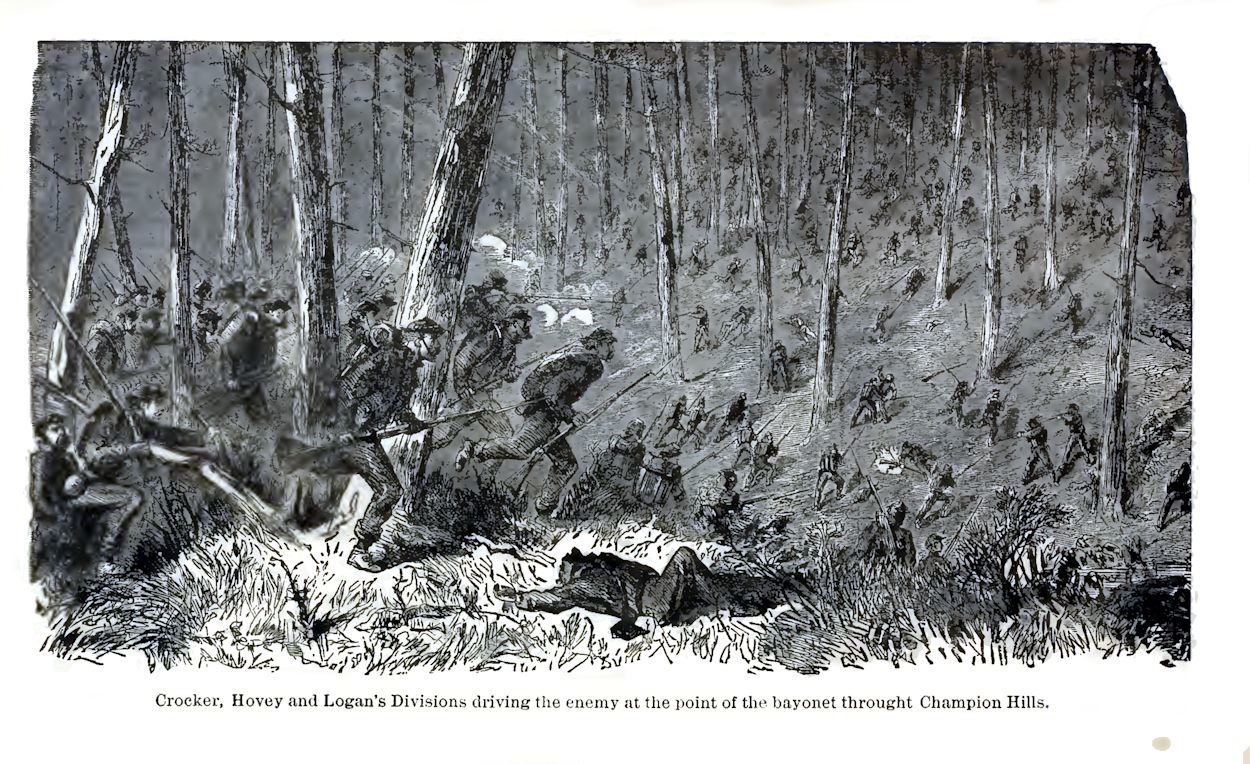
The battle to-day was commenced early in the morning by McClernand’s great fighting corps, and was a hot and severe contest, until Logan‘s division approached the road on the Confederates’ left, between them and Vicksburg, when the foe wavered and began to break. This was a hard day’s fight, for the rebels, finding that they had been beaten in three battles about Vicksburg, had no doubt resolved to make a desperate stand against our conquering march; but alas! for them, this day’s course of events was like the rest. When the fight was over, Generals Grant, McClernand, Sherman, McPherson and Logan rode over the victorious field, greeted with the wildest cheers. I wonder if they love their men as we love them. We received our mail an hour or two after the fight, and the fierce struggle through which we had just passed was forgotten as we read the news from home. Our fingers fresh from the field left powder marks on the white messengers that had come to cheer us.
Our forces captured eleven pieces of artillery and over one thousand prisoners. The retreating army will make another stand, but we shall move right on, undaunted. Several amusing incidents have occurred during the battle to-day. Company A, of the 20th, was sent out to skirmish, and moved forward till they could see the enemy. By this time General Logan made his appearance, when one of the boys who wished to go into the fight without impediments, approached Logan and said, “General, shall we not unsling knapsacks?” “No,” was the stern reply, “damn them, you can whip them with your knapsacks on.” This same company, in full view of a rebel battery, had taken refuge in a deep ditch, and when afterward the rebel captain cried out, “ready, take aim,” Lt. Bryant, feeling secure in his position, interrupted the order with a shout, “shoot away and be damned to you.”
We moved up through the woods to the road again after the fight, where we halted an hour. Near the road was a farm house which was immediately taken possession of for a hospital.
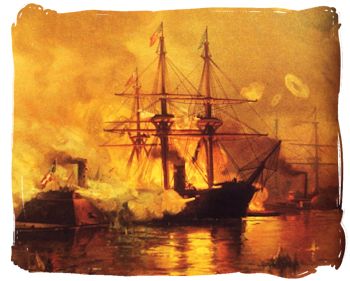
May 16th. Commences with light southerly breezes; at seven A. M. saw a wreck floating down, and sent the gunboat Sachem to see what it was; at nine A. M. inspected crew at quarters. The supposed wreck proved to be a snag; at 10 A.M., Commodore Palmer, and his clerk Nathaniel P. S. Thomas, also the Paymaster, Mr. Wm. F. Meredith, left the ship to go on board of the steamer Sachem. Sachem got under way, and steamed up Red river. Between the hours of eight and twelve (midnight), firing was heard down the river, inland, in the direction of Port Hudson.
by John Beauchamp Jones
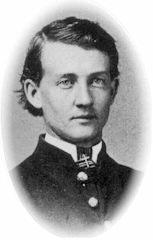
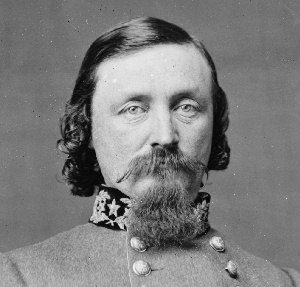 MAY 16TH.—It appears, after the consultation of the generals and the President yesterday, it was resolved not to send Pickett’s division to Mississippi, and this morning early the long column march through the city northward. Gen. Lee is now stronger than he was before the battle. Gen. Pickett himself, with his long, black ringlets, accompanied his division, his troops looking like fighting veterans, as they are. And two fine regiments of cavalry, the 2d and 59th North Carolina Regiments, passed through the city this morning likewise.
A letter was received from Gen. Beauregard to-day, again protesting against the movement of so many of his troops to Mississippi; 5000 on the 5th, and more than 5000 on the 10th instant. He makes an exhibit of the forces remaining in South Carolina and Georgia—about 4000 infantry, 5000 cavalry, and 6000 artillery, some 15,000 in all. He says the enemy is still on the coast, in the rivers, and on the islands, and may easily cut his communications with Savannah; and they have sufficient numbers to take Charleston, in all probability, without passing the forts. He says information of his weakness is sure to be communicated to the enemy—and I think so too, judging from the number of passports “allowed” by Judge Campbell and Mr. Benjamin!
There is some purpose on the part of Gen. Lee to have a raid in the enemy’s country, surpassing all other raids. If he can organize two columns of cavalry, 5000 each, to move in parallel lines, they may penetrate to the Hudson River; and then the North will discover that it has more to lose by such expeditions than the South. Philadelphia, even, may be taken.
To-day, the regular train on the Fredericksburg road came back to the city, the conductor being in a terrible fright, and reporting that the enemy were again at Ashland. But it turned out that the troops there were our men! It is not probable the enemy’s cavalry will soon approach Richmond again.
(Note: Photo of Gen. George E. Pickett, C.S.A., is from Library of Congress, Prints and Photographs Division)
May 16.—Last night a company of United States cavalry was surprised and captured at Charlestown, Jefferson County, Va. Major-General Schenck, on being informed by telegraph of the disaster, immediately ordered General Milroy to send out a force to intercept and attack the rebels, and to-day he received the following despatch from General Milroy, announcing the result: “The Federal cavalry captured at Charlestown were recaptured by detachments of Virginia and Pennsylvania cavalry, under Captain Vitt, this afternoon, about three o’clock, at Piedmont Station, in Fauquier County. We also captured forty rebels and a corresponding number of horses. Two rebels were killed. I regret to add that we lost Captain Vitt and one sergeant. Our cavalry recaptured one Federal lieutenant, and fifty privates, and their horses. Major Adams, of the First New-York cavalry, who arrived after the recapture, is still in pursuit of the rebels. The Virginia and Pennsylvania cavalry, who made the recapture, were sent out by me yesterday.”
—The United States steamer Monticello, captured the schooner Odd Fellow, off Little River Inlet, N. C.—At Bradyville Pike, in the vicinity of Cripple Creek, Tenn., General Palmer, accompanied by an escort of twenty-five men, and sixty men from the Middle Tennessee Union cavalry, made a sabre-charge on a detachment of the Third Georgia regiment, numbering eighty-five men, commanded by Lieutenant-Colonel Thompson. The rebels had no sabres, but fought desperately for a few moments. The Union force killed several of the enemy and brought in eighteen prisoners, among them Captains M. C. Edwards and Willis, the latter of the Third Georgia cavalry, and dangerously wounded.—Cincinnati Commercial.
—The battle of Champion Hill, or Baker’s Creek, Miss., was fought by the Nationals, under General Grant, and the rebels, under General Pemberton, in which the latter was compelled to fall back behind the Big Black River.—(Doc. 192.)
—A reconnoitring party of the First New York mounted rifle regiment, under the command of Major Patton, were attacked in the vicinity of Suffolk, Va., by a large body of rebel cavalry and routed with considerable loss.
—Sixteen men of the First New-York cavalry, under the command of Lieutenant Vermillion, attacked a party of twenty-two rebel soldiers, at Berry’s Ferry, Va., and killed two, wounded five, and captured ten of them.
—The rebel government steamer Cuba, was destroyed by the National gunboat De Soto, Captain W. W. Walker, in the Gulf of Mexico, off Mobile harbor, Ala.—Captain Walker’s Report.


