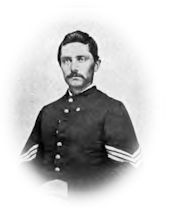
Saturday, 30th—Our expedition started back this morning for Vicksburg. We received orders to burn the buildings along the way and drive in all the cattle we could find. Our road ran along the south side of the Yazoo river, through rich bottom land planted to corn and cotton. The plantations are well improved with fine buildings. This bottom land is from one and one-half to two miles wide and springs in the bluffs pour out excellent water which runs in streams to the river. We got our fill of good water. When we halted at noon for lunch Company E, on rear guard, stopped in the sheds of a cotton gin in order to escape the hot sun. We had been there but a few minutes when some straggler set fire to the cotton, which being very dry and scattered about soon made a big fire, driving us out. The fire burned some sheep, a yoke of oxen and a wagon, besides other articles which we had taken en route.
May 2013
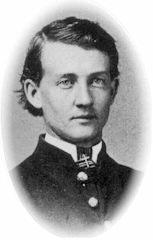
MAY 30TH.—Moved this morning at four o’clock back again towards Vicksburg—rather an early start, unless some special business awaits us. A few surmise that there is need for us at the front, but I think it is only a freak of General Frank Blair, who is in command of our excursion party. The day has been hot, and we have been rushed forward as though the salvation of the Union depended upon our forced march. I am not a constitutional grumbler, but I fail to understand why we have been trotted through this sultry Yazoo bottom where pure air seems to be a stranger. Probably our commander wants to get us out of it as soon as posible. A few of the men have been oppressed with the heat, and good water is very scarce. This seems to be a very rich soil, made up no doubt of river deposits. A ridge runs parallel with the river, and it is on that elevation all the plantation buildings are located, overlooking the rich country around. The Yazoo river is a very sluggish stream and said to be quite deep. The darkies claim it is “dun full of cat-fish.” I think we may probably have fresh, fish, but not till we catch Vicksburg, and then only in case we are allowed to take a rest, for I presume there will then turn up some other stronghold for Grant and his army to take, and for which we shall have to be off as soon as this job is ended. We camped at dark, after a severe and long march, and it is now raining very hard.
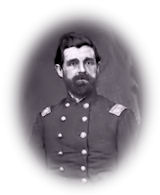
Colonel Lyons.
Fort Donelson, May 30, 1863.—The expedition from Waverly has just returned. They bring a report from Waverly that it was seen on fire yesterday—accidental, of course. It has been a pestiferous nest of traitors always and ought to be wiped out.
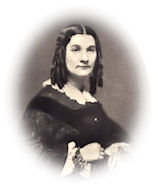
Mrs. Lyon’s Diary.
May 30, 1863.—Arrived home safely.
Letter No. IV.
Camp on the Rapidan,
May 30th, 1863.
My Precious Wife:
I write you a few lines by an Irishman who has just gotten a discharge from our regiment. I merely write to take the chance of letting you know that I am well and well satisfied. I am afraid that the Irishman will get drunk and lose this, so I have no heart to write you as fully as I would wish, besides I have only a few moments to write in.
We are five miles from the rest of the brigade on picket duty at Raccoon Ford. All of our company are doing well except Allen Killingsworth, who is sick at a private house about five miles off. He is getting better. I have written you a great many letters, and trust that this may reach you safely. Your daguerreotype is a great consolation to me; I look at it every day and remember the 49th Chapter and 11th verse of Jeremiah and feel satisfied, although a letter from home would be a great pleasure to me. I have nothing with me but the clothes on my back and a change of underclothing. I trust that our affairs may so result at Vicksburg as to leave the way open for you to make a visit to Columbia. I have laid out the plan for you in three or four letters. The principal features are for you not to go more than $500.00 in debt, and to leave the servants at home; to get a good escort to Jackson, and as much farther as you can, and then trust to conductors and your own good sense the rest of the way. You need not make or send anything to me as I am unable to march with it, and will have to throw it away. Mother gave me a nice pair of pants; they were cut out and made for $1.50. Lamar was taken prisoner and Gillespie Thornwell killed about three weeks ago. Lamar has been exchanged and is now with his command. Kiss the little darlings for me. I missed the pleasure of seeing Mac in Columbia; she had gone to Charleston. Tell the servants howdy for me, and tell them I say, obey you. Don’t forget Stark’s lessons. Your husband, faithfully ever,
John C. West.
May 30, Saturday. I am surprised at the loose and improper management of General Dix in regard to the blockade and traffic in the Rebel region. Admiral Lee has sent me, yesterday and to-day, some strange permits for trade signed by Dix, wholly unauthorized and which cannot in sincerity and good faith be allowed.
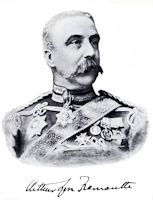
30th May (Saturday).—It rained hard all last night, but General Polk’s tent proved itself a good one. We have prayers both morning and evening, by Dr Quintard, together with singing, in which General Polk joins with much zeal. Colonel Gale, who is son-in-law and volunteer aide-de-camp to General Polk, has placed his negro Aaron and a mare at my disposal during my stay.
General Polk explained to me, from a plan, the battle of Murfreesborough. He claimed that the Confederates had only 30,000 troops, including Breckenridge’s division, which was not engaged on the first day. He put the Confederate loss at 10,000 men, and that of the Yankees at 19,000. With regard to the battle of Shiloh, [1] he said that Beauregard’s order to retire was most unfortunate, as the gunboats were doing no real harm, and if they (the Confederates) had held on, nothing could have saved the Federals from capture or destruction. The misfortune of Albert Johnston’s death, together with the fact of Beauregard’s illness and his not being present at that particular spot, were the causes of this battle not being a more complete victory. Ever since I landed in America, I had heard of the exploits of an Englishman called Colonel, who is now Inspector-General of Cavalry to Bragg’s army. This afternoon I made his acquaintance, and I consider him one of the most extraordinary characters I ever met. Although he is a member of a well-known English family, he seems to have devoted his whole life to the exciting career of a soldier of fortune. He told me that in early life he had served three years in a French lancer regiment, and had risen from a private to be a sous-lieutenant. He afterwards became a sort of consular agent at Tangier, under old Mr Drummond Hay. Having acquired a perfect knowledge of Arabic, he entered the service of Abd-el-Kader, and under that renowned chief he fought the French for four years and a half. At another time of his life he fitted out a yacht, and carried on a private war with the ERiff pirates. He was brigade-major in the Turkish contingent during the Crimean war, and had some employment in the Indian mutiny. He has also been engaged in war in Buenos Ayres and the South American republics. At an early period of the present troubles he ran the blockade and joined the Confederates. He was adjutant-general and right-hand man to the celebrated John Morgan for eight months. Even in this army, which abounds with foolhardy and desperate characters, he has acquired the admiration of all ranks by his reckless daring and gallantry in the field. Both Generals Polk and Bragg spoke to me of him as a most excellent and useful officer, besides being a man who never lost an opportunity of trying to throw his life away. He is just the sort of man to succeed in this army, and among the soldiers his fame for bravery has outweighed his unpopularity as a rigid disciplinarian. He is the terror of all absentees, stragglers, and deserters, and of all commanding officers who are unable to produce for his inspection the number of horses they have been drawing forage for. He looks about forty-five, but in reality he is fifty-six. He is rather tall, thin, very wiry and active, with a jovial English expression of countenance ; but his eyes have a wild, roving look, which is common amongst the Arabs. When he came to me he was dressed in an English staff blue coat, and he had a red cavalry forage-cap, which latter, General Polk told me, he always wore in action, so making himself more conspicuous. He talked to me much about John Morgan, whose marriage he had tried to avert, and of which he spoke with much sorrow. He declared that Morgan was enervated by matrimony, and would never be the same man as he was. He said that in one of the celebrated telegraph tappings in Kentucky, Morgan, the operator, and himself, were seated for twelve hours on a clay-bank during a violent storm, but the interest was so intense, that the time passed like three hours[2] General Polk’s son, a young artillery lieutenant, told me this evening that “Stonewall Jackson” was a professor at the military school at Lexington, in which he was a cadet. “Old Jack” was considered a persevering but rather dull master, and was often made a butt of by cheeky cadets, whose great ambition it was to irritate him, but, however insolent they were, he never took the slightest notice of their impertinence at the time, although he always had them punished for it afterwards. At the outbreak of the war, he was called upon by the cadets to make a speech, and these were his words: ‘Soldiers make short speeches: be slow to draw the sword in civil strife, but when you draw it, throw away the scabbard.” Young Polk says that the enthusiasm created by this speech of old Jack’s was beyond description.
[1] Called Pittsburg Landing and Corinth.
[2] This was the occasion, when they telegraphed such a quantity of nonsense to the Yankee general, receiving valuable information in return, and such necessary stores by train as Morgan was in need of.
30th. Rained last night. Eleven prisoners came in at 9 A. M. Pickets captured. Soon after 22 others. Kautz went to the forks before halting. Crossed at 2 A. M. and hastened towards Monticello, sending Detachments to the different fords to capture pickets. “E” and “C” covered the retreat. Skirmished a good deal. 20 to 40 rounds. I feel about the same, quite feverish and chilly at times.
Saturday, 30th—Came to Mr. Beasley’s and staid all night.
May 30—We see the Yankees in balloons every day, reconnoitering our lines.


