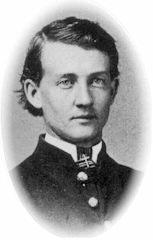
MAY 15TH.—The familiar “Attention, battalion!” was heard from our Colonel, when we marched back upon the same road that had led us to Jackson, camping as usual at dark. We passed through Clinton, and the inhabitants were surprised to see us returning so soon, for they fully expected to hear of our being defeated and driven back. But they did not know our metal. The last few days have been full of excitement, and although we have marched and fought hard, and lost some of our best men, besides getting tired and hungry ourselves, we are more resolved than ever to keep the ball rolling. The thinner our ranks are made by fighting and disease, the closer together the remnants are brought. We shall close up the ranks and press forward until the foe is vanquished. Soldiers grow more friendly as they are brought better to realize the terrible ravages of war. As Colonel Force called us to “Attention!” this morning, one of the boys remarked, “I love that man more than ever.” Yes, we have good reason to be proud of our Colonel, for upon all occasions we are treated by him as volunteers enlisted in war from pure love of country, and not regulars, drawn into service from various other motives, in time of peace.
May 2013

by John Beauchamp Jones
MAY 15TH.—The Tredegar Iron Works and Crenshou’s woolen factory were mostly destroyed by fire last night! This is a calamity.
We have also intelligence of the occupation of Jackson, Miss., by the enemy. Thus they cut off communication with Vicksburg, and that city may be doomed to fall at last. The President is at work again at the Executive Office, but is not fully himself yet.
The Secretary of War dispatched Gen. Lee a day or two ago, desiring that a portion of his army, Pickett’s division, might be sent to Mississippi. Gen. Lee responds that it is a dangerous and doubtful expedient; it is a question between Virginia and Mississippi; he will send the division off without delay, if still deemed necessary. The President, in sending this response to the Secretary, says it is just such an answer as he expected from Lee, and he approves it. Virginia will not be abandoned.
Gens. Lee, Stuart, and French were all at the War Department to-day. Lee looked thinner, and a little pale. Subsequently he and the Secretary of War were long closeted with the President.
Gen. Schenck (Federal) has notified Gen. W. E. Jones, that our men taken dressed in Federal uniform will not be treated as prisoners of war, but will be tried and punished as spies, etc. The President directed the Secretary of War to-day to require Gen. Lee to send an order to the commander of the Federal army, that accouterments and clothing will be deemed subjects of capture, and if our men are treated differently than prisoners of war, when taken, we will retaliate on the prisoners in our possession. [click to continue…]
May 15.—A fight took place in the vicinity of Camp Moore, La., between the expeditionary force under the command of Colonel Davis, and a body of rebel troops, resulting in a rout of the latter with great slaughter. After the fight, Colonel Davis advanced on Camp Moore, which he burned, together with the railroad depot and bridge, and a great quantity of property.—New Orleans Era.
— William Corbin and T. P. Graw, found guilty of enlisting for the rebel service within the National lines, were executed at Johnson’s Island, near Sandusky, Ohio.—The rebel schooner Royal Yacht, was captured by the bark W. G. Anderson.— The rebels captured two small steamboats in the Dismal Swamp Canal, N. C.—The ship Crown Point, in latitude 7° south, longitude 34° west, was captured and burned by the rebel privateer Florida.
—Several desperate infantry fights took place to-day in the vicinity of Carrsville and Suffolk, Va., between the National forces under the command of General Peck, and large bodies of rebel troops, in which both parties suffered severely, without gaining any material advantage.
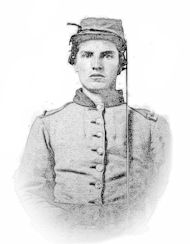
Thursday, 14th.—Sent out as skirmisher; but was soon ordered in, as regiment had orders to move; have to wait until to-morrow at 7 o’clock for rations.

Jackson, Miss., Thursday, May 14. Considerable rain during the night and indications of more. Moved on without much hindrance about four miles, when we came upon them in force, the rain falling in torrents. The infantry went forward and formed in line, a rebel battery throwing shells from the right at them. 1st and 2nd Brigades on the right, 3rd on the left. Batteries moved forward leaving the caissons behind. The 1st Missouri Battery took a position on the right and was hotly engaged with the enemy’s guns for half an hour.
Meanwhile we were waiting in the road in range of their shells, which were flying over us and dropping either side, but luckily none took effect. The enemy’s infantry in line in front doing sharp work, when the whole line of infantry prepared to make a charge,1st Section ordered out to support them. They unslung their knapsacks and went in with a shout, when the crash of musketry was terrific, volley after volley, the bullets flying thick around, all lying as close to the ground as practicable, when the cry “They run! They run!” was heard and after them they went in all directions. We were ordered forward and we did go at double quick across the charging ground. Dead rebels—and many of them lay there wounded and bleeding. The infantry followed them up the hill then fell back and we came into battery, when Captain Dillon said, “6th Wisconsin Battery, I am here—open fire on them”. And we did. The six pieces went off almost simultaneously, and we were enveloped in a cloud of powder smoke, then another, until nearly all the shells were gone, when we ceased firing, and they were gone. Cheer after cheer went up from the infantry as McPherson went galloping by. I never before could see how men could cheer on the battlefield, but I never felt more like it in my life. Such is victory.
At 2 o’clock we moved forward, the infantry in line and the artillery in column on the road. As we advanced, a man came from the right, where we could see that Sherman had sharp work to-day, reporting that he had entered Jackson and taken 5000 prisoners. It could hardly be credited, but at last we were convinced of it as we entered their ineffective earthworks with their pieces, caissons, etc. left uninjured; they had left everything, Sherman’s shells having scared them out of the capital of one of the strongest states of the Union. If there ever was a jubilant army, Grant’s army at Jackson was that night. The papers of the morning were found, which said that the Yankee vandals never would pollute Jackson. The force we met were direct from Charleston, S. C.—Eastern troops; but a wounded man told us they soon found out they were not fighting New York troops. Went into park in the suburbs of the town back of their breastworks. Lieutenant Simpson went down-town foraging. Ordered to cook three days’ rations.
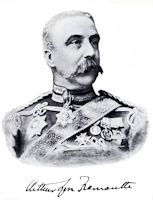
14th May (Thursday).—The officers and soldiers, about thirty in number, who came down the Wachita in my company, determined to proceed to Natchez today, and a very hard day’s work we had of it.
As the Louisianian bank of the Mississippi is completely overflowed at this time of year, and the river itself is infested with the enemy’s gunboats, which have run past Vicksburg and Port Hudson, the passage can only be made by a tedious journey in small boats through the swamps and bayous.
Our party left Trinity at 6 A.m. in one big yawl and three skiffs. In my skiff were eight persons, besides a negro oarsman named “Tucker.” We had to take it in turns to row with this worthy, and I soon discovered to my cost the inconvenience of sitting in close proximity with a perspiring darkie. This negro was a very powerful man, very vain, and susceptible of flattery. I won his heart by asking him if he wasn’t worth 6000 dollars. We kept him up to the mark throughout the journey by plying him with compliments upon his strength and skill. One officer declared to him that he should try to marry his mistress (a widow) on purpose to own him.
After beating up for about eight miles against one of three streams which units at, and give its name to, Trinity, we turned off to the right, and got into a large dense swamp. The thicket was so tangled and impenetrable that we experienced the greatest difficulty in forcing our way through it; we were often obliged to get into the water up to our middles and shove, whilst most of the party walked along an embankment.
After two hours and a half of this sort of work we had to carry our boats bodily over the embankment into a bayou called Log Bayou, on account of the numerous floating logs which had to be encountered. We then crossed a large and beautiful lake, which led us into another dismal swamp, quite as tangled as the former one. Here we lost our way, and got aground several times; but at length, after great exertions, we forced ourselves through it, and reached Lake Concordia, a fine piece of water, several miles in extent, and we were landed at dusk on the plantation of a Mr Davis.
These bayous and swamps abound with alligators and snakes of the most venomous description. I saw many of the latter swimming about exposed to a heavy fire of six-shooters; but the alligators were frightened away by the leading boat.
The yawl and one of the skiffs beat us, and their passengers reached Natchez about 9 P.M., but the other skiff, which could not boast of a Tucker, was lost in the swamp, and passed the night there in a wretched plight.
The weather was most disagreeable, either a burning sun or a downpour of rain.
The distance we did in the skiff was about twenty-eight miles, which took us eleven hours to perform.
On landing we hired at Mr Davis’s a small cart for Mr Douglas (the wounded Missourian) and our baggage, and we had to finish the day by a trudge of three miles through deep mud, until, at length, we reached a place called Vidalia, which is on the Louisianian bank of the Mississippi, just opposite Natchez.
At Vidalia I got the immense luxury of a pretty good bed, all to myself, which enabled me to take off my clothes and boots for the first time in ten days.
The landlord told us that three of the enemy’s gunboats had passed during the day; and as he said their crews were often in the habit of landing at Vidalia, he cautioned the military to be ready to bolt into the woods at any time during the night.
There were two conscripts on board my skiff to-day, one an Irishman and the other a Pole. They confessed to me privately their extreme dislike of the military profession; but at the same time they acknowledged the enthusiasm of the masses for the war.
Thursday, 14th—News came today that Richmond was taken. I took a walk and reviewed the rebels’ works about here. They were strongly fortified with heavy ordnance on the high bluff, about two hundred feet above water, with the river for a distance of two miles running straight to the bluff. This made it a very dangerous place for our gunboats to approach. But after two days’ shelling, our gunboats with two or three transports succeeded in running the blockade and landing below the fort.[1] The river coming with such force is fast washing away the bank and we hope that we may soon move from this place. The Third Brigade of Blair’s Division arrived late last night.
[1] At the time of the capture the first troops marched down and crossed the river onto high ground some two miles below, while our main army came Into the rear of the enemy, who were compelled to surrender, leaving all their heavy guns.—A. G. D.
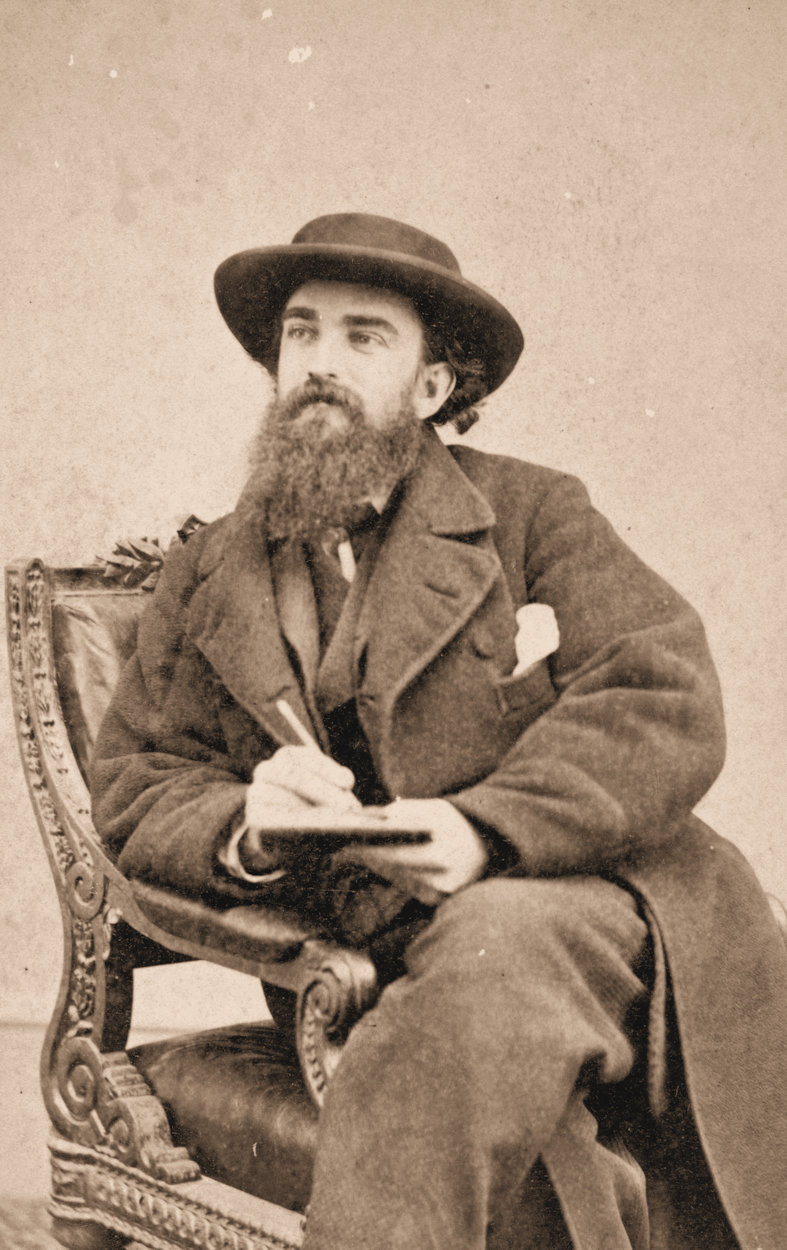
Alfred Waud, full-length portrait, seated, holding a pencil and pad, facing left.
Photographed by Alexander Gardner in 1863
Photographic print : albumen, on carte de visite mount.
Library of Congress image.
Civil War Portrait 033
May 14, Thursday. I wrote, two or three weeks since, a letter to Admiral Du Pont of affairs at Charleston and his reports, but have delayed sending it, partly in hopes I should have something suggestive and encouraging, partly because Fox requested me to wait, in the belief we should have additional information. Du Pont is morbidly sensitive, and to vindicate himself wants to publish every defect and weakness of the ironclads and to disparage them, regardless of its effect in inspiring the Rebels to resist them, and impairing the confidence of our own men in their invulnerability. I have tried to be kind and frank in my letter, but shall very likely give offense.
Had a little conversation to-day with Chase and Bates on two or three matters, but the principal subject was Earl Russell’s speech.
14th. Went down to H Co. after morning work and played chess. Beat Capt. N. three times and John Devlin four times. Cleaned up my revolvers. Col. Abbey appointed acting Brigade Com. Says Thede can be detailed here. Good. He has been sick with diarrhoea. Getting a little better. In evening read in “Les Miserables.” Has been a pleasant day. Girl of McGuire’s buried today. Alarmed last night. Morgan coming.


