Following the American Civil War Sesquicentennial with day by day writings of the time, currently 1863.

May 2013

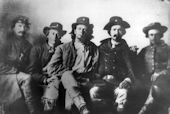
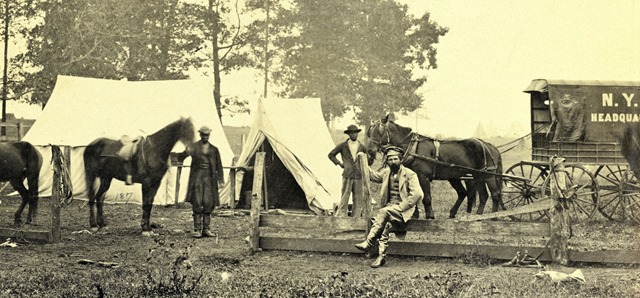
Headquarters of New York Herald in the field (1863)

Headquarters of New York Herald in the field (1863)

Photograph by Andrew J. Russell.

Library of Congress image.

__________

digital file from original itemNote – This image has been digitally adjusted for one or more of the following:

  • fade correction,
  • color, contrast, and/or saturation enhancement
  • selected spot removal.

Thursday, 14th—This evening we all went in and got supper then down to Mr. Wickwire’s and got supper and the supper is a mistake; danced until 12 o ‘clock. I and Miss Jimmy danced two sets. I enjoyed it finely, then bid them adieu and came out to Pete Laurence’s by daylight. Birch swapped horses on the way. Pete’s sister brought us provisions.

May.—A number of the teachers and pupils of the Academy have enlisted for the war. Among them E. C. Clarke, H. C. Kirk, A. T. Wilder, Norman K. Martin, T. C. Parkhurst, Mr Gates. They have a tent on the square and are enlisting men in Canandaigua and vicinity for the 4th N. Y. Heavy Artillery. I received a letter from Mr Noah T. Clarke’s mother in Naples. She had already sent three sons, Bela, William and Joseph, to the war and she is very sad because her youngest has now enlisted. She says she feels as did Jacob of old when he said, “I am bereaved of my children. Joseph is not and Simeon is not and now you will take Benjamin away.” I have heard that she is a beautiful singer but she says she cannot sing any more until this cruel war is over. I wish that I could write something to comfort her but I feel as Mrs Browning puts it: “If you want a song for your Italy free, let none look at me.”

Our society met at Fannie Pierce’s this afternoon. Her mother is an invalid and never gets out at all, but she is very much interested in the soldiers and in all young people, and loves to have us come in and see her and we love to go. She enters into the plans of all of us young girls and has a personal interest in us. We had a very good time to-night and Laura Chapin was more full of fun than usual. Once there was silence for a minute or two and some one said, “awful pause.” Laura said, “I guess you would have awful paws if you worked as hard as I do.” We were talking about how many of us girls would be entitled to flag bed quilts, and according to the rules, they said that, up to date, Abbie Clark and I were the only ones. The explanation is that Captain George N. Williams and Lieutenant E. C. Clarke, are enlisted in their country’s service. Susie Daggett is Secretary and Treasurer of the Society and she reported that in one year’s time we made in our society 133 pairs of drawers, 101 shirts, 4 pairs socks for soldiers, and 54 garments for the families of soldiers.

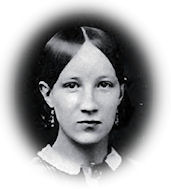
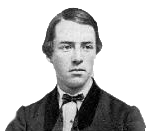
Abbie Clark and I had our ambrotypes taken to-day for two young braves who are going to the war. William H. Adams is also commissioned Captain and is going to the front.

May 14. — Weather was much cooler to-day. Very windy at night. Went over to headquarters in the evening. John Perry came over here to lunch. Two wrens have been building a nest in my stove-pipe for the past two days; they are quite tame, and come to the door of my tent to pick up rags, etc.

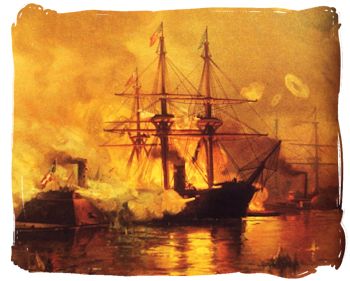
May 14th. Commences, “for a change,” with stormy weather, squalls of rain, and continued so during forenoon of this day; at seven A. M. the despatch steamer L. A. Sykes came out of Red River, direct from Alexandria, and made fast alongside of us, bringing despatches from Gen. Banks to Commodore Palmer; also the gunboat Sachem arrived; at seven thirty the Sykes got under way and went up Red river. This is a fine and fast little steamer, and is of great service to us; at six forty five P. M. the U. S. steamer Arizona came down and out of Red River, with Brig.-Gen. Dwight as a passenger, on his way to Grand Gulf to take command of some of Gen. Banks’s forces there. He came on board and paid his respects to Commodore Palmer. Let me here remark that this gentleman and soldier but a short time since had a brother killed near Alexandria by some guerrillas, while in the performance of his duty, whose loss he feels very much. He was a Captain in the army, and at the time he was killed was carrying despatches from Gen. Banks to some part of his command, and was mounted, but unarmed; at seven P. M. the Arizona steamed on her way up the river, bound to Grand Gulf. Nothing more of importance occurred during the remainder of these twenty-four hours.

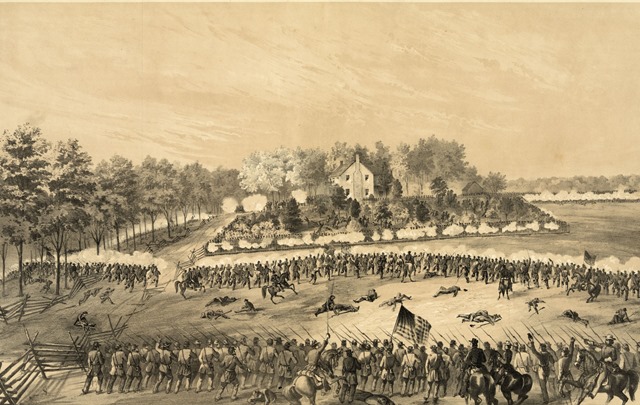
Battle of Jackson, Ms

Lithograph by Middleton, Strobridge & Co. Lith. Cin. O.

“Battle of Jackson, Mississippi–Gallant charge of the 17th Iowa, 80th Ohio and 10th Missouri, supported by the first and third brigades of the seventh division / sketched by A.E. Mathews, 31st Reg., O.V.I.”

Library of Congress image.

by John Beauchamp Jones

MAY 14TH.—We have been beaten in an engagement near Jackson, Miss., 4000 retiring before 10,000. This is a dark cloud over the hopes of patriots, for Vicksburg is seriously endangered. Its fall would be the worst blow we have yet received.

Papers from New York and Philadelphia assert most positively, and with circumstantiality, that Hooker recrossed the Rappahannock since the battle, and is driving Lee toward Richmond, with which his communications have been interrupted. But this is not all: they say Gen. Keyes marched a column up the Peninsula, and took Richmond itself, over the Capitol of which the Union flag is now flying.” These groundless statements will go out to Europe, and may possibly delay our recognition. If so, what may be the consequences when the falsehood is exposed? I doubt the policy of any species of dishonesty.

Gov. Shorter, of Alabama, demands the officers of Forrest’s captives for State trial, as they incited the slaves to insurrection.

Mr. S. D. Allen writes from Alexandria, La., that the people despair of defending the MississippiValley with such men as Pemberton and other hybrid Yankees in command. He denounces the action also of quartermasters and commissaries in the Southwest.

A letter from Hon. W. Porcher Miles to the Secretary of War gives an extract from a communication written him by Gen. Beauregard, to the effect that Charleston must at last fall into the hands of the enemy, if an order which has been sent there, for nearly all his troops to proceed to Vicksburg, be not revoked. There are to be left for the defense of Charleston only 100 exclusive of the garrisons!

May 14.—Jackson, Miss., was captured by the National forces belonging to the army of General Grant, after a fight of over three hours. General Joseph E. Johnston was in command of the rebels, who retreated toward the north.—(Doc. 191.)

—To-day a detachment of the National expeditionary force under Colonel Davis, destroyed the tannery, grist, and saw-mill, together with a steam-engine, at Hammond Station, on the Jackson Railroad, La.—New-Orleans Era.

—A scouting-party of National troops, sent out from Fairfax Court-House, Va., encountered a small force of the Black Horse cavalry, at the house of Mr. Masilla, five miles beyond Warrenton Junction, when a skirmish ensued, resulting in the dispersion of the rebels, the death of Mr. Masilla, and the wounding of several other rebels. The Nationals had three wounded.—New-York Tribune.

London, May 14, 1863

The telegraph assures us that Hooker is over the Rappahannock and your division regally indistinct “in the enemy’s rear.” I suppose the campaign is begun, then. Honestly, I’d rather be with you than here, for our state of mind during the next few weeks is not likely to be very easy.

But now that things are begun, I will leave them to your care. Just for your information, I inclose one of Mr. Lawley’s letters from Richmond to the London Times. It is curious. Mr. Lawley’s character here is under a cloud, as, strange to say, is not unusual with the employes of that seditious journal. For this and other reasons I don’t put implicit trust in him, but one fact is remarkably distinct. His dread of the shedding of blood makes him wonderfully anxious for intervention. A prayer for intervention is all that the northern men read in this epistle, and Mr. Lawley’s humanity does n’t quite explain his earnestness. . . .

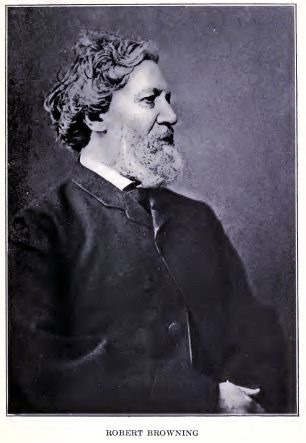
It was a party of only eleven, and of these Sir Edward [Lytton] was one, Robert Browning another, and a Mr. Ward, a well known artist and member of the Royal Academy, was a third. All were people of a stamp, you know; as different from the sky-blue, skim-milk of the ball-rooms, as good old burgundy is from syrup-lemonade. I had a royal evening; a feast of remarkable choiceness, for the meats were very excellent good, the wines were rare and plentiful, and the company was of earth’s choicest.
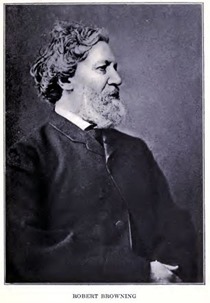
browning, robertSir Edward is one of the ugliest men it has been my good luck to meet. He is tall and slouchy, careless in his habits, deaf as a ci-devant, mild in manner, and quiet and philosophic in talk. Browning is neat, lively, impetuous, full of animation, and very un-English in all his opinions and appearance. Here, in London Society, famous as he is, half his entertainers actually take him to be an American. He told us some amusing stories about this, one evening when he dined here.

Just to amuse you, I will try to give you an idea of the conversation after dinner; the first time I have ever heard anything of the sort in England. Sir Edward is a great smoker, and although no crime can be greater in this country, our host produced cigars after the ladies had left, and we filled our claret-glasses and drew up together.

Sir Edward seemed to be continuing a conversation with Mr. Ward, his neighbor. He went on, in his thoughtful, deliberative way, addressing Browning.

“Do you think your success would be very much more valuable to you for knowing that centuries hence, you would still be remembered? Do you look to the future connection by a portion of mankind, of certain ideas with your name, as the great reward of all your labor?”

“Not in the least! I am perfectly indifferent whether my name is remembered or not. The reward would be that the ideas which were mine, should live and benefit the race!”

“I am glad to hear you say so,” continued Sir Edward, thoughtfully, “because it has always seemed so to me, and your opinion supports mine. Life, I take to be a period of preparation. I should compare it to a preparatory school. Though it is true that in one respect the comparison is not just, since the time we pass at a preparatory school bears an infinitely greater proportion to a life, than a life does to eternity. Yet I think it may be compared to a boy’s school; such a one as I used to go to, as a child, at old Mrs. S’s at Fulham. Now if one of my old school-mates there were to meet me some day and seem delighted to see me, and asked me whether I recollected going to old mother S’s at Fulham, I should say, ‘Well, yes. I did have some faint remembrance of it! Yes. I could recollect about it.’ And then supposing he were to tell me how I was still remembered there! How much they talked of what a fine fellow I’d been at that school.”

“How Jones Minimus,” broke in Browning, “said you were the most awfully good fellow he ever saw.”

“Precisely,” Sir Edward went on, beginning to warm to his idea. “Should I be very much delighted to hear that? Would it make me forget what I am doing now? For five minutes perhaps I should feel gratified and pleased that I was still remembered, but that would be all. I should go back to my work without a second thought about it.

“Well now, Browning, suppose you, sometime or other, were to meet Shakespeare, as perhaps some of us may. You would rush to him and seize his hand, and cry out, ‘My dear Shakespeare, how delighted I am to see you. You can’t imagine how much they think and talk about you on the earth!’ Do you suppose Shakespeare would be more carried away by such an announcement than I should be at hearing that I was still remembered by the boys at mother S’s at Fulham? What possible advantage can it be to him to know that what he did on the earth is still remembered there?”

The same idea is in LXII of Tennyson’s In Memoriam, but not pointed the same way. It was curious to see two men who, of all others, write for fame, or have done so, ridicule the idea of its real value to them. But Browning went on to get into a very unorthodox humor, and developed a spiritual election that would shock the Pope, I fear. According to him, the minds or souls that really did develope themselves and educate themselves in life, could alone expect to enter a future career for which this life was a preparatory course. The rest were rejected, turned back, God knows what becomes of them, these myriads of savages and brutalized and degraded Christians. Only those that could pass the examination were allowed to commence the new career. This is Calvin’s theory, modified; and really it seems not unlikely to me. Thus this earth may serve as a sort of feeder to the next world, as the lower and middle classes here do to the aristocracy, here and there furnishing a member to fill the gaps. The corollaries of this proposition are amusing to work out.
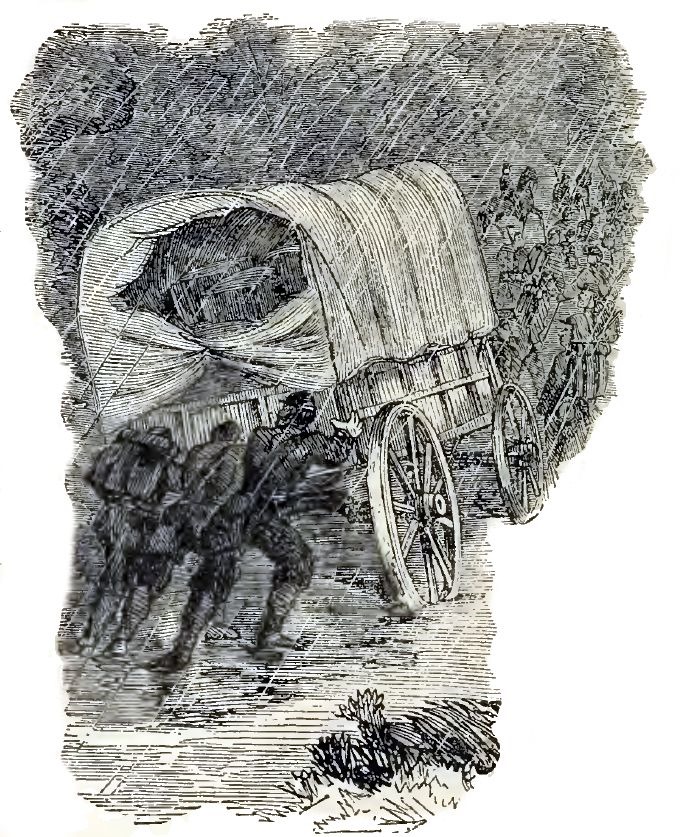
MAY 14TH.—Started again this morning for Jackson. When within five miles of the city we heard heavy firing. It has rained hard to-day and we have had both a wet and muddy time, pushing at the heavy artillery and provision A Soldier’s Story of the Siege of Vicksburg 10wagons accompanying us when they stuck in the mud. The rain came down in perfect torrents. What a sight ! Ambulances creeping along at the side of the track—artillery toiling in the deep ruts, while Generals with their aids and orderlies splashed mud and water in every direction in passing. We were all wet to the skin, but plodded on patiently, for the love of country.

When within a few miles of Jackson, the news reached us that Sherman had slipped round to the right and captured the place, and the shout that went up from the men on the receipt of that news was invigorating to them in the midst of trouble. I think they could have been heard in Jackson. Sherman’s army at the right and McPherson in our immediate front, with one desperate charge we ran without stopping till we reached the town. The flower of the confederate forces, the pride of the Southern States who had never yet known defeat, came up to Jackson last night to help demolish Grant’s army, but for once they failed. Veterans of Georgia stationed as reserves were also forced to yield in dismay, and never stopped retreating till they had passed far south of the Capital which they had striven so valiantly to defend. To-night the stars and stripes float proudly over the cupola of the seat of government of Mississippi—and if my own regiment has not had a chance to-day to cover itself with glory it has with mud.

I shall not soon forget the conversation I have had with a wounded rebel. He said that his regiment last night was full of men who had never before met us, and who felt sure it would be easy to whip us. How they were deceived! He said part of his regiment was behind a hedge fence, where they felt comparatively safe, but the Yankees jumped right over without stopping, and swept everything before them. I never saw finer looking men than the killed and wounded rebels of to-day, and with the smooth face of one of them, lying in a garden mortally wounded, I was so taken, that I eased his thirst with a drink from my own canteen. His piteous glance at me at that time I shall never forget. It is on the battle field and among the dead and dying we get to know each other better—nay, even our own selves. Administering to a stranger, we think of his mother’s love, as dear to him as our own to us. When the fight is over, away all bitterness. Let us leave with the foe some tokens of good will, that, when the cruel war at last is over, may be kindly remembered. I trust our enemies may yet be led to hail in good faith the return of peace and the restoration of the Union. This is a domestic war, the saddest of all, being fought between those whose hearts should be as brothers; and when it is at an end, may those hearts again throb together beneath the folds of the flag that once waved for defence over their sires and themselves —a flag whose proud motto will be, “peace on earth and good will to men.”

Some of the boys went down into the city to view our new possession. It seems ablaze, but I trust only public property is being destroyed, or such as might aid and comfort the enemy hereafter.

I am very tired, and of course can easily get excused, so I will go to my bed on the ground.