Following the American Civil War Sesquicentennial with day by day writings of the time, currently 1863.

May 2013

May 14. — A gentle rain is pattering on the tent-roof, — grateful to us now as a shower in August in Northern city or hamlet. To its soothing music the other men have gone to sleep; while I sit here with my back to the tent-pole, writing words to this pretty pattering tune. May is going; and we are, generally speaking, as idle here as during the previous month we were active. It is nearly three weeks since we encamped on the Courtableau, — weeks of glorious summer. Day and night, along the bayou, the mocking-bird “shakes from his little throat whole floods of delirious music;” and over the stream, from the boughs of the big trees, hang the ladders of moss, — the Jacob’s ladders, on which “the angels, ascending, descending, are the swift humming-birds.” The distant forest line is blue to the eye, and of impenetrable density. What enchanter’s incense is this sweet blue haze! lulling the outer sense, stimulating the fancy; so that I sit under our booth, my eyes upon the far-away woods, dreaming of romance,—just now of the “wood of Broceliande,” and Vivien charming Merlin with her spells “of woven paces and of waving arms.” O sweet “Idyls of the King”! is there any poetry like you? It is all beautiful. But our sojourn here is inglorious. Instead of being left behind to guard cotton, I would have preferred to march with Banks to the Red River: a cup of fatigue and hardship it would have been, but gloriously dashed with excitement.

The pile of cotton is a mountain on the landing. All day long, — every day for weeks, — teams have brought it in, until it almost seems worth while to build here the factories that are to work it up into fabric; but, since Mahomet will not come to the mountain (to set on its head the saying), the mountain is going to Mahomet. Down it goes, piecemeal, through the bayou, on little steamers padded out like lank belles, at every available place, into portentous embonpoint. They say our business here will be finished when the cotton is carried away: so we watch the slow decrease of the pile, hear the mocking-birds, wash lazily in the bayou in contempt of alligators, and live along.

Along the bank of the stream is an immense camp of negroes. They have come by thousands from the whole country round. Generally, their masters appear to have fled; and the negroes, harnessing up the mules, loading in their families together with their own and their masters’ goods, have come crowding in to us. They come trustingly, rejoicing in their freedom. By night, until long past midnight sometimes, we can hear them shout, pray, and sing. Gen. Ullman has been here, and the able-bodied men are to become soldiers. The women and older men, and all not fit for military duty, are to go on to plantations taken by the Government or by loyal men. They are to receive wages, and be well cared for. No doubt, their condition will be distressing in many cases. For them, it is a most momentous period of transition, — a crisis which they can hardly pass without suffering; but it will be temporary, and a bright future lies before them.

The other day, on the bank of the bayou, I found a man, born, as he said, in New Jersey. He came South as steward of a ship, and was coolly sold by his captain into slavery at New Orleans. From there he became a plantation-hand, and for fifteen years had been in bondage.

Last week, there came shivering through to us from Port Hudson, forty miles away, the boom of a mighty bombardment. We heard them, Friday and Saturday, getting the range; then Saturday night, —it was starlight, and all calm as an infant’s sleep, — that night we heard the roar of the real attack, — continuous thunder from the far north-east. We could tell the sharp reports of the Parrotts, the heavier boom of Dahlgren, the long-drawn crash of mortar. The whole air listened; and the land trembled, as if it partook in the guilt of its inhabitants, and quailed beneath the blasting and thunderous retribution that was falling. We felt it, rather than heard it, all through the long night, coming through desolate fen and over plain, through wood and over stream; imparting tremor to every foot in those dreary, intervening leagues, as if the Genius of the conquering North were making the land feel everywhere the -indignant stamp of her resistless heel!

So we live and listen and wait. I am reduced now to about the last stage. My poor blouse grows raggeder. My boots, as boys say, are hungry in many places. I have only one shirt; and that has shrunk about the neck, until buttons and button-holes are irretrievably divorced, and cannot be forced to meet. Washing-days, if I were anywhere else, I should have to lie abed until the washer-woman brought home the shirt. Now I cannot lie abed, for two reasons: first, I am washer-woman myself; second, the bed is only bed at night. By daytime, it is parlor-floor, divan, dining-table, and library, and therefore taken up. I button up in my blouse, therefore; and can so fix myself, and so brass matters through, that you would hardly suspect, unless you looked sharp, what a whited sepulchre it was that stood before you. I have long been without a cup. Somebody stole mine long ago; and I, unfortunate for me, am deterred, by the relic of a moral scruple which still lingers in my breast, from stealing somebody else’s in return. My plate is the original Camp-Miller tin plate, worn down now to the iron. I have leaned and lain and stood on it, until it looks as if it were in the habit of being used in the exhibitions of some strong man, who rolled it up and unrolled it to show the strength of his fingers. There is a big crack down the side; and, soup-days, there is a great rivalry between that crack and my mouth, —the point of strife being, which shall swallow most of the soup; the crack generally getting the best of it.

Rations pall now-a-days. The thought of soft bread is an oasis in the memory. Instead of that, our wearied molars know only hard-tack, and hard salt beef and pork. We pine for simple fruits and vegetables. The other day, however, I received a gift. An easy-conscienced friend of mine brought in a vast amount of provender from a foraging expedition, and bestowed upon me a superb turkey, — the biggest turkey I ever saw; probably the grandfather of his whole race. His neck and breast were decorated with a vast number of red and purple tassels and trimmings. He was very fat, moreover; so that he looked like an apoplectic sultan. I carried him home with toil and sweat; but what to do with him for the night! If he had been left outside, he would certainly have been stolen: so the only way was to make a bedfellow of him. Occasionally he woke up, and “gobbled;” and I feared all night long the peck of his bill and the impact of his spurs. In the morning, we immolated him with appropriate ceremonies. The chaplain’s coal-hod, the best thing in camp to make a soup in, was in use; but I found a kettle, and presided over the preparation of an immense and savory stew, the memory whereof will ever steam up to me from the past with grateful sweetness.

In spite of hard fare, I appear to flourish. The other day, I thought I was afflicted with some strange and terrible disease. I was growing short-winded, and had a novel fulness about the waist, which tightened my vest-buttons. Yesterday, however, I was weighed, and found myself fourteen or fifteen pounds beyond my usual weight. I was short-winded only because I was pursy; and the protuberant stomach was simply adipose. My gait, too, I thought was affected. Alas! is it simply that I waddle?

Near Vicksburg.

Wednesday, 13th.—Last night started at 9 o’clock and marched till 1 this morning. Rested until day. Started at daylight; crossed Big Black on railroad bridge at 11 A. M. Halted in line two miles from Edwards’ Station, near Vicksburg. Change of brigadier-generals to-day, General Taylor being superseded by General Cummings, of Georgia.

Wednesday, 13th.—I have just heard that my dear nephew, Will’by N., was wounded at Chancellorsville, and that his left leg has been amputated. He is at Mr. Marye’s, near Hamilton’s Crossings, receiving the warm-hearted hospitality of that house, now so widely known. His mother has reached him, and he is doing well. I pray that God may have mercy upon him, and raise him up speedily, for the Saviour’s sake.

New Clinton, Miss., Wednesday, May 13. Awoke from my bare bed on the rocky pavement to find the sun high and bright, shining in my face, a thing not known for a long time. Unharnessed and fed the poor, weary horses. Two interesting Creoles and black wenches treated us with a breakfast of corn dodgers, confiscated molasses. 7 A. M. the Division moved out on the Clinton road, second battery in column; advanced as fast as practicable, being obliged to reconnoiter and feel our way. Infantry formed in line twice. At 4 P. M. we entered Clinton, a respectable looking station on the Vicksburg road. Went into park two miles from town, eight miles from Jackson. Tomorrow we are to move on to the attack, great advance in three columns. Hot work ahead and many may fall. May I be able to discharge my duty.

MAY 13TH.—Up early, and on the march to Jackson, as we suppose.

I dreamed of my bunk-mate last night. Wonder if his remains will be put where they can be found, for I would like, if I ever get the chance, to put a board with his name on it at the head of his grave. When we enlisted we all paired off, each selecting his comrade—such a one as would be congenial and agreeable to him—and as yesterday’s battle broke a good many such bonds, new ties have been forming,—as the boys say, new couples are getting married. If married people could always live as congenial and content as two soldiers sleeping under the same blanket, there would be more happiness in the world. I shall await the return of one of the wounded.

We arrived at Clinton after dark, a place on the Jackson and Vicksburg railroad. Yesterday a train ran through, the last that will ever be run by confederates. The orders are to destroy the road here in each direction. We expected to have to fight for this spot, but instead we took possession unmolested. “Cotton is king,” and finding a good deal here, we have made our beds of it.

13th May (Wednesday).—There was a row on board last night; one of the officers having been too attentive to a lady, had to skedaddle suddenly into the woods, in order to escape the fury of her protector, and he has not thought it advisable to reappear. My trusty companion for several days, the poor young Missourian, was taken ill to-day, and told me lie had a “right smart little fever on him.” I doctored him with some of the physic which Mr Maloney had given me, and he got better in the evening.

We had pickets out in the woods last night. Two of my fellow-travellers on that duty fell in with a negro, and pretending they were Yankees, asked him to join them. He consented, and even volunteered to steal his master’s horses; and he then received a tremendous thrashing, administered by the two soldiers with their ramrods.

At 9 P.M., to the surprise of all, the captain suddenly made up his mind to descend the river at all hazards, thinking, I suppose, that anything was better than the uncertainty of the last twenty-four hours.

The further we went, the more beautiful was the scenery.

At 4 P.M. we were assured by a citizen on the bank that the gunboats really had retreated; and at 5.30 our doubts were set at rest, to our great satisfaction, by descrying the Confederate flag flying from Fort Beauregard, high above the little town of Harrisonburg. After we had landed, I presented my letter of introduction from General Hebert to Colonel Logan, who commands the fort. He introduced me to a German officer, the engineer.

They gave me an account of the attack and repulse of the four Federal gunboats under Commodore Woodford, and supposed to have been the Pittsburg (ironclad), the General Price, the Arizona, and another.

Fort Beauregard is a much more formidable looking work than I expected to see, and its strength had evidently been much underrated at Munroe.

A hill 190 feet high, which rises just in rear of Harrisonburg, has been scarped and fortified. It is situated at an angle of the river, and faces a long “reach” of two miles.

The gunboats, after demanding an unconditional surrender, which was treated with great contempt by Colonel Logan, opened fire at 2 P.M. on Sunday, and kept it up till 6.30, throwing about one hundred and fifty 9 and 11 inch shell. The gunboats reopened again for about an hour on Monday afternoon, when they finally withdrew, the Arizona being crippled.

The fort fired altogether about forty-five 32-pound shot (smooth bore.) The range was about a mile.

The garrison thought that they had loosened several of the Pittsburg’s iron-plates. They felt confident they could have sunk the wooden vessels if they had attempted to force the passage; and they were naturally much elated with their success, which certainly had not been anticipated on board my steamer, or at Munroe.

I had not time to visit the interior of the fort, but I saw the effect of the shell upon the outside. Those which fell in the sand did not burst. Only three men were wounded in the garrison. They told me the deck of the Pittsburg was furnished with a parapet of cotton bales for riflemen.

The river at Harrisonburg is about 160 yards broad, and very deep, with a moderate current. The town, being between the vessels and the fort, had, of course, suffered considerably during the bombardment.

When the works are complete they will be much more formidable.

To our great joy Colonel Logan decided that our vessel should proceed at once to Trinity, which is fifteen miles nearer Natchez (on the Mississippi) than Harrisonburg.

We arrived there at 8 P.M., and found that the gunboats had only just left, after having destroyed all the molasses and rum they could find, and carried away a few negroes.

Six of us pigged in one very small room, paying a dollar each for this luxury to an old woman, who was most inhospitable, and told us “she didn’t want to see no soldiers, as the Yanks would come back and burn her house for harbouring rebels.” I am always taken for a Confederate officer, partly from being in their company, and partly on account of my clothes, which happen to he a grey shooting-suit, almost the same colour as most of the soldiers’ coats.

Mrs. Lyon’s Diary.

May 13.—Arrived at Fort Donelson early and had breakfast on the boat.

Wednesday, 13th—After an early breakfast we left bivouac at 6 o’clock and took up our march. By noon we reached the Mississippi river, where we took boat, and going down about two miles landed on the east bank at Grand Gulf or Hard Times Landing—where the town once was. The town was destroyed just a year ago by the Union fleet, and there is nothing left but the streets and sidewalks. We went into camp here to stay until relieved.

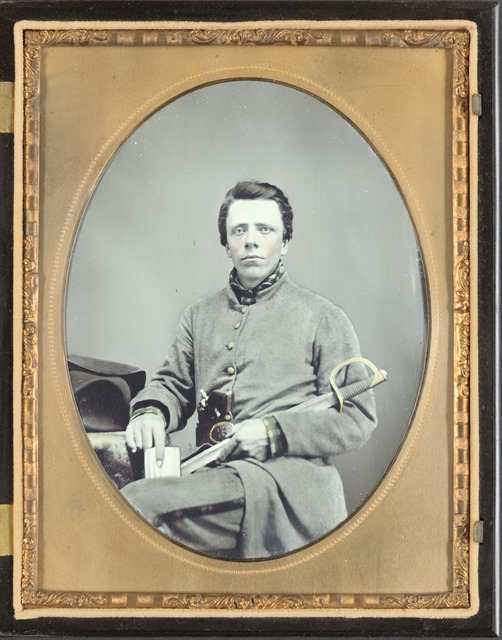
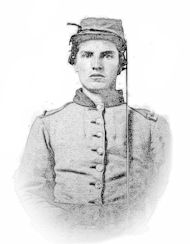
Private W.R. Clack of Co. B, 43rd Tennessee Infantry Regiment On May 10, 1863, Private Clack is on picket or fortification duty near Big Black River in Mississippi, outside of the Vicksburg fortifications.

__________

Private W.R. Clack of Co. B, 43rd Tennessee Infantry Regiment, with saber, pistol, and small book. half-plate ambrotype, hand-colored ; 15.7 x 12.7 cm (case) Donated by Tom Liljenquist; 2012 Liljenquist Family Collection of Civil War Photographs; Ambrotype/Tintype photograph filing series; Library of Congress Prints and Photographs Division. Record page for image is here.

______________

digital file from original itemNote: This image has been digitally enhanced for fade correction, color enhancement and selected spot removal. Civil War Portrait 030

May 13, Wednesday. The last arrival from England brings Earl Russell’s speech on American affairs. Its tone and views are less offensive than some things we have had, and manifest a dawning realization of what must follow if England persists in her unfriendly policy. In his speech, Earl R., in some remarks relative to the opinions of the law officers of the Crown on the subject of mails captured on blockade-runners, adroitly quotes the letter of Seward to me on the 31st of October, and announces that to be the policy of the United States Government, and the regulation which governs our naval officers. It is not the English policy, nor a regulation which they adopt, reciprocate, or respect, but the tame, flat concession of the Secretary of State, made without authority or law. The statement of Earl R. is not correct. No such orders as he represents have issued from the Navy Department. Not a naval officer or district attorney has ever been instructed to surrender the mails as stated, nor is there a court in the United States which would regard such instructions, if given, as good law. It is nothing more nor less than an attempted abandonment, an ignominious surrender, of our undoubted legal rights by a Secretary of State who knew not what he was about. The President may, under the influence of Mr. Seward, commit himself to this inconsiderate and illegal proceeding and direct such instructions to be issued, but if so, the act shall be his, not mine, and he will find it an unhappy error.

But Seward has been complimented in Parliament for giving away to our worst enemy his country’s rights, —for an impertinent and improper intermeddling, or attempt to intermeddle, with and direct the action of another Department, and the incense which he has received will tickle his vanity.

Sumner tells me of a queer interview he had with Seward. The first part of the conversation was harmonious and related chiefly to the shrewd and cautious policy and management of the British Ministry, who carefully referred all complex questions to the law officers of Her Majesty’s Government. It might have been a hint to Seward to be more prudent and considerate, and to take legal advice instead of pushing on, wordy and slovenly, as is sometimes done. Allusion was made to Mr. Adams and his unfortunate letter to Zerman.[1] Our Minister, Mr. Adams, was spoken of as too reserved and retiring for his own and the general good. Sumner said, in justification and by way of excuse for him, that it would be pleasanter and happier for him if he had a Secretary of Legation whose deportment, manner, and social position were different, — if he were more affable and courteous, in short more of a gentleman, — for he could in that case make up for some of Mr. A.’s deficiencies. At this point Seward flew into a passion, and, in a high key, told Sumner he knew nothing of political (meaning party) claims and services, and accused him of a design to cut the throat of Charley Wilson, the Secretary of Legation at London. Sumner wholly disclaimed any such design or any personal knowledge of the man, but said he had been informed, and had no doubt of the fact, that it was the daily practice of Wilson to go to Morley’s, seat himself in a conspicuous place, throw his legs upon the table, and, in coarse language, abuse England and the English. Whatever might be our grievances and wrong, this, Sumner thought, was not a happy method of correcting them, nor would such conduct on the part of the second officer of the Legation bring about kinder feelings or a better state of things, whereas a true gentleman could by suavity and dignity in such a position win respect, strengthen his principal, and benefit the country. These remarks only made Seward more violent, and louder in his declarations that Charley Wilson was a clever fellow and should be sustained.

I read to Attorney-General Bates the letters and papers in relation to mails on captured vessels, of which he had some previous knowledge. He complimented my letters and argument, and said my position was impregnable and the Secretary of State wholly and utterly wrong.

Mr. Seward sent me to-day a letter from Lord Lyons concerning the Mont Blanc and the Dolphin, and wished me to name some person at Key West to arbitrate on the former case, the vessel having been restored and the parties wanting damages. I named Admiral Bailey for this naval duty, but took occasion to reiterate views I have heretofore expressed, and especially in my letter yesterday that these matters belonged to the courts and not to the Departments.

Hear of no new move by Hooker. I am apprehensive our loss in killed and prisoners was much greater in the late battle than has been supposed.

_____________________

[1] Zerman was a Mexican in partnership with Howell, an American. The firm fitted out a vessel to trade with Matamoras. Mr. Adams, being satisfied of their good faith, gave them assurances of immunity from interference on the part of the United States Navy, and this discrimination against Englishmen engaged ostensibly in the same trade, was sharply criticized in the British Parliament.