Sketched on the afternoon of Gen Hookers retreat across the Rappahannock May 6th 1863.
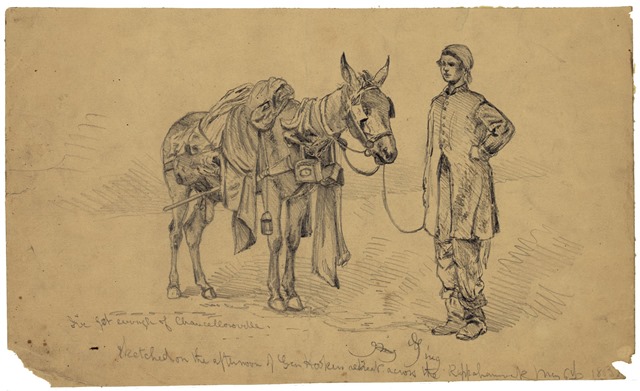
Library of Congress image.
Info on Library of Congress page:
Title: Just from Chancellorsville. An amateur quartermaster
Artist: Edwin Forbes.
Sketched on the afternoon of Gen Hookers retreat across the Rappahannock May 6th 1863.
Library of Congress image.
Info on Library of Congress page:
Title: Just from Chancellorsville. An amateur quartermaster
Artist: Edwin Forbes.
May 6.—The army of the Potomac, under the command of Major-General Hooker, was withdrawn from Fredericksburgh to the north bank of the Rappahannock River. General Hooker issued an address to the army, congratulating them on their achievements during the last seven days.—Alexandria, Miss., was occupied without resistance by the National forces under the command of Admiral D. D. Porter (Doc 187.)
—A fight took place between a National force under the command of Colonel Cornyn, encamped near Tupelo, Miss., and a body of rebel cavalry under General Ruggles, terminating, after a desperate conflict of half an hour’s duration, in the flight of the latter, leaving behind them a great number of arms, equipments, and ninety of their number as prisoners.
—The steamer Eugenia was captured by the gunboat R. R. Cuyler, off Mobile, Ala.—Disloyal citizens were sent South from Nashville, Tenn. Among them was Neill S. Brown, formerly Governor of that State.
The next morning, May 1st, we marched forward to Chancellorsville, where there was a small opening in the woods, and immediately began to manœuvre. Instead of giving an account of the movements of the troops myself, I shall here insert the official report of the general himself, which covers the whole ground, and is not to be found in any other publication.

Headquarters Third Brigade, Hancock’s Division, Second Corps,
Camp Near Falmouth, Va., May 12, 1863.
To Major John Hancock, A. A. G.
Major: I have the honor to submit the following report of the part taken by this brigade in the recent operations of the army of the Potomac.
On the 28th ult, we broke camp. On the evening of the 30th we crossed the Rappahannock at United States ford and bivouacked that night near Chancellorsville.
At noon on the 1st inst., the brigade marched out over the Fredericksburg and Gordonsville pike to a hill, in the direction of Fredericksburg, about a mile from the Chancellorsville house, where it was formed in two lines to the right of the road and the first brigade.
The Sixty-sixth New York and One Hundred and Fortieth Pennsylvana formed the first line and the Fifty-seventh and Fifty-second New York the second. Skirmishers were thrown out from the first line with instructions to remain under cover of the woods out of the enemy’s view. Subsequently Major Scott, of the division staff, in the name of the general, required of me a regiment to support the skirmish line, which he himself undertook to post. The Fifty-second New York were assigned to the performance of this duty, and by some mistake was deployed in full view of the enemy and within easy range of his batteries. Of course, the enemy opened fire upon the regiment with his artillery and advanced his infantry against it with such effect that twenty-four enlisted men out of one hundred and twenty-four, the total of the regiment, were killed or wounded without accomplishing any possible good.
Some time later I received orders to fall back with the brigade two hundred yards and await orders, which, however, were soon given, to hasten out of the woods, march rapidly towards the Chancellorsville House and re-form line of battle.
The line was formed in the best position the ground afforded, with one battery in front and another in rear. The fire of the latter injured one officer and several men of the One Hundred and Fortieth Pennsylvania by premature shell explosion.
After the repulse of the enemy, the brigade again advanced over the road by which it had just retired, and took position to its left at the foot of the ridge recently abandoned, forming a second line to the First brigade, General Caldwell’s. It remained here until 3 A.M. of the 2d, when it was again withdrawn to the Chancellorsville House. The enemy had shelled the position ineffectually during the early part of the night.
At sunrise the Fifty-seventh New York was detailed to picket near the ground just vacated by our lines. During the day it was frequently and determinedly attacked, but resisted successfully, killing and wounding many of the enemy. In the course of the morning a part of the Fifty-second was sent to its assistance, and, of course, shared the fighting and honor.
The remainder of the brigade at the same time marched towards the place of our first night’s bivouac to occupy a crest looking towards Fredericksburg, which they subsequently strengthened by rifle pits. At 10 A. M. the Sixty-sixth New York was detached to report to General Caldwell, and later in the day what remained of the Fifty-second was sent him also.
A battery enfilading my position threw a few shells about sunset, but fortunately without injury to the command. At 9 P. M. the Sixty-sixth and two companies of the One Hundred and Fortieth relieved the Fifty-seventh and the part of the Fifty-second which was on picket, the latter falling back to the rifle pits vacated by the Sixty-sixth on General Caldwell’s line. These pickets experienced severe fighting and considerable loss next day, especially when ordered to fall back.
On the morning of the 3d, some regiments having been withdrawn from the rifle pits on my right, the One Hundred and Fortieth was moved in that direction to maintain connection with those which remained. In this new position the regiment lost some men, killed and wounded by the enemy’s artillery. Lieutenant John Paden, Fifty-seventh New York, acting aide-de-camp, was wounded in the shoulder by a piece of shell at this place.
Subsequently the One Hundred and Fortieth was moved to the support of a battery on the right of the Chancellorsville House, the Fifth Maine.
Half an hour after taking this position the house caught fire. Being filled with our wounded, a company of the One Hundred and Fortieth was ordered to assist in their removal, which duty was well performed under very severe fire.
Another detail of forty men was made to bring off the guns of the battery above named, which had lost all its officers and nearly all its men and horses. This detail first drove two caissons into the woods out of the enemy’s sight and then returned and removed two guns to the same position. It was then and there they first saw men of any other brigade.
Some men of the Second brigade assisted part of the detail to bring off their guns, whilst the remainder went back for the other three, which they found some men of the Second and Fourth brigades endeavoring to remove. Lieutenant Linton, of the One Hundred and Fortieth, in charge of the detail, ordered some of his men to assist with each gun until they reached a place of safety, which was done.
The gun detail and that for the removal of the wounded necessarily left their arms with the regiment, which moved away in obedience to orders during their absence. In this way some rifles were lost, although many of the men and some of the officers carried off quite an arm load of pieces; conspicuous amongst the latter was Lieutenant Stokes, who abandoned his rations, blankets, etc., for the purpose.
On arriving upon the field near the White house, in rear of Chancellorsville, I found the other regiments of the brigade, the Fifty-second and Fifty-seventh, which had been operating under General Caldwell, as he informed me, with great credit, and the Sixty-sixth returned from picket.
These with the One Hundred and Fortieth were formed in line, in rear of General Caldwell’s brigade, in the new position of the left of the Third corps, where we remained until our withdrawal to the north bank of the river.
I am happy to express entire satisfaction with the conduct of my command and to return my thanks to Captain Rose and Lieutenants Favill, Broom, and Paden of my staff for their efficient assistance.
I am, Major,
Very respectfully, Your obedient servant,
S. K. Zook, Brigadier-General.

General Zook’s report was not forwarded to the War Department, as is usual, on account of the reference to Major Scott, which General Hancock deemed a reflection upon that officer, and as Zook stubbornly refused to change it, General Hancock sent it back again, and I have it now in my possession.
I was ordered to superintendent the dispositions of the Sixty-sixth and Fifty-second New York and rode with them to the edge of the woods, which was skirted by a little stream; on the other side of it the ground rose abruptly, forming a very steep hill, evidently commanding the ground occupied by our troops, the Chancellor house included. There was nothing in sight when we posted the skirmish line on the edge of the little stream; but as soon as this was done, Major Scott came along and ordered the line to advance to the crest of the hill over the open ground. They had hardly gone fifty yards when a heavy line of the enemy’s skirmishers came sweeping over the crest, directly in front, and upon seeing us immediately opened fire, to which we replied with so much spirit that they were compelled to halt, but in a few minutes a line of battle advanced to their support and obliged us to hastily fall back under cover of the woods, losing several men. As soon as the men crossed the stream, they were ordered to fall back slowly, contesting the woods as stubbornly as possible, while I rode back to the general to advise him of the situation. By this time the enemy had planted guns on the high ground we had just seen, and the woods I rode through were alive with bursting shells. Branches were torn off, and sometimes entire tops of trees came tumbling down. I managed to keep a fairly straight course in the thick wood, and soon ran into the general and his command, formed in two lines of battle, and it was only a short time before the rebel line came in sight and immediately opened fire. It is impossible to describe the tremendous noise made by the firing of so many thousands of men in heavy woods; the sound cannot get away easily, and so makes a continuous roar, while the smoke quickly obscures the ground between the contending forces, always leading to more or less uncertainty and requiring infinite skill and judgment on the part of commanding officers to conduct matters successfully.
In the course of the day, the rebel general Jackson moved swiftly across our front and swooped down upon our extreme right, held by General Howard, with the Eleventh corps of Dutchmen. Howard’s men had stacked arms and were playing cards and loitering about without any thought of danger, when the enemy sailed right into them, driving them like flocks of sheep. Our lines were so close together that the flying Dutchmen came in streams right up to our lines, and deaf to all entreaties many of them actually ran right across into the arms of the very men they were trying to avoid. It was really ludicrous. At last we faced about and drove them towards the ford. The line abandoned by the Eleventh corps was speedily re-established by fresh troops and Jackson’s advance repelled, in the doing of which the enemy sustained the loss of their renowned general, and thus their actual loss greatly exceeded ours. Stonewall Jackson has made the greatest reputation of any officer in either army thus far in the war, and we ourselves could not help feeling sorry for the loss of so brilliant a genius.
One of the sad scenes on the field when the Eleventh corps were in disorder was that of a man being led out of the fight with both his eyes laying out on his cheeks suspended by ligaments. A musket ball had traversed the rear of both eyes, forcing them out of their sockets; he passed close to me and I noticed he was able to talk. I thought it the most pitiable case I had ever seen. While standing amongst a group of officers a Whitworth solid shot came along, almost spent apparently; it was ricochetting over the ground, turning end on end, and seemed to be going so slowly that without thinking I put out my foot to stop it, when some one suddenly jerked me backwards; the ball struck an ambulance wheel a little behind us and smashed it all to pieces, the moral of which is never try to stop a cannon ball.
The scene about the Chancellor house at ten o’clock of the 3d beggars description. The open ground was covered with batteries; many of them had lost all their horses. A converging fire of the enemy’s guns from front, right, and left swept the ground; round shot and shell filled the air about us, and confusion reigned supreme. When the general and I rode up, after we had withdrawn the troops in rear of the road and house, we found the porch of the house full of officers; amongst them General Hooker himself, leaning against one of the pillars, apparently bewildered. A few moments after our arrival, the house took fire from a bursting shell. It was filled with wounded men who were safely removed by willing volunteers. In the midst of the tremendous noises of exploding shells and cracklin fire a couple of women rushed out of the building and fled to the rear, watched by thousands of men, not one of whom was not ready to sacrifice his own life to aid them in their flight for safety. As the general describes in his report, the final effort to remove the guns by hand and reform the line in rear of the house, I shall leave the matter here, only giving my opinion that the whole battle was mismanaged from beginning to end. If we had advanced in the direction of Fredericksburg and taken position on the open commanding ground, where all the troops could have been fought to advantage and our artillery used effectively, the result would have been very different.
While establishing the line in rear of the Chancellor House General Hancock, followed by his staff and General Zook and his staff, rode over the ground at the angle on the left down quite a declevity, where a rebel battery had the exact range. Shells flew all around and about us. One of them struck General Zook’s horse in the neck and carried away a piece weighing several pounds. The general was obliged to take an orderly’s horse, but very singularly his own horse lived for some time afterwards. It was interesting to see General Hancock ride along amidst this rain of shells utterly indifferent, not even ducking his head when one came close to him, which is a difficult thing to do, for one seems to do it involuntarily. General Hancock is in his element and at his best in the midst of a fight, which cannot be said of some of the general officers.
During the time we were on the south side of the river, our staff was without supplies and depended upon the orderlies and men for whatever we had to eat. At night we sat against a tree on our saddles, without fires and vainly endeavored to go to sleep or get into a comfortable position. It rained a good deal of the time, making matters much worse, but the three days passed and none of us was much the worse for our experience. The fact is, we are so tough and inured to exposure that we can stand anything. In the last position the men not employed dug holes in the sandy soil to escape the enemy’s shells, forming a gigantic rabbit warren. They protected themselves so well we had but few casualties.
Remained in this last position made impregnable by the industry of the troops until the night of the 5th, when we were ordered to recross the river and return to our winter quarters. Owing to the continued rainfall of the last two days all hands were liberally covered with mud and mighty glad to get out of the rain-soaked woods. The enemy had suffered too much in their frequent attempts to carry our lines to interfere with our movements in recrossing the river.
While we were engaged at Chancellorsville, Stoneman with the cavalry corps, made a diversion in the enemy’s rear by riding entirely around Lee’s army, to Richmond. He destroyed the Virginia Central Railroad from Gordonsville eastward, all the railroad equipment, cars, depots, telegraph, etc., for twenty miles or more; destroyed the Aquia and Richmond Railroad; all public and private stores they fell in with, and captured and took away mules, horses, and slaves in vast numbers. They went close to Richmond, causing the greatest consternation. The failure of so brilliant an opening on the part of the army of the Potomac is a great disappointment to us. General Hooker’s plans were excellent. Sedgwick, who crossed at Fredericksburg, was successful, and had we been properly handled and advanced towards that point on open ground, we might have gained a great victory, but we lacked the leader and are again looking for some one worthy of the army whose energies no defeat can tame.
by John Beauchamp Jones
MAY 6TH.—The excitement has subsided, as troops come pouring in, and many improvised cavalry companies go out in quest of the fox—who has vanished we know not exactly whither.
It is believed we have taken 15,000 or 20,000 prisoners, and that the enemy’s killed, wounded, and prisoners must reach the appalling number of 40,000.
On Sunday, the enemy opposite Fredericksburg sent over a flag, asking permission to bury their dead. This was granted. But when they came—two corps under Gen. Sedgwick came over and fell upon our few regiments in the vicinity. So goes the story. Then, it is said, when Gen. Lee ordered two of our divisions to drive Sedgwick back, the men, learning the enemy with the flag of truce had given no quarter to their comrades, refused to fight unless permitted to retaliate in kind. This was promised them; and then their charge was irresistible, never pausing until the Yankees were hurled back across the river. No prisoners were taken. However this may be, Gen. Lee sends the following to the President:
[Received by telegraph from Guiney’s Depot.]
“HEADQUARTERS, 10 o’clock A M.,
“May 5, 1863.
“To HIS EXCELLENCY, PRESIDENT DAVIS.
“At the close of the battle of Chancellorville, on Sunday, the enemy was reported advancing from Fredericksburg in our rear.
“Gen. McLaws was sent back to arrest his progress, and repulsed him handsomely that afternoon. Learning that this force consisted of two corps, under Gen. Sedgwick, I determined to attack it, and marched back yesterday with Gen. Anderson, and uniting with Gens. McLaws and Early in the afternoon, succeeded by the blessing of Heaven in driving [click to continue…]
Tuesday, 5th—Came to Gifford’s blacksmith shop. Albright had swapped horses, had two shoes put on, got dinner and came on to Joe Carter’s. A. had two more shoes put on, went on to Griggs and got supper. A. and Maze of Petticord’s Company came on. We came four miles to Joe Sullivan’s; left A. there. I and Maze went over to Jordan Carr’s. Yanks all through here yesterday.
May 5th. Commences with a sky overcast and cloudy, and thunder and lightning, precursors of a storm; finished repairing Albatross’s wheel broken in action of 4th inst.; at three A. M., at daylight, sent a party on shore to dig a grave; at five fifteen sent the body of Mr. Hamilton, pilot, on shore, in charge of Lieut. Watson, for interment; the grave was dug on the left bank of the river, a short distance below Col. Ackelon’s house; at eight A. M., got under way, and steamed down the river, Albatross and Sachem in company with us; at eleven o’clock saw a flat boat ahead crossing the river opposite Bayou Sara, having two hogsheads of sugar on board; called one gun’s crew to quarters, and fired the Sawyer rifle on forecastle ahead of same to bring it to, and sent the second cutter in charge of an officer and an armed crew to take it in tow; took her in tow, and brought her alongside of us and made her fast: received a white man and boy, and several negroes, prisoners from off the scow, on board; at eleven forty-five called all hands to bring ship to anchor; at twelve, noon, came to anchor five miles above Port Hudson; at one P. M., the Albatross and Sachem engaged shelling the woods on the point opposite Port Hudson, and in burning two frame buildings used by rebel pickets. Making signals from masthead to U. S. sloop-of-war Richmond, and receiving answers from her to same; paroled the two white prisoners; received no mail this time from lower fleet.
Tuesday, 5th.—Reported great victory in Virginia; also that General Forrest had captured 1,600 prisoners near Rome, Ga. Moved one and one-half miles.
Near Black River, Tuesday, May 5. A fine day. Health good. Lay quiet all the morning until 2 P. M. Orders came to hitch up a howitzer and a rifle piece; first and third pieces made ready and fell in with 5th and 10th Iowa Infantry and four companies of cavalry on a reeonnoitering expedition. Colonel Boomer in charge. Waited three quarters of an hour at the river to finish the bridge, when the cavalry crossed and started on, the bridge consisting of three flat-boats tied together endways, which reached across. Passed through a half mile of very swampy bottom, then came into an open country with fine plantations. Marched briskly on the road to Vicksburg, about four miles, then rested. General McPherson passed to the front and returned in about an hour, ordering us to retrace our steps as soon as possible as there was much need of us there and the roads were bad. Returned on full trot and came into camp a little after dark.
Tuesday, 5th—The Fourth Iowa Cavalry passed here this morning. It is a fine regiment of horse. Four hundred and forty-four rebel prisoners captured at Grand Gulf were taken by here this morning to be sent to our prisons in the North; they are a hard-looking set of men. News came today that our men have taken Grand Gulf with two thousand prisoners. If this is true it gives us a road to Vicksburg over high ground, which means the fall of Vicksburg.
May 5.—I had quite a treat to-day— have been with a party, horseback riding, to the top of Lookout Mountain. I do not know how many feet its elevation is, but the road we took was four miles from the base. It is a made one, and many parts of it is cut out of solid rock; some portions are very narrow, and it made me quite nervous and giddy to look back.
“Now wound the path its dizzy ledge
Around a precipice’s ledge;
Sometimes in dizzy steps ascending,
Sometimes in narrow circuit bending,
Sometimes in platform broad extending,
Its varying circuit did combine.”
When we reached the summit, the view from it was really entrancing.
We sat on the Point of Rocks, which is the furtherest point of the mountain, under the shade of some magnificent trees. The scene presented below was one of the most beautiful pictures I ever beheld. The Tennessee River, with its various windings, made the plain beneath look like many islands, on which were
“Deep waving fields and pastures green,
With gentle slopes and groves between.”
We sat for some time in perfect silence; I was completely awed; I thought of our Savior when he preached his memorable “sermon on the mount.” I am afraid we have not profited much by it, or we would not be as we are now.
I am told that on a clear day, with a good glass, seven states can be seen from the top of this mountain.
As we came down, a Mr. Chandler, who was with us, took us to a natural stone bridge, which was about a hundred feet high. A very fine spring of water gushed from the side of the rocks forming this bridge, making a perfect waterfall. The whole scene was like fairy land. I do not think that Switzerland or Scotland has any finer scenes than we have here. Had this country only poets to sing her beauties, I have no doubt they would be as famous as any in the old world.
 Follow on facebook
 RSS
RSS email
email