Following the American Civil War Sesquicentennial with day by day writings of the time, currently 1863.

May 2013

5th May (Tuesday).—We breakfasted at Huntsville at 5.30 A.M. The Federal officers captured in the Harriet Lane are confined in the penitentiary there, and are not treated as prisoners of war. This seems to be the system now with regard to officers since the enlistment of negroes by the Northerners.

My fellow-travellers were mostly elderly planters or legislators, and there was one judge from Louisiana. One of them produced a pair of boots which had cost him $100; another showed me a common wideawake hat which had cost him $40. In Houston, I myself saw an English regulation infantry sword exposed for sale for $225 (£45).

As the military element did not predominate, my companions united in speaking with horror of the depredations committed in this part of the country by their own troops on a line of march.

We passed through a well-wooded country—pines and post oaks—the road bad: crossed the river Trinity at 12 noon, and dined at the house of a disreputable looking individual called a Campbellite minister, at 4.30 P.m. The food consisted almost invariably of bacon, corn bread, and buttermilk: a meal costing a dollar.

Arrived at Crockett at 9.30 P.m., where we halted for a few hours. A filthy bed was given to the Louisianian Judge and myself. The Judge, following my example, took to it boots and all, remarking, as he did so, to the attendant negro, that “they were a d—d sight cleaner than the bed.”

Before reaching Crockett, we passed through the encampment of Phillipps’s regiment of Texas Rangers, and we underwent much chaff. They were en route to resist Banks.
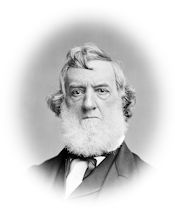
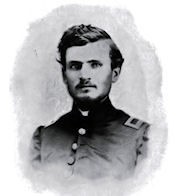
May 5, Tuesday. But little of importance at the Cabinet. The President read a brief telegram which he got last evening from General Hooker, to whom, getting nothing from the War Department, he had applied direct to ascertain whether the Rebels were in possession of the works on the heights of Fredericksburg. Hooker replied he believed it was true, but if so it was of no importance. This reply communicates nothing of operations, but the tone and whole thing — even its brevity — inspire right feelings. It is strange, however, that no reliable intelligence reaches us from the army of what it is doing, or not doing. This fact itself forebodes no good.

Sumner came in this afternoon and read to me from two or three documents — one the late speech of the Solicitor of the Treasury in the British Parliament on the matter of prize and prize courts — which are particularly favorable to our views in the Peterhoff case. From this we got on to the absorbing topic of the army under Hooker. Sumner is hopeful, and if he did not inspire me with his confidence, I was made glad by his faith. The President came in while we were discussing the subject, and, as is his way, at once earnestly participated. His suggestions and inferences struck me as probable, hopeful, nothing more. Like the rest of us, he wants facts; without them we have only surmises and surmises indicate doubt, uncertainty. He is not informed of occurrences as he should be, but is in the dark, with no official data, which confirms me in the belief that the War Department is in ignorance, for they would not withhold favorable intelligence from him, yet it is strange, very strange. In the absence of news the President strives to feel encouraged and to inspire others, but I can perceive he has doubts and misgivings, though he does not express them. Like my own, perhaps, his fears are the result of absence of facts, rather than from any information received.

5th. Rode into camp bright and early. Made a tent again and got some coffee. Cloudy and dark. Got dinner at a wealthy planter’s. We were all disgusted, so much superficiality. So little soul or mind. Marched towards the river. Ordered back to Somerset. Various reasons given. Many speculations. Got rations after stopping for night. Went two and a half miles and dealt with drunken Lt. Was angry and threatened him.

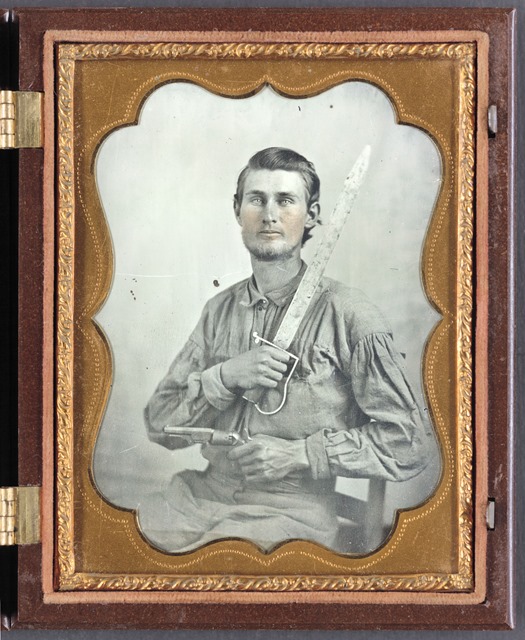
Private Simeon J. Crews of Co. F, 7th Texas Cavalry Regiment, with cut down saber and revolver


Private Simeon J. Crews of Co. F, 7th Texas Cavalry Regiment, with cut down saber and revolver

Medium: 1 photograph : quarter-plate ambrotype, hand-colored ; 12.4 x 10.1 cm (case)

Donated by Tom Liljenquist; 2012

Liljenquist Family Collection of Civil War Photographs; Ambrotype/Tintype photograph filing series; Library of Congress Prints and Photographs Division.

Record page for image is here.

_______

Note: image may be reversed – image at Find A Grave shows image with pistol in right hand vice left.

Civil War Portrait 025

MAY 5TH.–We were annoyed some little through the night, by the rebels firing, but they didn’t hit anybody. Two regiments of infantry with some cavalry crossed the river for a little scout. I do not think there are many rebels over there, but what few there are, ought to be whipped. They will have to fall back at the approach of our men, but that is easily done, and, when our forces return, they will be right back firing from behind the trees.

The army is marching on around Vicksburg, and we are very anxious to take our place in this grand column. We are quite tired of the duties assigned us here, and have had orders to move several times, which were as often countermanded.

Had chicken for dinner. Uncle Sam doesn’t furnish chickens in his bill of fare, but they will get into the camp kettle. We have to be very saving of the regular rations, consequently must look outside for extras—chickens, ham, sweet potatoes, etc., all taste good. I walked down the river a short distance, viewing the scenery, when a bullet flew through the trees not far from my head. I looked across the river from whence it came, but could not see anybody. Did not stay there long, but got back to camp, where I felt safer.

Our camp is in the bottom, close to the river bank. The enemy at Grand Gulf spiked their cannon and retreated to Vicksburg. If that place could not be taken by the gun-boats on the river in front, the infantry marching in their rear made them hustle out in a hurry. When the people in Vicksburg see their retreating troops returning to the town they went out to protect, they will think Grant’s marching around them means something.

While writing a few letters to-day I was amused to notice the various attitudes taken by the boys while writing. One wrote on a drum-head, another on his cartridge-box; one used a board and several wrote on the top of a battery caisson. These letters would be more highly appreciated by the recipients if the circumstances under which they were prepared were realized.

Tuesday, May 5th. Yesterday evening there were heavy clouds and a good deal of lightning in the North; after supper laid down on the deck and slept very comfortable until awakened by a heavy rain; gathered up my blanket and crowded into the state room, which proved to be almost suffocating. I was very sleepy, so went down in the engine room and slept until morning, crosswise on two barrels of rum; waked up quite refreshed to enjoy the beautiful scenery on the banks of the Ouachita, among the most picturesque of which was a high bluff on which was a single grave; a romantic lady, the wife of a pilot, was buried there by her request, where her gentle spirit might keep vigil over the destinies of her husband. We stopped during the morning to take an old rail fence for fuel; a soldier shot a hog, which gave us fresh pork for dinner; found some very nice mulberries on shore and wished my children, little Stark and Mary, had some of them. Had a very pleasant trip on to Hamburg; went ashore there and got transportation to Trinity; after supper proceeded down to the river and met the steamer, Tucker; stopped and had a talk and got the Natchez Courier.

Forgot to say above that I met Dr. Bock on this steamer; learned from him that Lieutenant Brandon was at Pine Bluff on the 8th of April, and was going to Virginia. Dr. Rock is on his way to Richmond. We reached Trinity about 12 o’clock at night, on Tuesday, the 5th, and have not stopped long enough during the day to write up this diary, and at night had no light; left the Trinity in a skiff with five others; proceeded up the Ouachita for about six miles; then into Brushy Bayou; after following this for about two miles the thorns and bushes were so troublesome that we had to get to land and walk about four miles, while the negroes worked the skiff through. In this walk I got far enough ahead of the skiff to take a nap; laid down on the ground and slept gloriously for an hour; would have enjoyed it more with a blanket to lie on. At the end of this walk we had a very good breakfast by paying five dollars a dozen for some eggs and furnishing our own coffee, and then paying two dollars a piece for breakfast. After breakfast pulled the skiff overland into Cane Bayou, and proceeded up this for six miles to Turtle Lake, a beautiful sheet of water three miles long; from this we entered Cocoda Bayou, which we followed for eight miles into Concordia Lake, up which we rowed for seven or eight miles, which landed us about three miles from Natchez. All this skiff trip is through just such a country as an alligator would thrive in; affording fine facilities for fishing and duck shooting; no one but a Newfoundland dog would enjoy it. We procured a cart to take our baggage to the Mississippi river; crossed in a skiff to Natchez; remained there all night and left Thursday morning for Brookhaven; stopped at Dr. Holden’s and got the second good dinner I have had since I left home; reached McDaniel’s at dark and found it quite a nice place, and met here that rare creature of the West—an old maid; she seems to be quite a nice person and I think has been doomed to this state of single felicity by circumstances for which she is not responsible. We got a good breakfast at 4 o’clock in the morning, which enabled us to reach Brockhaven (where I am now writing) by 10 o’clock. On the road to this place I passed a bridge which Grierson’s Cavalry had destroyed, and here I see the remains of the depot which they burned. These are the first practical examples of Yankee vandalism I have seen during the war. I expect to leave here to-day at 2 o’clock.

Reached Jackson at 6 o’clock and found the train for Meridian about to start and had no time to get transportation, and so have to remain here against my will until to-morrow evening. All these days which I have been delayed I had hoped to spend in Columbia, South Carolina.

May 5. — The whole of Sedgwick’s corps got across by 4 A.M., the enemy shelling at random, but not injuring any one. The night was dark and foggy, and favorable for taking up the bridges, which were swung round dismantled during the mist, the boats being drawn up the ravines under cover. During the day the enemy shelled us, throwing some shells over two miles. In the afternoon we started for United States Ford, having sent our wagons back to headquarters. We reached the ford at about 3.30 o’clock, and I was sent forward in a pouring rain to General Hooker, whom I found 3 miles out. He said that General Benham might return to camp. We found that the whole army was going to retreat during the night. On the way up, we passed all the wagon trains of the army on their way to Potomac Creek. We left United States Ford at 5 o’clock, and I went ahead. On arriving at the railroad, I found the creek so swollen that it could not be forded, so I went back to Falmouth, and spent the night with John Perry.

On the Old Camp Ground.

May 5. This morning we pitched our tents once more on Camp Oliver. This seems like home again. We shall now have little else than guard duty to perform, keep ourselves slicked up and do the town. This is what we call being on waiting orders, but as the colonel has not had a hack at us lately, I presume he will want to practice some new evolutions he has been studying up out of the tactics. At any rate, we shall not long remain idle.

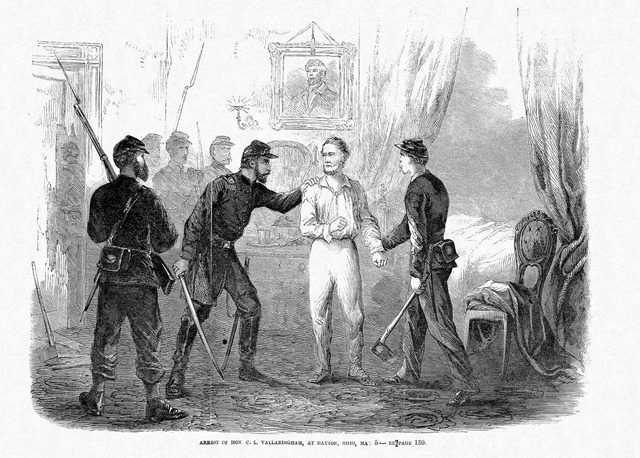
IMPORTANT ARREST.; Hon. Clement L. Vallandigham Apprehended —The Fire Bells at Dayton Rung, and an Attempt Made to Rescue Him. —RIOTING BY A DISLOYAL MOB.

CINCINNATI, Tuesday, May 5.  (NY Times)

Hon. CLEMENT L. VALLANDIGHAM was arrested at his residence at Dayton, Ohio, this morning, by a detachment of soldiers, who went up from Cincinnati by a special train last night.

The soldiers were obliged to batter down two or three doors of his house before they could reach his room and take him.

His friends rang the fire-bells and called out the people, when an attempt was made to rescue him, but it failed.

He was brought to this city.

CINCINNATI, Tuesday, May 5 — P.M.

A disloyal mob has cut all the telegraph wires in Dayton, and set the Journal office on fire. It is feared that the Philips house will be fired. The telegraph office has been closed, for fear of being gutted by the rioters.

arrest of Vallandigham


Arrest of Vallandigham from May 23, 1863 issue of Frank Leslie’s Illustrated Newspaper.

by John Beauchamp Jones

MAY 5TH.—To-day the excitement was quite as great as ever, for bodies of the enemy are still in the vicinity. They are like frightened quails when the hawks are after them, skurrying about the country in battalions and regiments. Fitzhugh Lee defeated one of their parties, and reports that the entire calvary force of Hooker, in anticipation of certain victory, had been detached in the rear of Lee’s army. This force comprises twenty-eight regiments, or 15,000 mounted men! Now that Hooker is defeated—our operator at Guiney’s station dispatches to-day that it is reported there, and believed, that Hooker and his staff are prisoners—it may be reasonably doubted whether one-half of this wild cavalry will escape. It was the mad pranks of a desperate commander. Hooker cast all upon the hazard of the die—and lost.

Among the mad pranks of the enemy, they sent a message over the wires to-day from LouisaCounty, I believe, to this purport: ” For Heaven’s sake, come and take us. We are broken down, and will surrender.”

They captured an engine sent out yesterday to repair the road. The white men escaped, leaving two free negroes. The Yankees made the negroes put on a full head of steam, and run the locomotive into the river.

One of the enemy was taken sleeping at one of our city batteries near the river.

My friend, Dr. Powell, on the Brooke Turnpike, sent his little son, mounted on his finest horse, on an errand to a neighbor. The lad fell in with, as he called them, “some Yankee Dutchmen,” who presented their pistols and made him dismount. They took his horse and allowed him to return.

At the hour we were dining yesterday, the enemy were within two and a half miles of us on the Brooke road, and might have thrown shell into this part of the city. [click to continue…]