Saturday, May 2nd. Was told by S. N. Brogdon, on the stage, that my old college classmate, Loudon Butler, was Captain of Company B, Nineteenth Louisiana regiment. Left Shreveport this morning at daylight and came through a very rich and pretty country for twenty-five or thirty miles; nearly all planted in corn; passed Mrs. Butler’s plantation and heard of Loudon; he is in Mobile. Came to Minden by dark and inquired for Mr. Bayliss, formerly pastor of the First Baptist church at Waco, Texas, and learned that he had left a day or two before for the army; came on after dark to stage stand ten miles east of Minden. There I met gentlemen just from Natchez, who told me that my former companions, Lieutenant Selman, Burwell Aycock and Coella Mullens were on the other side of the river.
May 2013
May 2. — General Reynolds’s corps moved up to-day from the left to United States Ford. Captain Lubey came here in the evening. He said that the canvas pontoon train was used at Kelly’s Ford, where three corps crossed on it. General Benham sent me to General Hunt,[1] to ascertain whether he considered himself in command here. General Hunt said that he did. There was heavy firing on the right in the evening, which turned out to be the enemy attacking the Eleventh Corps, which ran disgracefully.[2] Day was pleasant, and in the night we had the moon, which is now almost full. General B. spoke to me again about the occurrences of April 28 and 29, and I had to tell him my opinion again. Captains Strang and Nares were here to-day.
[1] General Hunt was Chief of the Artillery.
[2] May 2 was the second day of the battle of Chancellorsville.
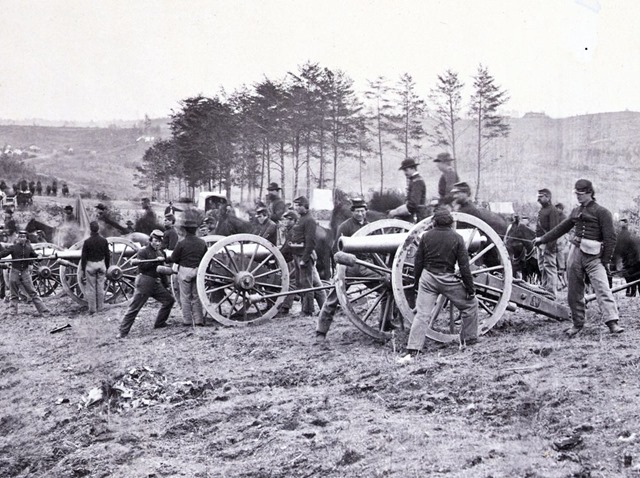
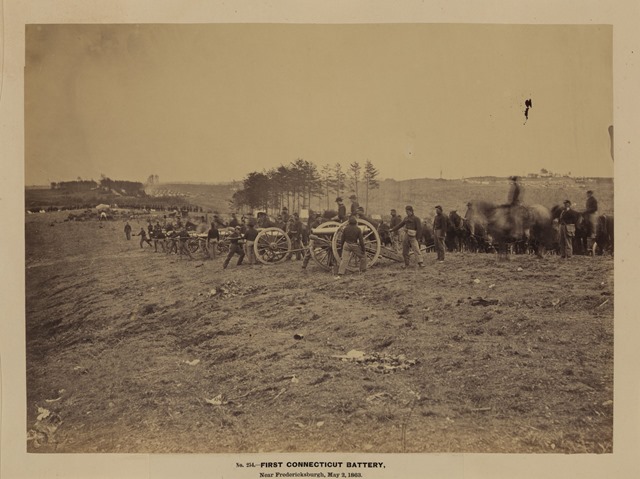
1st Connecticut Battery, near Fredericksburg, Va., May 2, 1863.
Photograph by Andrew J. Russell.
Library of Congress image.
______________
Image before cropping and digital enhancement (click on images for larger version)
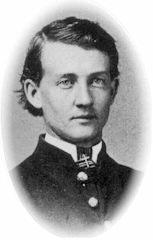
MAY 2ND.—As the sun peeped over the eastern horizon, we slipped out of camp and went our way rejoicing. Oh, how beautiful the morning; calm and pleasant, with the great variety of birds warbling, as though all was peace and quiet. When camping in the darkness of night, our surroundings astonish us in the broad day light. We scarcely know our next door neighbor until the morning light gleams upon him. While waiting orders to move, many thousand troops passed to the front, so I think our regiment will see another day pass with unbroken ranks. We have the very best fighting material in our regiment, and are ever ready for action, but are not particularly “spoiling for a fight.” Our turn will come, as it did at Fort Donelson, Shiloh and many other fields of glory. It is quite common to hear soldiers who have never seen the first fight say they are afraid they will never get any of the glories of this war. They never “spoil” for the second fight, but get glory enough in the first to last them. When our regiment was living upon soft bread and luxuries of sweet things from home, while camped in the rear of Covington, Kentucky, we thought that the war would be over and our names not be spread upon our banners as the victors in a battle. There is glory enough for all. We stopped awhile in Port Gibson, and the boys found a lot of blank bank currency of different denominations, upon the Port Gibson bank. They signed some of them, and it is quite common to see a private of yesterday a bank president to-day. This may not become a circulating medium to a very great extent, but it is not at all likely that it will be refused by the inhabitants along our route when tendered in payment for corn-bread, sweet potatoes, etc. In the afternoon we stopped awhile, and taking advantage of the halt made coffee, which is generally done, whether it is noon or not. There is a wonderful stimulant in a cup of coffee, and as we require a great nerve tonic, coffee is eagerly sought after. Dick Hunt, of Company G, and Tom McVey, of Co. B, discovered a poor lonely confederate chicken by the roadside. By some hen strategem it had eluded the eyes of at least ten thousand Yankees, but when the 20th Ohio came along the searching eyes of these two members espied its place of concealment. They chased it under an outhouse, which was on stilts, as a great many of the southern houses are. Dick being rather the fleetest crawled under the house and secured the feathered prize, but Tom seeing his defeat in not securing a “preacher’s dinner,” found a coffee-pot under another corner of the house, which he brought to daylight, and it proved to be full of silver coin mostly dollars. These he traded off to the boys for paper, as he could not carry his load. How foolish it is for the Southern people to flee and leave their beautiful property to the foe. We only want something to eat. There are some who would apply the torch to a deserted home, that would not do so if the owners remained in it. It is quite common here to build the chimneys on the outside of the houses, and I have noticed them still standing where the house had been burned. The march to-day, towards Black River, has be en a very pleasant one. I suppose Grant knows where he is taking us to, for we don’t, not having had any communications with him lately upon the subject.
by John Beauchamp Jones
MAY 2D.—The awful hour, when thousands of human lives are to be sacrificed in the attempt to wrest this city from the Confederate States, has come again. Now parents, wives, sisters, brothers, and little children, both in the North and in the South, hold their breath in painful expectation. At the last accounts the two armies, yesterday, were drawn up in battle array, facing each other. No water flowed between them, the Northern army being on this side of the Rappahannock. We have no means of knowing their relative numbers ; but I suspect Gen. Hooker commands more than 100,000 men, while Gen. Lee’s army, perhaps, does not exceed 55,000 efficients.
Accounts by passengers, and reports from the telegraph operators at the northern end of the line, some ten or twelve miles this side of the armies, indicate that the battle was joined early this morning. Certainly heavy cannonading was heard. Yet nothing important transpired up to 3 P.M., when I left the department, else I should have known it. Still, the battle may be raging, without, as yet, decisive result, and the general may not have leisure to be dictating dispatches.
Yet the heavy artillery may be only the preliminary overture to the desperate engagement; and it seems to me that several days might be spent in manœuvring into position before the shock of arms occurs, which will lay so many heads low in the dust.
But a great battle seems inevitable. All the world knows the fighting qualifications of Gen. Lee, and the brave army he commands; and Gen. Hooker will, of course, make every effort to sustain his reputation as “fighting Joe.” Besides, he commands, for the first time, an army: and knows well that failure to fight, or failure to win, will consign him to the same disgrace of all his predecessors who have hitherto commanded the “Army of the Potomac.”
It is certain that a column of Federal cavalry, yesterday, cut the Central Railroad at Trevillian’s depot, which prevents [click to continue…]
May 2.—The battle of Chancellorsville, or the “Wilderness,” Va., between the Union forces, under Major-General Hooker, and the rebels, under Gen. Lee, commenced this day.—(Doc. 183.)
—After repulsing the rebel force under General Marmaduke, at Cape Girardeau, on the twenty-sixth ultimo, General McNeil, with a much inferior force, immediately started in pursuit, and chasing them from point to point, finally came up with them to-day at Chalk Bluff, on the St. Francois, and drove them across the river into Arkansas, thus ending Marmaduke’s rebel raid into Missouri.—(Doc. 177.)
—The Union cavalry force, under Colonel Grierson, arrived at Baton Rouge, La., to-day, after a raid of fifteen days through the State of Mississippi. They had several skirmishes with parties of rebels, defeating them at every encounter; they destroyed bridges, camps, equipages, etc.; swam several rivers, captured a number of prisoners and horses, and obtained a large amount of important information concerning the rebel resources.—(Doc. 170.)
—A reconnoissance in force was this day made to the river Nansemond, Va., by a large body of Union troops, under the command of General Getty, supported by the gunboat Smith Briggs. The rebels were discovered in strong force, and an artillery fight was kept up all day, but without any material results.
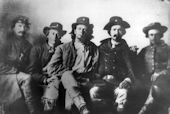
Friday, 1st day of May—Spent this day with Jimmy.
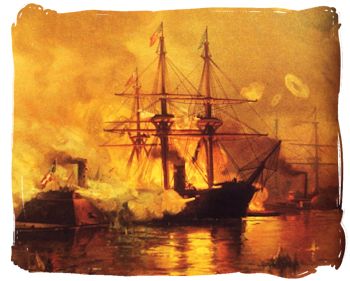
May 1st. The first day of May commences with clear and pleasant weather. This afternoon the Admiral despatched the ram Switzerland up the river as far as Grand Gulf, for news of what was going on in that quarter. At nine o’clock this evening, a rocket was reported as seen sent up Red River, and soon after a steamer’s light was seen coming down. Immediately the rattle was sprung, giving the alarm, and a few minutes afterwards all hands were at their guns and stations, while nearly all, officers and men, believed it was one of our own transports from Brashear City, via Berwick’s Bay and Atchafalaya River; still, they might be mistaken, and it was proper to be prepared against a surprise should it prove to be the enemy. Soon the vessel made her appearance, coming out of Red River, and signalized, by means of different colored lights, her number. Had she been a little dilatory in doing so, I have no doubt but a fight would have been the upshot of the matter, since the men were all anxious for the fray, and ready, with fifteen broadside guns, twelve of them nine-inch, bearing on their target, and only waiting for the old hero, the Admiral, to give them the order. She proved to be the U. S. gunboat and transport Arizona. Upon our hailing her and asking in trumpet voice what steamer that was, all was excitement unbounded among officers and crew, and a few moments of stillness and suspense followed ere she returned an answer to our inquiry; when her answer was known, joy pervaded the hearts of all ; three cheers were heartily given, the retreat beat, and every one left his quarters, thanking Him whose sun is made to shine upon the just and the unjust, that such success had crowned our efforts, and communication through another channel with our army, and New Orleans was now open to us, by the arrival of this long-expected visitor and stranger. The Arizona came to off our starboard quarter, and sent a boat with her Captain in same on board of us, with despatches from General Banks to Admiral Farragut ; after communicating with us, she wended her way back again, via Red and Atchafalaya Rivers to Brashear City.
Jeff has had the laugh on us for a long time, but now the tables are turned, and we come in to relieve him and take a spell at this pleasant recreation. I wonder how he likes it? Any how, we can now say, “Jeff, as you like it; this is kind of hard treatment of you, showing that we d_______ d Yankees have very little respect for your feelings; we know how arduously you have served your constituents, and that you need some rest. It shall not be denied you, and we shall take sole charge of affairs on the Mississippi, likewise Red River, until Port Hudson and Vicksburg fall.”
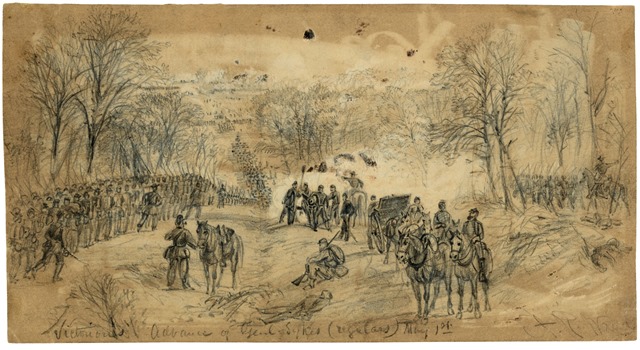
Drawing by Alfred R. Waud, drawing on light brown paper : pencil and Chinese white; 12.9 x 24.1. (sheet).
Published in: Harper’s Weekly, May 23, 1863, p. 328-9
Library of Congress image.
Inscribed on verso on attached piece of cream paper: If this picture is used and I think it ought to be for the regulars always do well, and seldom get any credit, not belonging to any crowd of voters the artist will notice that two lines are represented or suggested moving up to the crest of the hill where the rebels hold their positions. As the sketch is on so small a scale a little care must be used to bring out the idea.
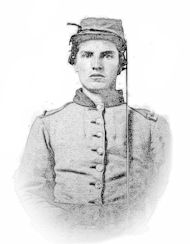
May 1st.—Rumored fighting going on below. General Tracy killed; went into ditches in front of Barton’s Brigade. Dick Anderson came from home and brought us nice box of provisions; cooked two days’ rations. Started towards Grand Gulf 6 P. M. Marched until 2:30 A. M. Reported heavy fighting the last two days.


