Near Grand Gulf, Friday, May 1. Awoke early to be soon on the march; travelled down the levee four miles, when we embarked on the “Silverwave” at Hard Times Landing. Seven gunboats and four transports crossing troops as fast as possible in sight of the bastions of Grand Gulf. Landed two miles below, and by 11 A. M. were on the march toward Port Gibson. The flat of Louisiana was relieved by the broken surface of Mississippi. Steep hills, and obliged to lock [the gun wheels] often. Marched very fast, only one mule team along. Heard firing all the afternoon in the advance. Encamped at sundown after travelling twelve miles. Mississippi furnished plenty of sweet potatoes, fresh pork, chickens, etc. All tired. Went to bed early.
May 2013
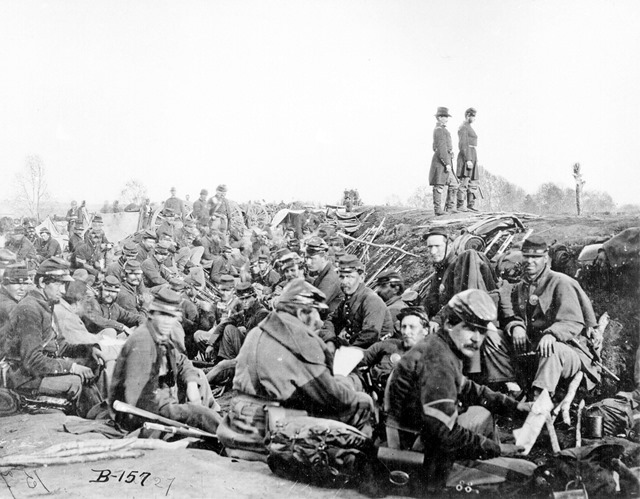
For a long time this photo was identified as being from Petersburg in 1864 or 1865. Today it is widely acknowledged as being from Fredericksburg in the spring of 1863, late April or early May.
_____________
Various information and sources related to the photo:
“Union soldiers entrenched along the west bank of the Rappahannock River at Fredericksburg, Virginia” – Library of Congress image. Photograph by Andrew J. Russell. “Formerly misidentified with the title “Union Soldiers in trenches before Petersburg,” Dec. 1864.”
“Line of Brooks’ Division at Fredericksburg, May 2, 1863. Rebels charged here 20 minutes after the picture was taken but were repulsed and driven back.” – hand written caption on a copy of the photo at the Western Reserve Historical Society in Cleveland, Ohio.)
“Line of Brooks’ Division at Fredericksburg, VA. April 29 or 50, 1863” – hand written caption on a copy at U.S. Army Heritage & Education Center.
“Soldiers in the trenches before battle, Petersburg, Va., 1865. 111-B-157.” – National Archives copy identification as Petersburg has been disputed by Civil War historians and photo-historians with documentary evidence suggesting that this image of Union forces was taken by Andrew J. Russell just before the Second Battle of Fredericksburg in the spring of 1863.
A Grand Old Photo Revisited – A somewhat detailed analysis by Barry McGhan at The Center for Civil War Photography.
Union Soldiers by the Rappahannock – Encyclopedia Virginia: “Union soldiers in William T. H. Brooks’s division of John Sedgwick’s Sixth Corps huddle together on the west bank of the Rappahannock River on April 29 or 30, 1863. Comprised mostly of New York, New Jersey, and Pennsylvania regiments, the division had just crossed the river on pontoon boats about a mile south of Fredericksburg and now occupied abandoned Confederate rifle pits, with Confederate pickets probably four hundred yards distant.”
Mrs. Lyon’s Diary.
May 1.—Our pickets were fired into last night. One man was wounded and two were captured. When we feel the most safe we appear to be in the most danger.

Friday, 1st—News came that General Sherman has again made an attack on Haines’s Bluff, the same as last fall when the plan failed because General Grant failed to co-operate with him. The plan is to be tried again this spring. A large ammunition train passed through here for Carthage, Louisiana. General Crocker left the command of our brigade, to take command of the Seventh Division of the Seventeenth Army Corps. The boys are all sorry to see him leave.
London, May 1, 1863
And so two years have passed over and gone, and still I am abroad and still you are a Captain of cavalry. You meanwhile are near twenty-eight years old. I shall never on this earth see my twenty-fifth birthday again. Does not this fact suggest certain ideas to you? Can a man at your time of life be a cavalry captain and remain a briefless solicitor? Can a man of my general appearance pass five years in Europe and remain a candidate for the bar? In short, have we both wholly lost our reckonings and are we driven at random by fate, or have we still a course that we are steering though it is not quite the same as our old one? By the Apostle Paul, I know not. Only one fact I feel sure of. We are both no longer able to protect ourselves with the convenient fiction of the law. Let us quit that now useless shelter, and steer if possible for whatever it may have been that once lay beyond it. Neither you nor I can ever do anything at the bar….
You don’t catch me entering the army now. It would be like entering college Freshman when all one’s friends were Seniors. I have a trick worth twenty of that. My friend General Zerman, who has been the means of kicking up such a row around us here, and who is an old Dugald Dalgetty; a midshipman under the French at Trafalgar; a sous-officier at Waterloo; a captain at Navarino; a Russian admiral; a Turkish admiral; a Carbonaro; a companion of Silvio Pellico in the prisons of Spielberg; a South American officer by land and sea; and lately a general in the army of the United States; now a Major General in the Mexican service; and I’ve no doubt a damned old villain, though a perfectly jovial old sinner of seventy odd; this distinguished individual offers to take me on his staff with the rank of major to Mexico. Would n’t I like to go! The chances are a thousand to one that my bones would bleach there, but for all that the chance is worth having, for it would be a great step for a young man to secure for himself a control even to a small extent over our Mexican relations. But such magnificent dreams, worthy of the daring of those heroes, Porthos, Athos, Aramis and D’Artagnan, are not for me. By the by, though, what a good Porthos Ben Crowny would make; you could do D’Artagnan, I would put in for Aramis, and no doubt you could hunt up some one that might pass equally badly for Athos. Then we could all go to Mexico together….
I left off by sending you the debate of last Friday night which contained Earl Russell’s brilliant remarks on the celebrated letter of our Minister to Admiral Dupont. In those remarks Earl Russell was indignant at the idea of his speaking to Mr. Adams about it. No! No! He should go straight to Washington! But my Lord, having thus pledged himself in order to please the English copper-heads, to go straight to Washington, amused himself the next morning by sending straight to Mr. Adams. Of course I know nothing of the conversation that followed. That is all a secret with Mr. Seward. But I think it is not difficult to guess. It had suited Lord Russell to yield a little to the copper-head pressure on Thursday night; it suited him to allow Mr. Adams to triumphantly purge himself of misdemeanor on Friday morning. It suited him to make the American Minister think that he (Lord R.) thought him to be in the wrong — moderately. It also suited him to make the British public think that Mr. Adams had confessed his error and contrition and had received pardon. English statesmanship consists in this sort of juggling and huckstering between interests.
Such was the position when I wrote to you, or rather, immediately after I wrote to you. Since then nothing has been heard of complaining at Washington. But now see the resources of a British Minister. Last Tuesday morning the City Article, what we call the money article, of the Times, in which most of the attack has been directed, contained the following paragraph:
“The public will be glad to learn that the difficulties occasioned by the recent issue by Mr. Adams of the certificate or pass to Messrs. Howell and Zerman, are likely to be smoothed down. It is reported that Mr. Adams is conscious of having acted in the matter upon imperfect representations and with undue haste, and that consequently he raises no pretensions such as would necessitate any absolute protest from one Government to the other on the subject. It is therefore believed that the relations between our Cabinet and the United States Legation in London will continue on a friendly footing — a result which in a personal sense will afford unmixed satisfaction, since the individual and historical claims of Mr. Adams to respect and esteem have never been disputed in any quarter.”
Now, is not this a remarkable State Paper? Did you ever see a case in which the butter was laid on so curiously over the interstices of the bread? The real fact is that you should read “Earl Russell” instead of “Mr. Adams” in the fifth line. That would be the correct thing. But this statement has received universal currency and is accepted as a conclusion of the difficulty. It now remains for Lord Russell to make the explanation which no doubt Mr. Adams must demand, at some time when the whole affair shall be forgotten, and then I hope this curious chapter will be closed….
Our own position here does not change. We lead a quiet and not unpleasant life, and I pass my intervals from official work, in studying De Tocqueville and John Stuart Mill, the two high priests of our faith. So I jump from International Law to our foreign history, and am led by that to study the philosophic standing of our republic, which brings me to reflection over the advance of the democratic principle in European civilization, and so I go on till some new question of law starts me again on the circle. But I have learned to think De Tocqueville my model, and I study his life and works as the Gospel of my private religion. The great principle of democracy is still capable of rewarding a conscientious servant. And I doubt me much whether the advance of years will increase my toleration of its faults. Hence I think I see in the distance a vague and unsteady light in the direction towards which I needs must gravitate, so soon as the present disturbing influences are removed.
We are surrounded by assistants. Mr. Aspinwall, Mr. J. M. Forbes, Mr. Robert J. Walker and Mr. Evarts are all here.
May 1, Friday. After Cabinet-meeting walked over with Attorney-General Bates to his office. Had a very full talk with him concerning the question of captured mails, — the jurisdiction of the courts, the law, and usage, and rights of the Government. He is unqualifiedly with me in my views and principles, — the law and our rights. He dwelt with some feeling on the courtesy which ought to exist between the several Departments and was by them generally observed. Although cautious and guarded in his remarks, he did not conceal his dissatisfaction with the conduct of the Secretary of State in writing to attorneys and marshals, and assuming to instruct and direct them in their official duties which were assigned to and required by law to be done by the Attorney-General.
We are getting vague rumors of army operations, but nothing intelligible or reliable.
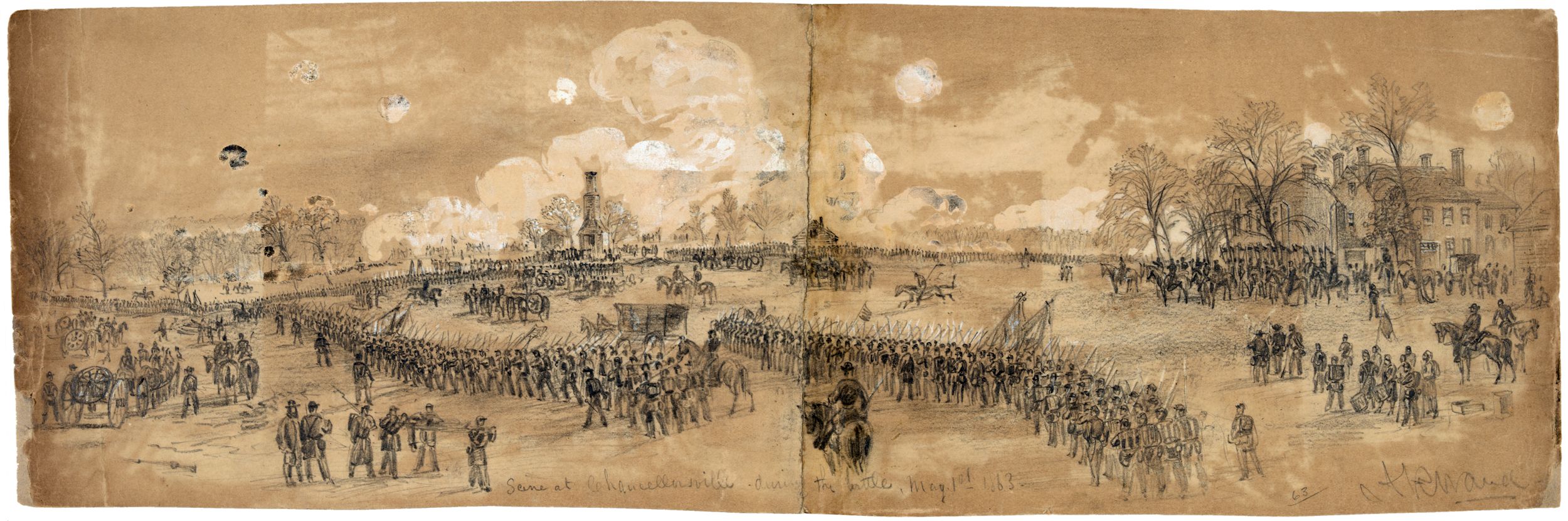
(Click on image for larger version.)
Drawing by Alfred R. Waud, drawing on light brown paper : pencil and Chinese white ; 17.2 x 52.8 cm. (sheet).
Published in: Harper’s Weekly, May 23, 1863, p. 328-9
Library of Congress image.

1st. Commenced moving across at 4 and all the regiments over by 9 A. M. Some fortifications on both sides of the river; Zollicoffer’s old huts still there. Moved on and overtook the 1st Battalion at Monticello. H, E, M in advance of column continually. Skirmishing. Four miles beyond M. found the rebels in force on two roads leading to Albany and Traversville. Howitzers, 1st. Ky., 45th O. V. I. on the Albany roads, 2nd O. V. C. on Traversville. In line near the woods. Co. D dismounted to fight on foot. Rebels broke. Pike fired 5 rounds at them, 500 or 600 yards, wounding some. Gave my canteen to one wounded man. Pursued two or three miles, ordered back. Several prisoners. Ate supper where one wounded 1st Tennessee man was, Andrew Johnson. Marched back to Monticello.
May 1—We left here this morning at thirty minutes after 4 for Kinston. Marched eleven miles without halting.
May 1—We left here this morning at thirty minutes after 4 for Kinston. Marched eleven miles without halting.


