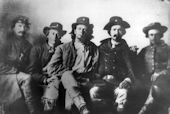
Monday, 22nd—All quiet.
June 2013
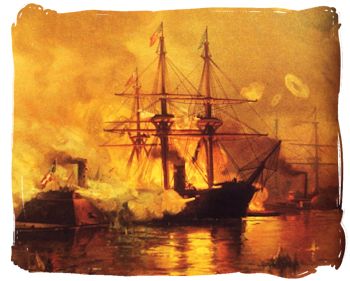
June 22d. Firing of musketry and artillery the whole forenoon of this day, in rear of Port Hudson. At nine P. M. steamer Laurel Hill arrived from Natchez.
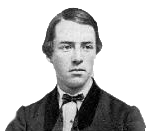
June 22. — Went over to General Howard’s this morning, and gave him a dispatch from General Reynolds. Left here at 10.36 and arrived there at 11.20, not meeting any bushwhackers on the way. The general had a dispatch this evening from General Meade, saying that he had laid a trap to catch Mosby, but that M. with 30 men drove our 40 cavalry and then escaped from 30 infantry. Tried to buy me some trousers this afternoon, but did not succeed. Weather cool and pleasant. Saw Colonel Asmussen, whom I met once at Stafford Court House, at General Howard’s headquarters.
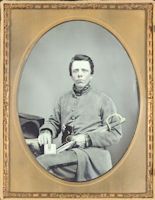
June 22 — At 12 o’clock last night Co. B and G. and one Co. of 57 Ga. was ordered outside of our entrenchments to attack and drive the enemy from the ditches which was near our picket post. We succeeded in driving them from their first ditch. But we were forced by over whelming numbers to fallback as their ditch did not give us any protection from the enemies fire; which we did in good order. Lieut. Crookshanks was killed; Sargeant Denton and Gilbert Murray was wounded of Co. G -Capt. Cawood, Sargent Miller and Wm. Brady of Co. B was wounded. One of the Ga. was killed and two wounded. It was with great reluctance that I went into it, but I said nothing. I saw it could not profit us anything for we could not hold it when taken. I thank God that we escaped as well as what we did. Sharp shooting going on as usual today. Oh Lord my heavenly Master deliver us from this unhappy state.Hear my prayer Oh! God and save us from the destruction of our enemies. W.R.C.
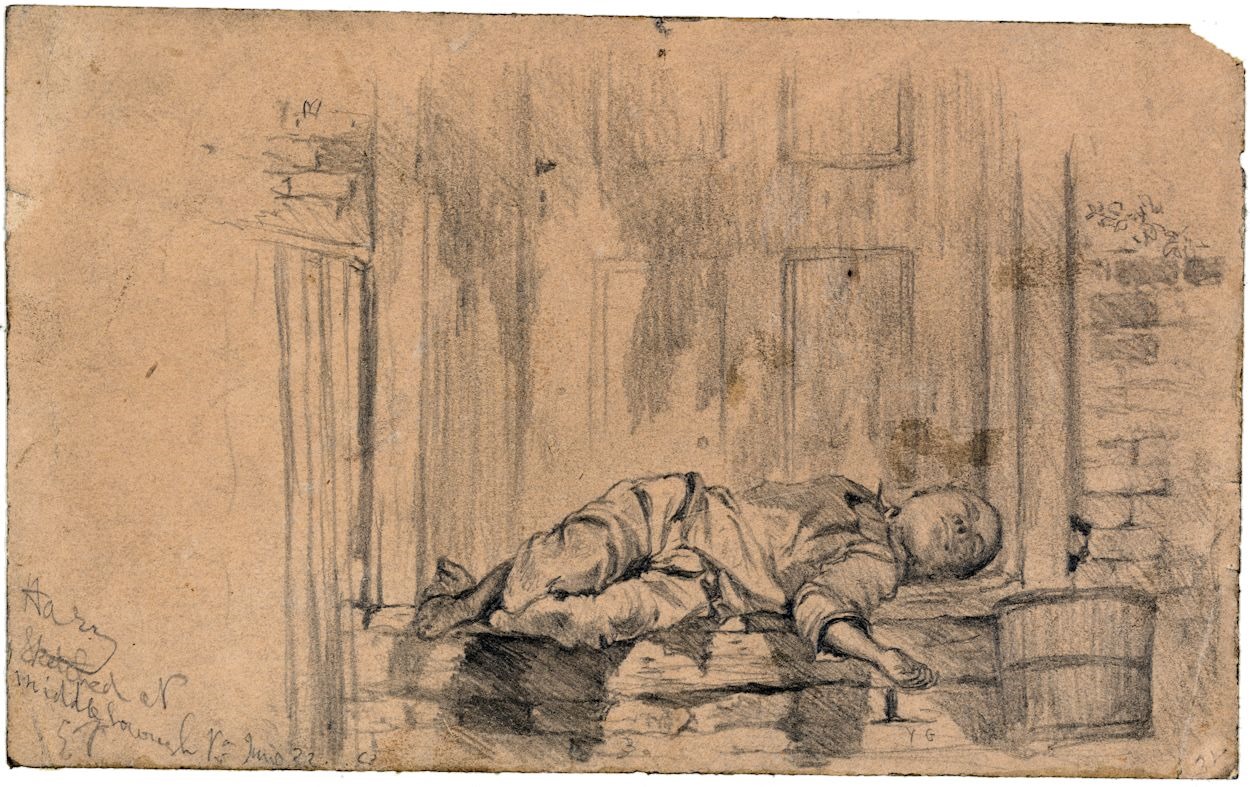
Harry, the innocent contraband.
Drawing by Edwin Forbes; June 22, 1863.
Library of Congress image.
__________
 Note – This image has been digitally adjusted for one or more of the following:
- fade correction,
- color, contrast, and/or saturation enhancement
- selected spot and/or scratch removal.
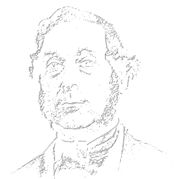
by John Beauchamp Jones
JUNE 22D.—To-day I saw the memorandum of Mr. Ould, of the conversation held with Mr. Vallandigham, for file in the archives. He says if we can only hold out this year that the peace party of the North would sweep the Lincoln dynasty out of political existence. He seems to have thought that our cause was sinking, and feared we would submit, which would, of course, be ruinous to his party! But he advises strongly against any invasion of Pennsylvania, for that would unite all parties at the North, and so strengthen Lincoln’s hands that he would be able to crush all opposition, and trample upon the constitutional rights of the people.
Mr. V. said nothing to indicate that either he or the party had any other idea than that the Union would be reconstructed under Democratic rule. The President indorsed, with his own pen, on this document, that, in regard to invasion of the North, experience proved the contrary of what Mr. V. asserted. But Mr. V. is for restoring the Union, amicably, of course, and if it cannot be so done, then possibly he is in favor of recognizing our independence. He says any reconstruction which is not voluntary on our part, would soon be followed by another separation, and a worse war than the present one.
The President received a dispatch to-day from Gen. Johnston, stating that Lt.-Gen. Kirby Smith had taken Milliken’s Bend. This is important, for it interferes with Grant’s communications.
Gov. Shorter writes that a company near Montgomery, Ala., have invented a mode of manufacturing cotton and woolen hand-cards, themselves making the steel and wire, and in a few weeks will be turning out from 800 to 1000 pairs of cards per week This will be a great convenience to the people.
Gen. Whiting writes that the river at Wilmington is so filled with the ships of private blockade-runners that the defense of the harbor is interfered with. These steamers are mostly filled with Yankee goods, for which they take them cotton, in the teeth of the law. He pronounces this business most execrable, as well as injurious to the cause. He desires the [click to continue…]
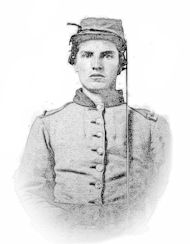
Monday, 22d.—Still unwell; various reports about Johnston, but don’t think any of them are reliable.
June 21.—At Baltimore, Md., as a matter of precaution against rebel demonstrations, earthworks were erected around the north and west sides of the city. The Council appropriated a forge sum of money, and a very large force of laborers (mostly contrabands) were impressed into the service. A line of barricades, composed of tobacco hogsheads and empty sugar and molasses hogsheads, filled with brick and sand, was erected within the city, extending from the high ground on the east to the south-western extremity. “These, if the rebels should come,” said a participant, “will be defended by the Union League men, who are being armed by General Schenck, and should a cavalry force manage to dash past the batteries, they would here meet a formidable resistance. The Union men are entirely confident that should the rebels be so rash as to attempt a raid in this direction, they will be able to effectually defeat them.”
—The Aeronautic corps of the army of the Potomac was dispensed with, and the balloons and inflating apparatus were sent to Washington.
—The fight at Lafourche Crossing, La., was renewed this day, and ended in the defeat of the rebels with a loss of sixty killed, two hundred and forty wounded, and seventy prisoners. The Union loss was eight killed and sixteen wounded.—New-Orleans Era, Jane 23.
—Major-General Pleasanton, with his cavalry, attacked the rebels, under General Stuart, at Middleburgh, Va., and after driving them over eight miles, succeeded in capturing two pieces of artillery, and sixty prisoners, besides killing and wounding over one hundred men.—(Doc. 77.)
—The ship Byzantium and bark Goodspeed were captured and burned by the rebel privateer Tacony off the coast of Massachusetts.—On the approach of the rebels toward Shippensburgh, Pa., the proprietor of the Union Hotel in that town blurred his sign over with brown paint.— The steamer Victory was captured off Cuba by the gunboat Santiago de Cuba, and the English schooner Frolic off Crystal Run, Florida, by the gunboat Sagamore.—This afternoon a party of the First Maryland cavalry, under Major Cole, dashed into Frederick, Md., driving out the rebels and capturing one. On the retirement of the Nationals, however, the rebels returned and reoccupied the town.
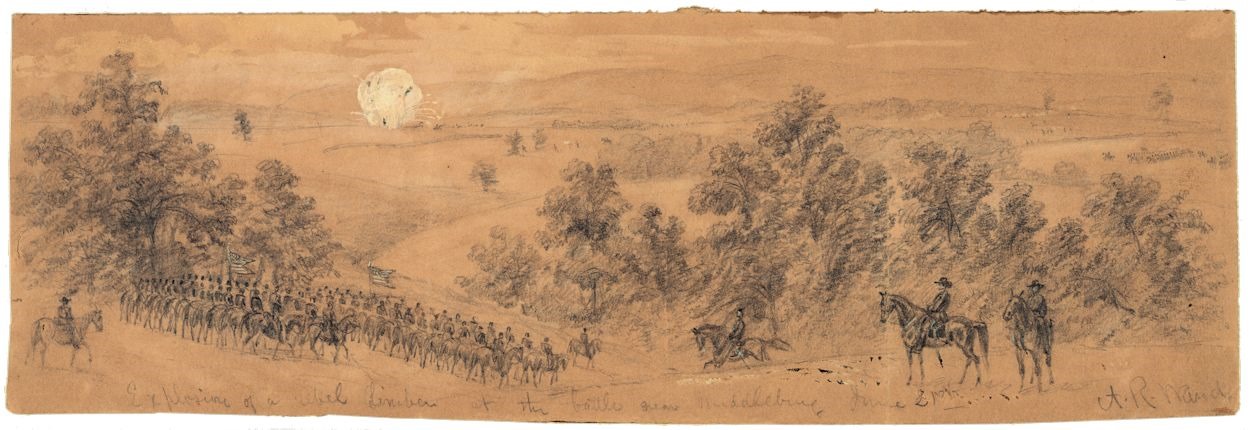
Explosion of a rebel limber at the battle near Middleburg June 21st, 1863; drawing by Alfred R. Waud; drawing on brown paper : pencil and Chinese white; 11.5 x 34.3 cm. (sheet).
Library of Congress image.
__________
 Note – This image has been digitally adjusted for one or more of the following:
- fade correction,
- color, contrast, and/or saturation enhancement
- selected spot and/or scratch removal.
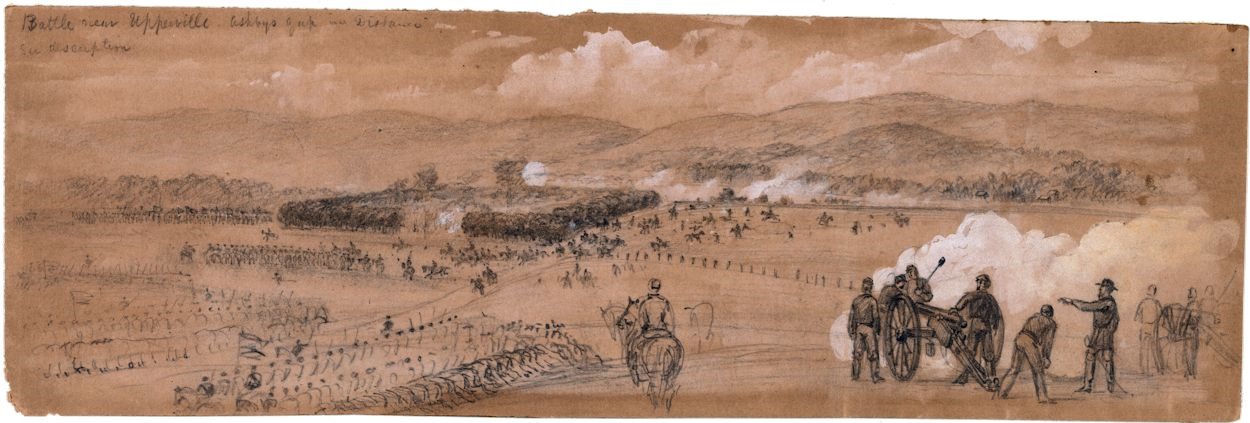
Battle near Upperville. Ashbys Gap in Distance; June 21, 1863; drawing by Alfred R. Waud; drawing on brown paper : pencil and Chinese white ; 11.0 x 34.0 cm. (sheet)
Library of Congress image.
__________
 Note – This image has been digitally adjusted for one or more of the following:
- fade correction,
- color, contrast, and/or saturation enhancement
- selected spot and/or scratch removal.


