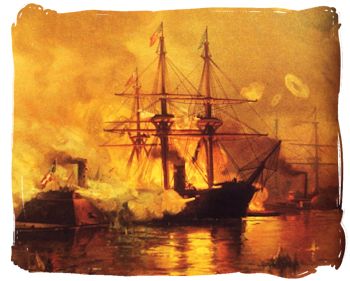
June 21st. Commences with pleasant weather. From twelve to four A. M., heavy firing going on at Port Hudson, mostly of musketry. At ten A. M., inspected crew at quarters, and performed Divine service upon the quarter-deck. Between the hours of eight P. M. and twelve midnight, heard reports of great guns in rear of Port Hudson.
June 2013
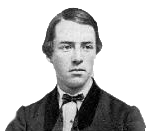
June 21.— Rosengarten relieved me as officer of the day this evening. The weather has been cloudy and rainy most of the day. We sent a regiment (7th Indiana) down to Frying-Pan, to capture guerillas, etc. A detachment came back this evening with seven citizens or bushwhackers. We found out to-day that our guide was captured at Coleman’s house yesterday. Coleman lives about two miles from here, and as he had a lot of forage, our guide and quartermaster’s clerk went there for it, and were caught by a Secesh there, said to be Mosby.
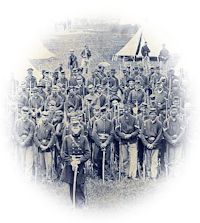
June 21st. 1863.
The sky is overcast with clouds, a cool breeze comes from the west, which makes the temperature delightful. I have been out berrying, and have succeeded admirably. On my way in I found some short pieces of board, of which I have made a comfortable seat, with a desk in front, on which I am now writing. I feel quite like an aristocrat. In my ramble across the field I discovered a flowering vine, the most bewitchingly beautiful thing I ever saw. I searched in vain for seed sufficiently matured to germinate. I wish I could describe its matchless beauty, but words are feeble.
We are still lying here waiting for Johnson, of course, to come to us, although no one seems to know where Johnson is—whether on the Yazoo, the Big Black or the little one. I suspect it is not definitely known whether his “large army” is a myth or a reality. But, doubtless, these hidden, secret, mysterious “strategic movements” and original plans will, some time, be made apparent, and then I, at least, will make one desperate attempt to appreciate and admire the wisdom and energy which could see, plan and execute with such unerring certainty and success. But Vicksburg, the center of gravity at present, is really a very stubborn fact. I do not understand it, cannot comprehend it, but I believe Grant will investigate it to the satisfaction of all loyal people. All the reliable information I can get at present is brought on the wings of the wind. This is not Grant’s official report, but the report of his artillery. Last night his cannons’ sullen roar reverberated from cliff to cliff and shook the hills. There are all sorts of rumors which it is folly to repeat, for they are replaced by new ones every hour. I believe I will record the latest, so here goes:
Last night Pemberton conceived the brilliant idea of turning loose four or five hundred horses and mules, creating a stampede among them, and, when Grant’s lines open to let them through, as certainly would be done, if he suspected nothing, why, out they would rush, artillery, infantry and all, before the lines could close again, and thus escape. But Grant was wide awake, fell back a mile or two to give himself room to work, opened his lines for the horses to pass through and the Rebels to pass in, then closed on them and had them trapped.
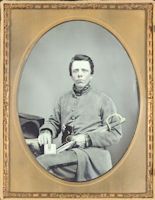
June 21 — Another Sabbath morning has rolled around and found us still confined to the neighboring hill of Vicksburg without any better prospects of our deliverance. It is reported that Johnson has attacked the enemy but I doubt it. Sharp shooters are pecking away as usual this morning. Warm firing was kept up all day. WRC
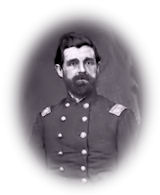
Colonel Lyons.
Fort Donelson, June 21, 1863.—I fear I wrote the last time in rather a depressing vein, but the news is much better now, so I feel much better.
Captain Kingman is detailed to take home money for our regiment. He is now out on an expedition. His brother, Lieut. Kingman, of the 22d, is here; also Lieut. Booth, of the same regiment, a relative of Mrs. Woodman. The regiment is at Nashville, under orders to go back to Franklin. They speak in the highest terms of Captains May and Mead, and well they can, for no braver or better boys than they live.
I spend the whole day at headquarters, and find plenty of occupation. Time passes more rapidly than it would were I unoccupied. I have been ordered to remove obstructions from the river at Line Island, twenty miles below here, and at Ingraham Shoals near Eddyville. I sent Captain Ruger and Lieut. Balis and Lieut. Lamoreau to Line Island yesterday to make an examination, and I think I will go myself to Eddyville on the same business in a few days. These obstructions are barges sunk in the river by Floyd when the rebels had possession in 1861.
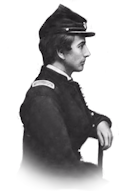
On the 29th [May] we got on board the train and went to Washington. There we left the general with his friend Williams and both of us proceeded to New York, where we renewed our social gaieties and fell at once into the ways of city life. There is much less enthusiasm now for officers from the seat of war and one gets little attention except from one’s immediate friends.
On the 17th of June, the papers announced the enemy in motion and the army of the Potomac as leaving their winter quarters about Falmouth. By nine o’clock I received a dispatch from the general, directing Broom and me to leave for Washington immediately; and so we took the train the same evening, arriving there the following morning, reporting without waiting for breakfast. Received a hospitable greeting from both the general and his friend Williams, who pressed us to remain and breakfast, but we respectfully declined in favor of our usual headquarters when in Washington, the Metropolitan Hotel. We remained in the city until the 21st before we could ascertain in which direction to go to reach our command, the general in a state of great disturbance on account of the delay. Early this morning we found out and took the military train to Fairfax court house, arriving there in the evening to find the corps had marched from that place early the same morning; each of us had a valise to carry, and being without horses or servants were at a loss how to proceed. Broom, however, proved equal to the emergency. He called upon the depot quartermaster greeted him in his usual irresistible and hearty manner, claimed an ancient acquaintance and comradeship as an old quartermaster, and finally wheedled an ambulance out of him, with directions to the driver to take us wherever we desired to go; thus comfortably cared for we started off in fine condition, arriving at Centreville, only to find the corps had gone on to Gainesville, and so we kept going, finally arriving at division headquarters at 7 P. M., after a tiresome journey lasting all day. General French’s division and our brigade were the only infantry troops in camp. All the rest had gone with General Hancock to Thoroughfare Gap. It was delightful to be back again to our command and meet with such a hearty welcome. The troops always like their regular officers along, when going on a campaign. General French occupied the best house in the place as headquarters and invited Zook to share it with him. The general accepted, and immediately assumed command of his brigade. From General French we received the first reliable information of the movements of the army and a full record of the events, which led up to the present movement. It seems Lee has taken the initiative again, and is believed to be moving a second time to the invasion of the Northern states. The army of the Potomac is watching his movements, moving on an inner circle, covering the capital and expects sooner or later to plant itself across his path.
Almost every foot of ground in this vicinity has been fought over time and again, since the beginning of the war. The Bull Run battlefield is only a short distance east of us, and Thoroughfare Gap and Centreville are on either side of us. Several roads converge here, and it is strategically a place of considerable importance and has been occupied by both armies alternately several different times. Outside of its military importance, it amounts to nothing.
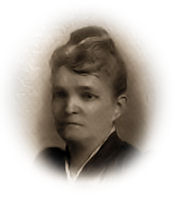
June 21st, 1863.—I had gone upstairs to-day during the interregnum to enjoy a rest on my bed and read the reliable items in the “Citizen,” when a shell burst right outside the window in front of me. Pieces flew in, striking all round me, tearing down masses of plaster that came tumbling over me. When H. rushed in I was crawling out of the plaster, digging it out of my eyes and hair. When he picked up beside my pillow a piece as large as a saucer, I realized my narrow escape. The window-frame began to smoke, and we saw the house was on fire. H. ran for a hatchet and I for water, and we put it out. Another (shell) came crashing near, and I snatched up my comb and brush and ran down here. It has taken all the afternoon to get the plaster out of my hair, for my hands were rather shaky.

______
Note: To protect Mrs. Miller’s job as a teacher in New Orleans, the diary was published anonymously, edited by G. W. Cable, names were changed and initials were often used instead of full names — and even the initials differed from the real person’s initials.
by John Beauchamp Jones
June 21ST—To-day we have an account of the burning of Darien, Ga. The temptation is strong for our army to retaliate on the soil of Pennsylvania.

21st.—We hear of fights and rumours of fights. It is said that Ewell’s Division captured 6,000 prisoners at Winchester, and that General Edward Johnson went to Berryville and captured 2,000 that were on their way to reinforce Millroy. They have driven the enemy out of the Valley, so that now we have possession of it once more. Our cavalry has been as far as Chambersburg, Pennsylvania, but I do not know what they have accomplished.
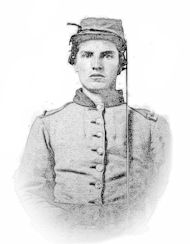
Sunday, 21st.—Heavy rumors afloat; one is a courier came in last night and said that on Friday and Saturday Johnston was crossing Big Black River with 90,000 men.


