Following the American Civil War Sesquicentennial with day by day writings of the time, currently 1863.

June 2013

JUNE 28TH.—The boys of the 20th left at Vicksburg joined our regiment to-day. We were very anxious to hear how the siege was progressing, and, to our surprise, learned that it was going right on as usual, without our assistance. It was interesting to hear of the blowing up of Fort ‘Hill by our division, but we did not ascertain the number killed, though the explosion


Hoisted two or three.

And blew a darky free

From slavery to freedom.

 
This negro, blown up with other chattels in the fort, was dropped into our lines and taken to General Logan’s headquarters, none the worse for his trip. When asked what he saw, he said, “As I was comin’ down I met massa gwine up.” Nothing, however, was gained by blowing up the fort, except planting the stars and stripes thereon, by our troops who made the charge after the explosion ; but our colors were removed, for safety, after dark. While our men lay all the afternoon on the side of the fort, the rebels threw into their ranks hand-grenades which killed and wounded quite a number. Our boys, however, would occasionally catch them and toss them back to the place from which they came, just in time to explode among their owners.

Living out here in the woods is quite different from camping before Vicksburg. Yet all is life and bustle wherever we are, from reveille at daybreak, to tattoo at night. Each man must answer to his name in ranks at roll-call in the morning, and must be properly dressed. Some of the most ludicrous scenes of army life are to be witnessed at this exercise. A few of the old fashioned, steady fellows, as a general thing appear quite thoroughly dressed ; but as you go down the ranks from the head where they stand, you will begin to find, now and then, a man who has but one boot or shoe on, with the other but half way on. Another boy will be putting on his blouse—having grabbed it in the dark—of course wrong side out. Another has tossed his blouse over his shoulders, and is trying to hide close to his right-hand man. Still another, trying to get his pants on between his bed and the line, has caught a foot in the lining, and hops along like a sore-footed chicken. I saw one fellow come out, at the foot of the company, wrapped only in a blanket. The orderly, however, sent him back to be better uniformed; he could not play Indian at morning roll-call. The last one of those who have overslept, makes his appearance holding on to his clothes with both hands. Some answer to their names before taking position in the ranks, and in fact, even some before they are fairly out of bed. A company which has for its orderly a person who is a little lenient, fares well ; but if he is inclined to strain his authority, he is bound to have its ill will. After roll-call, some of the half-dressed return to bed for another snooze, while the rest complete their toilet. After that comes the splitting of rails, building of fires, and a general rush for breakfast, which winds up the duties of the morning.

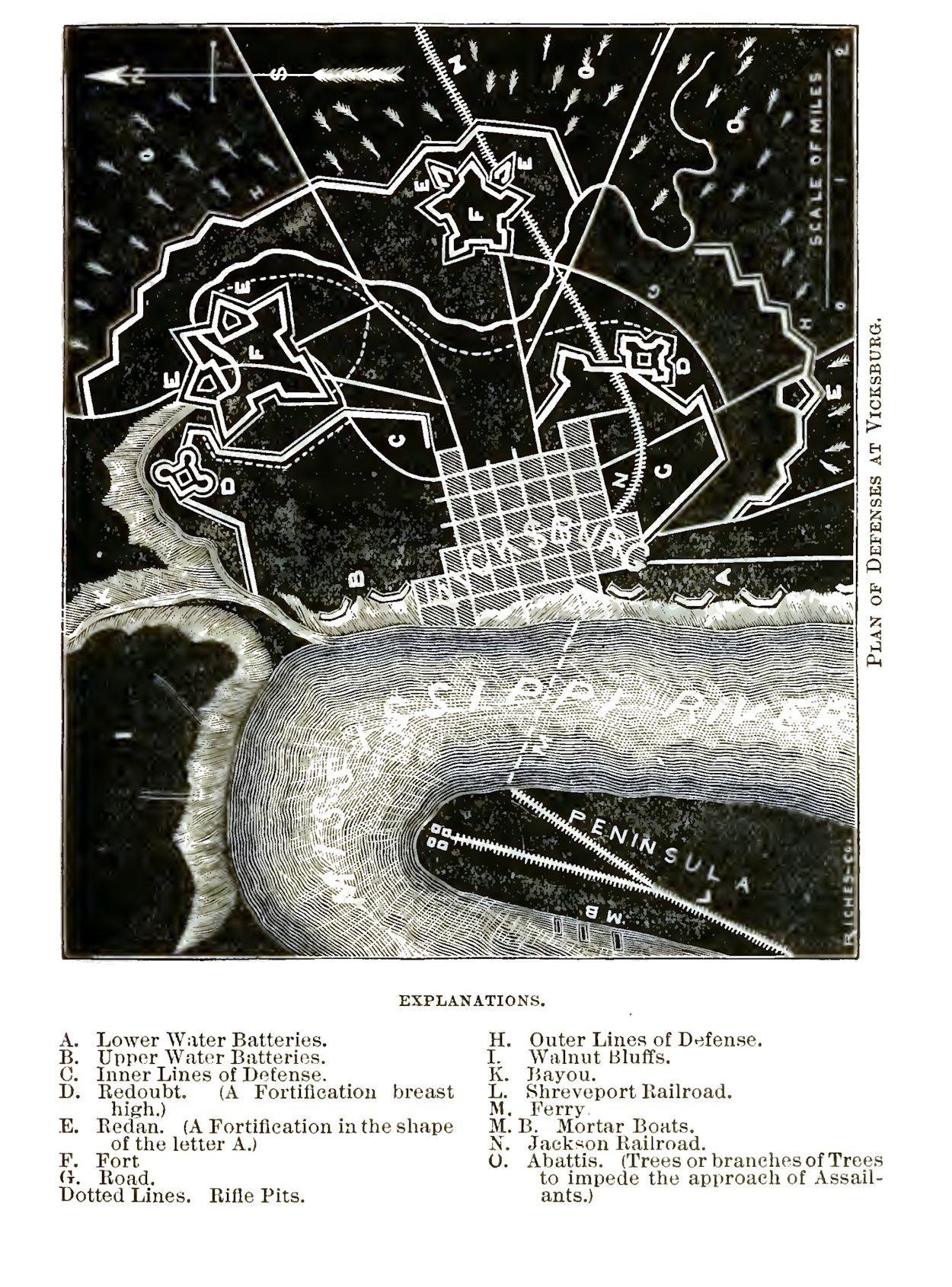
Map of the Siege of Vicksburg

Sunday, 28th—Came on to-day to Tullahoma; continues to rain night and day. I saw James Maxwell, Billy Dunson, Julius Lensing and Doc. Norwood.

June 28th. Commences with pleasant weather. Occasional firing at Port Hudson by the army mortars and great guns. At nine fifty A. M., inspected crew at quarters, and performed Divine service. Firing still going on at Port Hudson. This afternoon despatches were sent by Paymaster Meredith to Gen. Banks’s headquarters. At one P. M. an orderly came on board from the General’s headquarters. Steamer Bee came down the river, from Bayou Sara, with despatches and three soldiers of the 75th regiment N. Y. V., who were arrested at St. Francisville. From eight o’clock to twelve midnight, artillery firing heard in the rear of Port Hudson.

June 28 — Another Sabbath has found me alive and well for which I feel very thankful and glorify my heavenly Master. Things were very quiet last night. I worked nearly all night planting a battery. Sharp shooters commenced operating as usual at daylight. Lieut. Clepes of Co. E was mortally wounded this morning. He was in the trenches. W. R. C.

June 28th. Reveille at daybreak and immediately afterwards breakfast. At 6 A. M. the column was en route, stepping out at a brisk pace, arriving after a march of about twenty-five miles at Monocasy Junction with few stragglers and in excellent condition.

The country we marched through to-day is very beautiful and the inhabitants greatly excited over the invasion. The rebel cavalry is scouring the country, driving off the fanners’ stock and scaring everybody out of their wits. The militia have been called out again and are hurrying to Baltimore, Philadelphia, and Washington; exactly similar proceedings to those of last September.

June 28th, 1863. The army of Northern Virginia is pushing on to the invasion of the North. In this land of ours a curious species of fault-finders has developed. While the men, the true men, are at the front, struggling with might and main to save the South from destruction, there are others, poor weak-kneed cowards, who stand on street corners and criticise President Davis and the generals in command of our armies.

These cowardly back-biters have never smelled gun powder, they are Carpet Generals and yet, to listen to them talk, you would think that the only thing needed to insure victory would be to put them in command. I turn sick with scorn when I am obliged to be present while they are exploiting their wisdom.

by John Beauchamp Jones

JUNE 28TH.—By order of Brig.-Gen. G. W. Custis Lee, the department companies were paraded to-day, armed and equipped. These, with the militia in the streets (armed by the government to-day), amounted to several thousand efficient men for the batteries and for guard duty. They are to rendezvous, with blankets, provisions, etc., upon the sounding of the tocsin. I learn that 8000 men in the hospitals within convenient reach of the city, including those in the city, can be available for defense in an emergency. They cannot march, but they can fight. These, with Hill’s division, will make over 20,000 men; an ample force to cope with the enemy on the Peninsula. It has been a cool, cloudy day (we have had copious rains recently), else the civilians could not have stood several hours exercise so well. A little practice will habituate them by degees to the harness of war. No one doubts that they will fight, when the time for blows arrives. Gen. Jenkins has just arrived, with his brigade, from the south side of the James River.

I was in the arsenal to-day, and found an almost unlimited amount of arms.

We get not a word from Gen. Lee. This, I think, augurs well, for bad news flies fast. No doubt we shall soon hear something from the Northern papers. They are already beginning to magnify the ravages of our army on their soil: but our men are incapable of retaliating, to the full extent, such atrocities as the following, on the Blackwater, near Suffolk, which I find in the Petersburg Express:

“Mr. Smith resided about one mile from the town, a well-to-do farmer, having around him an interesting family, the eldest one a gallant young man in the 16th Virginia Regiment. When Gen. Longstreet invested Suffolk a sharp artillery and infantry skirmish took place near Mr. Smith’s residence, and many balls passed through his house. The Yankees finally advanced and fired the houses, forcing the family to leave. Mrs. Smith, with her seven children, the youngest only ten months old, attempted to escape to the woods and into the Confederate lines, when she was fired upon by the Yankee [click to continue…]

June 27.—A squadron of Scott’s Nine Hundred cavalry, under Major Remington, on their way to Centreville, Va., this morning, encountered, near Fairfax, the Sixth Virginia cavalry, and dashed at them with the sabre. The Major made two charges, and drove the rebels for three miles into a wood, and there encountered a superior force, that checked him with the fire of carbines. The fight, from the beginning to the end, was fierce. Major Remington, after having had his horse shot twice, cut his way out and made his escape with eighteen men. Eighty were reported missing. Among them were Captain Bagwell, Captain Campbell, and Lieutenant Hazleton. The companies were B and C.

—Carlisle, Pa., was abandoned by the Union forces, and soon after occupied by the rebels advancing on Gettysburgh.—A large number of rebel cavalry under command of Fitz-Hugh Lee, made a dash into Annandale, Va., capturing several sutlers who were in the vicinity, and burning a number of hospital stores and sutlers’ wagons.

—The Maryland Club-house at Baltimore, having “degenerated into a resort for those who are disaffected toward the Government, and hostile to its legally constituted authorities,” was closed by order of Major-General Schenck. —Manchester, Tenn., was entered and occupied by the Union forces under General J. J. Reynolds.—Shelbyville, Tenn., was occupied by General Granger.—Joel Parker, Governor of New-Jersey, on the reception of a message from Governor Curtin, informing him of the second entrance of the rebels into Pennsylvania, renewed his call upon the citizens of the State to hold themselves in readiness for immediate service.—York, Pa., was occupied by the rebels under General Gordon.—(Doc. 81.)

—The schooner Varnum H. Hill was captured by the rebel privateer Florida, in latitude 30° north, longitude 48° 50′, but was released on a bond, on condition her master would take to Bermuda, the prisoners captured by the privateer, from the ships lately destroyed by her.— A skirmish occurred on the Walnut Bottom road, at a point five miles from Carlisle, near the Stone Farm, between a detail of Pennsylvania militia under Captain Murray, and a party of rebels, in which ten of the militia were captured and one wounded.—The rebel schooner Archer, a tender to the privateer Tacony, entered the harbor of Portland, Me., and captured the revenue cutter Caleb Cushing.—(Doc. 21.)

27th June (Saturday).—Lawley was so ill this morning that he couldn’t possibly ride; I therefore mounted his horse a little before daybreak, and started in search of the generals. After riding eight miles, I came up with General Longstreet, at 6.30 A.m., and was only just in time, as he was on the point of moving. Both he and his Staff were most kind, when I introduced myself and stated my difficulties; he arranged that an ambulance should fetch Lawley, and he immediately invited me to join his mess during the campaign; he told me (which I did not know) that we were now in Pennsylvania, the enemy’s country— Maryland being only ten miles broad at this point; he declared that Bushwhackers exist in the woods, who shoot unsuspecting stragglers, and it would therefore be unsafe that Lawley and I should travel alone. General Longstreet is an Alabamian—a thickset, determined-looking man, forty-three years of age: he was an infantry major in the old army, and now commands the 1st corps d’armée: he is never far from General Lee, who relies very much upon his judgment. By the soldiers he is invariably spoken of as “the best fighter in the whole army.” Whilst speaking of entering upon the enemy’s soil, he said to me that although it might be fair, in just retaliation, to apply the torch, yet that doing so would demoralise the army and ruin its now excellent discipline. Private property is therefore to be rigidly protected.

At 7 A.M. I returned with an orderly (or courier, as they are called) to the farmhouse in which I had left Lawley; and after seeing all arranged satisfactorily about the ambulance, I rode slowly on to rejoin General Longstreet, near Chambersburg, which is a Pennsylvanian town, distant twenty-two miles from Hagerstown. I was with McLaws’s division, and observed that the moment they entered Pennsylvania the troops opened the fences and enlarged the road about twenty yards on each side, which enabled the waggons and themselves to proceed together: this is the only damage I saw done by the Confederates. This part of Pennsylvania is very nourishing, highly cultivated, and, in comparison with the Southern States, thickly peopled. But all the cattle and horses having been seized by Ewell, farm-labour had now come to a complete standstill.

In passing through Greencastle we found all the houses and windows shut up, the natives in their Sunday clothes standing at their doors regarding the troops in a very unfriendly manner. I saw no straggling into the houses, nor were any of the inhabitants disturbed or annoyed by the soldiers. Sentries were placed at the doors of many of the best houses, to prevent any officer or soldier from getting in on any pretence.

I entered Chambersburg at 6 P.M. This is a town of some size and importance: all its houses were shut up; but the natives were in the streets, or at the upper windows, looking in a scowling and bewildered manner at the Confederate troops, who were marching gaily past to the tune of Dixie’s Land. The women (many of whom were pretty and well dressed) were particularly sour and disagreeable in their remarks. I heard one of them say, “Look at Pharaoh’s army going to the Red Sea.” Others were pointing and laughing at Hood’s ragged Jacks, who were passing at the time. This division, well known for its fighting qualities, is composed of Texans, Alabamians, and Arkansians, and they certainly are a queer lot to look at. They carry less than any other troops; many of them have only got an old piece of carpet or rug as baggage; many have discarded their shoes in the mud; all are ragged and dirty, but full of good-humour and confidence in themselves and in their general, Hood. They answered the numerous taunts of the Chambersburg ladies with cheers and laughter. One female had seen fit to adorn her ample bosom with a huge Yankee flag, and she stood at the door of her house, her countenance expressing the greatest contempt for the barefooted Rebs; several companies passed her without taking any notice; but at length a Texan gravely remarked, “Take care, madam, for Hood’s boys are great at storming breastworks when the Yankee colours is on them.” After this speech the patriotic lady beat a precipitate retreat.

Sentries were placed at the doors of all the principal houses, and the town was cleared of all but the military passing through or on duty. Some of the troops marched straight through the town, and bivouacked on the Carlisle road. Others turned off to the right, and occupied the Gettysburg turnpike. I found Generals Lee and Longstreet encamped on the latter road, three-quarters of a mile from the town.

General Longstreet and his Staff at once received me into their mess, and I was introduced to Major Fairfax, Major Latrobe, and Captain Rogers of his personal Staff; also to Major Moses, the Chief Commissary, whose tent I am to share. He is the most jovial, amusing, and clever son of Israel I ever had the good fortune to meet. The other officers on Longstreet’s Headquarter Staff are Colonel Sorrell, Lieutenant-Colonel Manning (ordnance officer), Major Walton, Captain Goree, and Major Clark, all excellent good fellows, and most hospitable.[1]

Lawley is to live with three doctors on the Headquarter Staff: their names are Cullen, Barksdale, and Maury; they form a jolly trio, and live much more luxuriously than their generals.

Major Moses tells me that his orders are to open the stores in Chambersburg by force, and seize all that is wanted for the army in a regular and official manner, giving in return its value in Confederate money on a receipt. The storekeepers have doubtless sent away their most valuable goods on the approach of the Confederate army. Much also has been already seized by Ewell, who passed through nearly a week ago. But Moses was much elated at having already discovered a large supply of excellent felt hats, hidden away in a cellar, which he “annexed” at once.

I was told this evening the numbers which have crossed the Potomac, and also the number of pieces of artillery. There is a large train of ammunition; for if the army advances any deeper into the enemy’s country, General Lee cannot expect to keep his communications open to the rear; and as the Staff officers say, “In every battle we fight we must capture as much ammunition as we use.” This necessity, however, does not seem to disturb them, as it has hitherto been their regular style of doing business.

Ewell, after the capture of Winchester, had advanced rapidly into Pennsylvania, and has already sent back great quantities of horses, mules, waggons, beeves, and other necessaries; he is now at or beyond Carlisle, laying the country under contribution, and making Pennsylvania support the war, instead of poor, used-up, and worn-out Virginia. The corps of Generals A. P. Hill and Longstreet are now near this place, all full of confidence and in high spirits.


[1] Having lived at the Headquarters of all the principal Confederate Generals, I am able to affirm that the relation between their Staffs and themselves, and the way the duty is carried on, is very similar to what it is in the British army. All the Generals— Johnston, Bragg, Polk, Hardee, Longstreet, and Lee—are thorough soldiers, and their Staffs are composed of gentlemen of position and education, who have now been trained into excellent and zealous Staff officers.
27th. Thunder shower during the day. Passed the day reading and resting. At 5 P. M. commenced marching towards Jamestown. 7th and 2nd Ohio. Rained very hard. Fishing Creek too high to ford. Bivouacked on the bank. Cleared off, so slept very well, save wet clothes. Thede and I went together. Three days’ rations. A. B. along, first for two months.