Following the American Civil War Sesquicentennial with day by day writings of the time, currently 1863.

June 2013

4th June (Thursday).—Colonel Richmond rode with me to the outposts, in order to be present at the reconnaissance which was being conducted under the command of General Cheetham. We reached the field of operations at 2 P.m., and found that Martin’s cavalry (dismounted) had advanced upon the enemy about three miles, and, after some brisk skirmishing, had driven in his outposts. The enemy showed about 2000 infantry, strongly posted, his guns commanding the turnpike road. The Confederate infantry was concealed in the woods, about a mile in rear of the dismounted cavalry.

This being the position of affairs, Colonel Richmond and I rode along the road so far as it was safe to do so. We then dismounted, and sneaked on in the wood alongside the road until we got to within 800 yards of the Yankees, whom we then reconnoitred leisurely with our glasses. We could only count about seventy infantry soldiers, with one field-piece in the wood at an angle of the road, and we saw several staff officers galloping about with orders. Whilst we were thus engaged, some heavy firing and loud cheering suddenly commenced in the woods on our left; so, fearing to be outflanked, we remounted and rode back to an open space, about 600 yards to the rear, where we found General Martin giving orders for the withdrawal of the cavalry horses in the front, and the retreat of the skirmishers.

It was very curious to-see three hundred horses suddenly emerge from the wood just in front of us, where they had been hidden—one man to every four horses, riding one and leading the other three, which were tied together by the heads. In this order I saw them cross a cotton-field at a smart trot, and take up a more secure position; two or three men cantered about in the rear, flanking up the led horses. They were shortly afterwards followed by the men of the regiment, retreating in skirmishing order under Colonel Webb, and they lined a fence parallel to us. The same thing went on on our right.

As the firing on our left still continued, my friends were in great hopes that the Yankees might be inveigled on to follow the retreating skirmishers until they fell in with the two infantry brigades, which were lying in ambush for them; and it was arranged, in that case, that some mounted Confederates should then get in their rear, and so capture a good number; but this simple and ingenious device was frustrated by the sulkiness of the enemy, who now stubbornly refused to advance any further.

The way in which the horses were managed was very pretty, and seemed to answer admirably for this sort of skirmishing. They were never far from the men, who could mount and be off to another part of the field with rapidity, or retire to take up another position, or act as cavalry as the case might require. Both the superior officers and the men behaved with the most complete coolness; and, whilst we were waiting in hopes of a Yankee advance, I heard the soldiers remarking that they “didn’t like being done out of their good boots”—one of the principal objects in killing a Yankee being apparently to get hold of his valuable boots.

A tremendous row went on in the woods during this bushwhacking, and the trees got knocked about in all directions by shell; but I imagine that the actual slaughter in these skirmishes is very small, unless they get fairly at one another in the open cultivated spaces between the woods. I did not see or hear of anybody being killed to-day, although there were a few wounded and some horses killed. Colonel Richmond and Colonel Webb were much disappointed that the inactivity of the enemy prevented my seeing the skirmish assume larger proportions, and General Cheetham said to me, “We should be very happy to see you, Colonel, when we are in our regular way of doing business.”

After waiting in vain until 5 P.m., and seeing no signs of anything more taking place, Colonel Richmond and I cantered back to Shelbyville. We were accompanied by a detachment of General Polk’s body-guard, which was composed of young men of good position in New Orleans. Most of them spoke in the French language, and nearly all had slaves in the field with them, although they ranked only as private soldiers, and had to perform the onerous duties of orderlies (or couriers, as they are called). On our way back we heard heavy firing on our left, from the direction in which General Withers was conducting his share of the reconnaissance with two other infantry brigades.

After dark General Polk got a message from Cheetham, to say that the enemy had after all advanced in heavy force about 6.15 P.M., and obliged him to retire to Guy’s Gap. We also heard that General Cleburne, who had advanced from Wartrace, had had his horse shot under him. The object of the reconnaissance seemed, therefore, to have been attained, for apparently the enemy was still in strong force at Murfreesborough, and manifested no intention of yielding it without a struggle.

I took leave of General Polk before I turned in. His kindness and hospitality have exceeded anything I could have expected. I shall always feel grateful to him on this account, and I shall never think of him without admiration for his character as a sincere patriot, a gallant soldier, and a perfect gentleman. His aides-de-camp, Colonels Richmond and Yeatman, are also excellent types of the higher class of Southerner. Highly educated, wealthy, and prosperous before the war, they have abandoned all for their country. They, and all other Southern gentlemen of the same rank, are proud of their descent from Englishmen. They glory in speaking English as we do, and that their manners and feelings resemble those of the upper classes in the old country. No staff-officers could perform their duties with more zeal and efficiency than these gentlemen, although they were not educated as soldiers.
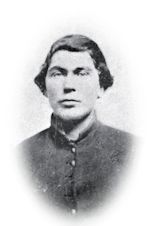
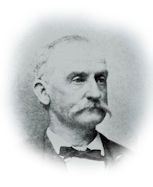
Before Vicksburg, Thursday, June 4. But little fighting done to-day with the exception of sharp-shooting. Sultry and heavy. Battery drew clothing. I got a rubber poncho.

Thursday, June 4th.

On yesterday evening we received orders to cook three days rations and be ready to march today at daylight. We were up late at night cooking and left this morning early, wading the Rapidan at Raccoon Ford. We are now, 2 o’clock p. m., one mile from Culpepper Court House, haying marched fifteen miles this morning

4th. After usual work, read some in paper. In the afternoon, went for some strawberries for Brother A. B. and ourselves. Had a nice meal of them, 25 cents per quart. Enjoyed them much. Mailed a letter to Melissa from A. B. Offered to write myself.

a copy of this original paper written by Charley June 4th:

Major General Meade, commanding 5th Corps.

General: I have the honor of transmitting to you herewith a copy of a telegram just received from the President respecting sentences of Daily, Magraffe and Harrington.

(Signed) C. W. W., A. D. C.”

and Charley had the pleasure of hurrying to Meade’s headquarters with the reprieve of these men from sentence to be shot. These are among the very few papers connected with Charley’s position at headquarters which are now in our possession, many others having been lost in the Morrell fire.

June 4—Got orders to cook three days’ rations immediately. We left our camp at 3 this morning, marched fourteen miles and halted. We march one hour and rest ten minutes.

Middleton, Tenn., June 4, 1863.

We made another little change yesterday. The regiment is now guarding the M. C. & R. R. from Grand Junction to Pocahontas. We are in detachments of two companies each. H Company is with mine. We marched 23 miles to make this point yesterday, and arrived at 10 o’clock p.m. We only made four miles after dark, and the road was so horrible and the woods so thick we had much difficulty in finding it at all. We occupy the depot and have strengthened it by a revetment of fascines, so that we consider ourselves perfectly safe if attacked by even ten times our number of infantry. Artillery would scoop us. This little town had when the war commenced some 40 houses; now it boasts of not more than 12 or 15, though a number of extra chimneys add so much to the picturesqueness of the scene, that I can excuse the houses for “going out.” This country has literally been scraped, swept and scoured. The guerrillas first ran the Union men off, and then when we came here the Unionists returned, took up arms and drove out all the secesh families. You can hear of murders being committed in every neighborhood by either one party or the other. It will take at least 8,000 years for this people alone to make this country what Illinois is now, on the average, and at least 1,000 to bring it up to the standard of poor, God-forsaken Lewistown township. I have never been so comfortably situated in the army, except when with Colonel Mizner, as I am now. The boys have rigged up nice bunks in the depot wareroom, which are dry and comfortable, have good water, light guard duty, and the citizens bring in to us their extra vegetables, etc., and trade them for our surplus rations. The boys give one pound of coffee for two dozen eggs, or two pounds of butter; sell them bacon for 15 cents per pound, etc. Two very fine elderly ladies pleading for a horse to-day, told stories of tremendous length about how “Union” their husbands were prior to their deaths. I’d almost rather give up my head than have two women of their age begging of me for anything that way. I have the telegraph room for myself and have fixed it up nicely. I know well enough that it is too good to last long and shall resign it without a sigh, and if ordered to Vicksburg, with a cheer. I fixed up our last camp as well as I could in hopes that my pains would bring us marching orders, and we got them, but the direction was wrong. This is so much better that it must surely win. Maybe you don’t know that there is a superstition (almost) among soldiers that arranging a camp particularly nice and comfortable brings marching orders.

June 4th. Commences with pleasant and calm weather. Slight firing heard, early this morning, at Port Hudson. Nothing worthy of mention occurred during the remainder of this day.

June 4 — We are now in Col. Brad rear on the Hauls Ferry road sharp shooters opened fire at daylight this morning in our front. An attack is expected today. The minies and shells are now whistling over our heads. God speed the happy hour when we shall be delivered from this unhappy state. 5 o’clock p.m. -I have just now been informed that some La troops went over the river and spiked those mortars opposite town last night. A negro boy had his head shot off with cannon ball in sight of us this morning and two other were wounded. He was in a house near the breastworks. 9 o’clock p.m. — firing has about ceased — occasionally we can hear a sharp report from the pickets. W.R.C.

by John Beauchamp Jones

JUNE 4TH.—To-day we have characteristic unintelligible dispatches from Mississippi. They say, up to third instant, yester­day, everything is encouraging; but the Memphis papers say Grant’s losses have not been so large as was supposed. Then it is reported that Grant has retired to GrandGulf. Yet it is expected the town will be stormed in twenty-four hours!

When Grant leaves Vicksburg, our generals will pursuer and assume the aggressive in more directions than one. Lee has some occult object in view, which must soon be manifest.

Major-Gen. D. H. Hill writes that if the enemy penetrates to the railroad, a great many men in North Carolina will welcome them, and return to their allegiance to the United States. The general wants Ranseur’s brigade sent him. He Says Mr. Warren, one of the governor’s council, in a recent speech remarked, if the enemy got the railroad, it would be a question whether they would adhere to the Confederate States or to the United States. Does the general mean to alarm the authorities here?

After a month of dry weather, we have just had a fine rain, most refreshing to the poor kitchen vegetables in my little garden, which I am cultivating with careful assiduity in hopes of saving some dollars in the items of potatoes, tomatoes, beets; etc.

The crops of wheat, etc. south of Virginia, mature and maturing, are perfect in quality and unprecedented in quantity.