Following the American Civil War Sesquicentennial with day by day writings of the time, currently 1863.

June 2013

June 4.—Joseph A. Gilmore was inaugurated Governor of New-Hampshire. In his message he stated that over eighteen thousand troops had been furnished for the war, and continued: “In such a contest as that in which we are now involved, I am unable to discriminate between the support of the Government and the support of the National Administration. It is no time now to speculate upon the causes of the rebellion. The only facts which we need are that it exists, and that it is our duty to put it down. It was a remark made to me, by a former Governor of this State, the late venerable Isaac Hill, in which I fully concur, that ‘a man who will not stand by his Government is a coward and a traitor.'”

—Prince Gortchakoff, in a dispatch to Mr. Clay, the American Minister at St Petersburgh, after expressing the satisfaction of the Emperor at the reply of Secretary Seward to the proposal of France to join the diplomatic intervention in favor of Poland, remarks: “Such facts draw closer the bonds of sympathy between Russia and America. The Emperor knows how to appreciate the firmness with which Mr. Seward maintains the principle of non-intervention.”

—Major-General Stahl sent the following dispatch to the War Department, from his headquarters at Fairfax Court-House, Va.: “All is quiet along our lines and in front, on the Orange and Alexandria Railroad. This morning, when the relief passed, our pickets were attacked on Sawyer’s road by guerrillas. Colonel Gray at once started, with about one hundred and twenty men, in pursuit of them, but could find nothing of them in the woods. He then went on to scout the whole country, and when he passed Frying Pan, his rear-guard was attacked by about one hundred rebels, who were hidden in a thick wood. Colonel Gray turned his column, and charged the rebels, who fled in great haste through the woods. He followed them up to Aldie, and from there returned, via Drainesville. Our entire loss is three, and some horses wounded. We captured their surgeon, Dr. Alexander.”

—An expedition left Yorktown, Va., proceeding to West-Point, and thence to Walkerstown, by way of the Mattapony. Thence it proceeded to Aylette’s Warehouse, about ten miles from the point of landing. At this place, the iron foundry, machine-shops, cotton mills, lumberyard, and four government warehouses, containing large quantities of corn and grain, were burned; also a large mill owned by Colonel Aylette, of the rebel army, with six thousand bushels of grain. The Colonel made his escape, although in the vicinity. The surgeon of the Fourth Delaware captured his horse, which was ready, saddled and bridled. A great number of barns, containing stores for the rebels, such as grain, corn, whisky, cotton goods, etc., were destroyed.—(Doc. 56.)

— A large and enthusiastic Union meeting was held at Chicago, Ill., this evening, at which speeches were made by Senators Trumbull and Doolittle and others.—Colonel A. Baird, in command of the garrison at Franklin, Tenn., was attacked by a force of rebels under General Forrest, and driven into his intrenchments, but being reenforced by a brigade of infantry sent by General Granger, he succeeded in repulsing the enemy with a heavy loss. At the same time an attack was made on Triune, but the rebels were driven off with a loss of two hundred men, four hundred horses, and a large quantity of camp and garrison equipage.—(Doc. 4.)

—General Burnside’s order suppressing the circulation of the Chicago Times was revoked.— The Twenty-second regiment N. Y. S. V., under the command of Colonel Phelps, returned to Albany from the seat of war.

—A fight took place at Sartoria, Miss., between a body of National troops, under General Nathan Kimball, and two thousand rebels commanded by General Wirt Adams, resulting in the defeat and rout of the latter after a contest of half an hour. The National loss was one killed and seventeen wounded, while the rebels lost over one hundred taken prisoners, and a number killed and wounded.—Simmsport, on the Atchafalaya River, La., was destroyed by the Union ram Switzerland, under the command of Lieut-Colonel John A. Ellet—(Doc. 53.)

—The rebel General Wheeler, with a body of cavalry, made an attack upon the National troops on the Shelbyville road, near Murfreesboro, Tenn., and skirmishing was kept up the whole day. The Second Indiana cavalry, on picket-duty, was first attacked, but being reenforced by the Thirty-ninth Indiana, under the command of Colonel Thos. J. Harrison, they succeeded in putting the rebels to rout, with a loss of several killed and wounded. The National loss was one killed and a number wounded.
Thursday, 4th.—Major Jackson took command of reserve battalion. Two men killed in 36th Georgia. Last night Company F ordered into a very dangerous place by Captain Osborne. All very glad when Jackson superseded him.

Wednesday 3rd—Ordered to remain in Camp.

June 3. — James came to me this morning, and said that he wished to go home. I shall have to let him go, I am afraid. Captain Dalton was over here this afternoon, and took dinner with us. Late at night we received orders to be ready to march at daylight in the morning. Day pleasant and cool. Showers in the morning and evening. General Reynolds returned from Washington this evening. Had a letter from Hannah saying that I was commissioned a captain in the 18th.1[1]


[1] My commission was dated May 4, 1863.

Wednesday, 3d—We lay still again today, but all improved their time cleaning up their accouterments. We drew two days’ rations, which relieved our hunger. We received orders to march early in the morning. Colonel Chambers returned from the North today. He is to take command of our brigade, a thing a great many of the boys were sorry to learn.

JUNE 3D.—Expected to move to-day, but got orders instead to remain in camp. Have heard heavy cannonading towards Vicksburg. Would prefer to take our place in the line around the city rather than stay away, for there is glory in action. It may be very nice, occasionally, to rest in camp, but to hear firing and to snuff the battle afar off, creates a natural uneasiness. Besides, if the city should surrender in the meantime, we might be cheated out of our share in a prize, to the taking of which we have contributed some valuable assistance.

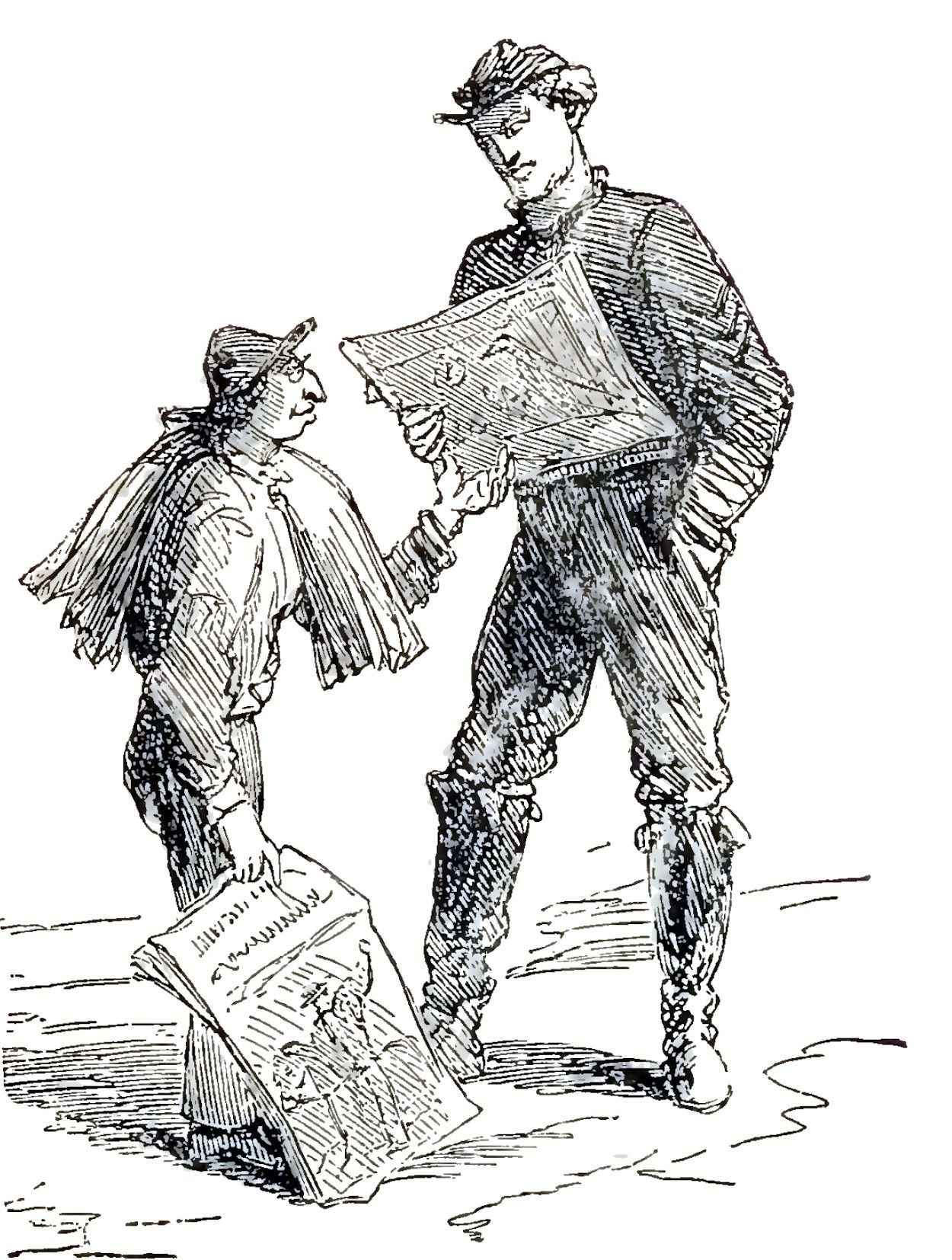
A Soldier’s Story of the Siege of Vicksburg 22Newsboys are thick in camp, with the familiar cries, “Chicago Times” and “Cincinnati Commercial.” The papers sell quite freely. At home each man wants to buy a paper for himself, but here a single copy does for a whole company, and the one that buys it reads it aloud—a plan which suits the buyer very well, if not the seller. While some of these papers applaud the bravery of the generals and their commands, and pray that the brilliancy of past achievements be not dimmed by dissensions in the face of the enemy, other papers have articles that sound to us like treason, slandering the soldier and denouncing the government. But they can not discourage or demoralize this army, for it was never stronger or more determined than now, and it will continue to strike for our country, even though bleeding at every pore. The rebels can not be subdued, so they say. Why not? In two years have we not penetrated to the very center of the South? And in less than that time we shall be seen coming out, covered all over with victory, from the other side.

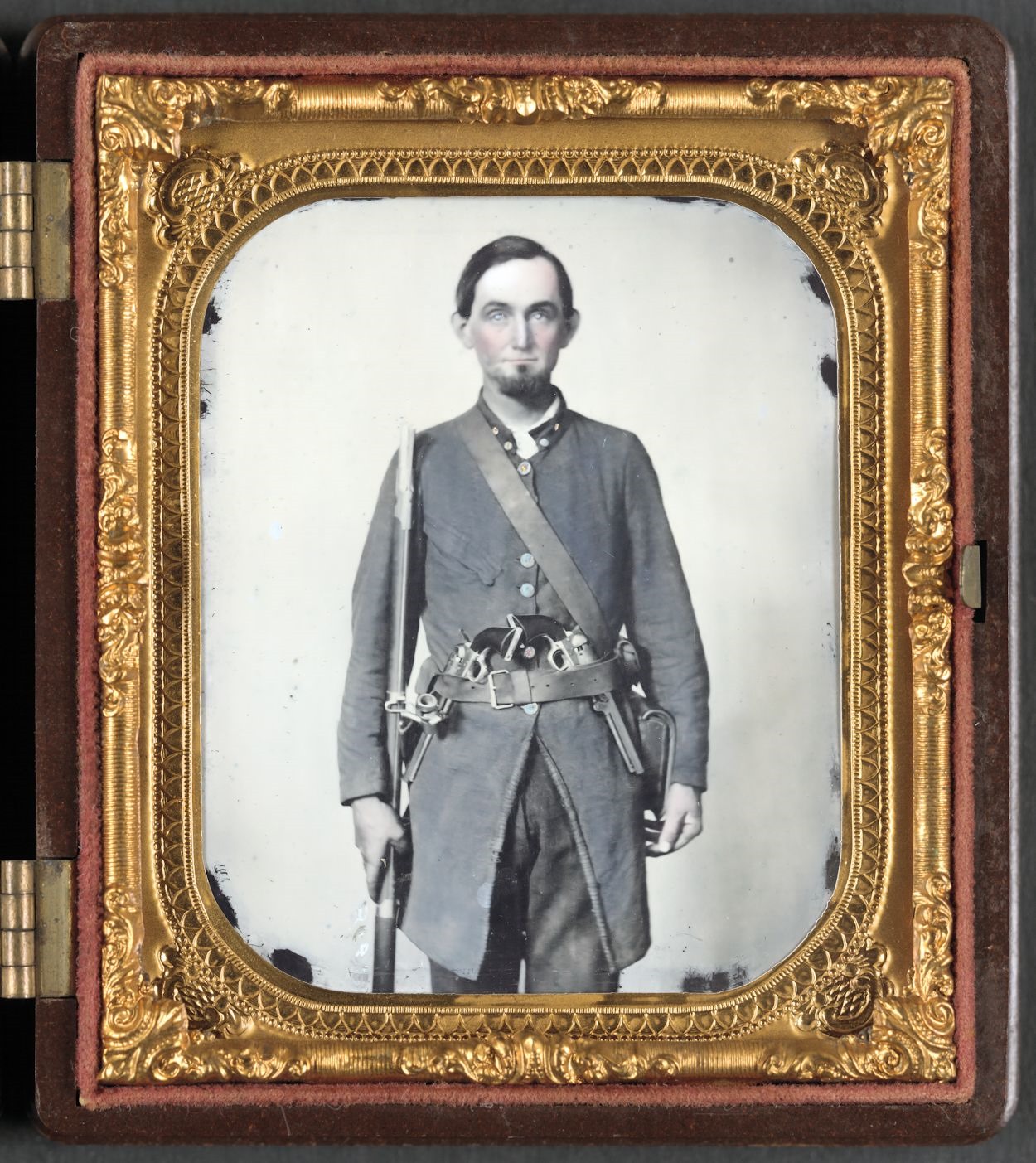
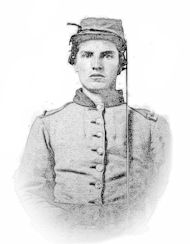
Private Jackson A. Davis of Co. E, Holcombe Legion South Carolina Cavalry Battalion, with musket and two pistols

Private Jackson A. Davis of Co. E, Holcombe Legion South Carolina Cavalry Battalion, with musket and two pistols.

sixth-plate ambrotype, hand-colored ; 9.5 x 8.4 cm (case)

Donated by Tom Liljenquist; 2012

Liljenquist Family Collection of Civil War Photographs; Ambrotype/Tintype photograph filing series; Library of Congress Prints and Photographs Division.

Record page for image is here.

__________

digital file from original item, photoNote – This image has been digitally adjusted for one or more of the following:

  • fade correction,
  • color, contrast, and/or saturation enhancement
  • selected spot removal.

Civil War Portrait 037

Colonel Lyons.

Fort Donelson, June 3, 1863.—Colonel Lowe was telegraphed for on account of the sickness of his wife, and the command of the post will doubtless be on my shoulders for some weeks. There is no danger at present that we shall be sent away from here. I do not like to have this responsibility upon me at all, but must stand it, I reckon. Captain Ruger starts out in the morning to make his surveys, or rather to commence them. His wife will worry for fear he will be shot by guerillas. When you write to her tell her that I will keep a strong guard of cavalry and infantry with him, and will do everything possible for his safety that I can.

June 3 — Rained last night, which made the red yellow clay in these Tuckeyhoe roads almost as sticky as shoemaker’s wax. We renewed our march this morning. Early in the day we passed Wolftown, a little hamlet of some six houses. Yesterday we crossed Middle and South Ann, and to-day we crossed North Ann, insignificant little streamlets that come down from the Blue Ridge. Their confluence forms the Rapidan. We passed through Madison Court House to-day. The town is situated on a wave-like swell, considerably elevated above the surrounding country. The houses are comparatively small, and most, or nearly all of them, are built of wood. The town in general is on the scattered order.

This afternoon we passed through a very small nest of a village sporting the great big name of James City. It is situated in a rolled-up country in the western part of Culpeper County. We crossed Robinson River today in Madison County. We are camped this evening at Bethel Church, nine miles from Culpeper Court House.

June 3.—Col. Kilpatrick returned from an expedition through the country situated between the Rappahannock and York Rivers, in Virginia, having been entirely successful.—(Doc. 3.)

—A meeting was held at Sheffield, England, under the presidency of Mr. Alderman Saunders, at which the following resolution was adopted:

“That this meeting has heard with profound regret of the death of Lieutenant-General Thomas Jefferson Jackson, of the confederate States of North-America; a man of pure and upright mind, devoted as a citizen to his duty, cool and brave as a soldier, able and energetic as a leader, of whom his opponents say he was ‘sincere and true and valiant.’ This meeting resolves to transmit to his widow its deep and sincere condolence with her in her grief at the sad bereavement, and with the great and irreparable loss the army of the confederate States of America have sustained by the death of their gallant comrade and general.” It was decided to request Mr. Mason to transmit the resolution to Mrs. Jackson and the troops lately commanded by the deceased General. —Ashepoo, S. C., was destroyed by the National forces, under the command of Colonel Montgomery, of the Second South-Carolina colored volunteers.—(Doc. 55.)

—Admiral Du Pont ordered Lieutenant Commander Bacon to proceed with the Commodore McDonough on an expedition against Bluffton, on the May River, S. C., a stream emptying into the Calibogue.

The army forces were landed near Bluffton, by the gunboat Mayflower and an army transport, under the protection of the Commodore McDonough, and took possession of the town, the rebels having retreated. By the order of Colonel Barton, the town was destroyed by fire, the church only being spared; and though the rebel troops made several charges, they were driven back by the troops, and the shells and shrapnel of the Commodore McDonough. Bluffton being destroyed, the soldiers reembarked without casualties, and returned to Hilton Head.—(Doc. 54.)